Inelastic Collisions
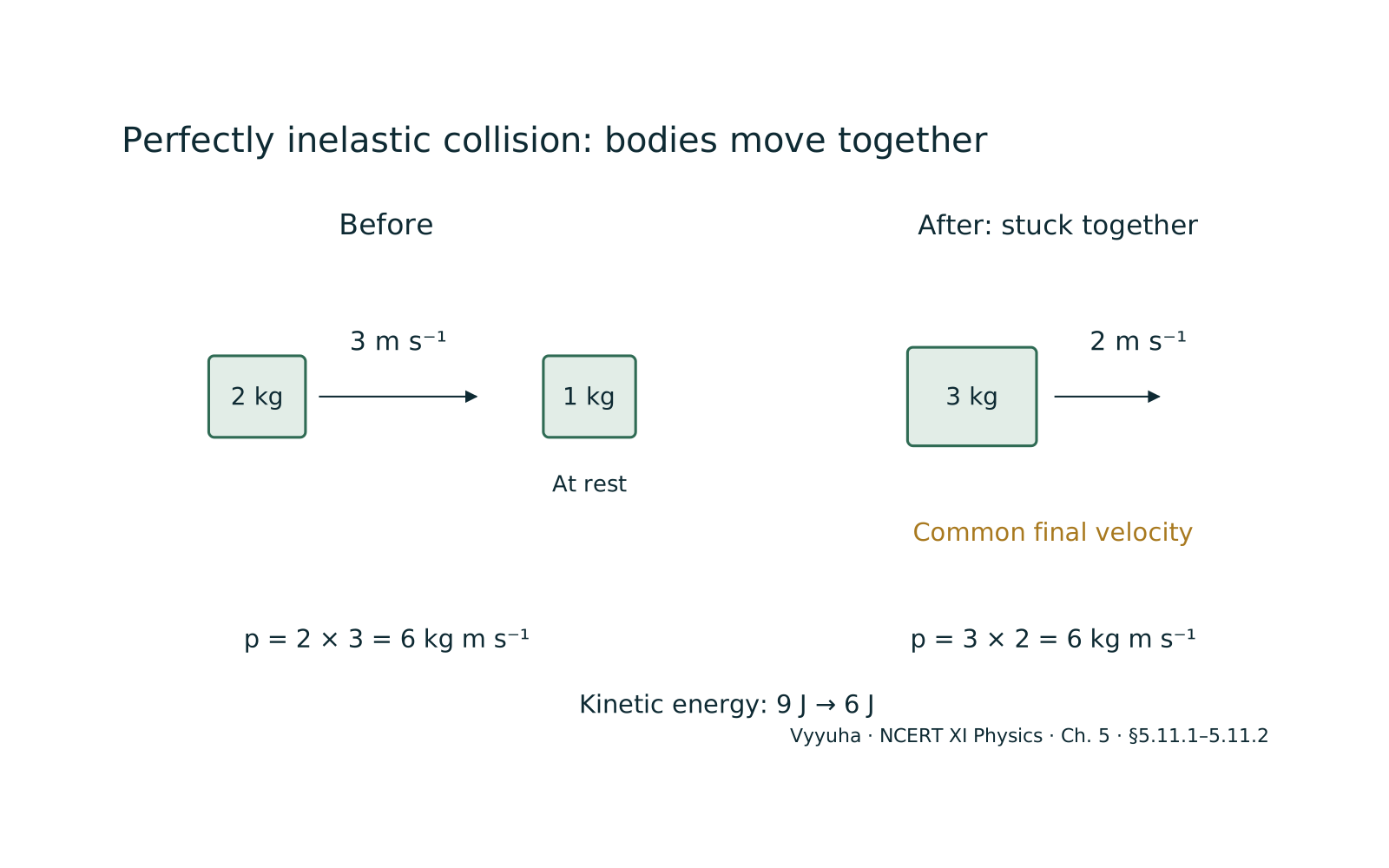
An inelastic collision is a type of collision in which the total kinetic energy of the system is not conserved, although the total linear momentum of the system remains conserved. During such a collision, some part of the initial kinetic energy is transformed into other forms of energy, such as heat, sound, or internal energy causing deformation of the colliding bodies. This energy transformation …
Quick Summary
Inelastic collisions are fundamental interactions where objects collide, and while their total linear momentum is always conserved, their total kinetic energy is not. A portion of the initial kinetic energy is transformed into other forms like heat, sound, or deformation energy.
This energy transformation means the system's mechanical energy decreases. The degree of inelasticity is quantified by the coefficient of restitution, 'e', which ranges from . A perfectly inelastic collision is a special case where objects stick together after impact, moving as a single unit, and experiencing the maximum possible kinetic energy loss.
Understanding the conservation of momentum and the non-conservation of kinetic energy, along with the concept of 'e', is crucial for solving problems related to inelastic collisions, especially common scenarios like bullet-block systems in NEET.
Full explanation
Collisions are fundamental interactions in physics where two or more bodies exert forces on each other for a relatively short period. These interactions lead to a change in the momentum and kinetic energy of the colliding bodies.
Collisions are broadly classified into two categories: elastic and inelastic. While elastic collisions conserve both momentum and kinetic energy, inelastic collisions, which are far more common in the macroscopic world, conserve only momentum, with kinetic energy being dissipated.
Conceptual Foundation of Inelastic Collisions
At its core, an inelastic collision is characterized by the transformation of a portion of the system's initial kinetic energy into other forms of energy. This energy might manifest as heat due to friction and deformation, sound waves generated by the impact, or internal energy causing permanent deformation of the colliding objects.
The key distinction from elastic collisions is this energy dissipation. Despite the loss of kinetic energy, the principle of conservation of linear momentum remains inviolable, provided no external forces act on the system during the collision.
This means the total momentum of the system immediately before the collision is equal to the total momentum immediately after.
Key Principles and Laws
- Conservation of Linear Momentum: — For a system of colliding particles, if no net external force acts on the system during the collision, the total linear momentum of the system remains constant. Mathematically, for a one-dimensional collision between two bodies and with initial velocities and and final velocities and :
- Non-Conservation of Kinetic Energy: — In an inelastic collision, the total kinetic energy of the system before the collision is greater than the total kinetic energy after the collision. The difference in kinetic energy is the energy lost or converted into other forms.
- Coefficient of Restitution (e): — This dimensionless quantity quantifies the 'bounciness' of a collision. It is defined as the ratio of the relative speed of separation after the collision to the relative speed of approach before the collision.
Derivations for One-Dimensional Inelastic Collisions
Consider two masses and moving along a straight line with initial velocities and respectively. After an inelastic collision, their final velocities are and .
From the conservation of linear momentum: (1)
From the definition of the coefficient of restitution: (2)
We can solve these two equations simultaneously for and . From (2), . Substitute this into (1):
Special Case: Perfectly Inelastic Collision ($e=0$)
In a perfectly inelastic collision, the objects stick together, so . Substituting into the momentum conservation equation:
Kinetic Energy Loss in Perfectly Inelastic Collisions
The loss of kinetic energy is maximum in a perfectly inelastic collision. Let's calculate it:
The loss of kinetic energy, , can be shown to be:
Real-World Applications
- Car Crashes: — These are classic examples of inelastic collisions. The kinetic energy of the vehicles is converted into deformation energy (crumpling of metal), heat, and sound. Engineers design crumple zones to maximize this energy absorption, thereby reducing the force transmitted to the occupants.
- Bullet-Block Pendulum: — A common physics experiment and NEET problem type. A bullet is fired into a wooden block suspended as a pendulum. The bullet gets embedded (perfectly inelastic collision), and the combined mass swings upwards. By measuring the maximum height reached, the initial velocity of the bullet can be calculated using conservation of momentum (during collision) and conservation of mechanical energy (after collision, as the block swings).
- Hammering a Nail: — When a hammer strikes a nail, the collision is highly inelastic. The kinetic energy of the hammer is used to drive the nail into the wood, deforming both the nail and the wood, and generating heat and sound.
- Catching a Ball: — When a fielder catches a cricket ball, the collision between the ball and the hands is inelastic. The kinetic energy of the ball is absorbed by the hands and arms, often by allowing the hands to move backward, increasing the time of impact and reducing the force.
Common Misconceptions
- Momentum is not conserved in inelastic collisions: — This is incorrect. Linear momentum is always conserved in any collision (elastic or inelastic) in an isolated system where no external forces act. It is kinetic energy that is not conserved in inelastic collisions.
- All energy is lost in inelastic collisions: — While kinetic energy is lost, the total energy of the universe is always conserved. The 'lost' kinetic energy is simply transformed into other forms (heat, sound, deformation energy), not destroyed.
- Perfectly inelastic means objects stop: — Not necessarily. It means they stick together and move with a common final velocity. If one object was initially at rest, the combined mass will move with some velocity. If they were moving towards each other, they might come to a stop if their initial momenta were equal and opposite.
NEET-Specific Angle
For NEET, inelastic collisions are a frequently tested topic. Questions often involve:
- One-dimensional collisions: — Calculating final velocities or initial velocities given masses and one set of velocities, often using the coefficient of restitution or the perfectly inelastic condition ().
- Energy loss calculations: — Determining the amount of kinetic energy lost during a collision, especially for perfectly inelastic scenarios.
- Bullet-block problems: — These are multi-concept problems combining conservation of momentum (during collision) and conservation of mechanical energy (after collision, as the block swings). Students must correctly identify which conservation law applies to which phase of the motion.
- Relative velocity: — Understanding the role of relative velocity in the definition of the coefficient of restitution.
- Graphical analysis: — Sometimes, questions might involve interpreting velocity-time graphs for colliding objects.
Mastering the two fundamental equations (momentum conservation and coefficient of restitution) and understanding their application to different scenarios is key. Pay special attention to the perfectly inelastic case as it simplifies calculations and is very common in exams.
Key Concepts
Even though kinetic energy is lost, the total linear momentum of the system remains constant in an inelastic…
In a perfectly inelastic collision, objects stick together and move as a single unit. This is characterized…
The coefficient of restitution, , is a measure of the elasticity of a collision. It is defined as $e =…
Often confused with
Side-by-side differences the NEET paper likes to test.
| Aspect | Inelastic Collisions | Elastic Collisions |
|---|---|---|
| Conservation of Linear Momentum | Conserved | Conserved |
| Conservation of Kinetic Energy | Not conserved ($KE_{initial} > KE_{final}$) | Conserved ($KE_{initial} = KE_{final}$) |
| Coefficient of Restitution (e) | $0 \le e < 1$ (e=0 for perfectly inelastic) | $e=1$ |
| Relative Velocity | Relative speed of separation < Relative speed of approach | Relative speed of separation = Relative speed of approach |
| Energy Transformation | Kinetic energy converted to heat, sound, deformation, etc. | No net conversion of kinetic energy to other forms |
| Deformation | Objects may undergo permanent deformation | Objects regain original shape without permanent deformation |
| Real-world Examples | Car crashes, bullet embedding in a block, catching a ball | Collisions between subatomic particles, ideal billiard ball collisions |
The fundamental distinction between inelastic and elastic collisions lies in the conservation of kinetic energy. While linear momentum is conserved in both types of collisions (assuming an isolated system), kinetic energy is only conserved in elastic collisions.
Inelastic collisions involve a loss of kinetic energy, which is transformed into other forms of energy such as heat, sound, or internal energy causing deformation. This difference is quantified by the coefficient of restitution 'e', which is less than 1 for inelastic collisions and exactly 1 for elastic collisions.
Why it is tested: For NEET, understanding these differences is crucial for correctly applying conservation laws. Questions often test the ability to distinguish between collision types based on given parameters (like 'e' or energy loss) and to apply the appropriate set of conservation principles to solve for unknown velocities or energy changes. The bullet-block problem, for instance, is a classic example that combines inelastic collision principles with energy conservation for subsequent motion.
Questions students ask
6 answered on this topic.
What is the primary difference between an elastic and an inelastic collision?
The primary difference lies in the conservation of kinetic energy. In an elastic collision, both linear momentum and kinetic energy are conserved. The objects rebound perfectly without any loss of kinetic energy.
In contrast, in an inelastic collision, while linear momentum is conserved, kinetic energy is not conserved. A portion of the initial kinetic energy is transformed into other forms of energy, such as heat, sound, or deformation energy, leading to a net loss of kinetic energy from the system.
Is linear momentum always conserved in an inelastic collision?
Yes, absolutely. The principle of conservation of linear momentum states that if no net external force acts on a system of particles, the total linear momentum of the system remains constant. This principle holds true for all types of collisions, whether elastic, inelastic, or perfectly inelastic. The internal forces between colliding bodies, though large, are internal to the system and do not change the total momentum of the system.
What is a 'perfectly inelastic collision' and how is it different from a general inelastic collision?
A perfectly inelastic collision is a special type of inelastic collision where the colliding objects stick together after impact and move as a single, combined mass with a common final velocity. This results in the maximum possible loss of kinetic energy consistent with the conservation of momentum.
A general inelastic collision, on the other hand, involves kinetic energy loss, but the objects do not necessarily stick together; they might separate, but with a reduced relative velocity compared to their approach.
The coefficient of restitution is zero for perfectly inelastic collisions and between 0 and 1 for general inelastic collisions.
How do we calculate the kinetic energy lost in an inelastic collision?
The kinetic energy lost in an inelastic collision is simply the difference between the total kinetic energy of the system before the collision and the total kinetic energy after the collision. That is, .
For a one-dimensional collision, a general formula for kinetic energy loss is , where 'e' is the coefficient of restitution. For a perfectly inelastic collision (), the loss is maximum and given by .
What is the significance of the coefficient of restitution (e) in inelastic collisions?
The coefficient of restitution (e) is a crucial parameter that quantifies the degree of elasticity or inelasticity of a collision. It is defined as the ratio of the relative speed of separation to the relative speed of approach of the colliding bodies.
For inelastic collisions, 'e' lies in the range . A value of signifies a perfectly inelastic collision where objects stick together, indicating maximum kinetic energy loss. Values closer to 1 (but less than 1) indicate less kinetic energy loss, meaning the collision is 'less inelastic' or 'more elastic'.
Can an inelastic collision occur in two or three dimensions?
Yes, inelastic collisions can certainly occur in two or three dimensions. The principles remain the same: linear momentum is conserved as a vector quantity, meaning its components along each axis (x, y, z) are conserved independently.
However, kinetic energy is still not conserved. Analyzing 2D or 3D inelastic collisions involves resolving velocities into components and applying momentum conservation along each perpendicular axis. For example, a billiard ball hitting another at an angle, where some energy is lost due to friction or deformation, would be a 2D inelastic collision.
Revise in 30 seconds
- Linear Momentum (p): — . Conserved in all collisions (isolated system). \n- Kinetic Energy (KE): . NOT conserved in inelastic collisions. \n- Inelastic Collision: Momentum conserved, KE NOT conserved. . \n- Perfectly Inelastic Collision: Objects stick together. . Maximum KE loss. \n- Conservation of Momentum (1D): . \n- Coefficient of Restitution (e): . \n- Common Final Velocity (Perfectly Inelastic): . \n- Kinetic Energy Loss (General): . \n- Max KE Loss (Perfectly Inelastic): .
In Momentum Conserved, Kinetic Energy Lost (IMCKEL) for Inelastic Collisions. \nEquals Zero Sticks Together (EZST) for Perfectly Inelastic.