Work, Energy and Power — Explained
Detailed Explanation
The concepts of Work, Energy, and Power form the bedrock of classical mechanics, providing a quantitative framework to analyze the interactions between objects and the transformations of energy within systems. These scalar quantities are indispensable for understanding motion, forces, and the efficiency of physical processes.
Conceptual Foundation
At its core, physics seeks to explain how and why things move. While Newton's laws of motion provide a direct link between force and acceleration, the concepts of work and energy offer an alternative, often simpler, approach, especially when dealing with complex systems or forces that vary with position. Energy is a conserved quantity, making it a powerful tool for analysis.
Work
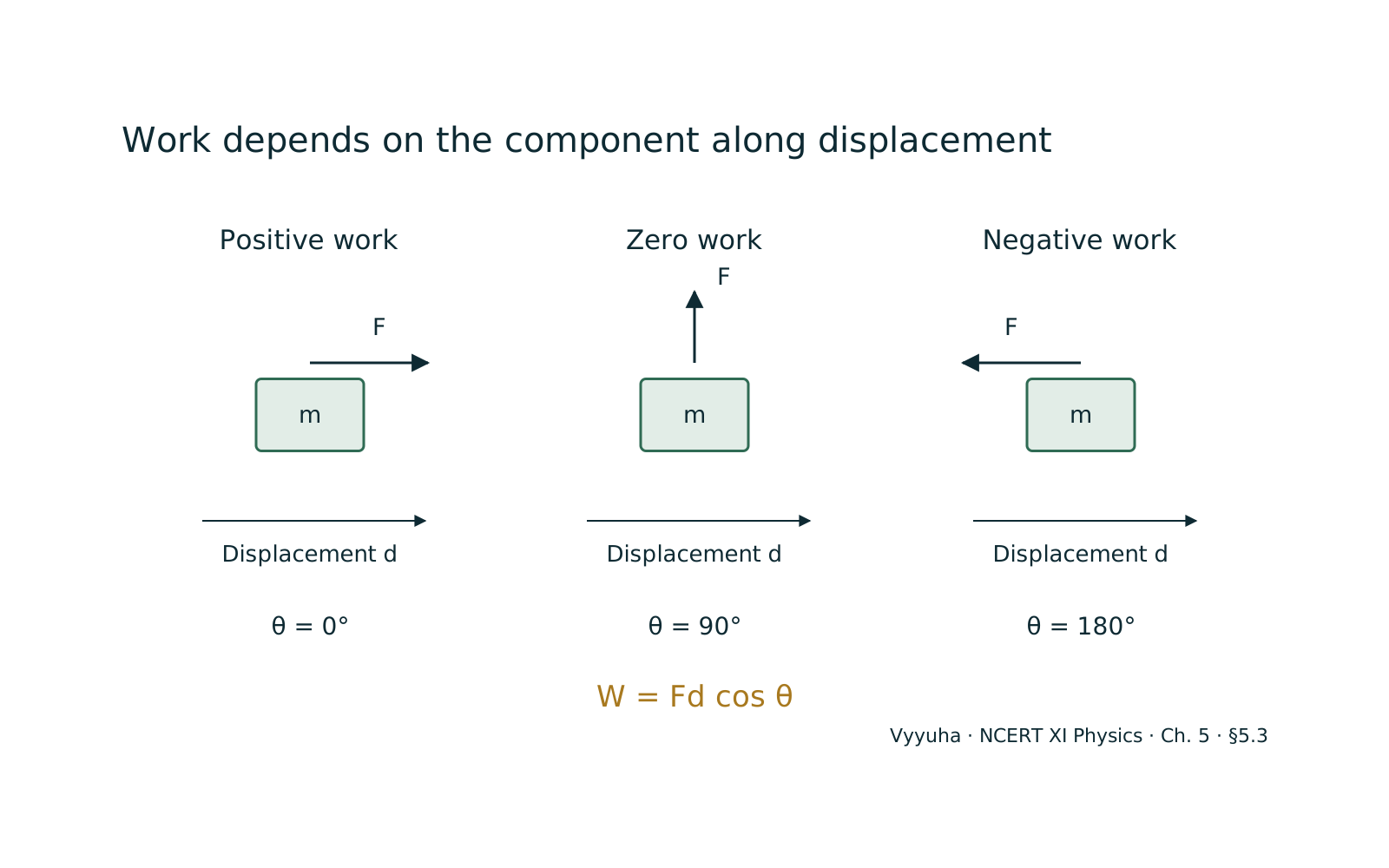
Work, in physics, is not synonymous with effort. It is a precise measure of energy transfer. When a force acts on an object and causes a displacement, work is said to be done by that force. Mathematically, work () done by a constant force () causing a displacement () is defined as the dot product of the force and displacement vectors:
Key Aspects of Work:
- Scalar Quantity: — Work has magnitude but no direction.
- Units: — The SI unit of work is the Joule (J), where . Other units include erg (CGS) and foot-pound (FPS).
- Types of Work:
* Positive Work: When is acute (), is positive, and work done is positive. This means the force aids the motion, increasing the object's kinetic energy (e.
g., pushing a car in the direction of its motion). * Negative Work: When is obtuse (), is negative, and work done is negative. This means the force opposes the motion, decreasing the object's kinetic energy (e.
g., friction acting on a moving object, or gravity acting on an object being lifted). * Zero Work: When , , and work done is zero. This occurs when the force is perpendicular to the displacement (e.
g., centripetal force on an object in circular motion, or gravity on an object moving horizontally).
- Work Done by a Variable Force: — If the force varies with position, the work done must be calculated using integration. For a one-dimensional motion from to :
Energy
Energy is the capacity to do work. It exists in various forms and can be transformed from one form to another. The SI unit of energy is also the Joule (J).
Forms of Mechanical Energy:
- Kinetic Energy ($E_k$ or $K$): — The energy possessed by an object due to its motion. For an object of mass moving with velocity :
- Potential Energy ($E_p$ or $U$): — The energy stored in an object due to its position or configuration. It is associated with conservative forces.
* **Gravitational Potential Energy ():** Energy stored due to an object's position in a gravitational field. For an object of mass at height above a reference level:
The choice of reference level is arbitrary, but the change in potential energy is physically significant. * **Elastic Potential Energy ():** Energy stored in an elastic object (like a spring) when it is stretched or compressed.
For a spring with spring constant stretched or compressed by a distance from its equilibrium position:
Work-Energy Theorem:
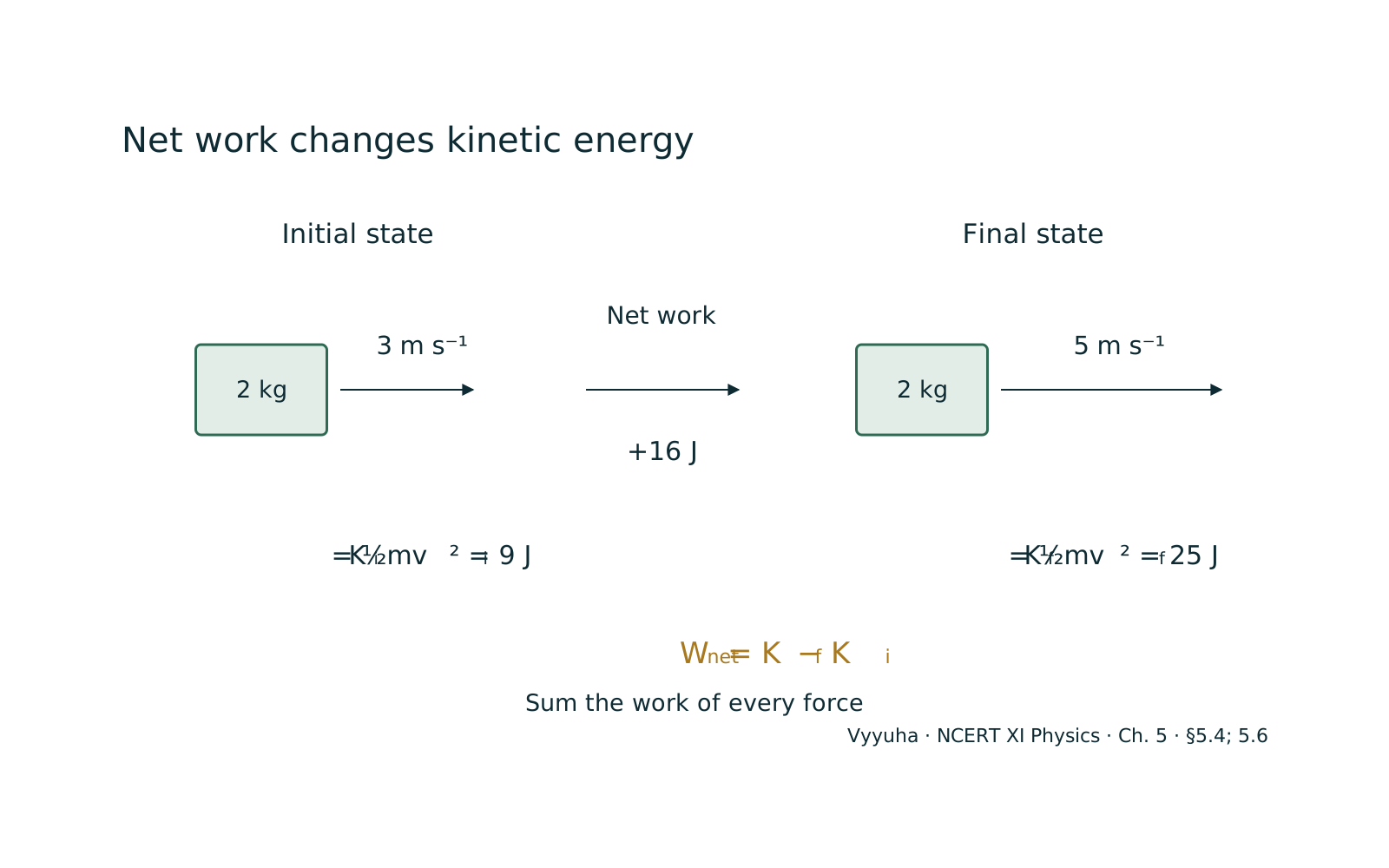
This fundamental theorem states that the net work done on an object by all forces acting on it is equal to the change in its kinetic energy.
Conservative and Non-Conservative Forces:
- Conservative Forces: — Forces for which the work done in moving an object between two points is independent of the path taken and depends only on the initial and final positions. The work done by a conservative force over a closed path is zero. Examples: gravitational force, elastic spring force, electrostatic force. Potential energy can be defined for conservative forces.
- Non-Conservative Forces: — Forces for which the work done depends on the path taken. The work done by a non-conservative force over a closed path is generally non-zero. Examples: friction, air resistance, viscous drag. These forces typically dissipate mechanical energy as heat or sound.
Conservation of Mechanical Energy:
In the absence of non-conservative forces (or if their work is accounted for), the total mechanical energy () of a system remains constant.
Power
Power is the rate at which work is done or energy is transferred. It quantifies how quickly a task is completed or how rapidly energy is converted.
Key Aspects of Power:
- Scalar Quantity: — Power has magnitude but no direction.
- Units: — The SI unit of power is the Watt (W), where . Other units include horsepower (hp), where .
- Average Power ($P_{avg}$): — The total work done divided by the total time taken.
- Instantaneous Power ($P$): — The rate of doing work at a particular instant.
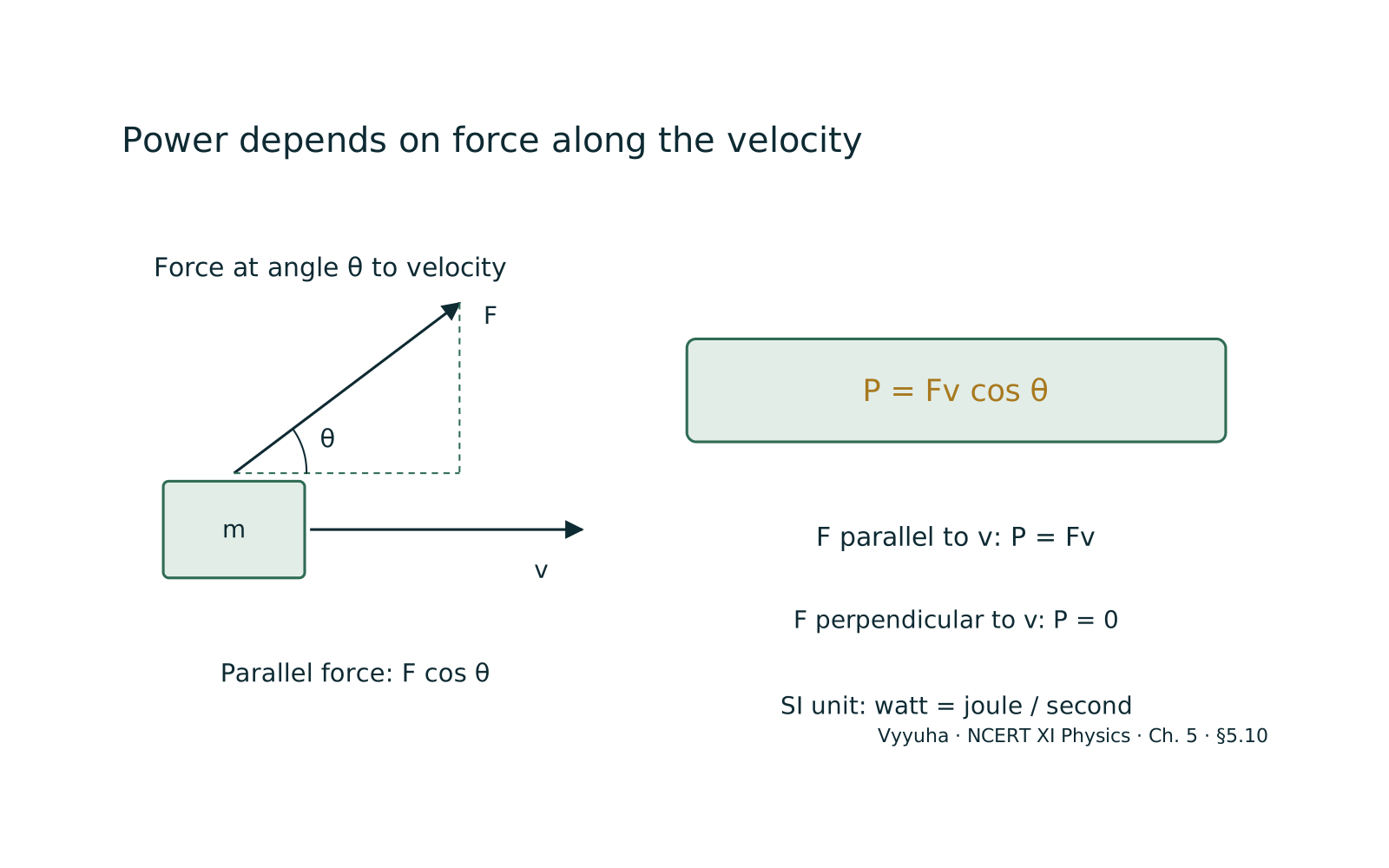
- Relation to Force and Velocity: — Instantaneous power can also be expressed as the dot product of the force and instantaneous velocity:
Real-World Applications
- Automobiles: — Engine power determines acceleration and top speed. Fuel energy is converted into kinetic energy and work against friction and air resistance.
- Roller Coasters: — Demonstrates the continuous conversion between gravitational potential energy and kinetic energy, assuming negligible friction.
- Hydropower Plants: — Gravitational potential energy of water stored at height is converted into kinetic energy, which then drives turbines to generate electrical energy.
- Sports: — Athletes doing work against gravity (e.g., weightlifting) or against air resistance (e.g., cycling). Power output is crucial for performance.
- Springs in Devices: — Springs store elastic potential energy in watches, toys, and shock absorbers.
Common Misconceptions
- Work vs. Effort: — Feeling tired does not necessarily mean work has been done in the physics sense. Work requires displacement in the direction of the force.
- Negative Work: — Often misunderstood as 'no work' or 'bad work'. Negative work simply means the force opposes the motion, reducing kinetic energy.
- Conservation of Energy: — Often confused with 'energy cannot be destroyed'. While true, it's more accurate to say total energy is conserved, but mechanical energy might not be if non-conservative forces are present, as it gets converted to other forms (e.g., heat).
- Power vs. Energy: — A powerful machine doesn't necessarily do more work, but it does the work faster. Energy is the 'amount' of work, power is the 'rate' of work.
NEET-Specific Angle
For NEET aspirants, a strong grasp of Work, Energy, and Power is crucial. Questions often involve:
- Direct application of formulas: — Calculating work, kinetic energy, potential energy, or power given specific values.
- Work-Energy Theorem: — Solving problems where forces are variable or where changes in speed are involved, often simplifying calculations compared to using Newton's laws directly.
- Conservation of Mechanical Energy: — Analyzing scenarios like objects falling, pendulums swinging, or blocks sliding on frictionless surfaces. Identifying when and how non-conservative forces affect energy conservation is key.
- Power calculations: — Relating power to force and velocity, or to work done over time.
- Graphical analysis: — Interpreting F-x graphs to find work done, or P-t graphs to find energy transferred.
- Conceptual understanding: — Differentiating between conservative and non-conservative forces, understanding the implications of positive, negative, and zero work.
Mastering these concepts requires not just memorizing formulas but also developing an intuitive understanding of energy transformations and the conditions under which work is performed.
Often confused with
Side-by-side differences the NEET paper likes to test.
| Aspect | Work, Energy and Power | Conservative vs. Non-Conservative Forces |
|---|---|---|
| Definition | Work done is independent of the path taken; depends only on initial and final positions. | Work done depends on the path taken between initial and final positions. |
| Work over a closed path | Work done over any closed path is zero. | Work done over a closed path is generally non-zero. |
| Potential Energy | A potential energy function can be associated with these forces. | No potential energy function can be uniquely associated with these forces. |
| Mechanical Energy Conservation | If only conservative forces do work, mechanical energy is conserved. | If non-conservative forces do work, mechanical energy is not conserved (it is dissipated). |
| Examples | Gravitational force, elastic spring force, electrostatic force. | Frictional force, air resistance, viscous drag. |
The distinction between conservative and non-conservative forces is fundamental to understanding energy conservation. Conservative forces, like gravity, allow for the definition of potential energy and ensure that mechanical energy remains constant in an isolated system.
Their work is path-independent. Non-conservative forces, such as friction, dissipate mechanical energy, converting it into other forms (like heat), and their work is path-dependent. This means that while total energy is always conserved, mechanical energy is only conserved in the absence of non-conservative forces or when their effects are explicitly accounted for.
Why it is tested: For NEET, understanding this difference is crucial for applying the principle of conservation of mechanical energy correctly. Questions often test scenarios where friction is present, requiring students to account for energy loss. It helps in identifying when to use $E_i = E_f$ versus $E_i + W_{nc} = E_f$ or $W_{nc} = \Delta E$.
Questions students ask
6 answered on this topic.
What is the primary difference between work and energy?
Work is a process of energy transfer, specifically the transfer of energy that occurs when a force acts over a displacement. It's an action that changes the energy of a system. Energy, on the other hand, is the capacity or ability of a system to do work.
It's a property that a system possesses. Think of it this way: energy is the 'money' you have, and work is the 'spending' or 'earning' of that money. You can have energy without doing work, but you cannot do work without energy being transferred or transformed.
Can work be negative? What does negative work signify?
Yes, work can absolutely be negative. Negative work occurs when the component of the force acting on an object is in the direction opposite to its displacement. For example, when you apply brakes in a car, the braking force acts opposite to the car's motion, doing negative work. This negative work signifies that the force is removing energy from the object, typically reducing its kinetic energy. Friction always does negative work on a moving object, converting mechanical energy into heat.
How is power related to speed and force?
Power is directly related to both force and speed. Instantaneous power () can be calculated as the dot product of the force vector () and the velocity vector (), i.e., .
This means that for a given force, the power delivered is greater if the object is moving faster. Conversely, to maintain a certain power output, if the speed decreases, the force must increase. This relationship is crucial for understanding engines and motors, where power output determines how quickly work can be done against resistive forces at a given speed.
What is the Work-Energy Theorem and why is it important?
The Work-Energy Theorem states that the net work done on an object by all forces acting on it is equal to the change in its kinetic energy. Mathematically, .
This theorem is incredibly important because it provides a powerful alternative to Newton's laws for solving problems involving forces and motion. It allows us to relate the initial and final speeds of an object to the work done on it, often without needing to calculate acceleration or time, simplifying many complex scenarios, especially when forces are variable.
When is mechanical energy conserved, and when is it not?
Total mechanical energy (the sum of kinetic and potential energy, ) is conserved in a system if only conservative forces (like gravity or spring force) do work. In such ideal scenarios, energy transforms between kinetic and potential forms, but their sum remains constant.
However, if non-conservative forces (like friction or air resistance) do work, mechanical energy is not conserved. These forces convert mechanical energy into other forms, primarily heat, leading to a decrease in the total mechanical energy of the system.
The work done by non-conservative forces equals the change in mechanical energy.
Can an object have energy without doing work?
Absolutely. An object can possess energy without actively doing work. For instance, a stationary object at a certain height above the ground has gravitational potential energy, but it is not doing work until it starts to fall or is used to lift something else.
Similarly, a compressed spring has elastic potential energy, and a moving car has kinetic energy. In all these cases, the objects possess the capacity to do work, but they are not necessarily performing work at that specific instant.
Work is the process of energy transfer, not the state of possessing energy.