Species Concept — Explained
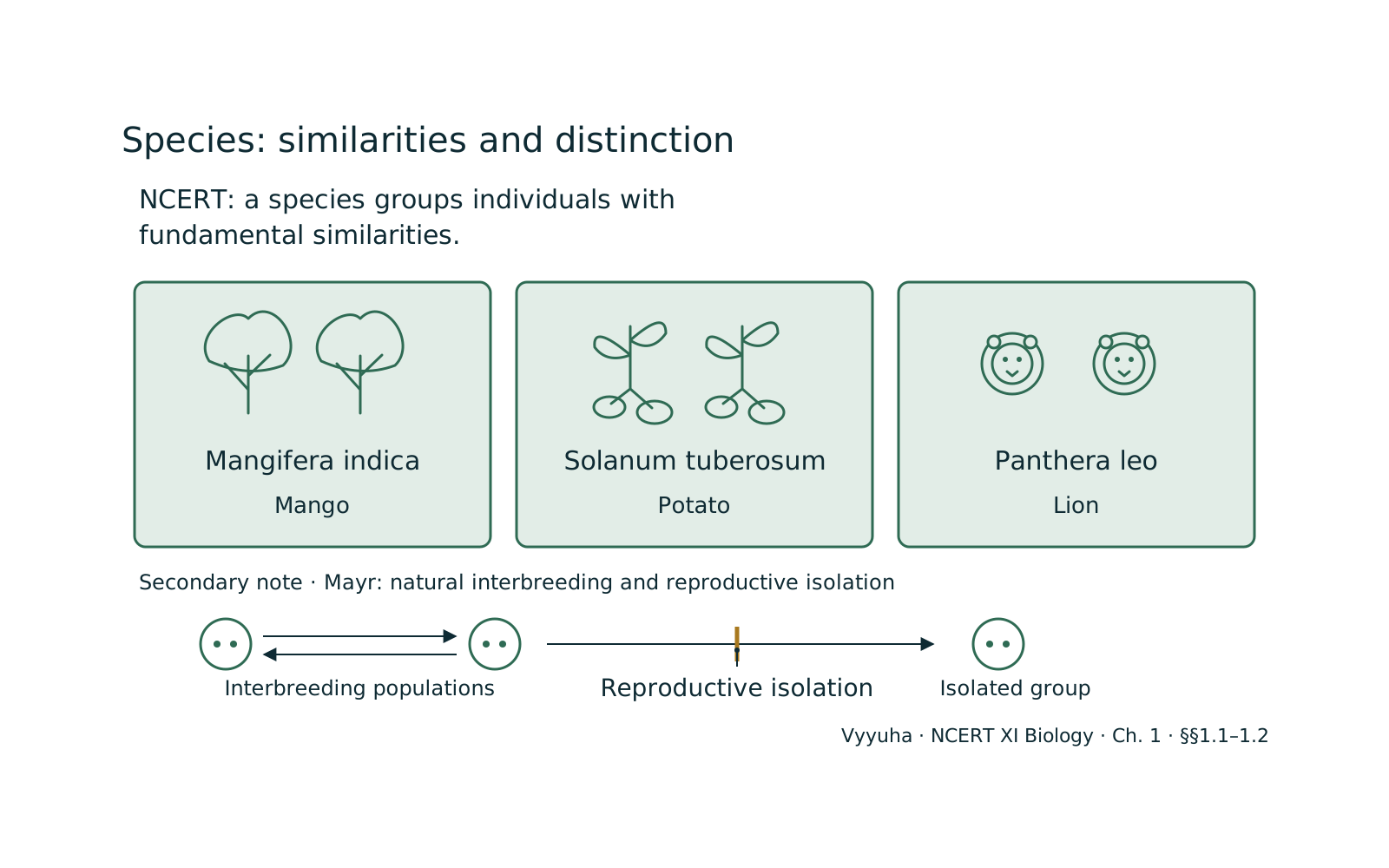
Detailed Explanation
The species concept is arguably the most fundamental and debated topic in biology, forming the bedrock of taxonomy, evolution, and ecology. Understanding what constitutes a 'species' is crucial for classifying life, studying evolutionary relationships, and implementing conservation strategies. While seemingly straightforward, the definition of a species is complex and has evolved significantly over time, leading to various 'species concepts' each with its own utility and limitations.
1. Conceptual Foundation: The Quest for a Universal Definition
Historically, the idea of species was largely based on observable morphological similarities – if two organisms looked alike, they were considered the same species. This 'typological' or 'morphological' concept, rooted in ancient Greek philosophy, viewed species as fixed, unchanging types.
However, this approach struggled with variations within a species (polymorphism), sexual dimorphism, and cryptic species (species that look identical but are reproductively isolated). The advent of evolutionary theory, particularly Darwin's work, highlighted the dynamic nature of life and the gradual divergence of populations, challenging the notion of fixed types.
This paved the way for a more biologically meaningful definition.
2. Key Principles and Laws: Diverse Species Concepts
- A. Biological Species Concept (BSC): — Proposed by Ernst Mayr, the BSC is the most widely recognized and taught concept, especially in introductory biology and for NEET. It defines a species as a group of natural populations whose members can interbreed and produce fertile offspring, and are reproductively isolated from other such groups. The emphasis is on gene flow (or lack thereof) between populations. If gene flow is possible, they are the same species; if not, they are different.
* Key Criterion: Reproductive isolation (pre-zygotic or post-zygotic barriers). * Strengths: Biologically intuitive, reflects evolutionary independence, applicable to sexually reproducing extant organisms.
* Limitations: Cannot be applied to asexual organisms (e.g., bacteria, archaea, some fungi, plants), fossil species, or geographically separated (allopatric) populations whose interbreeding potential is unknown.
Also, some 'good' species can hybridize in nature (e.g., some bird species).
- B. Morphological Species Concept: — This is the oldest and most practical concept, defining species based on distinct morphological (structural) characteristics. Organisms that look sufficiently similar are grouped into a species.
* Key Criterion: Shared anatomical features. * Strengths: Widely applicable (fossils, asexual organisms, museum specimens), practical for field identification. * Limitations: Subjective (what constitutes 'sufficiently similar'?), ignores cryptic species, struggles with sexual dimorphism, polymorphism, and convergent evolution.
- C. Phylogenetic Species Concept (PSC): — This concept defines a species as the smallest monophyletic group (a group that includes a common ancestor and all of its descendants) distinguishable by a unique combination of character states (morphological, genetic, behavioral). It emphasizes evolutionary history.
* Key Criterion: Monophyly and diagnosable distinctness. * Strengths: Applicable to all organisms (sexual, asexual, fossil), provides a clear evolutionary basis, identifies species even before reproductive isolation is complete. * Limitations: Requires extensive phylogenetic analysis (often genetic), can lead to an 'inflation' of species numbers by recognizing very fine-scale distinctions, character choice can be subjective.
- D. Ecological Species Concept: — Defines a species as a set of organisms exploiting a single niche. It emphasizes the role of natural selection in maintaining species boundaries.
* Key Criterion: Occupancy of a distinct ecological niche. * Strengths: Applicable to asexual organisms, highlights the ecological role of species. * Limitations: Defining a 'niche' can be challenging and subjective, different species can sometimes share similar niches, and a single species can occupy multiple niches.
- E. Evolutionary Species Concept: — Defines a species as a single lineage of ancestor-descendant populations that maintains its identity from other such lineages and has its own evolutionary tendencies and historical fate.
* Key Criterion: Distinct evolutionary trajectory. * Strengths: Applicable to both sexual and asexual organisms, and fossils, provides a temporal dimension. * Limitations: Difficult to operationalize and test in practice, requires extensive fossil record or genetic data to trace lineages.
- F. Typological Species Concept (Classical/Linnaean): — Based on the idea that species are defined by a 'type specimen' that embodies the essential characteristics of the species. Any individual deviating significantly from this type is considered a different species.
* Key Criterion: Adherence to a 'type' or ideal form. * Strengths: Simple for initial classification. * Limitations: Ignores natural variation, polymorphism, and evolutionary change. Largely superseded by modern concepts.
3. Real-World Applications and Implications
The species concept is vital for:
- Taxonomy and Systematics: — Providing a framework for naming and classifying organisms, organizing biodiversity into a hierarchical structure.
- Evolutionary Biology: — Understanding speciation (the process by which new species arise), adaptive radiation, and the mechanisms of reproductive isolation.
- Ecology: — Studying species interactions, community structure, and ecosystem dynamics. Different species occupy different niches, influencing nutrient cycling and energy flow.
- Conservation Biology: — Identifying endangered species, prioritizing conservation efforts, and defining conservation units. If we don't know what a species is, we can't protect it effectively.
- Agriculture and Medicine: — Identifying pests, pathogens, and beneficial organisms. For example, distinguishing between different species of mosquitoes is critical for controlling disease vectors.
4. Common Misconceptions
- Species are fixed and unchanging: — This is a pre-Darwinian view. Species evolve, adapt, and can diverge into new species over time.
- All members of a species look identical: — Significant variation (polymorphism, sexual dimorphism) can exist within a species. Think of different dog breeds, all belonging to the same species, Canis familiaris.
- Hybridization always means same species: — Not necessarily. While some species can produce fertile hybrids (e.g., some plant species), the BSC specifically requires natural interbreeding and fertile offspring. Mules are a classic example of sterile hybrids between different species (horse and donkey).
- Species are always clearly defined: — The boundaries between species can be blurry, especially in cases of ongoing speciation or ring species, leading to the 'species problem'.
5. NEET-Specific Angle
For NEET, the Biological Species Concept (BSC) is paramount. Questions frequently revolve around its definition, criteria (interbreeding, fertile offspring, reproductive isolation), and its limitations (asexual organisms, fossils).
Examples like the mule (horse x donkey) are classic illustrations of reproductive isolation leading to distinct species. Understanding the hierarchy of taxonomic categories, with species as the basic unit, is also crucial.
While other species concepts provide a richer understanding, the BSC remains the central focus for exam purposes. Be prepared to differentiate between pre-zygotic and post-zygotic reproductive barriers as well, as these directly relate to the BSC.
Often confused with
Side-by-side differences the NEET paper likes to test.
| Aspect | Species Concept | Morphological Species Concept |
|---|---|---|
| Primary Criterion | Biological Species Concept (BSC): Reproductive isolation (ability to interbreed and produce fertile offspring) | Morphological Species Concept: Observable physical characteristics (morphology) |
| Applicability | BSC: Sexually reproducing, extant organisms | Morphological Species Concept: All organisms (sexual, asexual, fossils) |
| Limitations | BSC: Cannot be applied to asexual organisms, fossils, allopatric populations; problematic with hybridization. | Morphological Species Concept: Subjective, overlooks cryptic species, struggles with polymorphism and sexual dimorphism. |
| Evolutionary Basis | BSC: Directly reflects evolutionary independence through gene flow barriers. | Morphological Species Concept: Indirectly reflects evolution; similarities might be due to convergence, not shared ancestry. |
| Identification | BSC: Requires observing reproductive behavior or genetic compatibility. | Morphological Species Concept: Based on visual inspection and measurement of traits. |
The Biological Species Concept (BSC) defines species based on their ability to interbreed and produce fertile offspring, emphasizing reproductive isolation as a key evolutionary barrier. It is highly relevant for sexually reproducing organisms but fails for asexual species and fossils.
In contrast, the Morphological Species Concept relies on observable physical similarities, making it broadly applicable to all forms of life, including fossils and asexual organisms. However, its subjectivity and inability to distinguish cryptic species are significant drawbacks.
For NEET, understanding the BSC's definition, applicability, and limitations is crucial, often contrasted with the practical but less biologically robust morphological approach.
Why it is tested: NEET relevance: This comparison is highly relevant for NEET as it highlights the strengths and weaknesses of the two most commonly discussed species concepts. Questions often test a student's ability to apply the BSC and identify scenarios where it is not suitable, necessitating an understanding of alternative concepts like the morphological one.
Questions students ask
5 answered on this topic.
What is the primary criterion for defining a species according to the Biological Species Concept (BSC)?
The primary criterion for the Biological Species Concept (BSC) is the ability of organisms to naturally interbreed and produce viable, fertile offspring. This means that individuals within a species can successfully mate in their natural environment, and their progeny are not only alive but also capable of reproducing themselves.
Crucially, they must also be reproductively isolated from other such groups, meaning they cannot successfully interbreed with members of different species, or if they do, the offspring are infertile.
Why is the Biological Species Concept (BSC) not universally applicable?
The BSC, while powerful, has significant limitations. It cannot be applied to organisms that reproduce asexually, such as bacteria, archaea, and many plants and fungi, because the concept of 'interbreeding' is irrelevant to them.
It also fails for fossil species, as their reproductive capabilities cannot be observed. Furthermore, geographically separated populations (allopatric populations) pose a challenge, as it's impossible to test their potential to interbreed.
Lastly, some distinct species can occasionally hybridize in nature and produce fertile offspring, blurring the lines defined by the BSC.
What is the difference between a viable offspring and a fertile offspring?
A viable offspring is one that is alive and capable of surviving after birth or hatching. It simply means the offspring is not stillborn or malformed to the point of immediate death. A fertile offspring, on the other hand, is a viable offspring that is also capable of reproducing itself. For a group of organisms to be considered the same species under the BSC, they must produce offspring that are both viable and fertile, ensuring the continuation of the lineage.
Can different species ever produce offspring? If so, are they considered the same species?
Yes, different species can sometimes produce offspring, but these offspring are typically sterile (infertile). A classic example is the mule, which is the offspring of a male donkey and a female horse.
Both horses and donkeys are distinct species because their offspring, the mule, is infertile and cannot reproduce. If the offspring were fertile and could successfully interbreed with either parent species or other hybrids, then the parent groups might be considered the same species or subspecies, depending on the context and extent of gene flow.
What is a 'cryptic species' and how does it challenge the morphological species concept?
A cryptic species refers to two or more distinct species that are morphologically identical or nearly indistinguishable, meaning they look exactly alike to the human eye. They challenge the morphological species concept because this concept relies solely on physical appearance for classification.
Since cryptic species cannot be differentiated based on their morphology, the morphological concept would incorrectly group them as a single species, even though they are reproductively isolated and represent distinct evolutionary lineages.