Gymnosperms
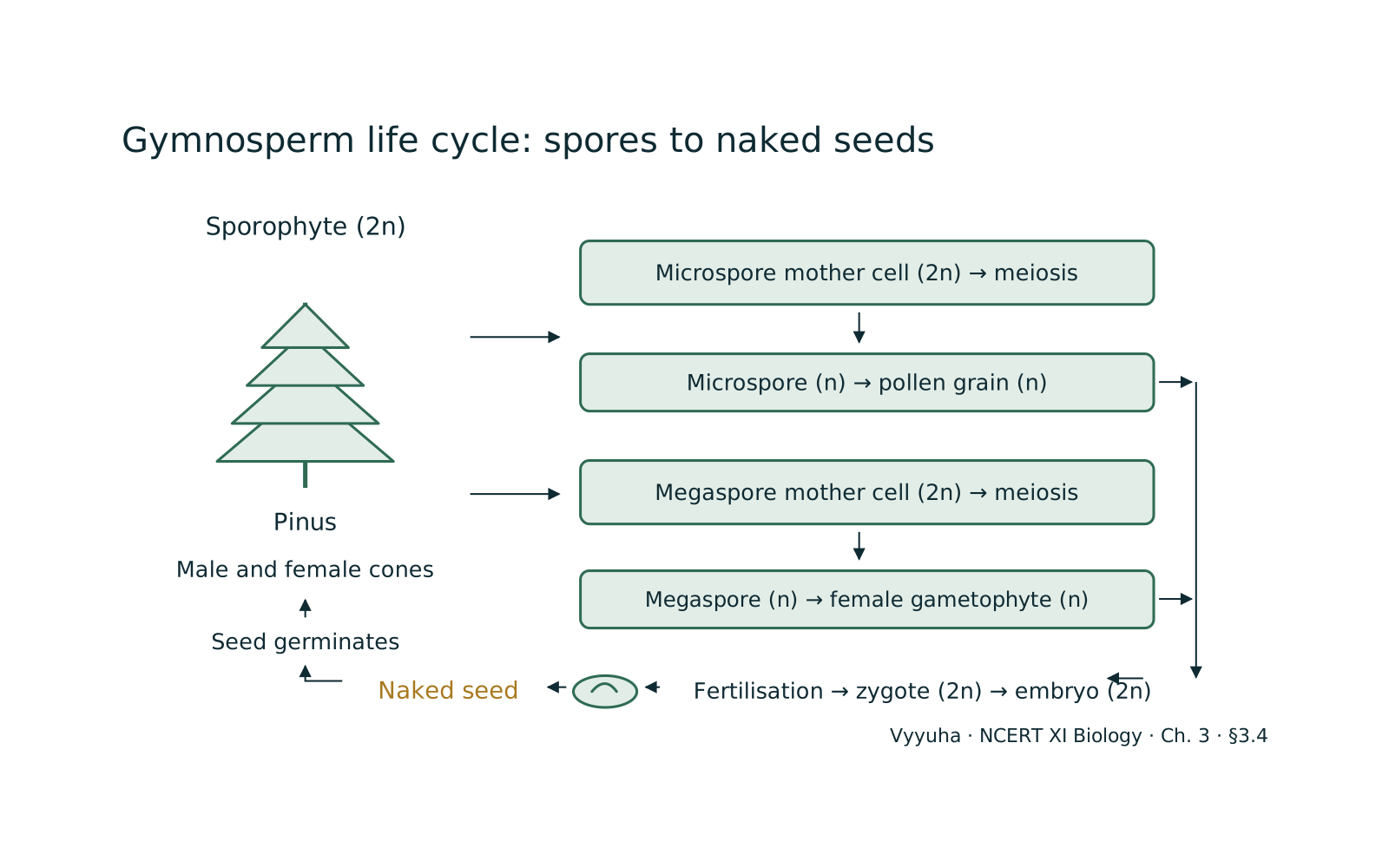
Gymnosperms, derived from the Greek words 'gymnos' (naked) and 'sperma' (seed), represent a group of seed-producing plants that do not enclose their seeds within an ovary. Unlike angiosperms, where seeds are protected within a fruit, gymnosperm seeds are exposed on the surface of specialized leaves called sporophylls, which are often organized into cone-like structures. This fundamental characteri…
Quick Summary
Gymnosperms are seed-bearing plants characterized by 'naked seeds,' meaning their ovules and subsequent seeds are not enclosed within an ovary wall. They represent an evolutionary bridge between spore-producing pteridophytes and fruit-bearing angiosperms.
Key features include a dominant sporophytic plant body, heterospory (producing microspores and megaspores), and highly reduced, dependent gametophytes. Reproduction involves distinct male and female cones (strobili) that produce pollen grains (male gametophytes) and ovules (containing female gametophytes).
Pollination is typically by wind, and fertilization is independent of external water. The endosperm, which nourishes the embryo, is haploid and forms before fertilization. Examples like Pinus (monoecious, mycorrhizal roots, needle-like leaves) and Cycas (dioecious, coralloid roots with cyanobacteria, pinnate leaves, circinate ptyxis) highlight their diversity.
They are economically important for timber, resins, and some food products, and play vital ecological roles in forest ecosystems.
Full explanation
Gymnosperms represent a pivotal group in the evolutionary history of plants, bridging the gap between the spore-reproducing pteridophytes and the fruit-bearing angiosperms. Their defining characteristic, 'naked seeds,' signifies a major adaptation for terrestrial life, offering enhanced protection and dispersal capabilities for the embryo compared to spores.
This section delves into the conceptual foundation, key principles, structural features, reproductive strategies, and ecological significance of gymnosperms, with a specific focus on aspects relevant for NEET UG aspirants.
Conceptual Foundation and Evolutionary Significance
Gymnosperms emerged during the late Paleozoic era, flourishing during the Mesozoic era, often referred to as the 'Age of Gymnosperms.' Their evolution marked several critical advancements:
- Seed Habit: — The most significant innovation is the development of the seed, which encapsulates the embryo, providing nourishment and protection, and facilitating dispersal. This freed reproduction from the absolute dependence on water for gamete transfer, a limitation of bryophytes and pteridophytes.
- Heterospory: — All gymnosperms are heterosporous, producing two types of spores: microspores (which develop into male gametophytes/pollen grains) and megaspores (which develop into female gametophytes/ovules). This is a prerequisite for seed formation.
- Reduced Gametophytes: — The gametophytes are highly reduced and entirely dependent on the sporophyte for nutrition and protection, a stark contrast to the free-living gametophytes of pteridophytes.
- Well-developed Vascular Tissue: — They possess efficient vascular tissues (xylem and phloem) for water and nutrient transport, allowing them to grow into large trees. Xylem typically lacks vessels (except in Gnetales), and phloem lacks companion cells.
Key Principles and Life Cycle
Gymnosperms exhibit an alternation of generations, with the sporophyte (the plant body) being the dominant, photosynthetic, and independent phase. The gametophytic phase is highly reduced and parasitic on the sporophyte.
1. Sporophyte: The mature gymnosperm plant (e.g., a pine tree) is the sporophyte (). It bears specialized reproductive structures called sporophylls, which are aggregated into cones or strobili.
2. Heterospory and Spore Production:
* Microsporophylls: These are male sporophylls, bearing microsporangia. Within microsporangia, microspore mother cells () undergo meiosis to produce haploid () microspores. * Megasporophylls: These are female sporophylls, bearing ovules.
An ovule consists of a megasporangium (nucellus) protected by integuments. Within the megasporangium, a single megaspore mother cell () undergoes meiosis to produce four haploid () megaspores. Usually, only one megaspore is functional, while the other three degenerate.
3. Gametophyte Development:
* Male Gametophyte (Pollen Grain): Each microspore develops into a pollen grain. A mature pollen grain typically consists of a few cells (e.g., two prothallial cells, a generative cell, and a tube cell).
The generative cell later divides to form two male gametes. Pollen grains are dispersed by wind. * Female Gametophyte (Embryo Sac/Endosperm): The functional megaspore develops into the female gametophyte, also known as the embryo sac or endosperm.
This structure is retained within the megasporangium (nucellus) of the ovule. The female gametophyte produces two or more archegonia, each containing an egg cell.
4. Pollination and Fertilization:
* Pollination: Wind carries pollen grains to the micropylar opening of the ovule. This process is called anemophily (wind pollination). * Pollen Tube Formation: Upon landing on the ovule, the pollen grain germinates, forming a pollen tube that grows through the nucellus towards the archegonia.
* Fertilization: The pollen tube carries the male gametes to the egg cell. One male gamete fuses with the egg cell to form a diploid () zygote. Unlike angiosperms, there is no double fertilization in gymnosperms.
The endosperm in gymnosperms is haploid () and develops from the functional megaspore before fertilization, serving as nutritive tissue for the developing embryo.
5. Seed Development: The zygote develops into an embryo. The ovule, containing the embryo and the haploid endosperm, matures into a seed. The integuments of the ovule harden to form the seed coat. The seeds are 'naked' as they are not enclosed within a fruit wall.
Structural Features and Classification
Gymnosperms are broadly classified into four main orders, though for NEET, understanding key examples and their unique features is more crucial.
1. Roots: Generally tap roots. Some have specialized associations: * **Coralloid roots in Cycas:** These are specialized roots that grow negatively geotropically (upwards) and contain nitrogen-fixing cyanobacteria (e.g., Anabaena, Nostoc). They appear coral-like. * **Mycorrhizal roots in Pinus:** Fungal associations (mycorrhiza) are common, aiding in nutrient absorption.
2. Stem: Can be unbranched (Cycas) or branched (Pinus, Cedrus).
3. Leaves: Generally well-adapted to extreme temperatures, humidity, and wind. * **Pinnate leaves in Cycas:** Large, compound, persistent for a few years. Young leaves show circinate ptyxis (coiling, like fern fronds). * **Needle-like leaves in Pinus:** Simple, needle-like, with thick cuticles, sunken stomata, and a thick epidermis to reduce water loss. * **Fan-shaped leaves in Ginkgo:** Dichotomous venation, deciduous.
4. Reproductive Structures:
* Cones/Strobili: Male and female sporophylls are typically arranged spirally to form compact cones. * Monoecious plants: Both male and female cones on the same plant (e.g., Pinus). * Dioecious plants: Male and female cones on separate plants (e.g., Cycas, Ginkgo). * Ovule: Orthotropous (straight) in Cycas, anatropous (inverted) in Pinus. The ovule is typically unitegmic (single integument).
Real-World Applications and Economic Importance
Gymnosperms hold significant economic and ecological value:
- Timber: — Conifers like pine, fir, spruce, and cedar are major sources of softwood timber used in construction, furniture, and paper production.
- Resins and Turpentine: — Pinus yields resin, which is distilled to produce turpentine (solvent) and rosin (used in varnishes, sizing paper, etc.).
- Food: — Seeds of Pinus gerardiana (chilgoza pine) are edible. Sago is obtained from the stem pith of Cycas.
- Ornamental Plants: — Many gymnosperms like Cycas, Thuja, Araucaria, and Juniperus are grown for their aesthetic appeal in gardens and landscapes.
- Medicinal: — Ephedrine, an alkaloid used in treating asthma and bronchitis, is obtained from Ephedra.
- Ecological Role: — They form vast forests, especially in temperate and boreal regions, contributing to carbon sequestration, soil stabilization, and habitat provision for wildlife.
Common Misconceptions
- 'Naked' vs. 'Unprotected': — While 'naked' implies exposure, the ovules and seeds are still protected by the cone scales. The 'nakedness' refers to the absence of an ovary wall, not a complete lack of protection.
- Endosperm Ploidy: — A common trap is confusing gymnosperm endosperm with angiosperm endosperm. Gymnosperm endosperm is haploid () and pre-fertilization in origin, while angiosperm endosperm is triploid () and post-fertilization in origin (resulting from double fertilization).
- Water for Fertilization: — While pollen is wind-dispersed, the final transfer of male gametes to the egg within the ovule still involves a pollen tube, making them independent of external water for fertilization, unlike bryophytes and pteridophytes.
- Vessels in Xylem: — While most gymnosperms lack vessels in xylem, the Gnetales (e.g., Ephedra, Gnetum, Welwitschia) are an exception, possessing vessels, which is a feature shared with angiosperms and indicates their advanced nature within gymnosperms.
NEET-Specific Angle
For NEET, focus on:
- Examples and unique features: — Memorize specific characteristics of Cycas (coralloid roots, unbranched stem, pinnate leaves, circinate ptyxis, largest ovule, dioecious), Pinus (mycorrhizal roots, branched stem, needle-like leaves, monoecious), Ginkgo (living fossil, fan-shaped leaves, dichotomous venation, dioecious).
- Life cycle stages: — Understand the sequence of events from sporophyte to gametophyte and back, emphasizing heterospory, pollen grain development, ovule structure, and fertilization without double fertilization.
- Distinguishing features: — Be able to differentiate gymnosperms from pteridophytes (presence of seeds, no water for fertilization) and angiosperms (naked seeds, haploid endosperm, absence of flowers/fruits, no double fertilization).
- Economic importance: — Recall key products like timber, resins, and medicinal compounds.
- Ploidy levels: — Know the ploidy of various structures (sporophyte , microspore , megaspore , pollen grain , female gametophyte/endosperm , zygote , embryo ).
Key Concepts
Gymnosperms exhibit a clear alternation of generations, but with a dominant sporophytic phase () and a…
Heterospory, the production of two distinct types of spores (microspores and megaspores), is a fundamental…
These two genera are frequently contrasted in NEET. *Cycas* is characterized by an unbranched stem, large…
Often confused with
Side-by-side differences the NEET paper likes to test.
| Aspect | Gymnosperms | Pteridophytes and Angiosperms |
|---|---|---|
| Seed Presence | Absent (reproduce by spores) | Present (naked seeds) |
| Ovule Protection | N/A (no ovules) | Naked (not enclosed by ovary wall) |
| Water for Fertilization | Essential for gamete transfer | Not essential (pollen tube, wind pollination) |
| Endosperm Ploidy | N/A (no endosperm) | Haploid ($n$), pre-fertilization |
| Vascular Tissue | Well-developed, but simpler (no vessels in xylem) | Well-developed (xylem lacks vessels, except Gnetales) |
| Dominant Phase | Sporophyte | Sporophyte |
| Flowers/Fruits | Absent | Absent (cones present) |
Gymnosperms represent an intermediate evolutionary stage between pteridophytes and angiosperms. They share with pteridophytes the dominant sporophytic phase and the absence of true flowers and fruits.
However, they advance beyond pteridophytes by possessing seeds and being independent of water for fertilization. Compared to angiosperms, gymnosperms are distinguished by their 'naked seeds,' the absence of flowers and fruits, and a haploid endosperm that forms before fertilization, contrasting with the triploid, post-fertilization endosperm of angiosperms.
Understanding these distinctions is fundamental for grasping plant evolution.
Why it is tested: NEET relevance: High. Questions frequently test the distinguishing features of gymnosperms from other plant groups, particularly regarding reproductive strategies, seed development, and ploidy levels of nutritive tissues. This comparison helps students identify key evolutionary advancements.
Questions students ask
6 answered on this topic.
What does 'naked seed' truly mean in the context of Gymnosperms?
The term 'naked seed' means that the ovules, which develop into seeds after fertilization, are not enclosed within an ovary wall. In flowering plants (angiosperms), the ovary wall matures into a fruit that encloses the seeds.
In gymnosperms, the ovules are directly exposed on the surface of modified leaves called sporophylls, which are often aggregated into cones. This exposure is the key distinction, not a complete lack of protection, as the cone scales themselves offer some degree of shielding.
How do Gymnosperms differ from Pteridophytes in terms of reproduction?
The primary difference lies in their reproductive strategies. Pteridophytes (like ferns) reproduce via spores and require external water for the transfer of male gametes to the female gametes. Gymnosperms, on the other hand, are seed-bearing plants.
They produce pollen grains (containing male gametes) that are typically wind-dispersed, and their ovules develop into seeds. This seed habit and independence from water for fertilization represent a significant evolutionary advancement for terrestrial adaptation.
What is the ploidy of the endosperm in Gymnosperms, and how does it form?
The endosperm in Gymnosperms is haploid (). It develops from the functional megaspore before fertilization. This is a crucial distinction from angiosperms, where the endosperm is triploid () and forms after fertilization through the fusion of a male gamete with the central cell (polar nuclei) in a process called double fertilization. The haploid endosperm in gymnosperms serves as the nutritive tissue for the developing embryo.
Are all Gymnosperms trees, and do they all have cones?
While many familiar gymnosperms like pines and firs are large trees, the group also includes shrubs (e.g., Ephedra). The vast majority of gymnosperms produce cones (strobili) to bear their reproductive structures (sporophylls). However, some, like Cycas, have loosely arranged sporophylls that might not form a compact cone, especially the female sporophylls, which can be leaf-like. But the principle of sporophylls bearing sporangia remains consistent.
What are coralloid roots, and which gymnosperm possesses them?
Coralloid roots are specialized roots found in Cycas. Unlike typical roots, they grow negatively geotropically (upwards) and branch dichotomously, giving them a coral-like appearance. These roots form a symbiotic association with nitrogen-fixing cyanobacteria (blue-green algae) like Anabaena and Nostoc. This association helps the Cycas plant in nitrogen fixation, providing a crucial nutrient in nutrient-poor soils.
Do Gymnosperms exhibit double fertilization?
No, Gymnosperms do not exhibit double fertilization. Double fertilization is a characteristic feature unique to Angiosperms (flowering plants). In Gymnosperms, only one male gamete fuses with the egg cell to form the diploid zygote. The other male gamete, if present, typically degenerates. The endosperm, which is the nutritive tissue, is haploid and forms before fertilization from the female gametophyte.
Revise in 30 seconds
- Defining Feature: — Naked seeds (ovules not enclosed by ovary wall).
- Life Cycle: — Dominant sporophyte (), reduced gametophytes ().
- Reproduction: — Heterosporous (microspores pollen, megaspores ovule).
- Endosperm: — Haploid (), formed before fertilization.
- Fertilization: — Single fertilization, no double fertilization.
- Pollination: — Mostly wind-pollinated (anemophily).
- Vascular Tissue: — Xylem lacks vessels (except Gnetales), phloem lacks companion cells.
- Examples:
- Cycas: Coralloid roots (with cyanobacteria), unbranched stem, pinnate leaves, dioecious. - Pinus: Mycorrhizal roots (with fungi), branched stem, needle-like leaves, monoecious. - Ginkgo: Living fossil, fan-shaped leaves, dichotomous venation, dioecious.
- Adaptations: — Xerophytic features (needle leaves, thick cuticle, sunken stomata).
Gymnosperms: Generally Naked Seeds, Haploid Endosperm, Cones, Wind-pollinated.
Cycas: Coralloid roots, Unbranched, Pinnate leaves, Dioecious. Pinus: Pine needles, Mycorrhizal, Branched, Monoecious.