Tissue Systems
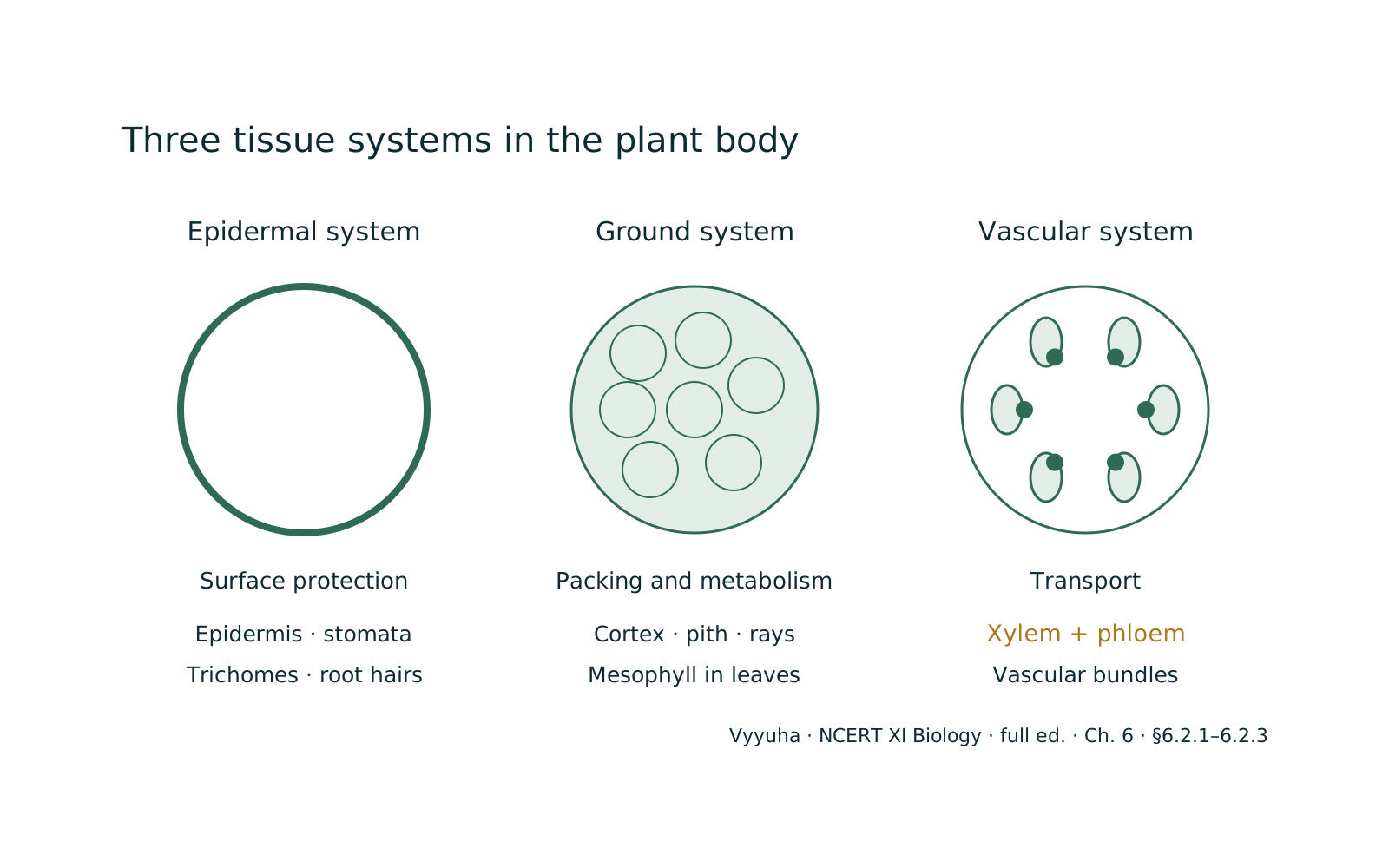
In the realm of plant anatomy, a tissue system refers to a group of tissues that perform a common function, irrespective of their location within the plant body. These systems are continuous throughout the plant, connecting various organs like roots, stems, and leaves, and are fundamentally categorized into three principal types: the Epidermal Tissue System, the Ground Tissue System, and the Vascu…
Quick Summary
Plant tissue systems are fundamental organizational units, grouping tissues with shared functions into continuous networks throughout the plant body. There are three primary systems: the Epidermal Tissue System (ETS), the Ground Tissue System (GTS), and the Vascular Tissue System (VTS).
The ETS forms the plant's outer protective layer, comprising the epidermis, cuticle, stomata for gas exchange, and epidermal outgrowths like root hairs and trichomes. The GTS constitutes the bulk of the plant, filling space between the ETS and VTS, and is responsible for photosynthesis, food storage, and structural support, primarily through parenchyma, collenchyma, and sclerenchyma tissues.
Key regions include the cortex, endodermis, pericycle, and pith. The VTS is the plant's transport network, consisting of xylem (for water and mineral conduction) and phloem (for food translocation), organized into vascular bundles.
These bundles can be radial (roots) or conjoint (stems/leaves), and open (dicots, secondary growth possible) or closed (monocots, no secondary growth). Together, these systems ensure protection, metabolic activity, and efficient transport, enabling the plant's survival and growth.
Full explanation
The intricate organization of a plant body, particularly in flowering plants (angiosperms), is a testament to evolutionary adaptation for terrestrial life. This organization is best understood by categorizing tissues into three fundamental tissue systems, each with specialized structures and functions, yet working synergistically to sustain the plant. These are the Epidermal Tissue System, the Ground Tissue System, and the Vascular Tissue System.
I. Conceptual Foundation: The Hierarchy of Organization
Plants, like animals, exhibit a hierarchical organization: cells form tissues, tissues form organs (roots, stems, leaves), and organs are integrated into the whole organism. Tissue systems represent an intermediate level, where groups of tissues, often composed of different cell types, are organized to perform a collective function across various organs. This continuity of tissue systems throughout the plant body is a key principle, allowing for coordinated physiological processes.
II. Key Principles and Components of Tissue Systems
A. The Epidermal Tissue System (ETS)
This system forms the outermost protective covering of the plant body, directly interacting with the external environment. It is primarily composed of the epidermis, a single layer of tightly packed cells, but also includes specialized structures.
- Epidermis:
* Structure: Typically a single layer of parenchymatous cells, often flattened and compactly arranged without intercellular spaces. The outer walls are usually thicker than the inner walls. In some cases (e.g., Ficus, Nerium), a multiple epidermis may be present. * Function: Primarily protection against mechanical injury, pathogen invasion, and excessive water loss. It also plays a role in secretion and absorption.
- Cuticle:
* Structure: A waxy, waterproof layer secreted by the epidermal cells, covering the outer surface of the epidermis, especially on leaves and stems. It is absent in roots. * Function: Reduces transpiration (water loss) significantly, providing a crucial adaptation for terrestrial plants.
- Stomata:
* Structure: Minute pores present mainly on the epidermis of leaves, but also on young stems. Each stoma is flanked by two kidney-shaped (dicots) or dumbbell-shaped (monocots) guard cells. These guard cells contain chloroplasts (unlike other epidermal cells) and regulate the opening and closing of the pore.
Surrounding the guard cells are often specialized epidermal cells called subsidiary cells or accessory cells, which assist in stomatal function. * Function: Facilitates gaseous exchange (uptake of for photosynthesis, release of ) and regulates transpiration.
- Epidermal Outgrowths (Appendages):
* Root Hairs: Unicellular elongations of epidermal cells in roots. Their primary function is to increase the surface area for absorption of water and mineral nutrients from the soil. * Trichomes: Multicellular (sometimes unicellular) epidermal outgrowths on stems and leaves. They can be branched or unbranched, soft or stiff. Functions vary widely: protection against herbivores, reduction of water loss, secretion of substances (e.g., glandular trichomes).
B. The Ground Tissue System (GTS)
This system constitutes the bulk of the plant body, filling the regions between the epidermal and vascular tissues. It is primarily composed of simple permanent tissues: parenchyma, collenchyma, and sclerenchyma.
- Parenchyma:
* Structure: Thin-walled, isodiametric cells with intercellular spaces. They are living cells and retain the power of division. * Function: Photosynthesis (chlorenchyma in leaves), storage of food (starch, fats, proteins) and water, secretion, and often involved in wound healing and regeneration.
- Collenchyma:
* Structure: Living cells with unevenly thickened cell walls, particularly at the corners, due to deposition of pectin and cellulose. They are typically found in layers below the epidermis in young stems and petiole of leaves. * Function: Provides mechanical support and flexibility to young, growing parts of the plant, preventing bending and breaking without hindering growth.
- Sclerenchyma:
* Structure: Dead cells at maturity, with thick, lignified cell walls. They are of two main types: fibres (long, pointed cells) and sclereids (short, isodiametric, often branched cells, also called stone cells). * Function: Provides rigid mechanical support and protection to mature parts of the plant. Fibres are common in vascular bundles and pericycle, while sclereids are found in fruit walls of nuts, pulp of fruits (e.g., guava, pear, sapota), and seed coats.
Regions of Ground Tissue:
- Cortex: — The region between the epidermis and the vascular bundles in stems and roots. It typically consists of parenchyma, collenchyma (in stems), and sometimes sclerenchyma. The innermost layer of the cortex is often the endodermis, characterized by Casparian strips (in roots) or starch sheaths (in stems), regulating water and solute movement.
- Pericycle: — Located just inside the endodermis, forming a layer around the vascular tissue. It is parenchymatous in roots (giving rise to lateral roots) and may be sclerenchymatous or parenchymatous in stems.
- Pith (Medulla): — The central part of the stem and some roots, composed of parenchymatous cells. Primarily involved in storage.
- Medullary Rays (Pith Rays): — Radial strips of parenchymatous cells extending between vascular bundles, connecting the pith to the cortex. Involved in radial conduction of water and food, and storage.
C. The Vascular Tissue System (VTS)
This system is responsible for the long-distance transport of water, minerals, and organic nutrients throughout the plant. It is composed of complex tissues: xylem and phloem, which are organized into vascular bundles.
- Xylem: — The water-conducting tissue.
* Components: Tracheids, vessels (trachea), xylem parenchyma, and xylem fibres. * Tracheids and Vessels: The primary water-conducting elements. Both are dead at maturity and have lignified walls.
Vessels are more efficient due to their wider lumen and continuous tube-like structure formed by perforated end walls. * Xylem Parenchyma: Living cells, primarily for storage of food (starch, fats) and radial conduction of water.
* Xylem Fibres: Sclerenchymatous cells, providing mechanical support. * Function: Conduction of water and dissolved minerals from roots to leaves, and mechanical support.
- Phloem: — The food-conducting tissue.
* Components: Sieve tube elements, companion cells, phloem parenchyma, and phloem fibres. * Sieve Tube Elements: Living cells, but enucleated at maturity, forming long tubes with perforated end walls (sieve plates).
They are responsible for translocation of food. * Companion Cells: Specialized parenchymatous cells closely associated with sieve tube elements. They are living, nucleated, and regulate the activity of sieve tube elements.
* Phloem Parenchyma: Living cells, for storage of food and other substances. * Phloem Fibres (Bast Fibres): Sclerenchymatous cells, providing mechanical support. They are generally absent in primary phloem but present in secondary phloem.
* Function: Translocation of organic nutrients (sugars) from leaves (source) to other parts of the plant (sink).
Types of Vascular Bundles:
- Radial: — Xylem and phloem are arranged on different radii, alternating with each other. Characteristic of roots.
- Conjoint: — Xylem and phloem are situated on the same radius. Characteristic of stems and leaves.
* Conjoint, Open: A strip of cambium (meristematic tissue) is present between xylem and phloem. This allows for secondary growth (increase in girth). Found in dicot stems. * Conjoint, Closed: Cambium is absent between xylem and phloem. No secondary growth. Found in monocot stems.
III. Real-World Applications and NEET-Specific Angle
Understanding tissue systems is crucial for:
- Agriculture: — Knowledge of root hair function helps in optimizing nutrient uptake. Understanding vascular tissue helps in grafting techniques and disease management (e.g., vascular wilts).
- Forestry: — The structure of xylem (wood) is critical for timber production and understanding tree growth.
- Pharmacology: — Many medicinal compounds are stored in ground tissues or transported via vascular tissues.
NEET Focus: Questions frequently test the identification of tissue system components, their specific functions, and their arrangement in different plant organs (root, stem, leaf) and between dicots and monocots.
For instance, distinguishing between radial and conjoint vascular bundles, identifying the presence or absence of cambium, or correlating specific cell types (e.g., guard cells, companion cells) with their functions are common themes.
The role of Casparian strips in the endodermis of roots, the presence of a starch sheath in dicot stems, and the arrangement of xylem and phloem (endarch, exarch) are also high-yield topics. Secondary growth, which involves the activity of vascular cambium and cork cambium, directly builds upon the understanding of primary vascular tissue systems.
IV. Common Misconceptions
- Tissue vs. Tissue System: — Students often confuse a single tissue (e.g., parenchyma) with a tissue system (e.g., ground tissue system, which comprises parenchyma, collenchyma, sclerenchyma). A tissue system is a higher level of organization.
- Function of Epidermis: — While protection is primary, students might forget its role in gas exchange (stomata) and absorption (root hairs).
- Xylem and Phloem: — Sometimes students mix up their functions or components. Remember 'X' for Xylem and 'W' for Water, and 'P' for Phloem and 'F' for Food. Also, xylem conducts unidirectionally, while phloem conducts bidirectionally.
- Cambium: — The presence or absence of cambium is key to distinguishing between open and closed vascular bundles, and thus between dicot and monocot stems. A common error is assuming all vascular bundles have cambium.
Key Concepts
The stomatal apparatus consists of a stomatal pore, two guard cells, and sometimes subsidiary cells. Guard…
Vascular bundles are classified based on the arrangement of xylem and phloem. Radial bundles, found in roots,…
The endodermis is the innermost layer of the cortex, particularly prominent in roots. Its cells have…
Often confused with
Side-by-side differences the NEET paper likes to test.
| Aspect | Tissue Systems | Dicot Stem vs. Monocot Stem Tissue Systems |
|---|---|---|
| Epidermis | Dicot Stem: Often has trichomes, cuticle present. Stomata may be present. | Monocot Stem: Cuticle present, stomata present. Trichomes are generally absent. |
| Hypodermis | Dicot Stem: Collenchymatous, providing flexible support. | Monocot Stem: Sclerenchymatous, providing rigid support. |
| Ground Tissue | Dicot Stem: Differentiated into cortex, endodermis, pericycle, and pith. Medullary rays present. | Monocot Stem: Undifferentiated ground tissue, usually parenchymatous, filling the entire cross-section. |
| Vascular Bundles | Dicot Stem: Arranged in a ring, 'open' (with cambium), allowing secondary growth. Fewer in number, larger. | Monocot Stem: Scattered throughout the ground tissue, 'closed' (without cambium), no secondary growth. Numerous, smaller, larger towards the center. |
| Bundle Sheath | Dicot Stem: Generally absent around vascular bundles. | Monocot Stem: Vascular bundles often surrounded by a sclerenchymatous bundle sheath. |
The tissue system organization in dicot and monocot stems exhibits distinct differences reflecting their growth patterns and evolutionary adaptations. Dicot stems show a clear differentiation of ground tissue into cortex, endodermis, pericycle, and pith, with vascular bundles arranged in a ring and possessing cambium for secondary growth.
Monocot stems, conversely, have an undifferentiated ground tissue and scattered, closed vascular bundles, precluding secondary thickening. These anatomical variations are crucial for identifying plant types and understanding their physiological capabilities, particularly relevant for NEET questions on comparative anatomy.
Why it is tested: For NEET, understanding these differences is critical for identifying plant types from anatomical diagrams, predicting growth patterns, and answering comparative questions. It's a high-yield area for factual recall and application-based questions.
Questions students ask
5 answered on this topic.
What is the primary difference between a tissue and a tissue system in plants?
A tissue is a group of similar or dissimilar cells that perform a specific function, like parenchyma or xylem. A tissue system, on the other hand, is a higher level of organization, comprising one or more types of tissues that collectively perform a broader, common function and are continuous throughout the plant body. For example, the vascular tissue system includes both xylem and phloem tissues, working together for transport across the entire plant.
Why is the cuticle absent in roots but present on stems and leaves?
The cuticle is a waxy layer primarily designed to reduce water loss through transpiration. Roots are typically underground, where water loss is not a concern; instead, their main function is water absorption. A cuticle on roots would impede water uptake, making it counterproductive. Stems and leaves, being exposed to the atmosphere, need the cuticle to prevent desiccation and maintain water balance.
What is the significance of the Casparian strip in the endodermis of roots?
The Casparian strip is a band of suberin and lignin in the radial and transverse walls of endodermal cells in roots. Its significance lies in regulating the movement of water and dissolved minerals into the vascular cylinder. It forces water and solutes to pass through the cytoplasm of endodermal cells (symplast pathway) rather than between them (apoplast pathway), allowing the plant to selectively absorb substances and prevent uncontrolled entry of toxins.
How do monocot and dicot stems differ in their vascular tissue system organization?
In monocot stems, vascular bundles are scattered throughout the ground tissue and are typically 'closed,' meaning they lack cambium between xylem and phloem, thus preventing secondary growth. They are also usually numerous and smaller towards the periphery. In dicot stems, vascular bundles are arranged in a ring, are 'open' (possessing cambium), allowing for secondary growth, and are fewer in number, larger, and more organized.
What are the main functions of the ground tissue system?
The ground tissue system is highly versatile and performs multiple crucial functions. Its primary roles include photosynthesis, especially in the chlorenchyma of leaves and young stems; storage of food reserves like starch, proteins, and fats in parenchymatous cells of the cortex and pith; and providing mechanical support and flexibility through collenchyma in young parts and rigid support through sclerenchyma in mature regions. It also participates in secretion and wound repair.
Revise in 30 seconds
- ETS (Epidermal Tissue System): — Outermost protection. Epidermis, cuticle, stomata (gas exchange), root hairs (absorption), trichomes (protection/secretion).
- GTS (Ground Tissue System): — Bulk of plant. Parenchyma (storage, photosynthesis), Collenchyma (flexible support), Sclerenchyma (rigid support). Regions: Cortex, Endodermis, Pericycle, Pith.
- VTS (Vascular Tissue System): — Transport. Xylem (water, minerals), Phloem (food).
- Xylem: Tracheids, Vessels (dead, water conduction), Xylem Parenchyma (living, storage), Xylem Fibres (dead, support). - Phloem: Sieve Tubes (living, enucleated, food conduction), Companion Cells (living, regulate sieve tubes), Phloem Parenchyma (living, storage), Phloem Fibres (dead, support).
- Vascular Bundles: — Radial (roots), Conjoint (stems/leaves).
- Conjoint Open: Cambium present (dicots, secondary growth). - Conjoint Closed: Cambium absent (monocots, no secondary growth).
- Casparian Strips: — In root endodermis, regulate water movement.
To remember the three main tissue systems: Every Great Vegetable.
- Epidermal Tissue System
- Ground Tissue System
- Vascular Tissue System