Prokaryotic and Eukaryotic Cells — Explained
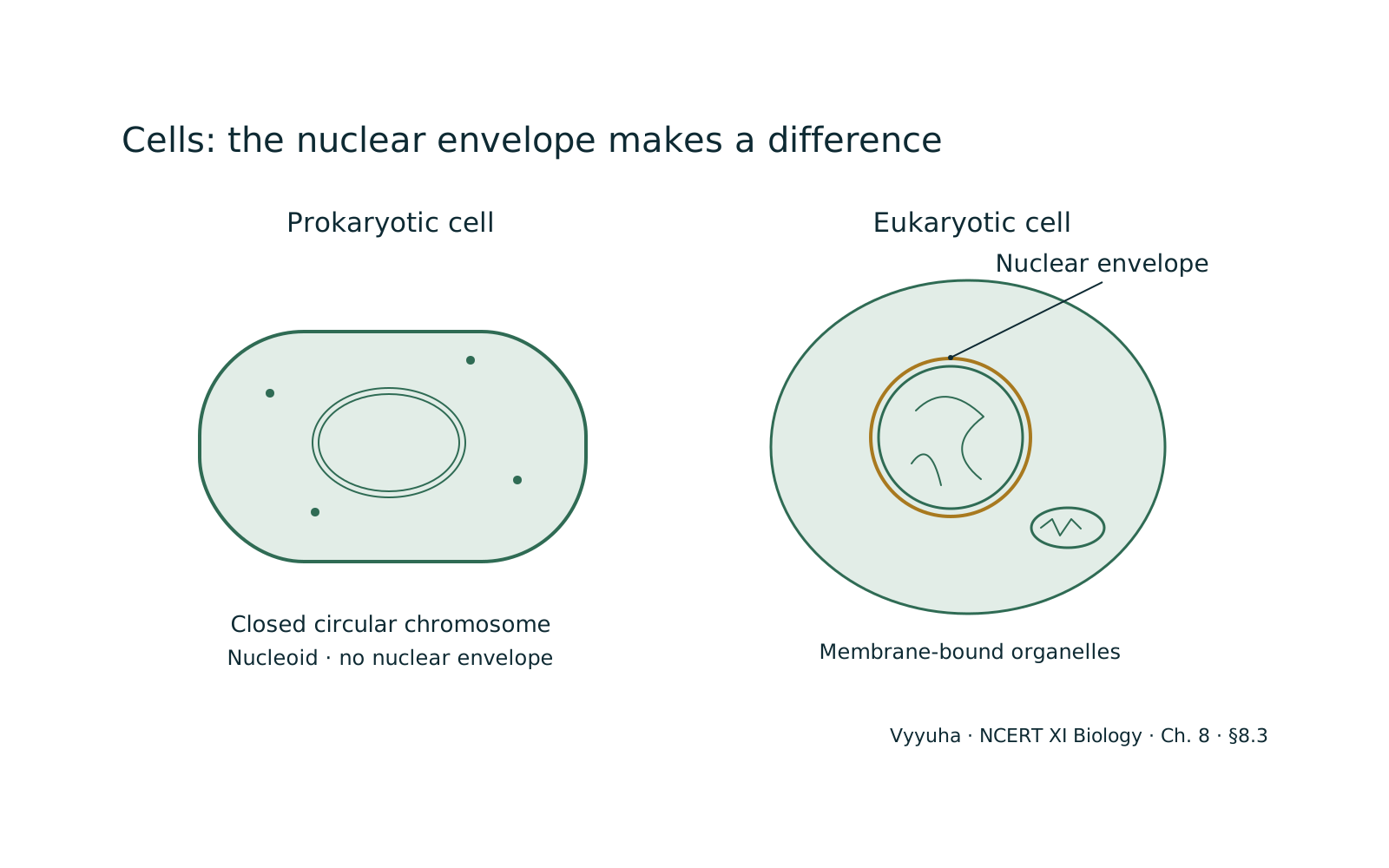
Detailed Explanation
The classification of cells into prokaryotic and eukaryotic types represents one of the most fundamental distinctions in biology, reflecting billions of years of evolutionary divergence. This distinction underpins our understanding of cellular organization, function, and the very diversity of life itself.
Conceptual Foundation: The Evolutionary Divide
Life on Earth is thought to have originated from simple, self-replicating molecules that eventually became enclosed within membranes, forming the first cells. These early cells were undoubtedly prokaryotic in nature, thriving in the primordial soup.
Over vast stretches of geological time, some prokaryotic lineages evolved greater complexity, eventually giving rise to eukaryotic cells. The endosymbiotic theory, a cornerstone of evolutionary biology, posits that mitochondria and chloroplasts (key eukaryotic organelles) originated from free-living prokaryotes that were engulfed by ancestral eukaryotic cells and established a symbiotic relationship.
This evolutionary journey from simple prokaryotes to complex eukaryotes marks a pivotal moment in the history of life, enabling the emergence of multicellularity and the vast array of complex organisms we see today.
Key Principles and Defining Characteristics
While both prokaryotic and eukaryotic cells adhere to the basic tenets of cell theory – that all living organisms are composed of cells and that all cells arise from pre-existing cells – their structural and organizational principles diverge significantly.
- Nucleus: — The most defining difference. Prokaryotes lack a true, membrane-bound nucleus. Their genetic material (nucleoid) is in the cytoplasm. Eukaryotes possess a distinct, membrane-bound nucleus containing their genetic material.
- Membrane-bound Organelles: — Prokaryotes lack all membrane-bound organelles (e.g., mitochondria, ER, Golgi, lysosomes). Eukaryotes are characterized by extensive internal compartmentalization through various membrane-bound organelles.
- Genetic Material: — Prokaryotes typically have a single, circular chromosome. Plasmids (extra-chromosomal DNA) are often present. Eukaryotes have multiple, linear chromosomes, tightly packed with histone proteins to form chromatin within the nucleus.
- Ribosomes: — Both have ribosomes for protein synthesis, but prokaryotic ribosomes are smaller (70S type) compared to eukaryotic ribosomes (80S type).
- Cell Size: — Prokaryotic cells are generally much smaller (0.1-5 m) than eukaryotic cells (10-100 m).
- Cell Division: — Prokaryotes divide by binary fission, a simpler process. Eukaryotes divide by mitosis (for somatic cells) and meiosis (for germ cells), which are complex processes involving spindle formation.
- Cell Wall: — Most prokaryotes (bacteria) have a cell wall made of peptidoglycan. Eukaryotic cells may or may not have a cell wall; if present (plants, fungi), its composition differs (cellulose in plants, chitin in fungi).
Prokaryotic Cell Structure: A Blueprint for Efficiency
Despite their apparent simplicity, prokaryotic cells are highly organized and efficient. A typical bacterial cell exhibits the following structures:
- Cell Envelope: — This is the outermost protective and structural layer, consisting of three components:
* Glycocalyx: A sticky outer layer, either a loose slime layer or a rigid capsule. It aids in adhesion and protection from desiccation or host immune responses. * Cell Wall: Located beneath the glycocalyx (if present), it provides structural support, prevents osmotic lysis, and determines cell shape.
In bacteria, it's primarily composed of peptidoglycan (murein). * Cell Membrane (Plasma Membrane): A selectively permeable lipid bilayer, similar to eukaryotes, regulating the passage of substances.
It also contains enzymes for respiration and photosynthesis (in photosynthetic bacteria).
- Cytoplasm: — The semi-fluid matrix filling the cell, where metabolic reactions occur. It lacks cytoplasmic streaming.
- Nucleoid: — The region where the single, circular bacterial chromosome is located. It is not membrane-bound.
- Plasmids: — Small, extra-chromosomal, circular DNA molecules that replicate independently. They often carry genes for antibiotic resistance or virulence factors, providing adaptive advantages.
- Ribosomes: — 70S type (composed of 50S and 30S subunits), responsible for protein synthesis. They are scattered throughout the cytoplasm.
- Inclusion Bodies: — Non-membrane-bound storage granules (e.g., phosphate granules, cyanophycean granules, glycogen granules) for reserve materials.
- Flagella: — Long, whip-like appendages for motility, composed of a filament, hook, and basal body. They rotate to propel the cell.
- Pili (Fimbriae): — Short, hair-like appendages. Fimbriae help in attachment to surfaces or host tissues. Pili (specifically sex pili) are involved in conjugation (transfer of genetic material).
Eukaryotic Cell Structure: The Power of Compartmentalization
Eukaryotic cells are characterized by their extensive internal compartmentalization, allowing for specialized functions and greater metabolic efficiency. Key structures include:
- Cell Membrane (Plasma Membrane): — A fluid mosaic model lipid bilayer, regulating transport and involved in cell signaling.
- Cytoplasm: — Comprises the cytosol (fluid portion) and various organelles. Cytoplasmic streaming is common.
- Nucleus: — The control center of the cell, enclosed by a double-layered nuclear envelope with nuclear pores. It contains:
* Nucleoplasm: The fluid matrix within the nucleus. * Chromatin: The complex of DNA and histone proteins, forming chromosomes. * Nucleolus: A non-membrane-bound structure involved in ribosome synthesis.
- Endomembrane System: — A functionally interconnected network of organelles:
* Endoplasmic Reticulum (ER): A network of tubules and sacs. Rough ER (RER) has ribosomes and synthesizes secreted/membrane proteins. Smooth ER (SER) synthesizes lipids, detoxifies drugs, and stores calcium.
* Golgi Apparatus: Modifies, sorts, and packages proteins and lipids from the ER for secretion or delivery to other organelles. * Lysosomes: Membrane-bound vesicles containing hydrolytic enzymes for intracellular digestion.
* Vacuoles: Membrane-bound sacs for storage, waste removal, and maintaining turgor pressure (especially large in plant cells).
- Mitochondria: — Double-membraned organelles, the 'powerhouses' of the cell, responsible for aerobic respiration and ATP production. They have their own circular DNA and 70S ribosomes.
- Plastids (in plants and algae): — Double-membraned organelles involved in photosynthesis (chloroplasts), storage (leucoplasts), or pigment synthesis (chromoplasts). Chloroplasts also have their own circular DNA and 70S ribosomes.
- Ribosomes: — 80S type (composed of 60S and 40S subunits), found free in the cytoplasm or attached to RER. Mitochondria and chloroplasts also have 70S ribosomes.
- Cytoskeleton: — A network of protein filaments (microfilaments, intermediate filaments, microtubules) providing structural support, facilitating cell movement, and organelle transport.
- Cilia and Flagella: — Motile appendages (in some eukaryotic cells) with a microtubule arrangement, involved in movement or moving fluids.
- Centrioles (in animal cells): — Involved in cell division and the formation of cilia/flagella basal bodies.
- Cell Wall (in plants and fungi): — Provides structural support and protection. Composed of cellulose in plants and chitin in fungi.
Real-World Applications and Significance
Understanding prokaryotic and eukaryotic cells is fundamental to various fields:
- Medicine: — Many diseases are caused by pathogenic prokaryotes (bacteria) or eukaryotic parasites. Knowledge of their cellular differences is crucial for developing targeted antibiotics (which attack bacterial structures without harming host eukaryotic cells) and antiviral therapies.
- Biotechnology: — Prokaryotes, especially bacteria like E. coli, are extensively used in genetic engineering to produce insulin, vaccines, and other therapeutic proteins due to their rapid growth and simple genetic manipulation. Eukaryotic cells (e.g., yeast, mammalian cell lines) are used for more complex protein production and drug screening.
- Ecology: — Prokaryotes play vital roles in nutrient cycling (nitrogen fixation, decomposition) and are the base of many food webs. Eukaryotes form the vast majority of visible life, contributing to biodiversity and ecosystem stability.
- Evolutionary Biology: — The study of cellular differences provides insights into the origin of life, the evolution of complexity, and the relationships between different life forms.
Common Misconceptions
- Prokaryotes are 'primitive' and less evolved: — While structurally simpler, prokaryotes are highly evolved and incredibly successful, adapting to virtually every environment on Earth. Their 'simplicity' is an evolutionary advantage for rapid reproduction and resource utilization.
- All prokaryotes are harmful: — The vast majority of prokaryotes are harmless or beneficial (e.g., gut bacteria, decomposers). Only a small fraction are pathogenic.
- All eukaryotes are multicellular: — Many eukaryotes are unicellular, such as yeasts, amoebas, and paramecia. Multicellularity is a characteristic of some eukaryotic lineages, not all.
- Prokaryotes have no genetic material: — They do, but it's not enclosed in a nucleus. The nucleoid region contains their DNA.
NEET-Specific Angle
For NEET, a deep understanding of the structural and functional differences between prokaryotic and eukaryotic cells is paramount. Questions frequently test:
- Key distinguishing features: — Presence/absence of nucleus, membrane-bound organelles, type of ribosomes, cell wall composition, genetic material organization.
- Specific structures and their functions: — E.g., peptidoglycan in bacterial cell walls, plasmids, nucleoid, 70S vs. 80S ribosomes, components of the endomembrane system, roles of mitochondria and chloroplasts.
- Examples: — Identifying organisms as prokaryotic (bacteria, archaea) or eukaryotic (plants, animals, fungi, protists).
- Evolutionary implications: — Basic understanding of endosymbiotic theory and the origin of eukaryotes.
- Diagram-based questions: — Identifying parts of a prokaryotic or eukaryotic cell from a labeled diagram.
Often confused with
Side-by-side differences the NEET paper likes to test.
| Aspect | Prokaryotic and Eukaryotic Cells | Eukaryotic Cells |
|---|---|---|
| Presence of Nucleus | Absent (genetic material in nucleoid) | Present (membrane-bound) |
| Membrane-bound Organelles | Absent | Present (e.g., mitochondria, ER, Golgi, lysosomes) |
| Genetic Material | Single, circular chromosome; often plasmids; no histones | Multiple, linear chromosomes; associated with histones (chromatin) |
| Ribosome Type | 70S type | 80S type (cytoplasmic); 70S in mitochondria/chloroplasts |
| Cell Size | Smaller (0.1-5 $\mu$m) | Larger (10-100 $\mu$m) |
| Cell Division | Binary fission | Mitosis and Meiosis |
| Cell Wall Composition | Peptidoglycan (in bacteria) | Cellulose (plants), Chitin (fungi), or absent (animals) |
| Cytoskeleton | Absent or rudimentary | Present (microfilaments, microtubules, intermediate filaments) |
| Respiration | Mainly in cell membrane and cytoplasm | Mainly in mitochondria |
| Examples | Bacteria, Archaea | Plants, Animals, Fungi, Protists |
The distinction between prokaryotic and eukaryotic cells is fundamental to biology, primarily revolving around the presence or absence of a true nucleus and membrane-bound organelles. Prokaryotes, like bacteria, are simpler, smaller, and lack internal compartmentalization, with their genetic material in a nucleoid and 70S ribosomes.
Eukaryotes, encompassing plants, animals, fungi, and protists, are larger, more complex, and feature a membrane-bound nucleus, multiple linear chromosomes, and a sophisticated endomembrane system with 80S ribosomes.
These differences reflect distinct evolutionary paths and functional capabilities, with eukaryotes achieving higher levels of specialization through compartmentalization.
Why it is tested: For NEET, understanding these differences is crucial for identifying cell types, predicting cellular functions, and comprehending the targets of various drugs (e.g., antibiotics). Questions often test specific structural components unique to each type and their functional implications.
Questions students ask
6 answered on this topic.
What is the primary difference between prokaryotic and eukaryotic cells?
The most fundamental difference lies in the organization of their genetic material and internal cellular structures. Eukaryotic cells possess a true, membrane-bound nucleus that houses their DNA, along with various other membrane-bound organelles like mitochondria and endoplasmic reticulum.
Prokaryotic cells, in contrast, lack a membrane-bound nucleus; their genetic material (DNA) is located in a region called the nucleoid within the cytoplasm, and they do not have any membrane-bound organelles.
This distinction drives many other differences in size, complexity, and metabolic capabilities.
Do prokaryotic cells have ribosomes?
Yes, prokaryotic cells do have ribosomes. Ribosomes are essential for protein synthesis, a process vital for all living cells. However, there's a difference in their size and composition. Prokaryotic ribosomes are of the 70S type, which are smaller than the 80S ribosomes found in eukaryotic cells. These 70S ribosomes in prokaryotes are typically found free in the cytoplasm, whereas in eukaryotes, 80S ribosomes can be free or attached to the endoplasmic reticulum.
What is the function of plasmids in prokaryotic cells?
Plasmids are small, circular, extra-chromosomal DNA molecules found in many prokaryotic cells, particularly bacteria. They replicate independently of the main bacterial chromosome. Plasmids often carry genes that provide advantageous traits to the bacterium, such as antibiotic resistance, virulence factors (which help in causing disease), or the ability to metabolize unusual compounds.
They are crucial in bacterial evolution and adaptation, as they can be easily transferred between bacteria through processes like conjugation, facilitating the spread of beneficial traits.
Why are mitochondria and chloroplasts considered unique organelles in eukaryotic cells?
Mitochondria and chloroplasts are unique because they possess their own circular DNA, 70S ribosomes (similar to prokaryotes), and can self-replicate independently of the cell's main nucleus. This supports the endosymbiotic theory, which proposes that these organelles originated from free-living prokaryotic cells that were engulfed by ancestral eukaryotic cells.
They maintain a symbiotic relationship, with mitochondria performing cellular respiration and chloroplasts carrying out photosynthesis, making them vital for energy production in eukaryotic cells.
Can prokaryotic cells be multicellular?
While prokaryotic cells are predominantly unicellular, meaning they exist as single, independent cells, some can form colonies or simple filamentous structures. These aggregations, however, typically lack true tissue differentiation or specialized functions among the cells, which are hallmarks of true multicellularity seen in eukaryotes.
Each cell in a prokaryotic colony generally retains its full metabolic independence. Therefore, while they can aggregate, they are not considered truly multicellular in the same complex sense as plants or animals.
What is the significance of the cell wall in prokaryotes?
The cell wall in prokaryotes, particularly bacteria, is a rigid outer layer primarily composed of peptidoglycan. Its significance is multifaceted: it provides structural support and maintains the characteristic shape of the cell, protects the cell from mechanical stress and osmotic lysis (bursting due to excessive water intake), and acts as a barrier against certain toxic substances.
The unique composition of the bacterial cell wall is also a target for many antibiotics, which inhibit its synthesis, leading to bacterial cell death without harming host eukaryotic cells.