Matter and Its Nature
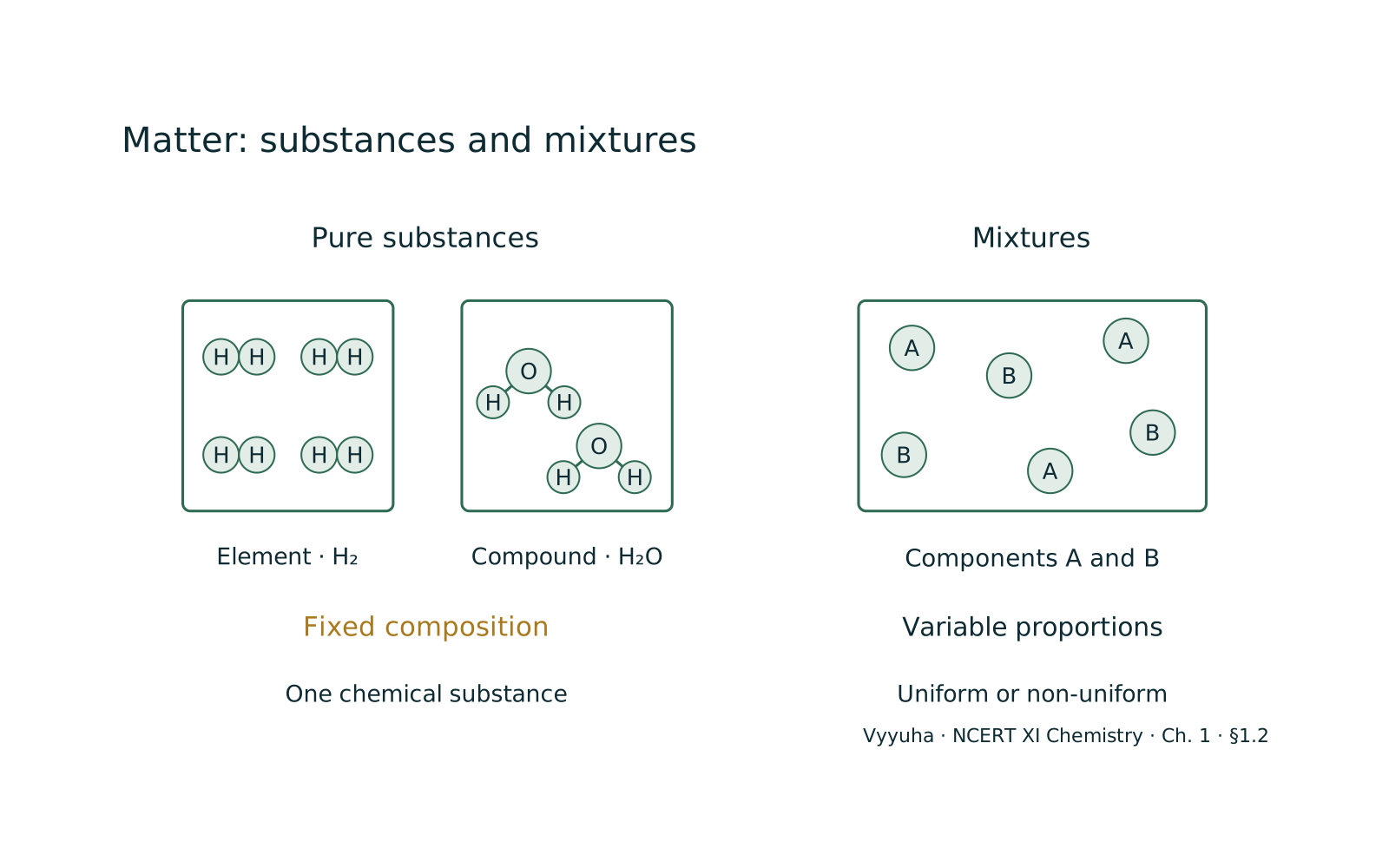
Matter, in the realm of chemistry and physics, is fundamentally defined as anything that possesses mass and occupies space. This seemingly simple definition underpins all of chemistry, as it describes the physical substance of the universe. Matter exists in various forms, known as states, and can undergo both physical and chemical changes. Its inherent properties, such as density, melting point, a…
Quick Summary
Matter is defined as anything that has mass and occupies space. It exists primarily in three states: solids (definite shape and volume, fixed particles), liquids (definite volume, indefinite shape, particles slide past each other), and gases (indefinite shape and volume, widely separated, rapidly moving particles).
Matter can be broadly classified into pure substances and mixtures. Pure substances include elements (simplest form, one type of atom, cannot be broken down chemically) and compounds (two or more elements chemically combined in a fixed ratio, can be broken down chemically).
Mixtures are physical combinations of two or more substances, retaining individual properties, and can be separated physically. Homogeneous mixtures (solutions) have uniform composition, while heterogeneous mixtures are non-uniform.
Properties of matter are either physical (observed without changing identity, e.g., color, melting point) or chemical (observed during a chemical change, e.g., flammability). Understanding these fundamental concepts is crucial for all of chemistry.
Full explanation
The concept of matter is the bedrock upon which the entire edifice of chemistry is built. Without a clear understanding of what matter is, how it behaves, and how it can be classified, it's impossible to grasp more complex chemical principles. Let's delve deep into its nature.
Conceptual Foundation
At its most fundamental level, matter is anything that possesses mass and occupies space (has volume). This definition, while simple, is profoundly important. Mass is an intrinsic property of matter, representing its resistance to acceleration (inertia).
Volume is the three-dimensional space an object occupies. These two properties are inseparable from the concept of matter. Energy, while often interacting with matter, is not matter itself, as it does not have mass or occupy space in the same way.
However, Einstein's famous equation, , demonstrates the interconvertibility of mass and energy, highlighting their deep connection.
Key Principles/Laws (Briefly Relevant)
While specific laws like the Law of Conservation of Mass are typically covered in subsequent topics, it's crucial to understand that matter is conserved in ordinary chemical and physical changes. This means matter cannot be created or destroyed, only transformed from one form to another. This principle is implicitly fundamental to understanding matter's transformations.
States of Matter
Matter primarily exists in three common physical states: solid, liquid, and gas. These states are distinguished by the arrangement and movement of their constituent particles (atoms, molecules, or ions) and the strength of intermolecular forces (IMFs) between them.
- Solids — In solids, particles are packed very closely together in fixed positions, often in a regular, crystalline lattice. The intermolecular forces are very strong, holding the particles rigidly. They can only vibrate about their mean positions. Consequently, solids have a definite shape and a definite volume, and they are generally incompressible.
* Examples: Ice, salt, metals.
- Liquids — In liquids, particles are still relatively close but are not fixed in position. The intermolecular forces are strong enough to keep the particles together but weak enough to allow them to slide past one another. This 'fluidity' means liquids have a definite volume but take the shape of their container. They are nearly incompressible.
* Examples: Water, oil, alcohol.
- Gases — In gases, particles are far apart and move randomly and rapidly in all directions. The intermolecular forces are very weak, almost negligible. Gases have neither a definite shape nor a definite volume; they expand to fill any container they occupy. They are highly compressible.
* Examples: Air (mixture of gases), oxygen, nitrogen.
Other States (Brief Mention):
- Plasma — Often called the fourth state of matter, plasma consists of ionized gas where atoms have lost or gained electrons, resulting in a mixture of ions and free electrons. It's the most common state of matter in the universe (e.g., stars, lightning).
- Bose-Einstein Condensate (BEC) — A state of matter formed by cooling a gas of extremely low density to temperatures very close to absolute zero. At this point, a large fraction of the atoms collapse into the lowest quantum state, behaving as a single quantum entity.
Phase Transitions: Matter can change from one state to another by adding or removing energy (usually heat). For example, melting (solid to liquid), freezing (liquid to solid), vaporization (liquid to gas), condensation (gas to liquid), sublimation (solid to gas), and deposition (gas to solid).
Classification of Matter
Matter can be classified in two primary ways: physically (based on its state) and chemically (based on its composition).
A. Physical Classification: As discussed above, based on states (solid, liquid, gas, etc.).
B. Chemical Classification: This is crucial for understanding chemical reactions.
- Pure Substances — These have a definite and constant composition and distinct properties. They cannot be separated into simpler substances by physical means.
* Elements: The simplest form of pure substance that cannot be broken down into simpler substances by ordinary chemical means. Each element is composed of only one type of atom. There are about 118 known elements, organized in the periodic table.
* Examples: Oxygen (), Gold (), Iron (). * Compounds: Formed when two or more different elements chemically combine in a fixed ratio by mass. The properties of a compound are entirely different from those of its constituent elements.
Compounds can be broken down into their constituent elements by chemical means. * Examples: Water (), Carbon Dioxide (), Sodium Chloride ().
- Mixtures — These consist of two or more pure substances (elements or compounds) that are physically combined but not chemically bonded. The components retain their individual properties and can be separated by physical methods. The composition of a mixture can vary.
* Homogeneous Mixtures (Solutions): Mixtures where the components are uniformly distributed throughout, and the mixture has a uniform composition and properties. Individual components are not visible.
* Examples: Saltwater, air, brass (alloy). * Heterogeneous Mixtures: Mixtures where the components are not uniformly distributed, and the composition and properties vary from one part to another.
Individual components are often visible. * Examples: Sand and water, oil and water, granite, smoke.
Properties of Matter
Properties are characteristics that allow us to distinguish one substance from another.
- Physical Properties — Can be observed or measured without changing the chemical identity of the substance. These include color, odor, density, melting point, boiling point, hardness, conductivity, and state of matter.
* Example: The boiling point of water is . When water boils, it changes from liquid to gas, but it is still water ().
- Chemical Properties — Describe a substance's ability to undergo changes that transform it into different substances. These properties are observed during a chemical reaction.
* Example: Flammability (ability to burn), reactivity with acids or bases, oxidation (rusting of iron).
Extensive vs. Intensive Properties:
- Extensive Properties — Depend on the amount of matter present. Examples: Mass, volume, energy.
- Intensive Properties — Do not depend on the amount of matter present. Examples: Temperature, density, melting point, boiling point, color.
Real-World Applications
Understanding matter's nature is fundamental to countless real-world applications:
- Material Science — Designing new alloys (homogeneous mixtures) with specific strengths or conductivities.
- Food Science — Understanding how ingredients (elements, compounds, mixtures) interact to create different textures and flavors.
- Environmental Science — Analyzing pollutants in air (gaseous mixture) or water (liquid mixture).
- Medicine — Formulating drugs (compounds) and understanding their interactions within the body (complex biological mixtures).
- Everyday Phenomena — Explaining why sugar dissolves in tea (homogeneous mixture), why oil and water separate (heterogeneous mixture), or why metals conduct electricity (property of elements).
Common Misconceptions
- Mixtures vs. Compounds — A common error is confusing a mixture with a compound. In a compound, elements are chemically bonded in a fixed ratio, forming a new substance with new properties. In a mixture, substances are physically combined, retain their individual properties, and can be separated physically.
- Atoms vs. Elements — While an element is composed of one type of atom, the terms are not interchangeable. An element is a macroscopic sample of that type of atom. For instance, 'oxygen' refers to the element, while 'an oxygen atom' refers to a single particle.
- Weight vs. Mass — Often used interchangeably, but mass is the amount of matter, while weight is the force of gravity acting on that mass ().
NEET-Specific Angle
For NEET UG, a strong grasp of 'Matter and Its Nature' is not just about memorizing definitions; it's about building a robust conceptual framework for the entire chemistry syllabus. Questions often test your ability to:
- Classify substances — Given a list, identify elements, compounds, homogeneous, or heterogeneous mixtures.
- Distinguish properties — Differentiate between physical and chemical changes, or extensive and intensive properties.
- Relate states to particle behavior — Understand how intermolecular forces dictate the properties of solids, liquids, and gases.
- Foundation for Stoichiometry — The concept of pure substances (elements and compounds) and their fixed compositions is essential for understanding mole concept, percentage composition, and stoichiometric calculations.
- Basis for Atomic Structure — Understanding elements as fundamental building blocks leads directly into atomic theory and structure.
This foundational topic ensures that students can correctly interpret chemical phenomena and apply principles accurately in subsequent, more complex chapters.
Key Concepts
The distinction between an element and a compound is fundamental to chemical understanding. An **element** is…
Mixtures are physical combinations of substances, but their uniformity dictates their classification. A…
Understanding the difference between physical and chemical properties helps us characterize substances and…
Often confused with
Side-by-side differences the NEET paper likes to test.
| Aspect | Matter and Its Nature | Pure Substances vs. Mixtures |
|---|---|---|
| Composition | Fixed and definite; uniform throughout. | Variable; components can be in any proportion. |
| Separation | Cannot be separated into simpler substances by physical methods (only chemical for compounds). | Can be separated into constituent substances by physical methods (e.g., filtration, distillation). |
| Properties | Has distinct, characteristic properties. | Components retain their individual properties. |
| Formation | Elements cannot be formed; compounds formed by chemical combination. | Formed by physical combination of substances. |
| Energy Change | Significant energy changes (absorption or release) during compound formation. | Little to no energy change during mixture formation. |
| Examples | Water ($H_2O$), Oxygen ($O_2$), Sodium Chloride ($NaCl$). | Saltwater, air, sand and water. |
Pure substances, comprising elements and compounds, possess a fixed chemical composition and distinct properties, making them inseparable by physical means. Their formation often involves significant energy changes. In contrast, mixtures are physical combinations of two or more substances with variable compositions, where components retain their individual properties and can be separated using physical methods. The distinction lies in the nature of bonding and the uniformity of composition.
Why it is tested: For NEET, understanding this distinction is crucial for classifying chemical entities, predicting their behavior in reactions, and applying concepts like stoichiometry. Many NEET questions test the ability to correctly identify whether a given substance is an element, compound, or a type of mixture, which forms the basis for understanding chemical reactions and properties.
Questions students ask
5 answered on this topic.
What is the primary difference between mass and weight?
Mass is a fundamental property of matter, representing the amount of 'stuff' an object contains and its resistance to acceleration (inertia). It remains constant regardless of location. Weight, on the other hand, is the force exerted on an object due to gravity, calculated as mass times the acceleration due to gravity (). Therefore, an object's weight can change depending on the gravitational field (e.g., on the Moon vs. Earth), while its mass stays the same.
Can a pure substance be a mixture?
No, by definition, a pure substance cannot be a mixture. A pure substance has a definite and constant composition and distinct properties throughout. It consists of only one type of matter, either an element (like pure gold) or a compound (like pure water). A mixture, however, is a physical combination of two or more pure substances, where each substance retains its individual properties and their proportions can vary. They are distinct categories of matter.
Why do gases fill their containers completely, unlike liquids or solids?
Gases fill their containers completely because their constituent particles (atoms or molecules) have very weak intermolecular forces of attraction between them. This allows the particles to move freely, rapidly, and randomly in all directions, constantly colliding with each other and the container walls. Without strong forces to hold them together or in a fixed volume, they spread out to occupy the entire available space, taking both the shape and volume of the container.
What is the significance of 'fixed ratio by mass' in defining a compound?
The 'fixed ratio by mass' is a defining characteristic of a chemical compound, stemming from the Law of Constant Proportions. It means that a specific compound, regardless of its source or method of preparation, will always contain its constituent elements combined in the same definite proportion by mass.
For example, water () always contains hydrogen and oxygen in a 1:8 mass ratio. This fixed ratio ensures that the compound has consistent properties and a unique chemical identity, unlike mixtures where ratios can vary.
Are alloys considered homogeneous or heterogeneous mixtures?
Alloys are generally considered homogeneous mixtures. An alloy is a mixture of two or more metals, or a metal and a non-metal, where the components are uniformly distributed throughout the solid structure. For example, brass is an alloy of copper and zinc, and its composition is uniform at a macroscopic level, making it a homogeneous mixture. While some specialized alloys might exhibit micro-heterogeneity, for general chemistry purposes, they are classified as homogeneous.
Revise in 30 seconds
- Matter — Has mass & occupies space.
- States — Solid (definite shape/vol, fixed particles), Liquid (definite vol, indefinite shape, sliding particles), Gas (indefinite shape/vol, random particles).
- Pure Substances — Elements (one type of atom, cannot break down chemically) & Compounds (2+ elements chemically combined in fixed ratio, new properties, break down chemically).
- Mixtures — Physical combo of 2+ substances, retain properties, variable ratio, separate physically.
- Homogeneous: Uniform composition (e.g., saltwater, air). - Heterogeneous: Non-uniform composition (e.g., sand & water, oil & water).
- Properties — Physical (observed without changing identity, e.g., color, BP), Chemical (observed during chemical change, e.g., flammability).
- Extensive — Depends on amount (mass, volume). Intensive: Independent of amount (density, temp, BP).
To remember the states of matter and their key characteristics: Strong Loose Gone.
- Strong: Solids have Strong IMFs, fixed particles.
- Loose: Liquids have Loose (moderate) IMFs, particles slide.
- Gone: Gases have IMFs almost Gone (negligible), particles far apart.