Mole Concept and Molar Mass
The mole (symbol: mol) is the unit of amount of substance in the International System of Units (SI). One mole contains exactly elementary entities. This number is the fixed numerical value of the Avogadro constant, , when expressed in the unit , and is called the Avogadro number. The amount of substance, , of a system is a measure of the number …
Quick Summary
The mole concept is a fundamental tool in chemistry for quantifying substances. A mole is defined as the amount of substance containing Avogadro's number () of elementary entities (atoms, molecules, ions, etc.
). This allows chemists to count particles indirectly. Molar mass is the mass of one mole of a substance, expressed in grams per mole (). Numerically, it's equivalent to the atomic mass (for elements) or molecular mass (for compounds) in amu.
For example, carbon's atomic mass is 12 amu, so its molar mass is 12 . For compounds like , with a molecular mass of 18 amu, its molar mass is 18 . For ideal gases at Standard Temperature and Pressure (STP: , 1 atm), one mole occupies a volume of 22.
4 liters. These relationships allow interconversion between mass, moles, number of particles, and gas volume, forming the basis for all quantitative chemical calculations, including stoichiometry and solution chemistry.
Full explanation
The mole concept is arguably the most fundamental quantitative concept in chemistry, serving as a bridge between the microscopic world of atoms and molecules and the macroscopic world of grams, liters, and measurable quantities. Without the mole, stoichiometry – the quantitative study of reactants and products in chemical reactions – would be impossible.
Conceptual Foundation: The Need for a Counting Unit
Early chemists, like John Dalton, established the idea of atoms as indivisible particles. However, they quickly realized that atoms and molecules are incredibly small. Even a tiny speck of dust contains billions of atoms.
To perform chemical reactions and understand their proportions, chemists needed a way to count these particles indirectly. They couldn't count them one by one. Instead, they needed a 'collective unit' that represented a specific, very large number of particles, much like a 'dozen' represents 12 items or a 'gross' represents 144 items.
This led to the development of the mole concept.
The idea gained traction with Amedeo Avogadro's hypothesis in 1811, which stated that equal volumes of all gases, at the same temperature and pressure, contain the same number of molecules. While Avogadro didn't determine the exact number, his work laid the groundwork for defining a standard quantity of particles. Later, scientists like Jean Baptiste Perrin coined the term 'Avogadro's number' and experimentally determined its value.
Key Principles and Laws
- The Mole (mol): — The SI unit for the amount of substance. It is defined as the amount of substance that contains as many elementary entities (atoms, molecules, ions, electrons, etc.) as there are atoms in 0.012 kilogram (or 12 grams) of carbon-12 isotope. This definition links the mole directly to a measurable mass of a specific isotope.
- Avogadro's Number ($N_A$): — The number of elementary entities in one mole of a substance. Its experimentally determined and internationally accepted value is . This number is a universal constant.
* 1 mole of atoms = atoms * 1 mole of molecules = molecules * 1 mole of ions = ions
- Molar Mass ($M$): — The mass of one mole of a substance. Its unit is grams per mole (). Numerically, the molar mass of an element in grams is equal to its atomic mass in atomic mass units (amu). For compounds, it's the sum of the atomic masses of all atoms in its chemical formula, expressed in .
* Atomic mass of amu Molar mass of * Molecular mass of amu Molar mass of
- Molar Volume of Gases: — For any ideal gas, one mole occupies a specific volume at standard temperature and pressure (STP) or normal temperature and pressure (NTP).
* STP (Standard Temperature and Pressure): (273.15 K) and 1 atm pressure. At STP, 1 mole of any ideal gas occupies 22.4 liters. * NTP (Normal Temperature and Pressure): (293.
15 K) and 1 atm pressure. At NTP, 1 mole of any ideal gas occupies 24.04 liters. * New IUPAC STP: (273.15 K) and 1 bar ( Pa) pressure. At this STP, 1 mole of any ideal gas occupies 22.
7 liters. For NEET, 22.4 L at and 1 atm is most commonly used unless specified otherwise.
Derivations and Interconversions
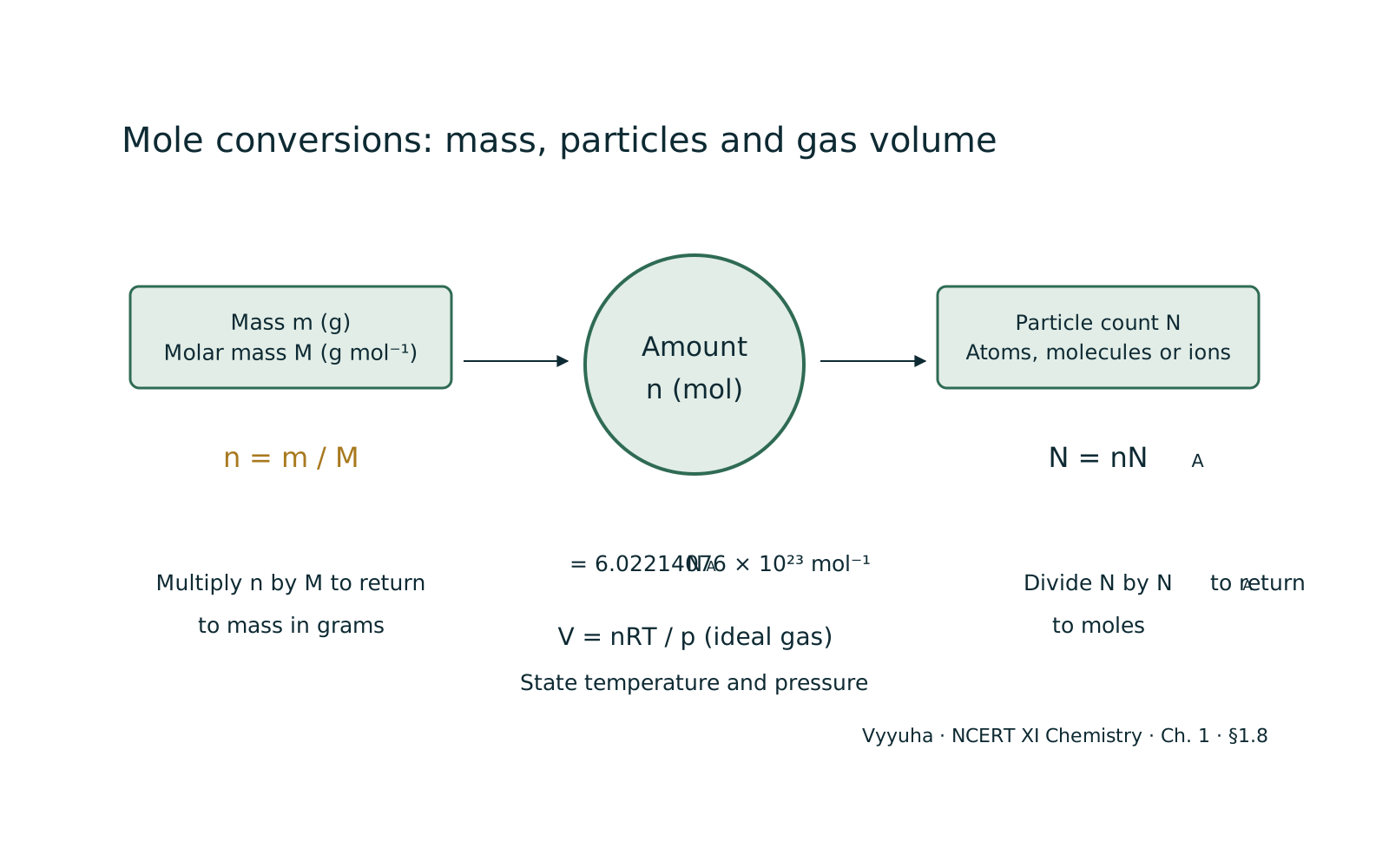
The mole concept allows us to interconvert between mass, moles, and the number of particles (atoms/molecules/ions) using simple formulas:
- Mass to Moles:
- Moles to Number of Particles:
- Number of Particles to Moles:
- Moles to Volume of Gas (at STP):
- Volume of Gas to Moles (at STP):
These relationships form the cornerstone for all quantitative chemical calculations. For example, if you have 49 grams of (molar mass = 98 ):
- Moles of
- Number of molecules = molecules
- Number of atoms = atoms
Real-World Applications
The mole concept is not just an academic exercise; it's vital for:
- Stoichiometry: — Calculating the exact amounts of reactants needed and products formed in chemical reactions, crucial for industrial chemical processes.
- Solution Chemistry: — Determining concentrations (molarity, molality) of solutions, essential in biochemistry, medicine, and environmental science.
- Gas Laws: — Relating the amount of gas to its pressure, volume, and temperature (e.g., Ideal Gas Law: ).
- Analytical Chemistry: — Quantifying substances in samples, such as in forensic analysis or quality control.
- Pharmacy: — Formulating precise dosages for medications.
Common Misconceptions
- Confusing Atomic Mass with Molar Mass: — Atomic mass is the mass of a single atom (or average of isotopes) in amu. Molar mass is the mass of one mole of atoms/molecules in grams. While numerically similar, their units and conceptual meanings are distinct.
- Misinterpreting Avogadro's Number: — It's not just for atoms; it applies to any elementary entity specified. One mole of electrons, one mole of protons, one mole of chairs – all contain of those entities.
- Incorrectly Applying Molar Volume: — The 22.4 L/mol rule is strictly for ideal gases at STP (, 1 atm). It does not apply to liquids, solids, or gases at different conditions without using the Ideal Gas Law.
- Unit Errors: — Forgetting to convert units (e.g., milligrams to grams, milliliters to liters) before applying formulas.
- Stoichiometric Coefficients: — Not using the coefficients from balanced chemical equations when calculating moles of reactants/products in a reaction.
NEET-Specific Angle
For NEET aspirants, a strong grasp of the mole concept is non-negotiable. It forms the bedrock for almost all quantitative problems in physical chemistry. Questions often involve:
- Direct calculations: — Converting between mass, moles, number of particles, and gas volume.
- Stoichiometric calculations: — Using mole ratios from balanced equations to find amounts of reactants/products.
- Percentage composition and empirical/molecular formula determination: — Calculating the relative amounts of elements in a compound.
- Limiting reagent problems: — Identifying the reactant that gets consumed first and determines the maximum amount of product.
- Concentration terms: — Molarity, molality, mole fraction, mass percentage, which all rely on the mole concept.
- Integrated problems: — Combining mole concept with gas laws, solution stoichiometry, or even redox reactions.
Speed and accuracy are key. Practice dimensional analysis to ensure units cancel correctly. Memorize Avogadro's number and common atomic masses (H, C, N, O, Na, S, Cl, K, Ca, Fe). Understand the 'mole map' – the interconnections between mass, moles, particles, and volume – to navigate complex problems efficiently.
Key Concepts
The mole concept acts as a crucial bridge connecting the macroscopic world (measurable quantities like mass…
To find the molar mass of a compound, you sum the atomic masses of all the atoms present in its chemical…
For ideal gases, the mole concept provides a direct link to volume. At Standard Temperature and Pressure…
Often confused with
Side-by-side differences the NEET paper likes to test.
| Aspect | Mole Concept and Molar Mass | Atomic Mass vs. Molar Mass |
|---|---|---|
| Definition | Atomic Mass: The mass of a single atom of an element. | Molar Mass: The mass of one mole ($6.022 \times 10^{23}$) of atoms or molecules of a substance. |
| Units | Atomic Mass: Expressed in atomic mass units (amu). | Molar Mass: Expressed in grams per mole ($\text{g/mol}$). For compounds, it's also called gram molecular mass. |
| Scale | Atomic Mass: Microscopic scale, refers to individual particles. | Molar Mass: Macroscopic scale, refers to a measurable quantity of substance. |
| Numerical Value | Atomic Mass: For an element, it's the weighted average of isotopic masses. | Molar Mass: Numerically equal to the atomic mass (for elements) or molecular mass (for compounds). |
| Application | Atomic Mass: Used in theoretical calculations of individual particle masses. | Molar Mass: Used in practical laboratory calculations, stoichiometry, and solution preparation. |
While atomic mass and molar mass share the same numerical value for a given substance, they represent fundamentally different concepts and scales. Atomic mass quantifies the mass of a single, incredibly tiny atom in amu, a unit designed for the subatomic realm.
Molar mass, conversely, quantifies the mass of a vast collection of these atoms or molecules (one mole) in grams, a unit suitable for laboratory measurements. Understanding this distinction is crucial to avoid conceptual errors in chemical calculations, especially when converting between the number of particles and bulk mass.
Why it is tested: NEET relevance: This distinction is frequently tested in conceptual questions and is foundational for solving numerical problems involving mass-to-mole conversions. Misunderstanding this can lead to incorrect unit usage and calculation errors in stoichiometry.
Questions students ask
5 answered on this topic.
What is the primary difference between atomic mass and molar mass?
Atomic mass refers to the mass of a single atom, typically expressed in atomic mass units (amu). For example, the atomic mass of carbon is approximately 12 amu. Molar mass, on the other hand, is the mass of one mole ($6.
022 \times 10^{23}\text{g/mol}$). While the numerical value is often the same (e.g., 12 for carbon), the units and the scale are vastly different.
Atomic mass deals with individual particles, while molar mass deals with a macroscopic collection of particles.
Why is Avogadro's number so specific ($6.022 \times 10^{23}$)? Why not a simpler number?
Avogadro's number isn't an arbitrarily chosen simple number. It's defined such that the mass of one mole of a substance, in grams, is numerically equal to its atomic or molecular mass in atomic mass units (amu).
This definition was historically tied to the mass of 12 grams of the carbon-12 isotope. The specific value arises from experimental measurements that precisely determined how many atoms are in 12 grams of carbon-12.
It's a consequence of this fundamental definition, making it a bridge between the atomic mass scale and the gram scale.
Does the molar volume of 22.4 L at STP apply to all substances, including liquids and solids?
No, the molar volume of 22.4 L at STP (, 1 atm) is specifically applicable only to ideal gases. It does not apply to liquids or solids because their particles are much closer together and interact significantly, leading to much smaller and substance-specific molar volumes. Even for real gases, 22.4 L is an approximation, though often accurate enough for NEET problems. For gases at conditions other than STP, the ideal gas law () must be used to calculate volume.
How do I calculate the number of atoms in a given mass of a compound?
To calculate the number of atoms in a given mass of a compound, you need to follow a few steps. First, convert the given mass of the compound to moles using its molar mass. Second, multiply the moles of the compound by Avogadro's number () to get the number of molecules of the compound.
Finally, multiply the number of molecules by the number of atoms of the specific element present in one molecule of the compound. For example, in , there are 2 hydrogen atoms per molecule.
What is the significance of the mole concept in stoichiometry?
The mole concept is the backbone of stoichiometry. Chemical reactions occur in definite proportions of atoms and molecules. A balanced chemical equation provides these proportions in terms of moles. For instance, means 2 moles of hydrogen react with 1 mole of oxygen to produce 2 moles of water.
By converting given masses of reactants or products into moles, we can use these mole ratios to predict the amount of other substances involved in the reaction, making quantitative predictions possible.
Revise in 30 seconds
- Mole (n): — Amount of substance,
- Avogadro's Number ($N_A$): — entities/mol
- Number of Particles: —
- Molar Mass (M): — Mass of 1 mole, numerically equal to atomic/molecular mass in amu, unit g/mol.
- Molar Volume (Gases at STP): — 22.4 L/mol (at , 1 atm)
- Volume of Gas (STP): —
- Key Interconversions: — Mass Moles Number of Particles Volume of Gas (STP)
To remember the mole map and its connections:
Many Moles Need Volume
- Mass Moles (using Molar Mass)
- Moles Number of Particles (using Avogadro's Number)
- Number of Particles Volume (for gases at STP, via Moles)