Atomic and Molecular Masses
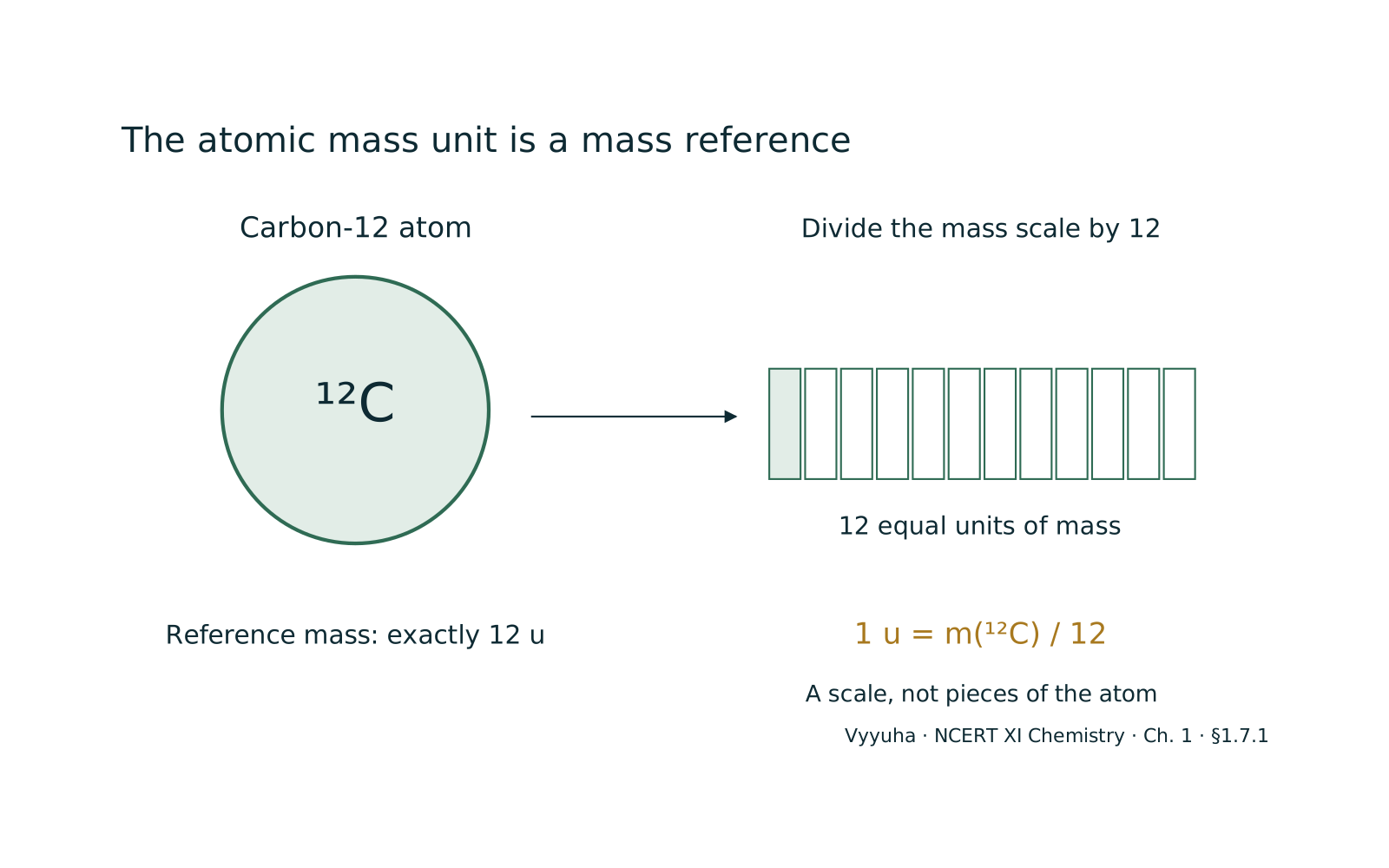
Atomic mass refers to the mass of an atom, typically expressed in atomic mass units (amu or u). Historically, atomic masses were determined relative to hydrogen, then oxygen, and are now standardized against carbon-12. One atomic mass unit is defined as exactly one-twelfth (1/12) the mass of an atom of carbon-12 isotope. Molecular mass, on the other hand, is the sum of the atomic masses of all the…
Quick Summary
Atomic and molecular masses are fundamental concepts in chemistry, providing a quantitative basis for understanding matter. Atomic mass refers to the mass of a single atom, expressed in atomic mass units (amu or u).
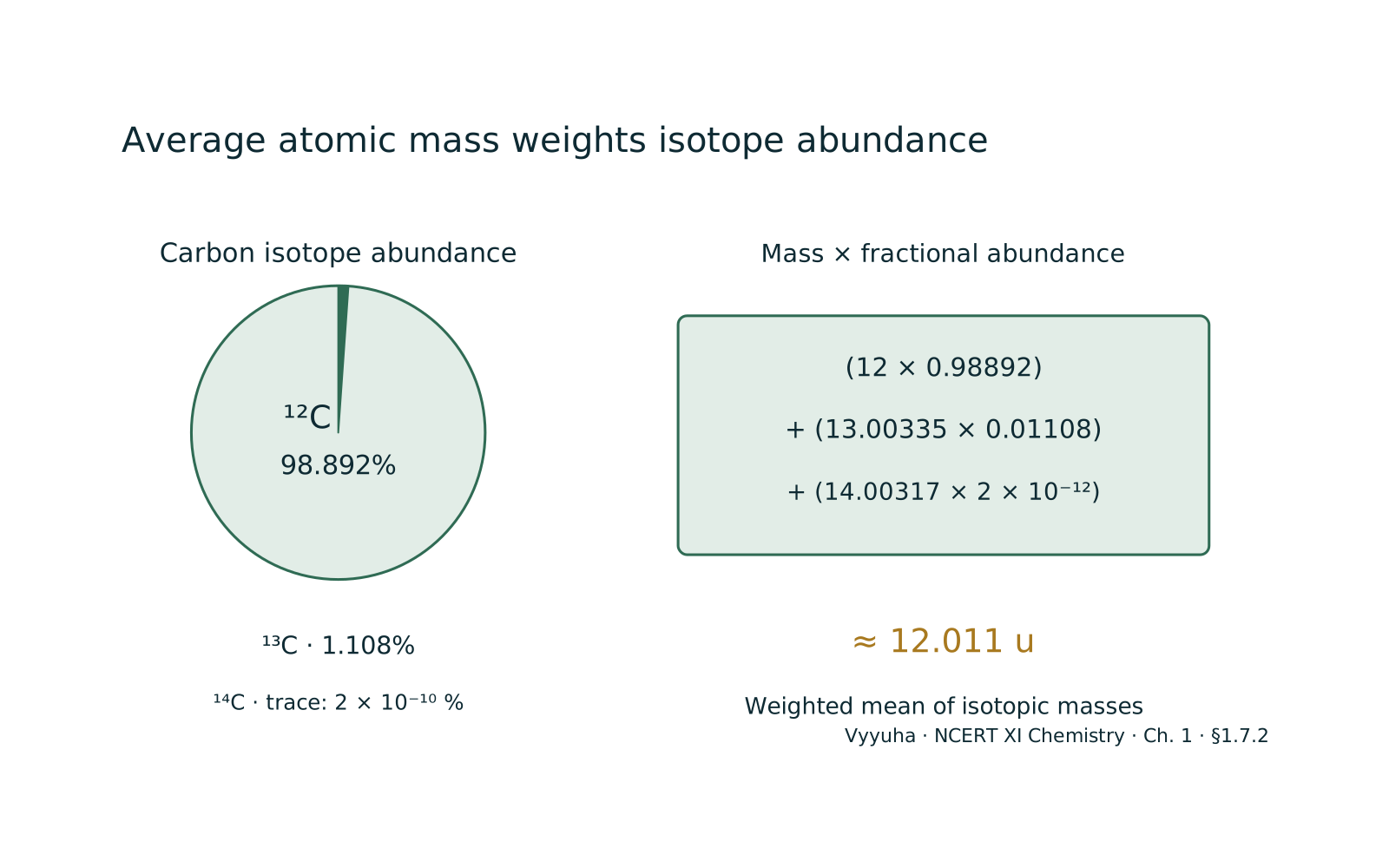
One amu is defined as exactly 1/12th the mass of a carbon-12 atom. The average atomic mass of an element, found on the periodic table, is a weighted average of the masses of its naturally occurring isotopes, considering their relative abundances.
This accounts for the decimal values seen for most elements.
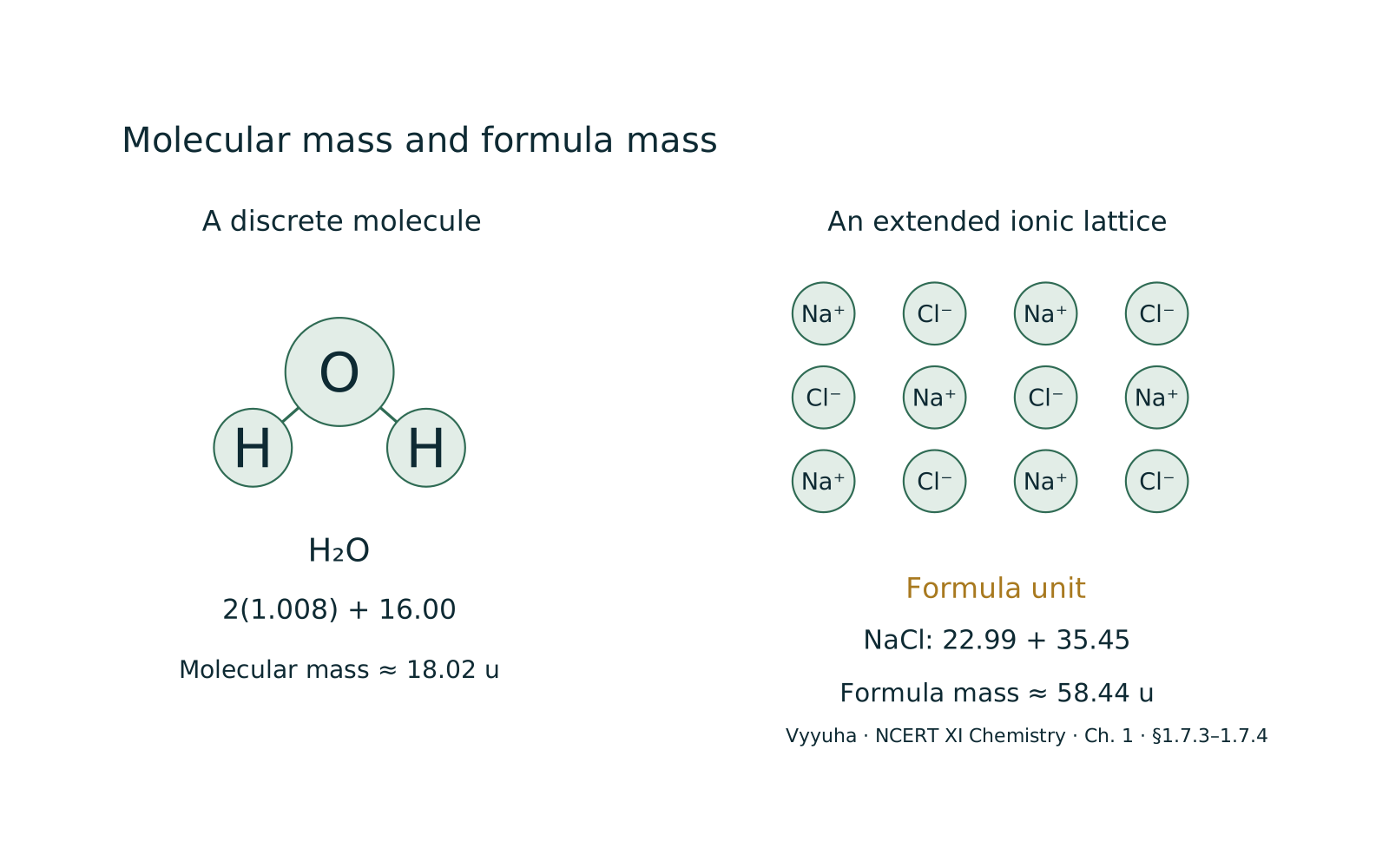
Molecular mass is the sum of the atomic masses of all atoms in a molecule. For example, water () has a molecular mass calculated by adding the atomic masses of two hydrogen atoms and one oxygen atom.
For ionic compounds, which form crystal lattices rather than discrete molecules, the term 'formula mass' is used, calculated similarly by summing the atomic masses in the empirical formula. These masses are crucial for the mole concept, allowing conversion between mass and the number of particles, which is essential for all stoichiometric calculations in chemistry.
Full explanation
The concepts of atomic and molecular masses are foundational to quantitative chemistry, providing the bridge between the microscopic world of atoms and molecules and the macroscopic world of measurable quantities. Understanding these masses is essential for stoichiometry, mole concept, and predicting reaction yields.
Conceptual Foundation: The Atomic Mass Unit (amu)
Atoms are incredibly small, with masses on the order of grams. Working with such minuscule numbers is cumbersome. To simplify these measurements, scientists developed a relative scale for atomic masses. Initially, hydrogen, the lightest element, was assigned a mass of 1. Later, oxygen was used as a reference. However, the modern and internationally accepted standard, established in 1961, is based on the carbon-12 isotope.
Definition of Atomic Mass Unit (amu or u): One atomic mass unit (1 amu or 1 u) is defined as exactly one-twelfth (1/12) the mass of an atom of carbon-12 isotope. The carbon-12 atom is chosen because it is abundant, stable, and its mass can be determined with high precision using mass spectrometry.
Mathematically, . Experimentally, the mass of one atom is approximately . Therefore, .
This definition allows us to express the mass of any atom relative to the carbon-12 standard. For example, a hydrogen atom has a mass of approximately 1.008 u, meaning it is about 1.008 times heavier than 1/12th of a carbon-12 atom.
Key Principles and Calculations:
- Relative Atomic Mass: — This is the ratio of the average mass of an atom of an element to one-twelfth of the mass of a carbon-12 atom. Since it's a ratio of masses, it is a dimensionless quantity, but it's often expressed with the unit 'u' for convenience, indicating the mass on the atomic mass scale. The relative atomic mass of an element is the value typically found in the periodic table.
- Average Atomic Mass: — Most elements in nature exist as a mixture of two or more isotopes. Isotopes are atoms of the same element that have the same number of protons but different numbers of neutrons, leading to different atomic masses. The atomic mass listed in the periodic table for an element is the average atomic mass, which is a weighted average of the atomic masses of all its naturally occurring isotopes, considering their relative abundances.
Derivation of Average Atomic Mass:
If an element has isotopes with atomic masses and their respective natural abundances are (expressed as fractions or percentages), then the average atomic mass () is calculated as:
Example: Chlorine has two main isotopes: with an atomic mass of 34.9689 u and an abundance of 75.77%, and with an atomic mass of 36.9659 u and an abundance of 24.23%. Average atomic mass of Cl = . This value (approximately 35.45 u) is what you find on the periodic table.
- Molecular Mass: — For substances that exist as discrete molecules (e.g., , , ), the molecular mass is the sum of the atomic masses of all the atoms present in one molecule. It is also expressed in atomic mass units (u).
Calculation Steps: a. Identify the chemical formula of the molecule. b. List the number of atoms of each element present. c. Look up the average atomic mass of each element from the periodic table. d. Multiply the atomic mass of each element by the number of its atoms in the molecule. e. Sum up these products to get the molecular mass.
*Example: Molecular mass of Glucose ()* Atomic mass of C = 12.011 u Atomic mass of H = 1.008 u Atomic mass of O = 15.999 u
Molecular mass of .
- Formula Mass: — This term is used for ionic compounds (e.g., , ) or other substances that do not exist as discrete molecules but rather as a network of ions or atoms in a crystal lattice. Since there isn't a single 'molecule', we refer to the 'formula unit' (the simplest whole-number ratio of ions in the compound). The formula mass is calculated in the same way as molecular mass: by summing the atomic masses of all the atoms in the empirical formula.
*Example: Formula mass of Sodium Chloride ()* Atomic mass of Na = 22.990 u Atomic mass of Cl = 35.453 u
Formula mass of .
Real-World Applications:
- Stoichiometry: — Atomic and molecular masses are fundamental for stoichiometric calculations. They allow chemists to convert between the mass of a substance and the number of moles, and subsequently, the number of atoms or molecules. This is critical for predicting the amount of reactants needed and products formed in a chemical reaction.
- Chemical Analysis: — Techniques like mass spectrometry directly measure the mass-to-charge ratio of ions, which helps in determining the atomic and molecular masses of unknown compounds, identifying isotopes, and elucidating molecular structures.
- Drug Discovery and Development: — Precise molecular mass determination is crucial for synthesizing new drugs, ensuring purity, and characterizing their properties.
- Environmental Monitoring: — Measuring the molecular masses of pollutants helps in identifying their chemical nature and sources.
- Material Science: — Understanding the atomic masses of constituent elements is vital for designing materials with specific properties.
Common Misconceptions:
- Atomic Mass vs. Mass Number:
* Atomic Mass: The actual mass of an atom (or average mass of an element's atoms), expressed in u. It's a precise value, often with decimals, reflecting isotopic abundances. * Mass Number (A): The total number of protons and neutrons in the nucleus of a specific isotope of an atom.
It is always a whole number (e.g., carbon-12 has a mass number of 12). It's an integer count, not a mass measurement. While the mass number is numerically close to the atomic mass of a single isotope, they are distinct concepts.
- Molecular Mass vs. Molar Mass:
* Molecular Mass: The mass of one molecule of a substance, expressed in atomic mass units (u). * Molar Mass: The mass of one mole of a substance, expressed in grams per mole (g/mol). Numerically, the molecular mass in 'u' is equal to the molar mass in 'g/mol'. For example, the molecular mass of is 18.015 u, and its molar mass is 18.015 g/mol. This numerical equivalence is a direct consequence of the definition of the mole and Avogadro's number.
- Atomic Mass vs. Weight: — Mass is a measure of the amount of matter in an object, while weight is a measure of the force of gravity on that object. In chemistry, we almost exclusively deal with mass.
NEET-Specific Angle:
For NEET aspirants, a solid understanding of atomic and molecular masses is non-negotiable. This topic serves as the bedrock for the entire 'Some Basic Concepts of Chemistry' chapter and subsequent quantitative topics. Questions frequently appear in the following forms:
- Direct Calculation: — Calculating average atomic mass given isotopic abundances, or molecular/formula mass given atomic masses.
- Conceptual Understanding: — Distinguishing between atomic mass, mass number, molecular mass, and molar mass.
- Application in Stoichiometry: — Using these masses to convert between grams and moles, and then to calculate quantities of reactants or products in chemical reactions. This is where the concepts truly integrate with the mole concept.
- Identifying Correct Definitions: — Questions testing the definition of amu or the method for calculating average atomic mass.
Mastering these concepts ensures a strong foundation for solving numerical problems in physical chemistry, which often involve multiple steps building upon these fundamental mass calculations.
Key Concepts
The average atomic mass accounts for the natural abundance of an element's isotopes. Since most elements are…
Calculating molecular mass involves summing the atomic masses of all atoms present in a molecule. This…
For ionic compounds, which form extended lattices rather than discrete molecules, the term 'formula mass' is…
Often confused with
Side-by-side differences the NEET paper likes to test.
| Aspect | Atomic and Molecular Masses | Molecular Mass |
|---|---|---|
| Definition | The mass of a single atom of an element, expressed in atomic mass units (u). For elements with isotopes, it refers to the average atomic mass. | The sum of the atomic masses of all the atoms present in a single molecule of a substance, expressed in atomic mass units (u). |
| Applicability | Applies to individual atoms or elements (as an average). | Applies to substances that exist as discrete molecules (e.g., $H_2O$, $CO_2$, $C_6H_{12}O_6$). |
| Calculation Basis | Based on the mass of a single atom or the weighted average of isotopic masses. | Based on the sum of atomic masses of constituent atoms in the molecular formula. |
| Example | Atomic mass of Oxygen = 15.999 u | Molecular mass of $O_2 = 2 \times 15.999,u = 31.998,u$ |
Atomic mass refers to the mass of a single atom or the weighted average mass of an element's isotopes, while molecular mass is the total mass of all atoms within a discrete molecule. Atomic mass is a fundamental property of an element, whereas molecular mass is a property of a compound formed by specific atoms bonded together. Both are expressed in atomic mass units (u) and are crucial for quantitative chemical calculations, particularly in converting between mass and moles.
Why it is tested: For NEET, understanding the distinction is vital for correctly calculating molar masses of elements versus compounds, which is a common step in stoichiometry problems. Misinterpreting these can lead to errors in mole calculations and subsequent reaction yield predictions.
Questions students ask
6 answered on this topic.
What is the significance of the carbon-12 isotope as the standard for atomic mass?
The carbon-12 isotope was chosen as the international standard for atomic mass because it is abundant, stable, and its mass can be determined with high precision using mass spectrometry. Defining 1 amu as exactly 1/12th the mass of a carbon-12 atom provides a consistent and universally accepted reference point.
This standardization ensures that atomic masses measured by different scientists in different parts of the world are comparable and accurate, forming a reliable basis for all quantitative chemical calculations.
How does average atomic mass differ from the mass number of an isotope?
Average atomic mass is the weighted average of the masses of all naturally occurring isotopes of an element, taking into account their relative abundances. It is typically a decimal value found on the periodic table.
The mass number, on the other hand, is a whole number representing the total count of protons and neutrons in the nucleus of a specific isotope. For example, carbon has an average atomic mass of 12.011 u, but the carbon-12 isotope has a mass number of 12, and the carbon-13 isotope has a mass number of 13.
Why do we use 'formula mass' for ionic compounds instead of 'molecular mass'?
Ionic compounds, such as sodium chloride (NaCl), do not exist as discrete, individual molecules. Instead, they form extended crystal lattices where each ion is surrounded by multiple ions of opposite charge.
There isn't a distinct 'molecule' to measure. Therefore, we use 'formula mass' to represent the sum of the atomic masses of the ions in the empirical formula, which represents the simplest whole-number ratio of ions in the compound.
The calculation method is identical to molecular mass, but the terminology reflects the structural difference.
Is atomic mass the same as atomic weight?
While often used interchangeably in general conversation, in scientific terms, 'mass' and 'weight' are distinct. Mass is an intrinsic property of an object, representing the amount of matter it contains, and is constant regardless of location.
Weight, however, is the force exerted on an object due to gravity, and thus varies with gravitational field strength. In chemistry, when we refer to 'atomic mass' or 'molecular mass', we are strictly talking about the mass of atoms or molecules, not their weight.
The term 'atomic weight' is an older, less precise term for average atomic mass.
How are atomic and molecular masses related to the mole concept?
Atomic and molecular masses are directly linked to the mole concept. The numerical value of an element's atomic mass in atomic mass units (u) is numerically equal to its molar mass in grams per mole (g/mol).
Similarly, the numerical value of a molecule's molecular mass in u is equal to its molar mass in g/mol. This relationship is crucial because it allows us to convert between the mass of a substance (measurable in grams) and the number of moles, which directly corresponds to a specific number of particles (Avogadro's number, $6.
022 \times 10^{23}$). This conversion is the cornerstone of all stoichiometric calculations.
Can atomic mass be a non-integer value?
Yes, the average atomic mass of an element, as found on the periodic table, is almost always a non-integer (decimal) value. This is because most elements exist as a mixture of several isotopes, each with its own unique atomic mass (which is very close to a whole number, but not exactly, due to mass defect).
The average atomic mass is a weighted average of these isotopic masses, taking into account their natural abundances. Only for elements that exist as a single, naturally occurring isotope (like Fluorine, ) or for specific isotopes, would the atomic mass be very close to a whole number.
Revise in 30 seconds
- Atomic Mass Unit (amu or u): — .
- Average Atomic Mass: — .
- Molecular Mass: — Sum of atomic masses of all atoms in a molecule (for covalent compounds).
- Formula Mass: — Sum of atomic masses of atoms in the empirical formula (for ionic compounds).
- Relationship: — Numerical value of atomic/molecular mass in 'u' is equal to molar mass in 'g/mol'.
- Key Distinction: — Atomic Mass (u) vs. Mass Number (integer, count of protons + neutrons).
All Molecules Undergo Calculations 12 times. (Atomic Mass Unit: Carbon-12 standard, 1/12th mass)