Law of Conservation of Mass — Explained
Detailed Explanation
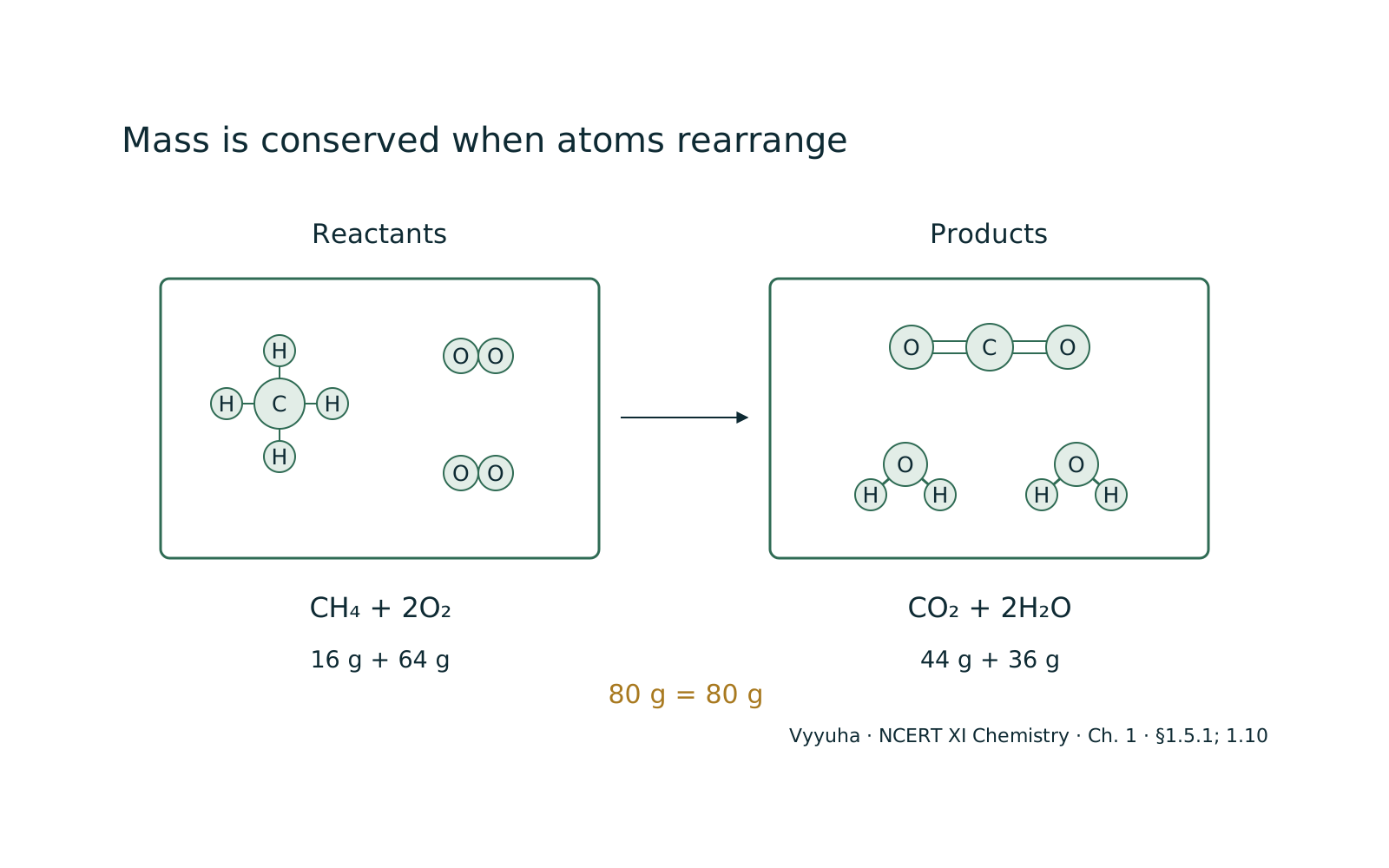
The Law of Conservation of Mass is one of the most fundamental principles in chemistry, serving as a bedrock for understanding chemical reactions and stoichiometry. At its core, it asserts that matter can neither be created nor destroyed in an isolated chemical system. Instead, during a chemical transformation, atoms are merely rearranged to form new substances, but their total number and identity, and consequently their total mass, remain constant.
1. Conceptual Foundation and Historical Context:
Before the late 18th century, chemistry was largely qualitative, with many alchemical notions still prevalent. The concept of mass conservation was implicitly understood by some, but it was Antoine Lavoisier, often regarded as the 'Father of Modern Chemistry,' who rigorously established this law through meticulous quantitative experiments. Lavoisier's work was revolutionary because he emphasized precise measurements, particularly weighing reactants and products in sealed vessels.
One of his most famous experiments involved heating mercury(II) oxide () in a sealed retort. He observed that upon heating, the red mercury(II) oxide decomposed into silvery liquid mercury () and a gas, which he identified as oxygen ().
Crucially, he found that the total mass of the mercury and oxygen produced was exactly equal to the initial mass of the mercury(II) oxide. When he then recombined the mercury and oxygen, he reformed mercury(II) oxide, and again, the mass was conserved.
This quantitative evidence directly contradicted the phlogiston theory, which proposed that a substance called 'phlogiston' was released during combustion, leading to a loss of mass.
Lavoisier's precise measurements and the formulation of the Law of Conservation of Mass provided a rational framework for understanding chemical changes, moving chemistry from a descriptive art to a quantitative science. It laid the groundwork for the atomic theory proposed by John Dalton, which further solidified the idea that atoms are indivisible and merely rearrange during reactions.
2. Key Principles and Implications:
- Atomic Rearrangement: — The law implies that chemical reactions involve the breaking and forming of chemical bonds, leading to a rearrangement of atoms. The atoms themselves are not destroyed or created; they simply change their partners.
- Balancing Chemical Equations: — This law is the fundamental reason why chemical equations must be balanced. A balanced chemical equation ensures that the number of atoms of each element on the reactant side (left) is equal to the number of atoms of that same element on the product side (right). For example, in the reaction of hydrogen with oxygen to form water:
Here, there are 4 hydrogen atoms and 2 oxygen atoms on both sides of the equation, thus conserving mass.
- Stoichiometry: — The law is central to stoichiometry, the branch of chemistry that deals with the quantitative relationships between reactants and products in chemical reactions. It allows chemists to predict the amount of product that can be formed from a given amount of reactant, or vice versa.
- Closed Systems: — The law strictly applies to 'closed systems,' where no matter can enter or leave the system. In an open system, if gaseous products escape or reactants from the surroundings are consumed, the apparent mass of the system might change, but the total mass of all participating substances (including those that escaped or were consumed) would still be conserved.
3. Derivations (Conceptual):
The Law of Conservation of Mass is not 'derived' in the mathematical sense from more fundamental principles within classical chemistry; rather, it's an empirical law based on experimental observation. However, it can be seen as a direct consequence of the atomic theory, which posits that atoms are fundamental, indivisible particles that retain their identity during chemical reactions. If atoms are conserved, and each atom has a specific mass, then the total mass must also be conserved.
4. Real-World Applications:
- Industrial Chemistry: — In manufacturing processes, understanding mass conservation is critical for optimizing yields, calculating raw material requirements, and managing waste. For instance, in the production of ammonia via the Haber process, chemists use this law to determine the exact amounts of nitrogen and hydrogen needed to produce a desired quantity of ammonia.
- Environmental Science: — When analyzing pollutants or biogeochemical cycles (like the carbon cycle), mass balance calculations are essential. For example, tracking the mass of carbon dioxide released into the atmosphere and its subsequent absorption by oceans and plants relies on the principle of mass conservation.
- Analytical Chemistry: — In quantitative analysis, such as gravimetric analysis, the mass of a precipitate is used to determine the concentration of an ion in a solution, directly applying the law.
- Everyday Life: — From baking (where the mass of ingredients contributes to the mass of the final product) to understanding why a rusting iron nail gains mass (it's reacting with oxygen from the air, which adds mass), the law is implicitly at play.
5. Common Misconceptions:
- Mass Loss in Open Systems: — A common misconception is that mass is lost during reactions like burning wood or dissolving an antacid tablet in water because the visible solid disappears or the ash weighs less. This ignores the gaseous products that escape into the atmosphere. If the system were closed, the total mass would remain constant.
- Confusion with Volume Conservation: — Students sometimes confuse mass conservation with volume conservation. Volume is generally not conserved in chemical reactions. For example, mixing two liquids might result in a solution with a volume slightly different from the sum of the individual liquid volumes due to intermolecular interactions.
- Nuclear Reactions: — The Law of Conservation of Mass, as formulated by Lavoisier, applies strictly to chemical reactions. In nuclear reactions (like fission or fusion), a small but significant amount of mass is converted into energy, as described by Einstein's famous equation . This means that the total mass of the products in a nuclear reaction is slightly less than the total mass of the reactants. However, if we consider the conservation of mass-energy, then the principle holds true even for nuclear processes. For NEET UG, unless specified, the law refers to chemical reactions.
6. NEET-Specific Angle:
For NEET aspirants, the Law of Conservation of Mass is not just a theoretical concept; it's a practical tool. Questions often involve:
- Stoichiometric Calculations: — Calculating the mass of a reactant consumed or a product formed given the mass of another substance in a balanced chemical equation. This requires a solid understanding of mole concept and molar masses.
- Balancing Chemical Equations: — While not always directly asked as 'balance this equation,' many problems implicitly require a balanced equation to perform calculations correctly.
- Conceptual Questions: — Understanding the conditions under which the law applies (closed system) and its implications (atomic rearrangement, not creation/destruction of matter).
- Identifying Errors: — Analyzing experimental setups where mass might appear to be lost or gained and explaining why (e.g., open vs. closed systems, involvement of atmospheric gases).
Mastering this law is crucial for building a strong foundation in stoichiometry, which is a high-weightage topic in NEET chemistry. It connects directly to the mole concept, limiting reagents, and concentration terms, making it an indispensable tool for solving a wide range of problems.
Often confused with
Side-by-side differences the NEET paper likes to test.
| Aspect | Law of Conservation of Mass | Law of Definite Proportions and Law of Multiple Proportions |
|---|---|---|
| Core Principle | Law of Conservation of Mass: Total mass of reactants equals total mass of products in a closed system. | Law of Definite Proportions: A given chemical compound always contains its component elements in fixed ratio by mass. Law of Multiple Proportions: When two elements combine to form more than one compound, the masses of one element that combine with a fixed mass of the other are in ratios of small whole numbers. |
| Focus | Focuses on the total mass before and after a reaction. | Focuses on the composition of compounds (definite proportions) or the ratios of masses of elements forming multiple compounds (multiple proportions). |
| Application | Applies to all chemical reactions; fundamental for balancing equations and stoichiometry. | Applies to the composition of specific compounds (definite proportions) or sets of compounds formed by the same elements (multiple proportions). |
| Pioneer | Antoine Lavoisier | Joseph Proust (Definite Proportions), John Dalton (Multiple Proportions) |
| Underlying Concept | Atoms are neither created nor destroyed, only rearranged. | Atoms combine in fixed whole-number ratios to form compounds (Definite Proportions); atoms combine in different whole-number ratios to form different compounds (Multiple Proportions). |
While all three are fundamental Laws of Chemical Combination, the Law of Conservation of Mass addresses the overall mass balance in any chemical reaction, stating that mass is conserved. In contrast, the Law of Definite Proportions focuses on the constant elemental composition by mass within a specific compound, regardless of its source.
The Law of Multiple Proportions, on the other hand, explains the mass relationships when two elements form more than one compound, showing that the masses of one element combining with a fixed mass of the other are in simple whole-number ratios.
Together, these laws provide a comprehensive framework for understanding how matter behaves during chemical changes and forms compounds.
Why it is tested: NEET relevance: These laws form the bedrock of stoichiometry and the atomic theory. Questions often test the understanding of each law individually or require their combined application in problem-solving. A clear distinction between them is crucial for conceptual clarity and avoiding common pitfalls in numerical and theoretical questions related to chemical reactions and compound formation.
Questions students ask
6 answered on this topic.
What is the primary difference between the Law of Conservation of Mass and the Law of Conservation of Energy?
The Law of Conservation of Mass states that in a closed system, the total mass of reactants before a chemical reaction equals the total mass of products after the reaction. Mass is neither created nor destroyed.
The Law of Conservation of Energy states that energy can neither be created nor destroyed, but can only be transformed from one form to another. While distinct in classical physics and chemistry, Einstein's theory of relativity () unified them into the Law of Conservation of Mass-Energy, indicating that mass and energy are interconvertible, especially significant in nuclear reactions.
Does the Law of Conservation of Mass apply to nuclear reactions?
In its strict classical sense, as applied to chemical reactions, the Law of Conservation of Mass does not hold true for nuclear reactions. In nuclear processes like fission or fusion, a small but measurable amount of mass is converted into a very large amount of energy, or vice versa, according to Einstein's equation .
Therefore, the total mass of the products in a nuclear reaction is slightly less than the total mass of the reactants. However, the more encompassing principle, the Law of Conservation of Mass-Energy, does apply, stating that the total mass and energy combined remain constant.
Why does a burning candle appear to lose mass if the Law of Conservation of Mass is true?
A burning candle appears to lose mass because it is an open system. The candle wax (hydrocarbon) reacts with oxygen from the air (a reactant) to produce carbon dioxide and water vapor (gaseous products).
These gaseous products escape into the surroundings, so they are not weighed along with the remaining solid wax or soot. If the candle were burned in a sealed container, and all the gaseous products were collected and weighed along with any remaining solids, the total mass inside the container would remain constant.
How does the Law of Conservation of Mass relate to balancing chemical equations?
The Law of Conservation of Mass is the fundamental principle that necessitates balancing chemical equations. A balanced chemical equation ensures that the number of atoms of each element on the reactant side is exactly equal to the number of atoms of that same element on the product side.
Since each atom has a specific mass, conserving the number of atoms of each type automatically conserves the total mass of the substances involved in the reaction. It reflects the idea that atoms are merely rearranged, not created or destroyed.
Is it possible for the mass of a solution to be different from the sum of the masses of its components?
No, according to the Law of Conservation of Mass, the mass of a solution will always be equal to the sum of the masses of its components (solute and solvent), assuming no matter escapes or enters the system. For example, if you dissolve 10 grams of salt in 100 grams of water, the resulting salt solution will have a mass of 110 grams. While the volume might not be perfectly additive due to intermolecular interactions, the mass will always be conserved.
Who is credited with formulating the Law of Conservation of Mass?
The French chemist Antoine Lavoisier is widely credited with formulating and experimentally verifying the Law of Conservation of Mass in the late 18th century. Through meticulous quantitative experiments, particularly involving the combustion and decomposition of substances in sealed vessels, he demonstrated that the total mass of reactants always equals the total mass of products. His work was pivotal in transforming chemistry into a quantitative science.