Atomic Mass Unit — Explained
Detailed Explanation
The concept of atomic mass is fundamental to chemistry, providing a quantitative basis for understanding the composition of matter and the stoichiometry of chemical reactions. However, the absolute masses of individual atoms are extraordinarily small, making direct measurement and expression in conventional units like grams or kilograms impractical for routine chemical calculations. This challenge led to the development of a relative mass scale, anchored by the Atomic Mass Unit (amu).
Historical Context and Evolution of the Standard:
Early attempts to quantify atomic masses began with John Dalton in the early 19th century, who proposed that atoms of different elements have different characteristic masses. He initially assigned hydrogen a mass of 1 and expressed other atomic masses relative to it.
Later, oxygen-16 became a common reference point, with its mass set to 16. However, this led to two slightly different scales: one used by physicists (based on the mass of the most abundant isotope of oxygen, oxygen-16) and another by chemists (based on the average atomic mass of natural oxygen, which is a mixture of isotopes).
This discrepancy caused confusion and minor inconsistencies in calculations.
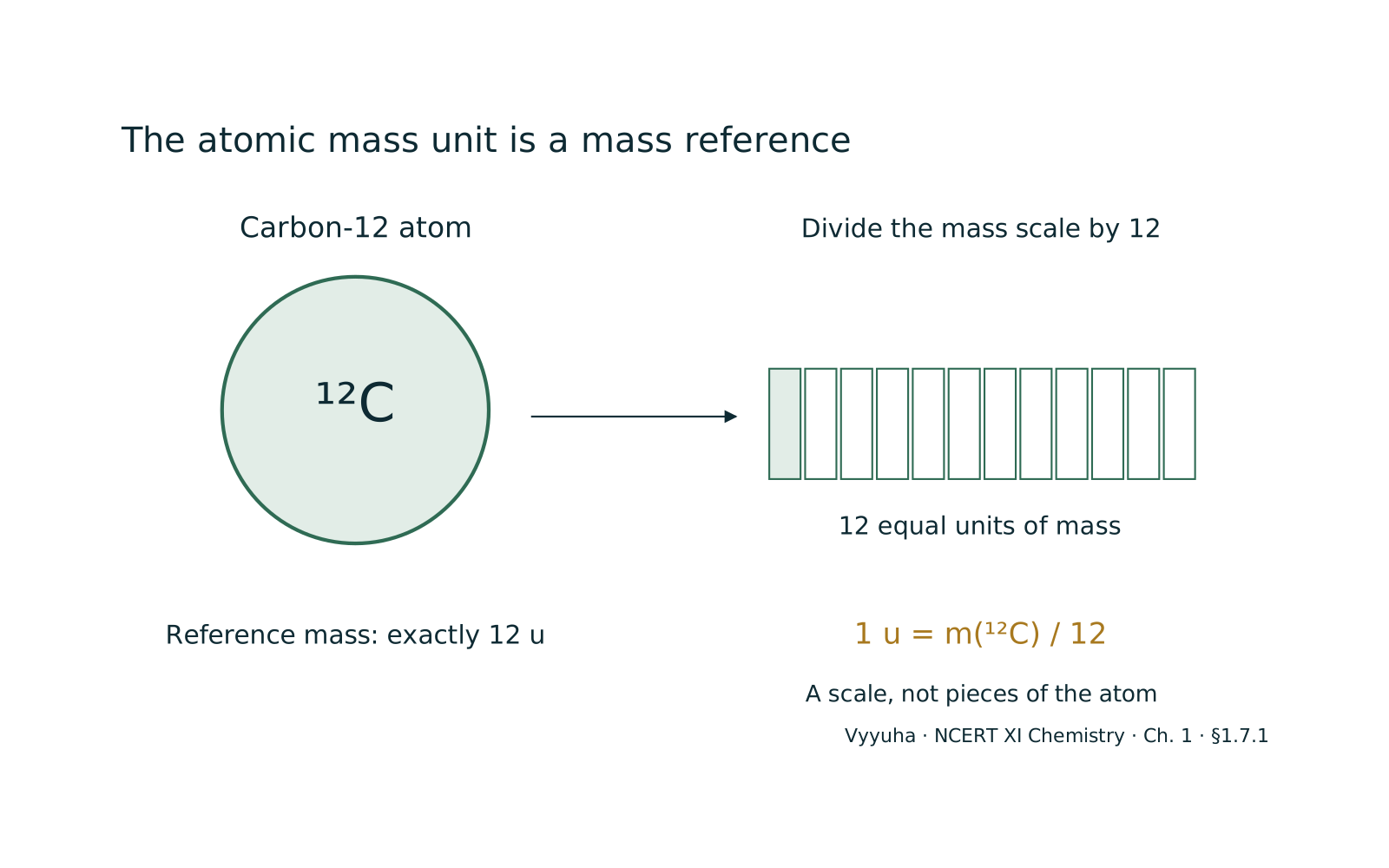
To resolve this, in 1961, the International Union of Pure and Applied Chemistry (IUPAC) and the International Union of Pure and Applied Physics (IUPAP) jointly adopted a unified atomic mass scale based on the carbon-12 isotope. This decision was largely driven by the high precision with which the mass of carbon-12 could be measured using mass spectrometry, its abundance, and its stability. The carbon-12 isotope has exactly 6 protons and 6 neutrons in its nucleus, and 6 electrons orbiting it.
Definition of the Atomic Mass Unit (amu):
The unified atomic mass unit (u), often still referred to as the atomic mass unit (amu) or sometimes the Dalton (Da), is defined as exactly one-twelfth (1/12) the mass of an unbound atom of carbon-12 in its nuclear and electronic ground state. Mathematically, this can be expressed as:
Conversion to Standard Units:
Through precise experimental measurements, particularly using mass spectrometry, the mass of a single carbon-12 atom has been determined. From this, the value of 1 amu in grams can be calculated: Mass of one Carbon-12 atom Therefore,
This conversion factor is crucial for relating the atomic scale to the macroscopic scale. It allows us to convert atomic masses expressed in amu to grams, which is essential when dealing with molar quantities.
Relationship with Avogadro's Number and Molar Mass:
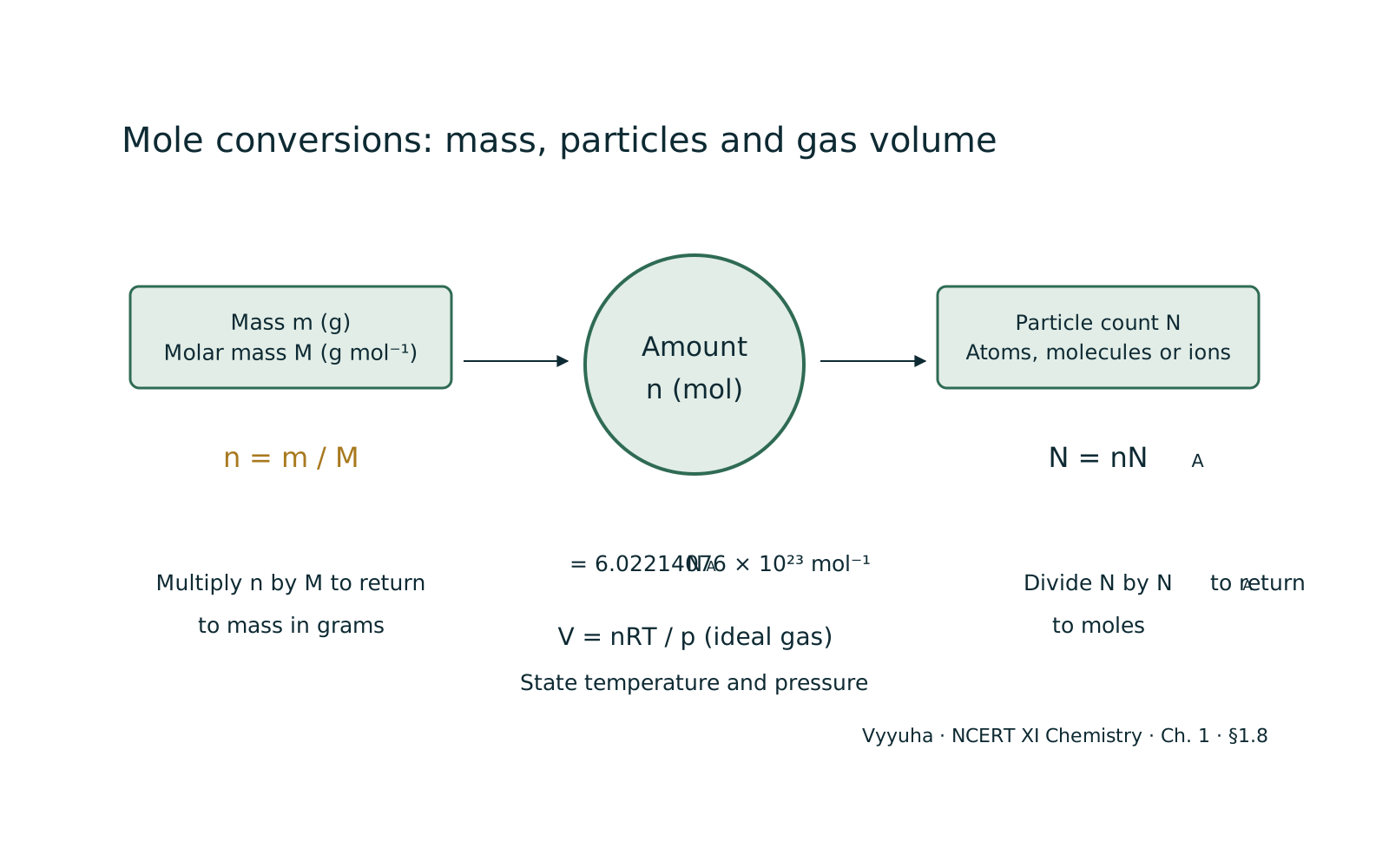
The definition of the mole is directly linked to the carbon-12 standard. One mole is defined as the amount of substance that contains as many elementary entities (atoms, molecules, ions, etc.) as there are atoms in exactly 12 grams of carbon-12. This number of entities is known as Avogadro's number (), which is approximately .
This elegant definition establishes a direct numerical equivalence between atomic mass in amu and molar mass in grams per mole. If an atom has an atomic mass of 'X' amu, then one mole of that atom will have a mass of 'X' grams. For example:
- Mass of one Carbon-12 atom = 12 amu
- Mass of one mole of Carbon-12 atoms = 12 g
This relationship arises because: Mass of 1 mole of atoms = (Mass of 1 atom) If the atomic mass is 'A' amu, then the mass of 1 atom = So, Mass of 1 mole of atoms = Substituting the value of 1 amu in grams: Mass of 1 mole of atoms = $A \times (1.
6605 \times 10^{-24},\text{g}) \times (6.022 \times 10^{23},\text{mol}^{-1})(1.6605 \times 10^{-24}) \times (6.022 \times 10^{23}) \approx 1\approx A,\text{g/mol}$ This numerical equivalence is incredibly convenient for chemical calculations, allowing chemists to easily transition between the atomic scale (amu) and the macroscopic scale (grams per mole).
Relative Atomic Mass vs. Absolute Atomic Mass:
- Absolute Atomic Mass: — This is the actual mass of a single atom, typically expressed in grams or kilograms. For instance, the absolute mass of a carbon-12 atom is approximately . These values are extremely small and not practical for everyday chemical calculations.
- Relative Atomic Mass: — This is the mass of an atom relative to the mass of the carbon-12 standard. It is a dimensionless quantity, but when expressed in amu, it indicates the mass in terms of the unified atomic mass unit. For example, the relative atomic mass of hydrogen is approximately 1.008, meaning a hydrogen atom is about 1.008 times heavier than 1/12th the mass of a carbon-12 atom. The values listed on the periodic table are typically relative atomic masses (or average atomic masses) expressed in amu.
Average Atomic Mass:
Most elements found in nature exist as a mixture of several isotopes, each with its own distinct mass number. The atomic masses listed on the periodic table are usually the average atomic masses of these elements.
This average is calculated by taking into account the masses of all naturally occurring isotopes and their relative abundances. For example, chlorine exists as two main isotopes: chlorine-35 (approx. 75% abundance) and chlorine-37 (approx.
25% abundance). Its average atomic mass is calculated as: Average atomic mass of Cl = $(34.96885\,\text{amu} \times 0.7577) + (36.96590\,\text{amu} \times 0.2423) \approx 35.
Applications in Chemistry:
- Atomic Mass Determination: — The primary use of amu is to express the masses of individual atoms. The atomic mass of an element, as found on the periodic table, is typically given in amu.
- Molecular Mass Calculation: — For molecules, the molecular mass is the sum of the atomic masses of all atoms present in the molecule. For example, the molecular mass of water () is .
- Formula Mass Calculation: — For ionic compounds, which do not exist as discrete molecules but rather as a lattice, the term 'formula mass' is used. It is calculated similarly to molecular mass, by summing the atomic masses of the ions in the empirical formula unit. For example, the formula mass of NaCl is .
- Stoichiometry: — The numerical equivalence between amu and g/mol allows for straightforward conversion between the mass of a substance and the number of moles, which is central to all stoichiometric calculations in chemistry.
Common Misconceptions:
- AMU is the same as gram: — While related, 1 amu is an extremely small fraction of a gram (). They are different units for different scales.
- Atomic mass is always an integer: — Only for specific isotopes (like carbon-12, which is exactly 12 amu by definition) is the mass an integer. Due to the mass defect (binding energy) and the existence of isotopes with varying abundances, most atomic masses on the periodic table are not exact integers.
- AMU is a measure of weight: — AMU measures mass, which is an intrinsic property of matter, not weight, which is a force due to gravity.
In summary, the Atomic Mass Unit is an indispensable tool in chemistry, providing a practical and consistent way to quantify the masses of atoms and molecules, bridging the gap between the submicroscopic world of atoms and the macroscopic world of laboratory measurements.
Often confused with
Side-by-side differences the NEET paper likes to test.
| Aspect | Atomic Mass Unit | Absolute Atomic Mass |
|---|---|---|
| Definition | A standard unit of mass defined as 1/12th the mass of a carbon-12 atom. It's a relative unit. | The actual mass of a single atom of a specific isotope, expressed in standard mass units like grams or kilograms. |
| Units | Atomic Mass Unit (amu or u), or Dalton (Da). | Grams (g) or Kilograms (kg). |
| Magnitude | A very small, convenient unit for atomic scale. $1\,\text{amu} \approx 1.6605 \times 10^{-24},\text{g}$. | Extremely small numbers when expressed in grams (e.g., $10^{-23},\text{g}$ to $10^{-22},\text{g}$). Less practical for calculations. |
| Purpose | To provide a relative scale for comparing atomic and molecular masses easily, and to link to molar mass. | To represent the true, intrinsic mass of an individual atom, used in highly precise physics calculations. |
| Periodic Table Value | Atomic masses on the periodic table are typically given in amu (or are numerically equivalent to g/mol). | Not directly listed on the periodic table; requires conversion from amu using Avogadro's number and the amu-to-gram conversion factor. |
The Atomic Mass Unit (amu) provides a relative and convenient scale for expressing the masses of atoms and molecules, simplifying chemical calculations by avoiding extremely small numbers. It is defined relative to carbon-12 and is numerically equivalent to molar mass in g/mol.
In contrast, absolute atomic mass refers to the actual, intrinsic mass of a single atom, typically expressed in grams or kilograms. While absolute mass is the true physical quantity, amu offers a practical and widely used relative measure in chemistry, bridging the atomic and macroscopic scales.
Why it is tested: For NEET, understanding the distinction is crucial for conceptual clarity and for solving problems involving conversions between the mass of a single atom and molar mass. Questions often test the ability to convert between amu and grams, or to relate atomic mass in amu to the mass of a mole of atoms.
Questions students ask
6 answered on this topic.
Why was Carbon-12 chosen as the standard for the atomic mass unit?
Carbon-12 was chosen as the standard for the atomic mass unit (amu) primarily due to its stability, abundance, and the precision with which its mass could be measured using mass spectrometry. It has an even number of protons (6) and neutrons (6), contributing to its stability.
Furthermore, carbon is a ubiquitous element in organic chemistry, making it a convenient and relevant reference. The previous standards (hydrogen and oxygen) suffered from issues like isotopic variations and less precise measurement capabilities, which Carbon-12 largely overcame, leading to a universally accepted and highly accurate standard.
What is the difference between atomic mass and atomic weight?
While often used interchangeably in general contexts, in precise scientific terms, 'atomic mass' refers to the mass of a single atom of a specific isotope, typically expressed in atomic mass units (amu).
For example, the atomic mass of a carbon-12 atom is exactly 12 amu. 'Atomic weight' (or more accurately, 'average atomic mass') refers to the weighted average of the atomic masses of all naturally occurring isotopes of an element, taking into account their relative abundances.
This is the value typically found on the periodic table and is also expressed in amu, but it's an average, not the mass of a single, specific isotope.
How does the atomic mass unit relate to Avogadro's number?
The atomic mass unit (amu) and Avogadro's number () are intrinsically linked through the definition of the mole. One mole is defined as the amount of substance containing entities. Crucially, if an atom has an atomic mass of 'X' amu, then one mole of that atom will have a mass of 'X' grams.
This means that . This relationship allows chemists to easily convert between the mass of a single atom (in amu) and the mass of a macroscopic quantity (in grams per mole), forming the cornerstone of stoichiometry.
Can atomic mass be less than 1 amu?
No, an atom cannot have an atomic mass less than 1 amu. The lightest known atom is protium (the most common isotope of hydrogen), which consists of one proton and one electron. Its atomic mass is approximately 1.
0078 amu. Since 1 amu is defined as 1/12th the mass of a carbon-12 atom, and a carbon-12 atom is composed of 12 nucleons (protons and neutrons), any atom must have at least one proton, making its mass inherently greater than or equal to approximately 1 amu.
Subatomic particles like electrons or protons have masses less than 1 amu, but they are not considered 'atoms'.
Is the atomic mass unit (amu) the same as a Dalton (Da)?
Yes, the atomic mass unit (amu), unified atomic mass unit (u), and Dalton (Da) are essentially interchangeable terms for the same unit of mass. The term 'Dalton' is often preferred in biochemistry and molecular biology, particularly for large molecules like proteins and nucleic acids, where it is used to express molecular weight.
One Dalton is precisely equal to one unified atomic mass unit, which is defined as 1/12th the mass of a carbon-12 atom. So, .
Why are atomic masses on the periodic table not whole numbers?
Atomic masses on the periodic table are generally not whole numbers because they represent the average atomic mass of an element. Most elements exist naturally as a mixture of two or more isotopes, each having a slightly different mass number (due to varying numbers of neutrons).
The average atomic mass is calculated as a weighted average of the masses of these isotopes, taking into account their relative natural abundances. For example, chlorine has isotopes and , leading to an average atomic mass of approximately 35.
453 amu, which is not a whole number.