Avogadro's Number — Explained
Detailed Explanation
The concept of Avogadro's Number is a cornerstone of modern chemistry, providing the essential link between the microscopic world of atoms and molecules and the macroscopic world of measurable quantities. It's not just a number; it's a fundamental constant that underpins our understanding of chemical reactions, stoichiometry, and the very nature of matter.
1. Conceptual Foundation: From Relative Mass to Absolute Count
Historically, chemists could only determine the relative masses of atoms and molecules. For example, they knew that a carbon atom was about 12 times heavier than a hydrogen atom. However, they couldn't determine the absolute mass of a single atom or how many atoms were in a given sample. This changed with the introduction of the mole concept and Avogadro's number.
Amadeo Avogadro, in 1811, proposed his hypothesis: 'Equal volumes of all gases, at the same temperature and pressure, have the same number of molecules.' While this hypothesis didn't directly give us the number, it laid the groundwork by suggesting a universal relationship between volume and particle count under specific conditions. It implied that if we could find the number of molecules in a standard volume of gas, we'd have a universal constant.
Later, the mole was defined as the amount of substance that contains as many elementary entities (atoms, molecules, ions, etc.) as there are atoms in 12 grams of carbon-12. This definition is crucial because it fixes the number of particles in a mole to a specific, experimentally determinable value. That value is Avogadro's Number, .
2. Key Principles and Laws Related to Avogadro's Number
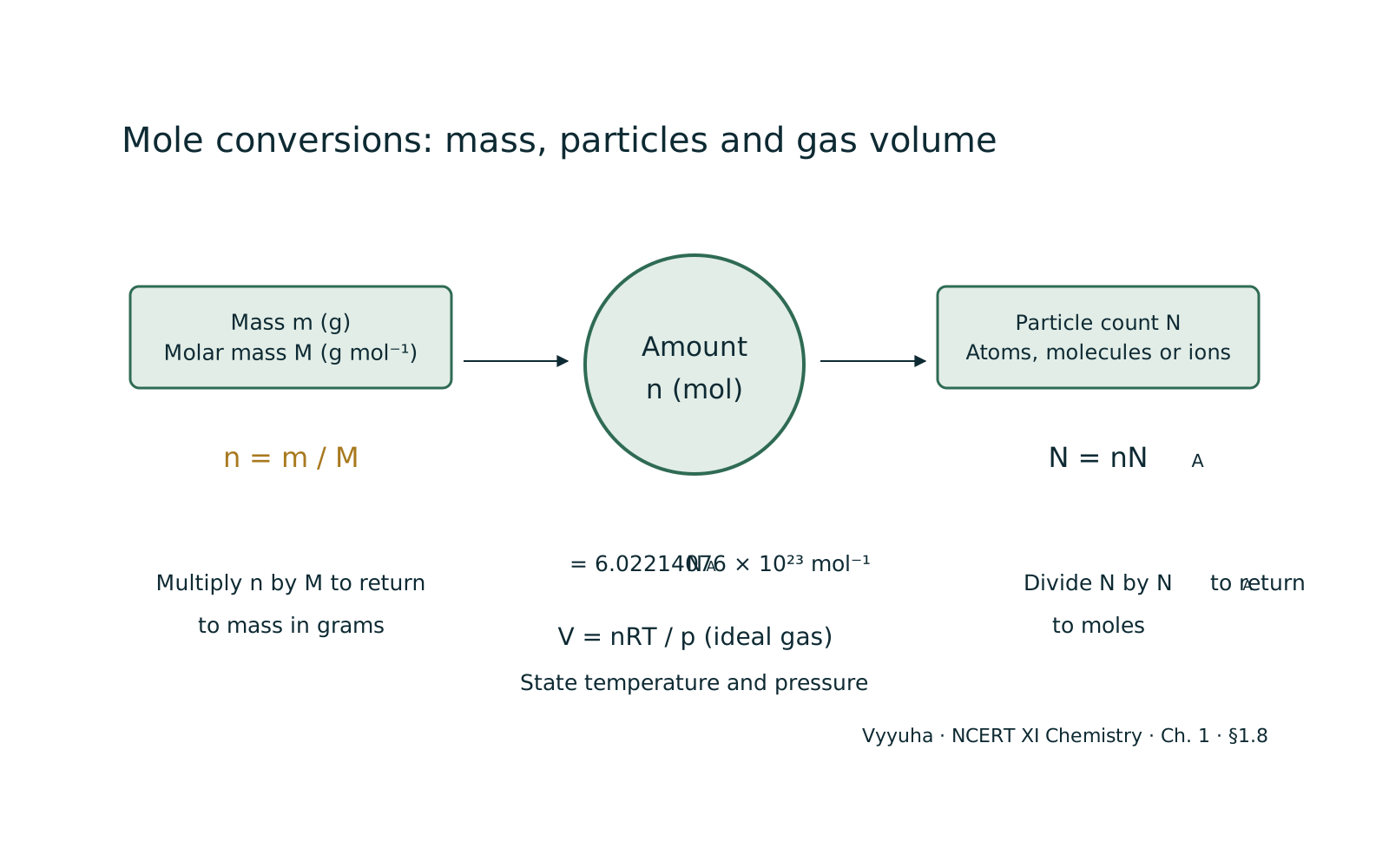
- The Mole Concept: — Avogadro's number is inextricably linked to the mole. One mole of any substance contains particles. This allows us to convert between the number of moles () and the number of particles () using the formula: .
- Molar Mass: — The molar mass () of a substance is the mass of one mole of that substance, expressed in grams per mole (). Numerically, the molar mass in is equal to the average atomic or molecular mass in atomic mass units (amu). For example, the atomic mass of carbon is 12.01 amu, and its molar mass is 12.01 . This equivalence is a direct consequence of Avogadro's number. If one atom of carbon-12 has a mass of exactly 12 amu, then atoms of carbon-12 have a mass of exactly 12 grams.
- Molar Volume of Gases: — For an ideal gas, one mole occupies a specific volume at standard temperature and pressure (STP). At STP ( or 273.15 K and 1 atm pressure), one mole of any ideal gas occupies 22.4 liters. This is known as the molar volume of a gas. This means molecules of any ideal gas will occupy 22.4 L at STP. This principle is extremely useful in gas stoichiometry.
3. Derivations and Experimental Determination (Brief Overview)
While a detailed derivation is beyond NEET scope, understanding the principles of its determination is helpful:
- X-ray Diffraction (XRD) of Crystals: — This is one of the most precise methods. By knowing the crystal structure, the density of the crystal, and the unit cell dimensions (determined by XRD), one can calculate the number of atoms in a unit cell and thus the number of atoms per unit volume. Combining this with the molar mass and density, can be determined.
- Electrolysis (Faraday's Constant): — Faraday's constant () is the charge carried by one mole of electrons (, where is the charge of a single electron). By precisely measuring the charge required to deposit one mole of a substance during electrolysis and knowing the charge of an electron, can be calculated.
- Brownian Motion: — Einstein's theory of Brownian motion provided a way to estimate by observing the random movement of particles suspended in a fluid.
4. Real-World Applications and Significance
Avogadro's number is not just a theoretical concept; it has profound practical implications:
- Stoichiometry: — It is fundamental to all stoichiometric calculations, allowing chemists to predict the quantities of reactants and products in chemical reactions. For example, to determine how much oxygen is needed to burn a certain amount of methane, we use molar ratios derived from balanced equations, which are ultimately based on particle counts linked by .
- Drug Dosage and Formulation: — In pharmacy, precise amounts of active ingredients are crucial. Avogadro's number helps in calculating the exact number of molecules of a drug in a given dose.
- Nanotechnology: — When dealing with materials at the nanoscale, understanding the number of atoms or molecules in a given volume or mass becomes critical for designing and synthesizing new materials.
- Environmental Chemistry: — Calculating pollutant concentrations, understanding atmospheric reactions, and assessing environmental impact often requires converting between mass and number of particles.
- Material Science: — Designing materials with specific properties (e.g., strength, conductivity) requires knowledge of the number of atoms and their arrangement, which is facilitated by Avogadro's number.
5. Common Misconceptions and NEET-Specific Angle
- Avogadro's Number vs. Mole: — Students often confuse the two. The mole is a unit of amount, while Avogadro's number is the count of particles in one mole. Think of 'dozen' as the unit and '12' as the number.
- Applicability to all particles: — Avogadro's number applies to any elementary entity. It could be atoms, molecules, ions, electrons, or even photons, as long as we specify 'one mole of that entity'.
- STP conditions for Molar Volume: — Remember that the 22.4 L molar volume is specific to ideal gases at STP ( and 1 atm). For real gases or different conditions, the ideal gas law () must be used.
- Calculating atoms within a molecule: — A common NEET trap involves asking for the number of specific atoms within a given mass of a compound. For example, 'How many oxygen atoms are in 180g of glucose ()?' Here, you first find moles of glucose, then molecules of glucose (using ), and finally multiply by the number of oxygen atoms per glucose molecule (which is 6).
- Units: — Always pay attention to units. Avogadro's number is . Molar mass is in . Number of particles is dimensionless, but often specified as 'atoms' or 'molecules'.
Mastering Avogadro's number and its applications is crucial for NEET, as it forms the bedrock for solving a wide range of problems in physical chemistry, particularly in the 'Mole Concept' and 'Stoichiometry' chapters. Questions often involve multi-step calculations, requiring conversion between mass, moles, number of particles, and sometimes volume for gases.
Often confused with
Side-by-side differences the NEET paper likes to test.
| Aspect | Avogadro's Number | Mole |
|---|---|---|
| Definition | Avogadro's Number ($N_A$) | Mole (mol) |
| Nature | A specific numerical constant ($6.022 \times 10^{23}$) | An SI unit for the amount of substance |
| Role | Represents the *count* of particles in one mole | Represents a *quantity* of substance containing $N_A$ particles |
| Units | Per mole ($\text{mol}^{-1}$) | mol |
| Analogy | The number '12' in a dozen | The 'dozen' itself |
While often used interchangeably in casual conversation, Avogadro's Number and the mole are distinct but intrinsically linked concepts. Avogadro's Number is a fixed numerical constant, , representing the count of elementary entities.
The mole, on the other hand, is the SI unit for the amount of substance, defined as the quantity containing Avogadro's Number of particles. Essentially, the mole is the 'package' or 'grouping' unit, and Avogadro's Number tells us exactly how many items are in that package.
Understanding this distinction is crucial for precise chemical calculations.
Why it is tested: NEET relevance: This distinction is fundamental for conceptual clarity in mole concept problems. Confusing the two can lead to errors in calculations involving number of particles, mass, and volume. Many conceptual questions in NEET test this precise understanding.
Questions students ask
6 answered on this topic.
What is the exact value of Avogadro's Number and why is it important?
The currently accepted value of Avogadro's Number () is . It's important because it provides a fundamental link between the macroscopic world (what we can weigh in grams) and the microscopic world (individual atoms and molecules). It allows chemists to count an immense number of tiny particles by simply weighing a bulk sample, which is indispensable for quantitative chemical analysis and understanding reaction stoichiometry.
How is Avogadro's Number related to the mole concept?
Avogadro's Number is the defining constant of the mole. One mole of any substance is defined as the amount of that substance which contains exactly elementary entities (atoms, molecules, ions, etc.). So, if you have 2 moles of water, you have water molecules. The mole is a unit of 'amount of substance', and Avogadro's Number specifies how many particles are in that unit.
Does Avogadro's Number apply to all types of particles?
Yes, Avogadro's Number is universal. It applies to any elementary entity you specify. You can have Avogadro's number of atoms, molecules, ions, electrons, protons, or even macroscopic objects like grains of sand (though you'd need an impossibly large amount of sand to make a mole of it!). The key is to specify 'one mole of what entity'.
What is the relationship between Avogadro's Number, molar mass, and atomic mass unit (amu)?
Avogadro's Number establishes a direct numerical equivalence between atomic/molecular mass in amu and molar mass in grams per mole. For example, if an atom has an average mass of 'x' amu, then one mole of those atoms will have a mass of 'x' grams. This means that atoms, each weighing 'x' amu, collectively weigh 'x' grams. This relationship is crucial for converting between mass and number of particles.
How is Avogadro's Number used in calculating the number of atoms in a compound?
To calculate the number of specific atoms in a compound, you first determine the number of moles of the compound from its given mass. Then, multiply the moles of the compound by Avogadro's Number to get the number of molecules of the compound. Finally, multiply the number of molecules by the subscript of the specific atom in the chemical formula. For example, in , each molecule has 2 hydrogen atoms and 1 oxygen atom.
Why is Avogadro's Number so large?
Avogadro's Number is so large because atoms and molecules are incredibly tiny. To have a measurable, macroscopic amount of a substance (like a few grams), you need an enormous quantity of these microscopic particles. The value of is chosen such that the mass of one mole of a substance in grams is numerically equal to its atomic or molecular mass in atomic mass units, providing a convenient bridge between the atomic and macroscopic scales.