Quantum Mechanical Model of Atom — Explained
Detailed Explanation
The journey to the Quantum Mechanical Model of the Atom was necessitated by the inherent limitations of earlier atomic theories, particularly Bohr's model. While Bohr's model successfully explained the stability of atoms and the line spectrum of hydrogen, it failed spectacularly for multi-electron atoms, could not account for the fine structure of spectral lines (splitting into even finer lines), and was unable to explain the Zeeman effect (splitting of spectral lines in a magnetic field) or the Stark effect (splitting in an electric field).
It also treated electrons purely as particles moving in well-defined, classical orbits, which contradicted emerging experimental evidence.
Conceptual Foundation
- Wave-Particle Duality (de Broglie's Hypothesis): — Louis de Broglie, in 1924, proposed that just as light exhibits both wave-like and particle-like properties, matter (like electrons, protons, and atoms) also possesses a dual nature. He hypothesized that a moving particle has an associated wavelength, known as the de Broglie wavelength (), given by the equation:
For an electron confined within an atom, its wave nature implies that only certain wavelengths (and thus certain energies) are allowed, leading naturally to quantized energy levels, much like a standing wave on a string can only have specific resonant frequencies.
- Heisenberg's Uncertainty Principle: — Werner Heisenberg, in 1927, formulated a fundamental principle stating that it is impossible to simultaneously determine with absolute precision both the position and momentum (or velocity) of a microscopic particle like an electron. Mathematically, this is expressed as:
This principle fundamentally undermines the classical idea of an electron moving in a well-defined orbit. If we try to precisely locate an electron (), its momentum becomes highly uncertain (), and vice-versa.
This means we cannot talk about the exact path of an electron; instead, we must describe its probable location.
Key Principles and Laws: The Schrödinger Wave Equation
Erwin Schrödinger, in 1926, developed a mathematical equation that describes the wave-like behavior of electrons in atoms. This equation, known as the Schrödinger wave equation, is a cornerstone of quantum mechanics.
For a time-independent system (like an electron in a stationary state within an atom), it is often written as:
- Wave Function ($\Psi$): — The wave function itself has no direct physical meaning. It is a mathematical function whose value depends on the coordinates of the electron (x, y, z) and time. It contains all the information about the electron's state.
- Probability Density ($\Psi^2$): — The square of the magnitude of the wave function, (or for real wave functions), at any point in space gives the probability of finding the electron at that particular point. This is why we speak of 'electron clouds' or 'orbitals' – regions of space where the probability of finding an electron is high. An atomic orbital is thus defined as a three-dimensional region around the nucleus where the probability of finding an electron is maximum (typically 90-95%).
- Quantization: — The Schrödinger equation naturally leads to the quantization of energy levels, angular momentum, and magnetic moment, without needing to assume them, as Bohr did. The solutions to the equation are only physically meaningful for specific, discrete values of energy, which correspond to the allowed energy levels of the electron.
Quantum Numbers
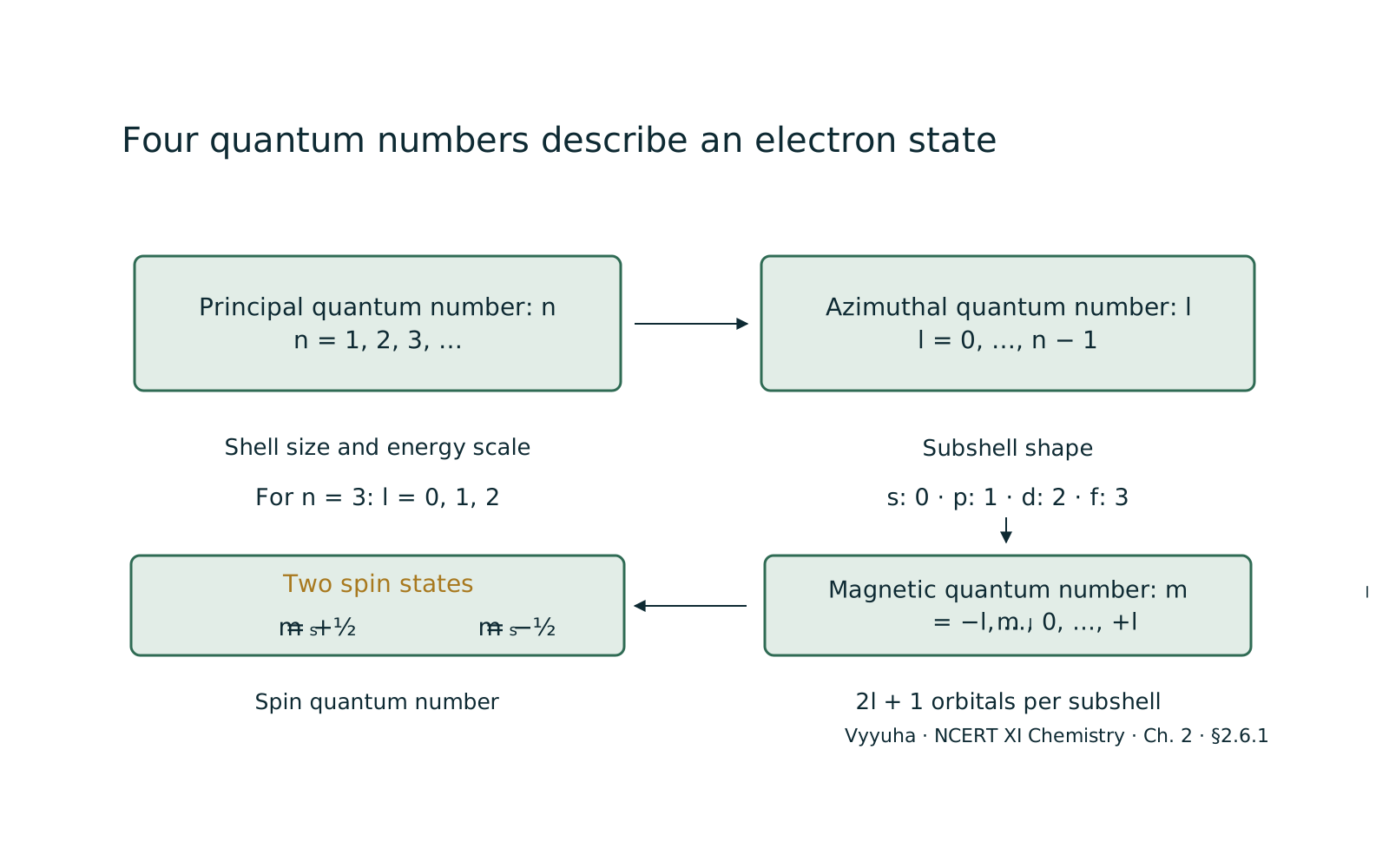
The solutions to the Schrödinger equation for an electron in an atom give rise to a set of three quantum numbers: principal (n), azimuthal (l), and magnetic (m_l). A fourth quantum number, spin (m_s), was later introduced to account for the intrinsic angular momentum of the electron.
- Principal Quantum Number (n):
* Significance: Determines the main energy level or shell of the electron and primarily dictates the size of the orbital. Higher 'n' values mean higher energy and larger orbitals. * Allowed values: Positive integers: * Shells: (K shell), (L shell), (M shell), etc.
- Azimuthal (or Angular Momentum) Quantum Number (l):
* Significance: Determines the shape of the orbital and the angular momentum of the electron. It also defines subshells within a main shell. * Allowed values: Integers from to . * Subshells: * : s subshell (spherical shape) * : p subshell (dumbbell shape) * : d subshell (cloverleaf or double dumbbell shape) * : f subshell (complex shapes)
- Magnetic Quantum Number (m_l):
* Significance: Determines the orientation of the orbital in space. It describes the number of orbitals within a subshell. * Allowed values: Integers from to , including . * Orientations: For (s subshell), (1 orbital). For (p subshell), (3 orbitals: ). For (d subshell), (5 orbitals).
- Spin Quantum Number (m_s):
* Significance: Describes the intrinsic angular momentum of an electron, often visualized as the electron spinning on its own axis. This spin creates a magnetic field. * Allowed values: (spin up) or (spin down). * Pauli Exclusion Principle: No two electrons in an atom can have the same set of all four quantum numbers.
Orbital Shapes and Nodes
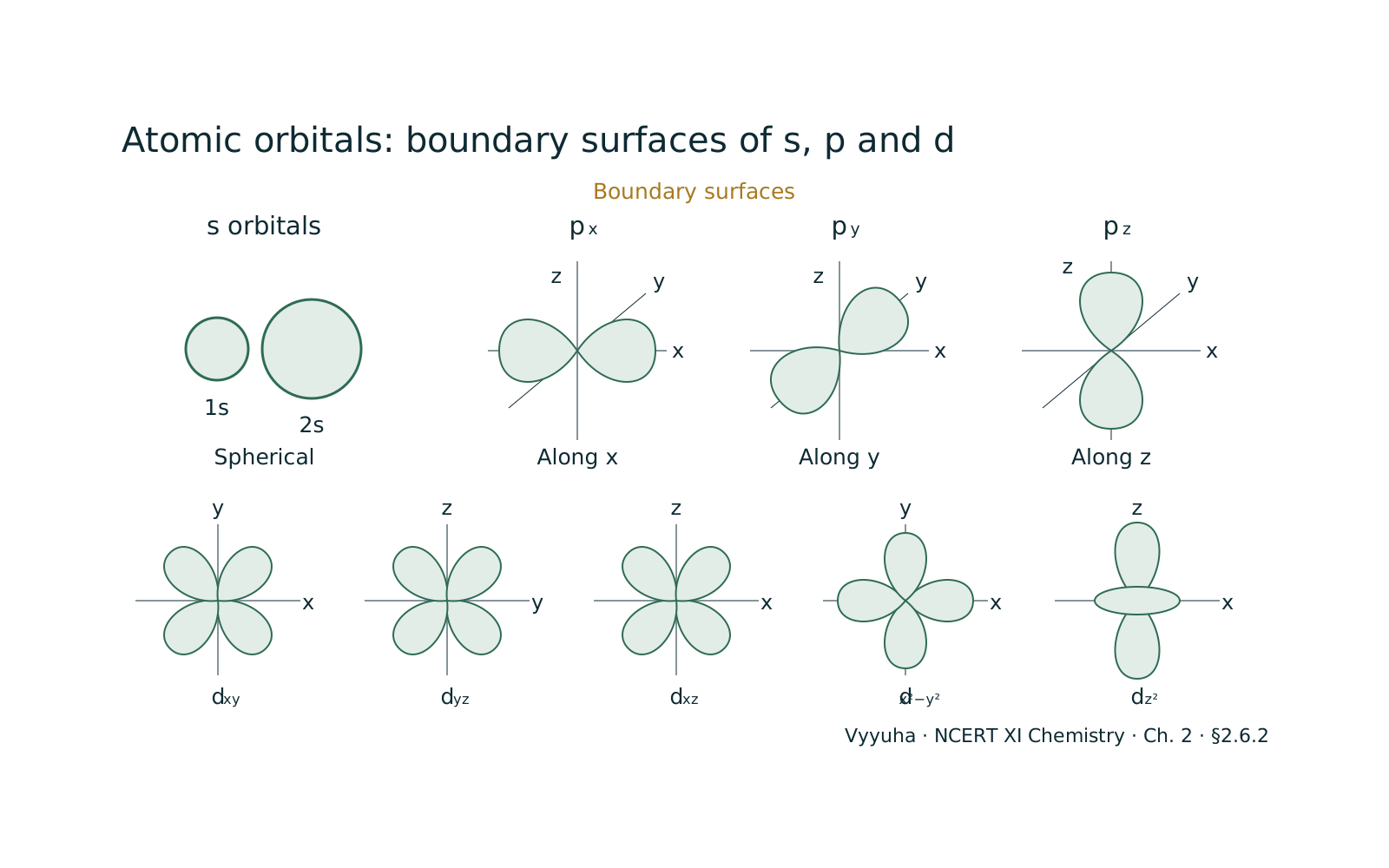
- s-orbitals ($l=0$): — Always spherical. The size increases with 'n' (1s < 2s < 3s). They have radial nodes (spherical nodes). A radial node is a spherical surface where the probability of finding an electron is zero.
- p-orbitals ($l=1$): — Dumbbell-shaped, with two lobes on opposite sides of the nucleus. There are three p-orbitals (), oriented along the x, y, and z axes, respectively. Each p-orbital has one angular node (a planar node passing through the nucleus). The total number of nodes is . So, for a 2p orbital, total nodes = , which is an angular node. For a 3p orbital, total nodes = , one angular and one radial node.
- d-orbitals ($l=2$): — More complex shapes. There are five d-orbitals. Four of them () have cloverleaf shapes, while the fifth () has a dumbbell shape with a 'doughnut' ring around the middle. Each d-orbital has two angular nodes. Total nodes = . For a 3d orbital, total nodes = , which are both angular nodes.
Real-World Applications
The Quantum Mechanical Model is not just an abstract theory; it forms the basis for understanding a vast array of chemical and physical phenomena:
- Chemical Bonding: — Explains how atoms form bonds by overlapping orbitals, leading to the formation of molecules with specific geometries and properties.
- Spectroscopy: — Provides the theoretical framework for interpreting atomic and molecular spectra, allowing scientists to identify elements and compounds and study their electronic structures.
- Material Science: — Helps design new materials with desired properties (e.g., semiconductors, superconductors, catalysts) by understanding electron behavior.
- Lasers: — The principle of stimulated emission, crucial for laser operation, is rooted in quantum mechanics and the discrete energy levels of atoms.
- Magnetic Properties: — Explains paramagnetism and diamagnetism based on the presence of unpaired or paired electrons in orbitals.
Common Misconceptions
- Electrons Orbiting the Nucleus: — Students often confuse 'orbitals' with 'orbits'. Orbitals are regions of probability, not fixed paths. An electron does not 'travel' in an orbital in the classical sense.
- Exact Position of Electron: — The model does not allow for knowing the exact position of an electron at any given time. It describes the probability distribution.
- Quantum Numbers as Arbitrary: — Quantum numbers are not arbitrarily assigned but arise naturally as solutions to the Schrödinger equation, reflecting fundamental properties of the electron's state.
- Orbital Boundary Surfaces: — The boundary surfaces drawn for orbitals (like spheres for s, dumbbells for p) represent regions where the probability of finding the electron is high (e.g., 90-95%), not a hard boundary beyond which the electron cannot go.
NEET-Specific Angle
For NEET aspirants, a deep understanding of quantum numbers is paramount. You must be able to:
- Determine valid sets of quantum numbers.
- Relate quantum numbers to orbital energy, shape, and orientation.
- Calculate the number of radial and angular nodes for s, p, and d orbitals.
- Understand the relative energies of orbitals (e.g., vs. ).
- Apply the Aufbau principle, Pauli's Exclusion Principle, and Hund's Rule of Maximum Multiplicity for electron configuration, which are direct consequences of the quantum mechanical description of electrons.
- Recognize the shapes of s, p, and d orbitals and their spatial orientations.
The Quantum Mechanical Model provides a sophisticated and accurate description of atomic structure, moving beyond the limitations of classical physics to embrace the probabilistic and wave-like nature of the subatomic world. Mastery of its principles is essential for a strong foundation in chemistry.
Often confused with
Side-by-side differences the NEET paper likes to test.
| Aspect | Quantum Mechanical Model of Atom | Bohr's Model of Atom |
|---|---|---|
| Electron Description | Electrons are particles orbiting the nucleus in fixed, well-defined circular paths (orbits). | Electrons exhibit wave-particle duality; their location is described probabilistically in three-dimensional regions called orbitals. |
| Quantization | Energy levels are quantized by assumption (postulate). | Quantization of energy, angular momentum, and magnetic moment arises naturally from solving the Schrödinger wave equation. |
| Applicability | Applicable only to hydrogen and hydrogen-like ions (single-electron species). | Applicable to all atoms and molecules, providing a more accurate description for multi-electron systems. |
| Heisenberg's Uncertainty Principle | Violates the uncertainty principle by assuming simultaneous precise knowledge of position and momentum. | Incorporates the uncertainty principle, acknowledging the fundamental limit to knowing both position and momentum simultaneously. |
| Spectral Phenomena | Cannot explain the fine structure of spectral lines, Zeeman effect, or Stark effect. | Successfully explains the fine structure of spectra, Zeeman effect, and Stark effect by considering orbital shapes and orientations. |
| Orbital Shapes | All orbits are circular (or elliptical in Sommerfeld's extension). | Orbitals have distinct shapes (spherical for s, dumbbell for p, complex for d, f) determined by quantum numbers. |
The transition from Bohr's Model to the Quantum Mechanical Model represents a fundamental paradigm shift in atomic theory. Bohr's model, while historically significant for introducing quantized energy levels, was limited by its classical particle-in-orbit approach and its failure to explain complex atomic phenomena.
The Quantum Mechanical Model, built on wave-particle duality and the uncertainty principle, provides a probabilistic and wave-based description of electrons in orbitals, naturally deriving quantization and accurately explaining the behavior of all atoms and their interactions, thus forming the bedrock of modern chemistry.
Why it is tested: For NEET, understanding these differences is crucial for conceptual questions. Students must grasp why the Quantum Mechanical Model superseded Bohr's model, focusing on the underlying principles (wave-particle duality, uncertainty principle) and its broader explanatory power for multi-electron atoms and spectral phenomena. Questions often test the limitations of Bohr's model and how the QM model addresses them.
Questions students ask
6 answered on this topic.
What were the main failures of Bohr's model that led to the Quantum Mechanical Model?
Bohr's model, while a significant step, had several critical limitations. It could only explain the spectrum of hydrogen and hydrogen-like ions (single-electron species) but failed for multi-electron atoms.
It couldn't account for the fine structure of spectral lines, nor could it explain the splitting of spectral lines in the presence of a magnetic field (Zeeman effect) or an electric field (Stark effect).
Furthermore, it treated electrons as particles moving in fixed, classical orbits, which contradicted the wave-like nature of matter later proposed by de Broglie.
What is the significance of the wave function ($\Psi$) and its square ($\Psi^2$) in the Quantum Mechanical Model?
The wave function () is a mathematical function that describes the state of an electron in an atom. It contains all the information about the electron but has no direct physical meaning itself. However, the square of the magnitude of the wave function, (or for real wave functions), has profound physical significance.
It represents the probability density of finding the electron at a particular point in space around the nucleus. This means that where is large, there is a higher probability of finding the electron, and where it is small, the probability is lower.
This probabilistic interpretation is central to the quantum mechanical description of atomic orbitals.
How do 'orbitals' differ from 'orbits'?
This is a crucial distinction. An 'orbit' (as in Bohr's model) implies a well-defined, circular or elliptical path that an electron follows around the nucleus, similar to planets orbiting the sun. It suggests a deterministic trajectory.
In contrast, an 'orbital' (in the Quantum Mechanical Model) is a three-dimensional region of space around the nucleus where there is a high probability (typically 90-95%) of finding an electron. It does not describe a fixed path but rather a probability distribution or an 'electron cloud', reflecting the wave-like nature and uncertainty principle associated with electrons.
What is the physical meaning of each of the four quantum numbers?
The principal quantum number (n) defines the main energy level and the size of the orbital. The azimuthal (l) quantum number determines the shape of the orbital and the subshell. The magnetic (m_l) quantum number specifies the spatial orientation of the orbital. Finally, the spin (m_s) quantum number describes the intrinsic angular momentum of the electron, often visualized as its spin, which can be either 'up' (+1/2) or 'down' (-1/2).
What are nodes in atomic orbitals, and how are they calculated?
Nodes are regions in an atomic orbital where the probability of finding an electron is zero. There are two types: radial (or spherical) nodes and angular (or planar) nodes. Radial nodes are spherical surfaces, while angular nodes are planar surfaces passing through the nucleus.
The total number of nodes in an orbital is given by . The number of angular nodes is equal to , and the number of radial nodes is given by . For example, a 3p orbital () has total nodes, with angular node and radial node.
Why is the Quantum Mechanical Model considered more accurate than previous models?
The Quantum Mechanical Model is more accurate because it incorporates fundamental principles of quantum mechanics, such as wave-particle duality and the Heisenberg Uncertainty Principle, which are essential for describing the behavior of subatomic particles.
It naturally explains the quantization of energy, the existence of different orbital shapes and orientations, and the behavior of multi-electron atoms, including phenomena like the Zeeman and Stark effects, which Bohr's model could not.
Its predictions align much better with experimental observations across a wider range of atoms and conditions.