Spin Quantum Number — Explained
Detailed Explanation
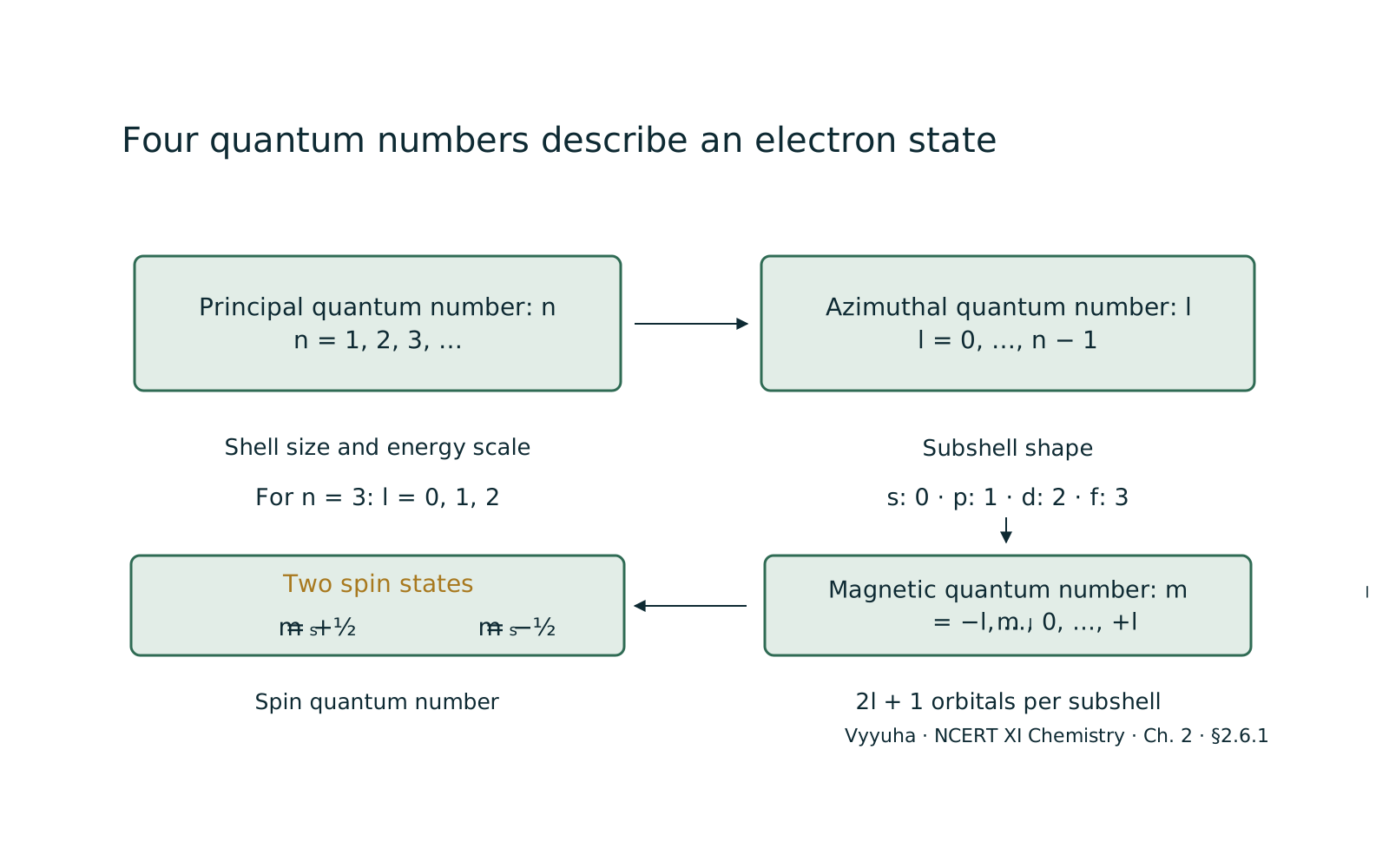
The journey into understanding atomic structure begins with the three orbital quantum numbers: principal (n), azimuthal (l), and magnetic (). However, these three alone are insufficient to fully characterize an electron's state.
The need for a fourth quantum number became evident through experimental observations, particularly in spectroscopy and the behavior of atoms in magnetic fields. This led to the introduction of the spin quantum number, , which describes an intrinsic property of the electron.
Conceptual Foundation: The Electron's Intrinsic Angular Momentum
Historically, the concept of electron spin was first proposed by George Uhlenbeck and Samuel Goudsmit in 1925 to explain the fine structure observed in atomic spectra, which couldn't be accounted for by the orbital quantum numbers alone.
They hypothesized that electrons possess an intrinsic angular momentum, independent of their orbital motion around the nucleus, and that this 'spin' could have two possible orientations. While the classical analogy of a spinning charged sphere is helpful for visualization, it's crucial to understand its quantum nature.
An electron is a point particle, and its 'spin' is a purely quantum mechanical phenomenon, a fundamental property like its charge or mass, rather than a literal rotation.
The most compelling experimental evidence for electron spin came from the Stern-Gerlach experiment (1922). Otto Stern and Walther Gerlach passed a beam of neutral silver atoms through an inhomogeneous magnetic field.
According to classical physics, if the atoms possessed a magnetic moment due to electron orbital motion, they should have been deflected by varying amounts, resulting in a continuous smear on a detector screen.
However, they observed that the beam split into two distinct components. This discrete splitting indicated that the magnetic moment of the silver atoms (primarily due to the single unpaired electron in their outermost shell) could only take on two specific orientations relative to the magnetic field, corresponding to the two possible spin states of the electron.
This experiment unequivocally demonstrated the quantization of electron spin.
Key Principles and Laws Related to Spin Quantum Number
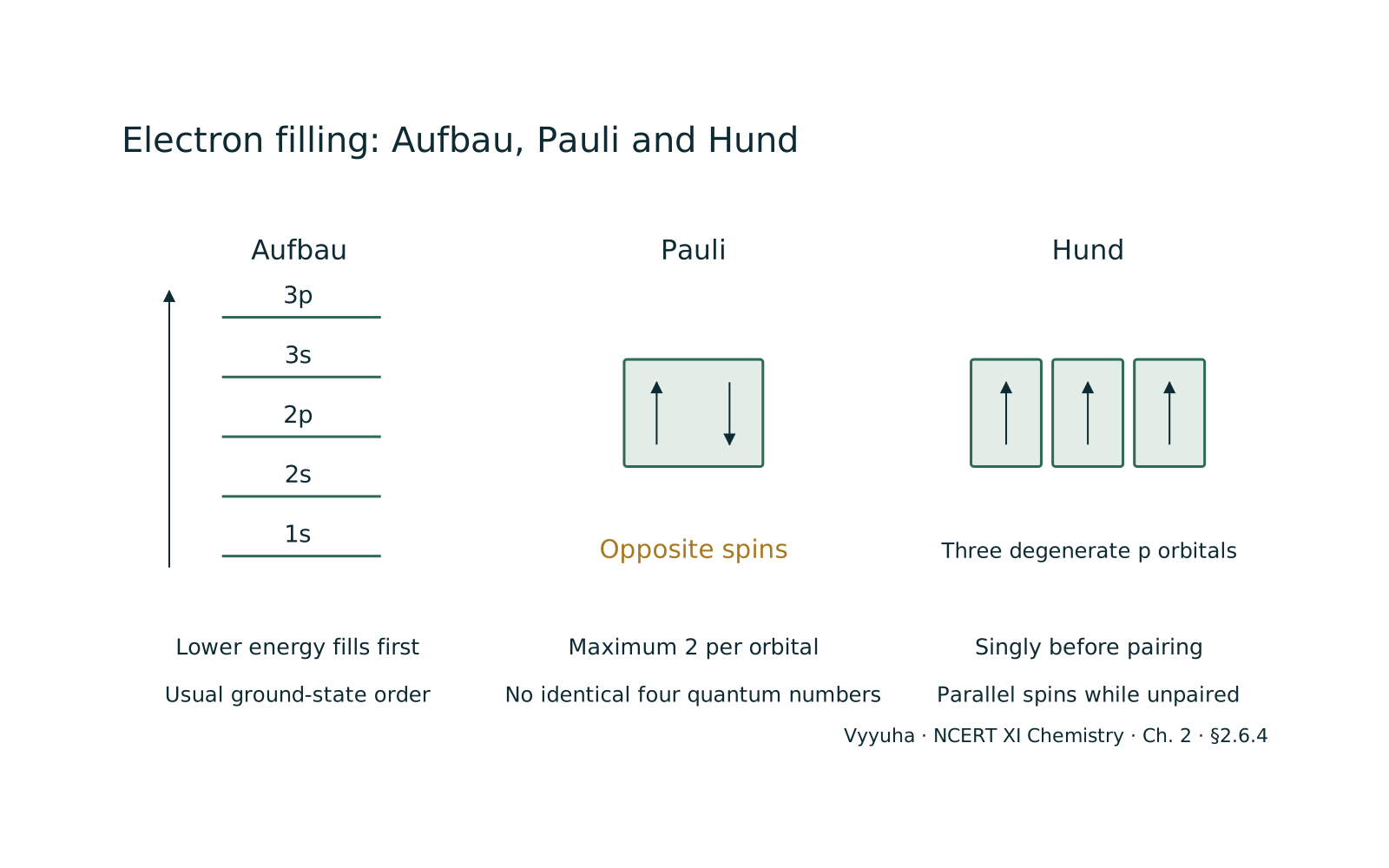
- Pauli Exclusion Principle — This fundamental principle, formulated by Wolfgang Pauli, states that no two electrons in an atom can have the exact same set of all four quantum numbers (n, l, , ). This means that if two electrons occupy the same orbital (which implies they have identical n, l, and values), they must have opposite spin quantum numbers. One electron will have (spin up, ) and the other will have (spin down, ). This principle is vital for understanding electron configurations and the stability of atoms.
- Hund's Rule of Maximum Multiplicity — When filling degenerate orbitals (orbitals of the same energy, e.g., the three p orbitals or five d orbitals), electrons first occupy each orbital singly with parallel spins (same value, typically ) before any orbital is doubly occupied. This maximizes the total spin angular momentum and leads to a more stable configuration. For example, in a p-subshell with three electrons, each electron will go into a separate p orbital with parallel spins (e.g., ). Only after all degenerate orbitals are half-filled do electrons start pairing up with opposite spins.
- Spin Multiplicity — This concept is directly related to the number of unpaired electrons and their spins. Spin multiplicity is given by the formula , where S is the total spin angular momentum (sum of individual electron spins). For example, if an atom has one unpaired electron, , and multiplicity is (a doublet). If it has two unpaired electrons with parallel spins, , and multiplicity is (a triplet). Spin multiplicity is crucial in spectroscopy and understanding reaction mechanisms.
Derivations and Quantum Mechanical Origin
The spin quantum number does not arise from the solution of the non-relativistic Schrödinger equation, which only yields n, l, and . Instead, it emerges naturally from the relativistic quantum mechanical description of the electron, specifically the Dirac equation (formulated by Paul Dirac in 1928).
Dirac's theory, which incorporated special relativity into quantum mechanics, predicted that electrons must possess an intrinsic angular momentum and an associated magnetic moment, with only two possible orientations.
This provided a rigorous theoretical foundation for the empirically observed electron spin.
Real-World Applications
- Magnetism — The spin of electrons is the primary source of magnetism in materials. Atoms with unpaired electrons (and thus net electron spin) exhibit paramagnetism, meaning they are weakly attracted to an external magnetic field. Examples include oxygen () and many transition metal ions. Diamagnetic substances, on the other hand, have all their electrons paired, resulting in zero net spin magnetic moment, and are weakly repelled by magnetic fields (e.g., water, ). Ferromagnetism, seen in materials like iron, cobalt, and nickel, is a more complex phenomenon involving the alignment of electron spins in domains.
- Spectroscopy — Electron spin is fundamental to several spectroscopic techniques:
* Electron Spin Resonance (ESR) or Electron Paramagnetic Resonance (EPR) Spectroscopy: This technique detects and studies species with unpaired electrons. It's widely used in chemistry, biology, and materials science to study free radicals, transition metal complexes, and defects in solids.
* Nuclear Magnetic Resonance (NMR) Spectroscopy: While NMR primarily involves the spin of atomic nuclei, the principles of spin quantization and interaction with magnetic fields are analogous to electron spin.
It's an indispensable tool for determining the structure of organic molecules and is the basis for MRI in medicine.
- Quantum Computing — The spin state of an electron (spin up or spin down) can be used as a quantum bit or 'qubit' in quantum computing, offering a potential pathway for storing and processing information in novel ways.
Common Misconceptions
- Physical Spinning — The most common misconception is that electrons literally 'spin' like a top or a planet. As discussed, this is a classical analogy that fails in the quantum realm. The electron is a point particle, and its spin is an intrinsic quantum property, not a rotational motion.
- Relation to Orbital Motion — Electron spin is entirely independent of the electron's orbital motion around the nucleus. The orbital angular momentum is described by the azimuthal (l) and magnetic () quantum numbers, while spin angular momentum is an inherent property of the electron itself.
- Spin Direction is Fixed — The terms 'spin up' and 'spin down' refer to the orientation of the electron's magnetic moment relative to an external magnetic field or a defined axis, not an absolute direction in space. An electron's spin can be flipped by applying energy (e.g., in ESR).
NEET-Specific Angle
For NEET aspirants, understanding the spin quantum number is crucial for several key areas:
- Electron Configuration — Correctly applying the Pauli Exclusion Principle and Hund's Rule, which both rely on electron spin, is essential for writing accurate electron configurations and orbital diagrams. For example, knowing that an orbital can hold a maximum of two electrons with opposite spins () is fundamental.
- Magnetic Properties — Predicting whether an atom or ion is paramagnetic (attracted to a magnetic field due to unpaired electrons) or diamagnetic (repelled by a magnetic field due to all paired electrons) is a common NEET question type. This directly depends on identifying the presence and number of unpaired electrons, which is determined by their spin states.
- Quantum Number Sets — Questions often ask to identify valid or invalid sets of (n, l, , ) quantum numbers. The spin quantum number's restriction to only or is a critical check. Additionally, ensuring that if n, l, and are the same for two electrons, their values must be opposite, is a direct application of the Pauli Exclusion Principle.
- Stability of Electron Configurations — Hund's rule, which dictates the filling of degenerate orbitals with parallel spins, explains the extra stability of half-filled and completely filled subshells, a concept frequently tested in relation to ionization energies and electron affinities.
In summary, the spin quantum number, , despite its simple values of and , is a cornerstone of atomic theory, explaining fundamental properties of electrons and atoms that are indispensable for understanding chemistry.
Often confused with
Side-by-side differences the NEET paper likes to test.
| Aspect | Spin Quantum Number | Other Quantum Numbers (n, l, $m_l$) |
|---|---|---|
| Property Described | Spin Quantum Number ($m_s$): Intrinsic angular momentum of the electron (spin) | Other Quantum Numbers (n, l, $m_l$): Orbital properties of the electron (energy, shape, orientation) |
| Values | $m_s$: Only $+1/2$ or $-1/2$ | n: Positive integers (1, 2, 3...) l: Integers from 0 to n-1 $m_l$: Integers from -l to +l |
| Origin | $m_s$: Arises from relativistic quantum mechanics (Dirac equation), intrinsic to electron | n, l, $m_l$: Arise from the solution of the non-relativistic Schrödinger equation, describe orbital motion |
| Dependence | $m_s$: Independent of n, l, $m_l$ | n, l, $m_l$: l depends on n, $m_l$ depends on l |
| Uniqueness | $m_s$: Differentiates electrons within the same orbital | n, l, $m_l$: Define the orbital itself |
The spin quantum number () fundamentally differs from the principal (n), azimuthal (l), and magnetic () quantum numbers. While n, l, and describe the energy, shape, and spatial orientation of an electron's orbital, describes an intrinsic property of the electron itself – its spin angular momentum.
has only two fixed values (, ), independent of the other quantum numbers, whereas n, l, and have values that depend on each other and describe the orbital's characteristics. is crucial for distinguishing two electrons within the same orbital, a requirement of the Pauli Exclusion Principle.
Why it is tested: NEET relevance: Understanding these differences is crucial for correctly assigning quantum numbers to electrons, applying the Pauli Exclusion Principle, and predicting the magnetic properties of atoms and ions. Questions often involve identifying valid sets of quantum numbers or explaining why certain electron configurations are stable, all of which hinge on the distinct roles of these quantum numbers.
Questions students ask
6 answered on this topic.
What does the spin quantum number actually represent if an electron doesn't physically spin?
The spin quantum number, , represents an intrinsic angular momentum of the electron, a fundamental property akin to its mass or charge. While the classical analogy of 'spinning' is used for visualization, it's a quantum mechanical phenomenon.
It describes the electron's inherent magnetic moment and its two possible orientations (spin up or spin down) in a magnetic field. This property is predicted by relativistic quantum mechanics (Dirac equation) and experimentally confirmed by the Stern-Gerlach experiment, showing discrete magnetic orientations rather than continuous ones.
Why are there only two possible values for the spin quantum number, $+1/2$ and $-1/2$?
The two values, and , arise from the quantum mechanical nature of spin. It's a fundamental property of electrons (and other fermions) that their intrinsic angular momentum is quantized and can only align in two opposite directions relative to a given axis.
This 'two-state' nature is a direct consequence of the electron being a spin-1/2 particle, meaning its total spin angular momentum is , where . The projection of this spin along an axis (e.
g., z-axis) can only be or , hence or , which are represented by the values.
How does the spin quantum number relate to the Pauli Exclusion Principle?
The spin quantum number is absolutely critical to the Pauli Exclusion Principle. This principle states that no two electrons in an atom can have the same set of all four quantum numbers (n, l, , ).
This means that if two electrons occupy the same orbital, they must have identical n, l, and values. To satisfy the Pauli principle, their spin quantum numbers () must be different. Therefore, one electron must have and the other , ensuring they have unique quantum states.
This is why an orbital can hold a maximum of two electrons, and they must have opposite spins.
Can an electron's spin change?
Yes, an electron's spin orientation can change, or 'flip'. This process is known as spin flip. It typically occurs when an electron absorbs or emits energy, often in the presence of an external magnetic field.
For instance, in Electron Spin Resonance (ESR) spectroscopy, unpaired electrons absorb microwave radiation when their spin orientation flips from a lower energy state (aligned with the magnetic field) to a higher energy state (opposed to the magnetic field).
This phenomenon is crucial for many applications, including spectroscopy and quantum computing.
What is the significance of spin quantum number in determining magnetic properties of substances?
The spin quantum number is the key determinant of a substance's magnetic properties. Each electron, due to its spin, acts like a tiny magnet. If an atom or ion has unpaired electrons, their individual spin magnetic moments do not cancel out, resulting in a net magnetic moment.
Such substances are called paramagnetic and are weakly attracted to external magnetic fields. If all electrons are paired, their opposite spins cancel out their magnetic moments, leading to zero net magnetic moment.
These substances are diamagnetic and are weakly repelled by magnetic fields. Thus, by knowing the electron configuration and the number of unpaired electrons (determined by spin), we can predict magnetic behavior.
Is the spin quantum number always $1/2$ for an electron?
Yes, for an electron, the intrinsic spin quantum number 's' is always . This is a fundamental property of electrons, classifying them as fermions. The values and are the possible projections of this spin angular momentum along a specific axis, denoted by . So, while 's' is always , the 'spin quantum number' can be either or , indicating the orientation of that intrinsic spin.