Quantum Numbers — Explained
Detailed Explanation
The quantum mechanical model of the atom, primarily based on the Schrödinger wave equation, revolutionized our understanding of electron behavior. Unlike Bohr's model, which depicted electrons orbiting the nucleus in fixed, planetary paths, the quantum model describes electrons in terms of probabilities, residing in specific three-dimensional regions called orbitals.
Quantum numbers are the fundamental descriptors that emerge from the solutions of the Schrödinger equation, providing a precise characterization of these orbitals and the electrons within them.
Conceptual Foundation:
At its heart, the Schrödinger equation treats electrons not as particles with definite positions and momenta, but as waves. The solutions to this equation are wave functions (), and the square of the wave function () gives the probability of finding an electron at a particular point in space.
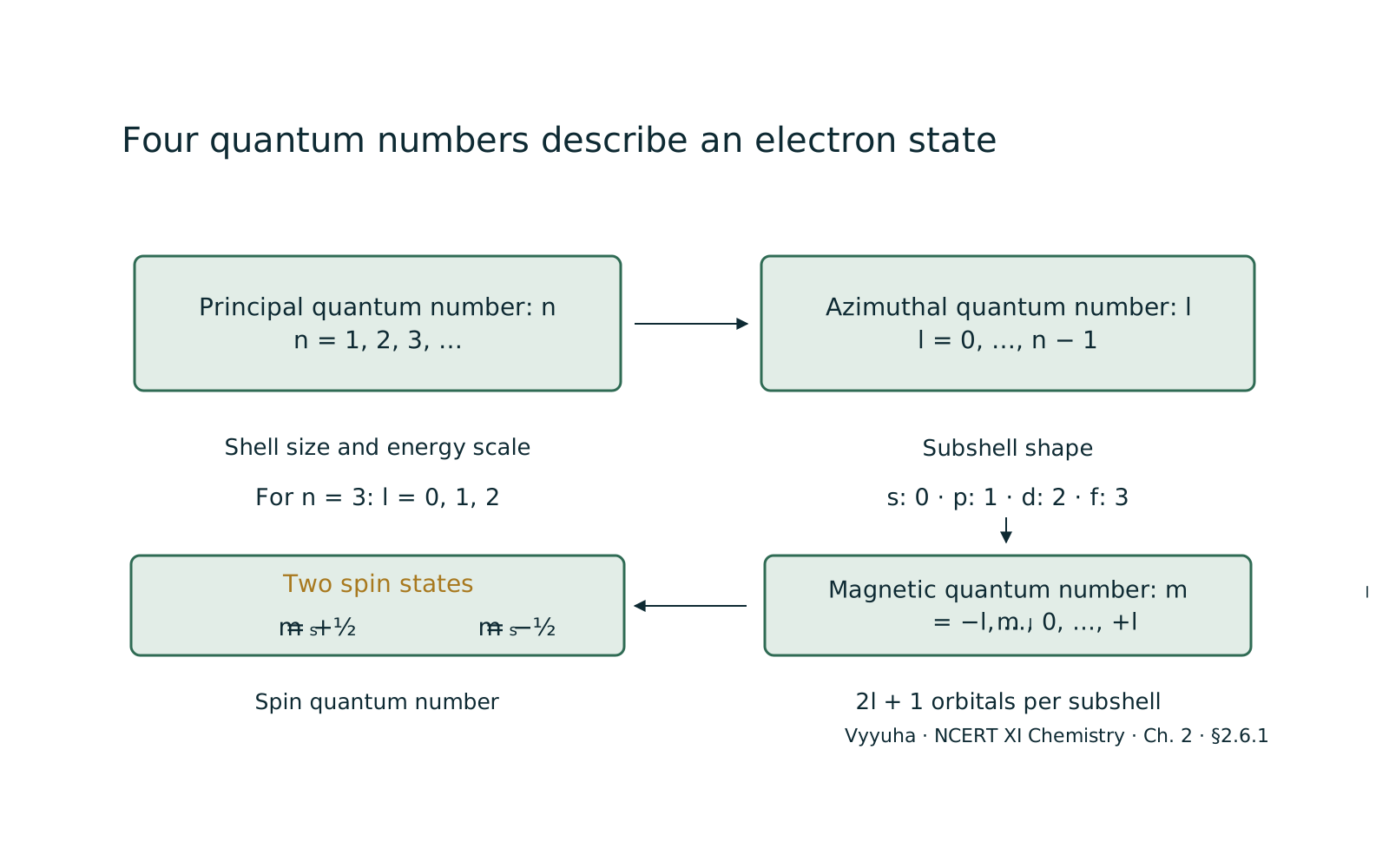
For an electron in a three-dimensional atom, the Schrödinger equation yields a set of quantized solutions, each characterized by a unique set of three integer quantum numbers: , , and . A fourth quantum number, , was later introduced to account for the intrinsic angular momentum (spin) of the electron.
Key Principles and Laws:
- Principal Quantum Number (n):
* Symbol: * Allowed Values: Positive integers: * Significance: This number primarily determines the energy of the electron and the size of the orbital. Higher values of correspond to higher energy levels and larger orbitals, meaning the electron is, on average, further from the nucleus.
These are often referred to as electron shells (K, L, M, N shells for respectively). * Origin: It arises from the radial part of the Schrödinger equation solution. * Maximum electrons in a shell: .
- Azimuthal (or Angular Momentum) Quantum Number (l):
* Symbol: * Allowed Values: Integers from to . For a given , can be . * Significance: This number determines the shape of the orbital and the orbital angular momentum of the electron.
Each value of corresponds to a specific subshell, denoted by letters: * subshell (spherical shape) * subshell (dumbbell shape) * subshell (more complex, often cloverleaf shape) * subshell (even more complex shapes) * Origin: It arises from the angular part of the Schrödinger equation solution.
* Number of orbitals in a subshell: . * Orbital angular momentum: Given by the formula or .
- Magnetic Quantum Number (m_l):
* Symbol: * Allowed Values: Integers from to , including . For a given , can be . * Significance: This number describes the spatial orientation of the orbital in a three-dimensional space relative to a standard set of axes (e.
g., x, y, z axes). For example, a subshell () has three orbitals (), which correspond to orbitals, each oriented along a different axis. In the presence of an external magnetic field, these orbitals, having different orientations, will have slightly different energies due to their interaction with the field (Zeeman effect).
* Origin: It also arises from the angular part of the Schrödinger equation solution.
- Spin Quantum Number (m_s):
* Symbol: * Allowed Values: Only two values: or . * Significance: This number describes the intrinsic angular momentum of the electron, often visualized as the electron 'spinning' on its own axis.
This spin generates a tiny magnetic field. The two values, and , represent the two possible orientations of this spin (spin up and spin down). This property is crucial for understanding the magnetic properties of materials and the behavior of electrons in external magnetic fields.
* Origin: It was not derived from the Schrödinger equation but was proposed by Uhlenbeck and Goudsmit to explain fine spectral lines and other experimental observations.
Pauli Exclusion Principle:
This fundamental principle states that no two electrons in the same atom can have identical values for all four quantum numbers (). This means that an orbital can hold a maximum of two electrons, and these two electrons must have opposite spins (one with and the other with ). This principle is essential for building up the electron configurations of multi-electron atoms.
Derivations (Conceptual for NEET):
While the full mathematical derivation of quantum numbers from the Schrödinger equation is beyond the scope of NEET, it's important to understand why they are quantized. The boundary conditions imposed on the wave function (e.
g., the wave function must be continuous, finite, and single-valued) naturally lead to discrete, integer values for . Just as a vibrating string can only sustain certain discrete wavelengths (harmonics), an electron wave in an atom can only exist in specific, quantized states.
Real-World Applications:
- Periodic Table Structure: — Quantum numbers explain the arrangement of elements in the periodic table, the filling of electron shells and subshells, and the periodicity of chemical properties.
- Spectroscopy: — The specific energy levels defined by quantum numbers explain the discrete lines observed in atomic emission and absorption spectra, which are used for elemental analysis.
- Chemical Bonding: — Understanding orbital shapes and orientations (from and ) is crucial for explaining how atoms form covalent bonds, the geometry of molecules, and hybridization.
- Material Science: — The magnetic properties of materials (diamagnetism, paramagnetism, ferromagnetism) are directly related to the spin and orbital angular momentum of electrons, as described by and .
- Lasers: — The principle of stimulated emission, fundamental to laser operation, relies on electrons transitioning between specific quantized energy levels defined by quantum numbers.
Common Misconceptions:
- Quantum numbers are arbitrary: — They are not arbitrary but are direct consequences of the wave nature of electrons and the boundary conditions of the Schrödinger equation.
- Electrons orbit like planets: — This is the classical Bohr model. In quantum mechanics, electrons exist in probability distributions (orbitals), not fixed paths.
- Spin is actual rotation: — Electron spin is an intrinsic quantum property, not a classical rotation. It's an analogy to help visualize its magnetic moment.
- Higher 'n' means higher speed: — While higher 'n' means higher energy, it doesn't necessarily mean higher speed in a classical sense. It means the electron is in a larger, less tightly bound orbital.
- All orbitals in a subshell have different energies: — In the absence of an external magnetic field, all orbitals within a given subshell (e.g., ) are degenerate, meaning they have the same energy. The quantum number differentiates their spatial orientation, not their energy in an isolated atom.
NEET-Specific Angle:
For NEET, the focus is on understanding the allowed values for each quantum number, their physical significance (what each number tells us), and how to apply them to determine electron configurations, predict orbital shapes, and identify valid/invalid sets of quantum numbers.
Questions often involve calculating the number of orbitals in a subshell or shell, identifying the quantum numbers for a specific electron, or relating them to the Aufbau principle, Hund's rule, and Pauli's exclusion principle.
A strong grasp of the relationships between is paramount, especially the constraints on their values (e.g., , ).
Often confused with
Side-by-side differences the NEET paper likes to test.
| Aspect | Quantum Numbers | Bohr's Orbits vs. Quantum Mechanical Orbitals |
|---|---|---|
| Nature of electron path | Orbit (Bohr Model): Fixed, well-defined circular path. | Orbital (Quantum Mechanical Model): Three-dimensional region of space where probability of finding electron is high. |
| Quantization | Orbit (Bohr Model): Only energy is quantized (n). | Orbital (Quantum Mechanical Model): Energy, shape, and orientation are all quantized (n, l, m_l). |
| Number of electrons | Orbit (Bohr Model): Maximum $2n^2$ electrons per orbit/shell, without specifying sub-levels. | Orbital (Quantum Mechanical Model): Each orbital holds a maximum of 2 electrons with opposite spins (Pauli Exclusion Principle). |
| Shape | Orbit (Bohr Model): All orbits are circular. | Orbital (Quantum Mechanical Model): Orbitals have distinct shapes (s-spherical, p-dumbbell, d-complex, etc.). |
| Origin | Orbit (Bohr Model): Based on classical mechanics with quantum postulates. | Orbital (Quantum Mechanical Model): Derived from the Schrödinger wave equation, based on wave mechanics. |
The transition from Bohr's 'orbits' to quantum mechanical 'orbitals' represents a fundamental shift from a classical, deterministic view of electrons to a probabilistic, wave-mechanical one. Orbits were fixed paths with quantized energy, while orbitals are three-dimensional probability distributions characterized by a set of quantum numbers (n, l, m_l) that define not just energy but also shape and spatial orientation.
This distinction is crucial for understanding the complex electron configurations and chemical behavior of multi-electron atoms, which the simpler Bohr model could not fully explain.
Why it is tested: For NEET, understanding this difference is fundamental. Questions often test the conceptual understanding of why the quantum mechanical model, with its quantum numbers and orbitals, superseded the Bohr model. It's essential for explaining electron configurations, orbital shapes, and the periodic properties of elements, which are all core NEET chemistry topics.
Questions students ask
6 answered on this topic.
What is the primary difference between an orbit (Bohr model) and an orbital (quantum mechanical model)?
In Bohr's model, an 'orbit' is a well-defined, two-dimensional circular path around the nucleus where an electron is assumed to travel. It's a classical concept. In contrast, an 'orbital' in the quantum mechanical model is a three-dimensional region of space around the nucleus where there is a high probability (typically 90-95%) of finding an electron.
It's a probabilistic, wave-mechanical concept, not a fixed path. Orbitals are described by quantum numbers, defining their energy, shape, and orientation.
Why can't the azimuthal quantum number (l) be equal to or greater than the principal quantum number (n)?
The azimuthal quantum number defines the subshell within a principal shell . Its values range from to . If were equal to , it would imply a subshell with an energy and spatial distribution that is inconsistent with the definition of the principal shell. Conceptually, defines the main energy level and size, and describes the shape within that size. A subshell cannot exist 'outside' or 'at the same level' as its parent shell in this hierarchical structure.
How many electrons can a d-subshell accommodate, and what are their quantum numbers?
For a d-subshell, the azimuthal quantum number . The magnetic quantum number can take values from to , so for , can be . This means there are orbitals in a d-subshell. According to the Pauli Exclusion Principle, each orbital can hold a maximum of two electrons with opposite spins ( and ). Therefore, a d-subshell can accommodate a total of electrons.
What is the significance of the spin quantum number (m_s) even though it's not derived from the Schrödinger equation?
The spin quantum number () describes an intrinsic property of the electron, its 'spin angular momentum,' which creates a magnetic dipole moment. Even though it wasn't directly derived from the original Schrödinger equation, it was experimentally necessary to explain phenomena like the fine structure of spectral lines and the Zeeman effect.
It's crucial for the Pauli Exclusion Principle, ensuring no two electrons in an atom have identical quantum numbers, and for understanding the magnetic properties of atoms and materials.
Can an electron have $n=3, l=3, m_l=0, m_s=+1/2$?
No, this set of quantum numbers is invalid. The rule for the azimuthal quantum number () states that its value must be less than the principal quantum number (). In this case, and , which violates the rule . For , the allowed values for are . Therefore, an electron cannot exist in a state where and simultaneously.
How do quantum numbers relate to the Aufbau principle and Hund's rule?
Quantum numbers provide the framework for these rules. The Aufbau principle dictates that electrons fill orbitals in increasing order of energy, which is primarily determined by and (the rule).
Hund's rule of maximum multiplicity states that within a subshell (same and ), electrons will first occupy separate orbitals () with parallel spins () before pairing up. The Pauli Exclusion Principle, which states no two electrons can have the same four quantum numbers, is the overarching principle that limits each orbital to two electrons with opposite spins.