Aufbau Principle, Pauli's Exclusion Principle and Hund's Rule — Explained
Detailed Explanation
The electronic structure of an atom, specifically how its electrons are arranged in various orbitals, is fundamental to understanding its chemical properties, reactivity, and even its physical characteristics.
The quantum mechanical model of the atom, which describes electrons in terms of probabilities and wave functions, necessitates a set of rules to predict the most stable, ground-state electron configuration.
These rules are the Aufbau Principle, Pauli's Exclusion Principle, and Hund's Rule of Maximum Multiplicity. Together, they provide a systematic approach to 'building up' the electron configuration of any atom.
Conceptual Foundation: The Need for Rules
Before delving into the rules, it's crucial to appreciate why they are necessary. Electrons in an atom are not randomly distributed. They occupy specific regions of space called atomic orbitals, each characterized by a unique set of quantum numbers (, , ).
The energy of these orbitals varies, and electrons naturally seek the lowest possible energy state to achieve maximum stability. However, electrons are also charged particles, and they repel each other.
These repulsive forces, combined with the quantum mechanical nature of electrons (like their spin), mean that simple energy minimization isn't the only factor. A set of principles is required to account for both energy minimization and electron-electron interactions, leading to the observed electron configurations.
1. The Aufbau Principle: Building Up Energy Levels
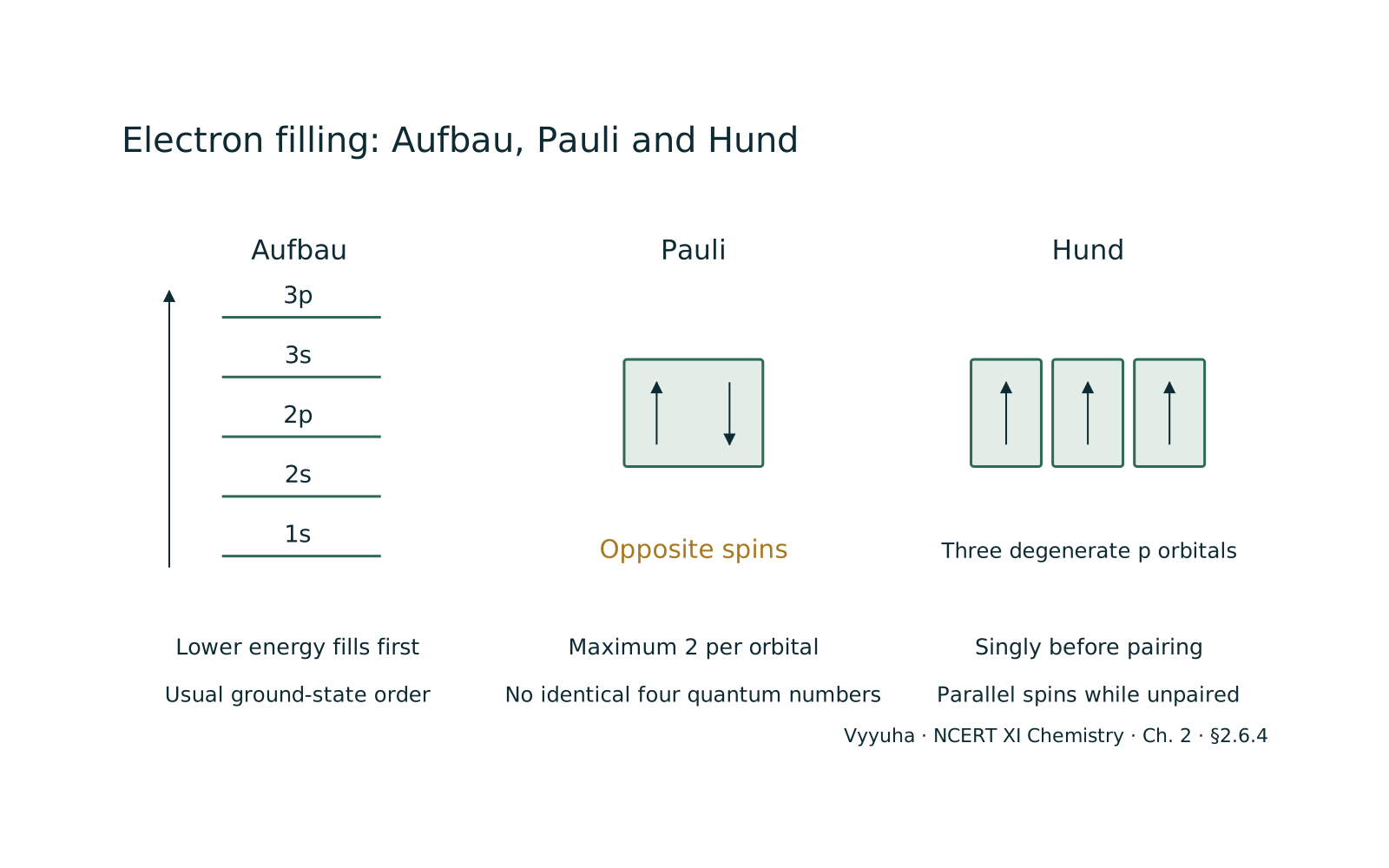
'Aufbau' is a German word meaning 'building up.' This principle dictates that in the ground state of an atom, electrons fill atomic orbitals in order of increasing energy. The orbital with the lowest energy is filled first, followed by the next lowest, and so on. This sequential filling ensures the atom is in its most stable energy state.
Order of Filling: The relative energies of orbitals are not always straightforward. While orbitals with lower principal quantum numbers () generally have lower energy, the overlap of energy levels for higher values means that a orbital, for instance, is often lower in energy than a orbital. The empirical rule used to predict the order of filling is the ** rule** (also known as the Madelung rule or Klechkovsky rule):
- Rule 1: — Orbitals are filled in increasing order of the sum . For example, a orbital has , while a orbital has .
- Rule 2: — If two orbitals have the same value, the orbital with the lower principal quantum number () is filled first. Following the previous example, since () has a lower than (), is filled before .
This leads to the familiar sequence:
Example: For Carbon (Z=6):
- First two electrons go into orbital:
- Next two electrons go into orbital:
- Remaining two electrons go into orbital:
2. Pauli's Exclusion Principle: The Quantum Number Uniqueness
Proposed by Wolfgang Pauli in 1925, this principle is a cornerstone of quantum mechanics. It states that **no two electrons in the same atom can have identical values for all four of their quantum numbers (, , , and )**. This seemingly abstract rule has a very concrete and practical consequence: an atomic orbital can hold a maximum of two electrons, and these two electrons must have opposite spins.
- Principal quantum number ($n$): — Defines the electron shell and energy level.
- Azimuthal (or angular momentum) quantum number ($l$): — Defines the subshell and shape of the orbital (s, p, d, f).
- Magnetic quantum number ($m_l$): — Defines the specific orbital within a subshell and its orientation in space.
- Spin quantum number ($m_s$): — Defines the intrinsic angular momentum of an electron, which can be either (spin up) or (spin down).
If two electrons occupy the same orbital, they must have identical , , and values. To satisfy Pauli's Exclusion Principle, their values must be different. Thus, one electron will have and the other . This is why electrons in an orbital are depicted with opposite spin arrows ().
Example: For a orbital:
- Electron 1:
- Electron 2:
No third electron can enter the orbital because it would have to duplicate one of these sets of quantum numbers, violating the principle.
3. Hund's Rule of Maximum Multiplicity: Filling Degenerate Orbitals
Hund's Rule, formulated by Friedrich Hund, addresses how electrons fill orbitals within a subshell when there are multiple orbitals of the same energy (degenerate orbitals). For example, a subshell has three degenerate orbitals (), a subshell has five, and an subshell has seven.
The rule states: When filling a set of degenerate orbitals, electrons will first occupy each orbital singly with parallel spins before any orbital is doubly occupied. This means that electrons will spread out among the available degenerate orbitals, each taking its own orbital with the same spin direction, before any orbital gets a second electron with opposite spin.
Why parallel spins? This arrangement maximizes the total spin multiplicity (, where is the total spin angular momentum). A higher multiplicity generally corresponds to a more stable state. This stability arises because electrons with parallel spins tend to avoid each other more effectively (due to quantum mechanical exchange energy), thus reducing electron-electron repulsion. Reduced repulsion means lower energy and greater stability.
Example: For Nitrogen (Z=7), electron configuration
- : Two electrons in (paired, opposite spins).
- : Two electrons in (paired, opposite spins).
- : The three electrons will occupy each of the three orbitals () singly, and all with parallel spins (e.g., all spin up).
(Correct for ) (Incorrect, violates Hund's Rule)
Example: For Oxygen (Z=8), electron configuration
- : Same as Nitrogen.
- : The first three electrons occupy singly with parallel spins. The fourth electron then pairs up with one of the electrons in one of the orbitals, but with opposite spin.
(Correct for )
Real-World Applications and Significance
These three principles are not just theoretical constructs; they have profound implications for understanding the physical and chemical world:
- Chemical Bonding: — The number of valence electrons (outermost shell electrons) and their arrangement dictates how atoms interact to form molecules. These rules explain why certain elements form specific types of bonds and exhibit particular valencies.
- Periodic Table Structure: — The periodic table is a direct consequence of these rules. The blocks (s, p, d, f) correspond to the filling of specific subshells, and the periodicity of chemical properties arises from recurring outer electron configurations.
- Magnetic Properties: — Elements with unpaired electrons (due to Hund's Rule) are paramagnetic (attracted to a magnetic field), while those with all electrons paired are diamagnetic (repelled by a magnetic field). This is directly predictable from electron configurations.
- Spectroscopy: — The energy levels and transitions between them, which are observed in atomic spectra, are governed by these electron arrangements.
Common Misconceptions and NEET-Specific Angle
- Exceptions to Aufbau Principle: — While Aufbau provides a general order, there are notable exceptions, particularly for transition metals like Chromium (Cr, Z=24) and Copper (Cu, Z=29). Instead of for Cr, it's , and instead of for Cu, it's . This occurs because half-filled () and completely filled () subshells exhibit extra stability due to symmetry and exchange energy. NEET often tests these exceptions.
- Incorrect $(n+l)$ rule application: — Students sometimes misapply the rule, especially when values are similar. Always remember that if is the same, the orbital with lower is filled first.
- Violating Hund's Rule: — A common mistake is to pair electrons in degenerate orbitals before all orbitals are singly occupied, or to assign non-parallel spins to singly occupied orbitals.
- Confusing Pauli's Principle with Hund's Rule: — Pauli's principle limits the number of electrons per orbital (max 2, opposite spins). Hund's rule dictates how electrons are distributed among degenerate orbitals (single occupancy first, parallel spins).
- Quantum Numbers: — NEET questions frequently combine these principles with the concept of quantum numbers, asking to identify valid or invalid sets of quantum numbers for electrons in a given configuration, or to determine the number of unpaired electrons.
Often confused with
Side-by-side differences the NEET paper likes to test.
| Aspect | Aufbau Principle, Pauli's Exclusion Principle and Hund's Rule | Pauli's Exclusion Principle and Hund's Rule |
|---|---|---|
| Primary Focus | Aufbau Principle | Pauli's Exclusion Principle |
| What it dictates | Order of filling orbitals based on increasing energy. | Maximum number of electrons per orbital and their spin states. |
| Key Statement | Electrons fill lowest energy orbitals first (e.g., $(n+l)$ rule). | No two electrons in an atom can have the same set of four quantum numbers (max 2 electrons/orbital, opposite spins). |
| Application Scope | Determines the overall sequence of orbital filling for an atom. | Applies to any single orbital, limiting its electron capacity. |
| Example (for $2p^3$) | Ensures $1s, 2s$ are filled before $2p$. | Each $2p$ orbital can hold $\uparrow\downarrow$ (max 2 electrons). |
While all three principles are crucial for determining electron configurations, they address distinct aspects. The Aufbau Principle sets the overall energy hierarchy for orbital filling. Pauli's Exclusion Principle defines the fundamental limit of two electrons per orbital with opposite spins, ensuring each electron has a unique quantum identity.
Hund's Rule then refines the filling process for orbitals of equal energy, prioritizing single occupancy with parallel spins to maximize stability. Together, they provide a comprehensive framework for understanding atomic structure and chemical behavior.
Why it is tested: For NEET, understanding the distinct roles of each principle is vital. Questions often test the application of one principle while assuming knowledge of the others. For instance, identifying violations of Hund's rule in a given configuration, or determining the maximum number of electrons in a subshell based on Pauli's principle, or predicting the correct filling order using Aufbau and the $(n+l)$ rule. The exceptions to Aufbau (Cr, Cu) are also frequently tested.
Questions students ask
6 answered on this topic.
What is the primary purpose of the Aufbau Principle?
The primary purpose of the Aufbau Principle is to predict the ground-state electron configuration of an atom. It provides a systematic method for filling atomic orbitals with electrons, ensuring that electrons occupy the lowest available energy levels first.
This 'building up' approach helps in understanding the most stable arrangement of electrons, which in turn dictates an atom's chemical behavior and position in the periodic table. It's a foundational rule for constructing electron configurations.
How does Pauli's Exclusion Principle relate to quantum numbers?
Pauli's Exclusion Principle is directly tied to quantum numbers by stating that no two electrons in the same atom can possess an identical set of all four quantum numbers (, , , ). This means if two electrons share the same principal, azimuthal, and magnetic quantum numbers (i.
e., they are in the same orbital), they must differ in their spin quantum number (). One will have a spin of and the other , leading to the conclusion that an orbital can hold a maximum of two electrons with opposite spins.
Why do electrons prefer parallel spins in degenerate orbitals according to Hund's Rule?
Electrons prefer parallel spins in degenerate orbitals to achieve a more stable configuration. This stability arises from two main factors: reduced electron-electron repulsion and increased exchange energy.
When electrons occupy separate degenerate orbitals with parallel spins, they are spatially further apart on average, minimizing repulsive forces. Additionally, quantum mechanics dictates that electrons with parallel spins can 'exchange' positions, leading to a phenomenon called exchange energy, which is a stabilizing factor.
This combination results in a lower overall energy state for the atom.
Are there any exceptions to the Aufbau Principle, and why do they occur?
Yes, there are notable exceptions to the Aufbau Principle, primarily observed in transition metals like Chromium (Cr) and Copper (Cu). For Chromium, the expected configuration becomes .
For Copper, becomes . These exceptions occur because half-filled () and completely filled () subshells possess extra stability. This enhanced stability is attributed to greater symmetry and maximized exchange energy, which outweighs the energy cost of promoting an electron from a lower energy orbital to a higher energy orbital.
What is the significance of these principles in understanding the periodic table?
These principles are foundational to the structure and understanding of the periodic table. The Aufbau principle explains the sequential filling of shells and subshells, leading to the distinct blocks (s, p, d, f) of elements.
Pauli's Exclusion Principle limits the number of electrons per orbital, determining the maximum capacity of each subshell and shell, which in turn defines the length of each period. Hund's Rule explains the magnetic properties and stability trends within groups, especially for elements with partially filled d and f subshells.
Together, they rationalize the recurring patterns of chemical properties across the periods and down the groups.
Can an electron have all four quantum numbers identical to another electron in the same atom?
No, absolutely not. This is the core statement of Pauli's Exclusion Principle. If two electrons were to have identical values for all four quantum numbers (, , , and ), it would mean they are in the exact same quantum state, which is forbidden.
This principle is fundamental to the stability and distinct electronic structure of atoms, ensuring that each electron occupies a unique quantum state within the atom. Without it, all electrons would collapse into the lowest energy orbital.