SI Units — Explained
Detailed Explanation
The International System of Units (SI) stands as the bedrock of modern scientific and technological measurement. It is a meticulously constructed, coherent system that provides a universal language for quantifying physical phenomena. Understanding SI units is not merely about memorizing definitions; it's about grasping the underlying principles of consistency, coherence, and universality that make scientific communication and progress possible.
Conceptual Foundation: Why SI?
Before the advent of a standardized system, different regions and disciplines used various units, leading to confusion, errors, and significant barriers to international trade and scientific collaboration.
The SI system, formally established in 1960 and continuously refined by the General Conference on Weights and Measures (CGPM), addressed this by providing a single, globally accepted framework. Its core strength lies in its coherence, meaning that when base units are combined to form derived units, no numerical factors other than unity are needed.
For example, if you multiply a length in meters by a force in Newtons, you directly get energy in Joules, without any conversion factors.
Key Principles and Laws: The Seven Base Units
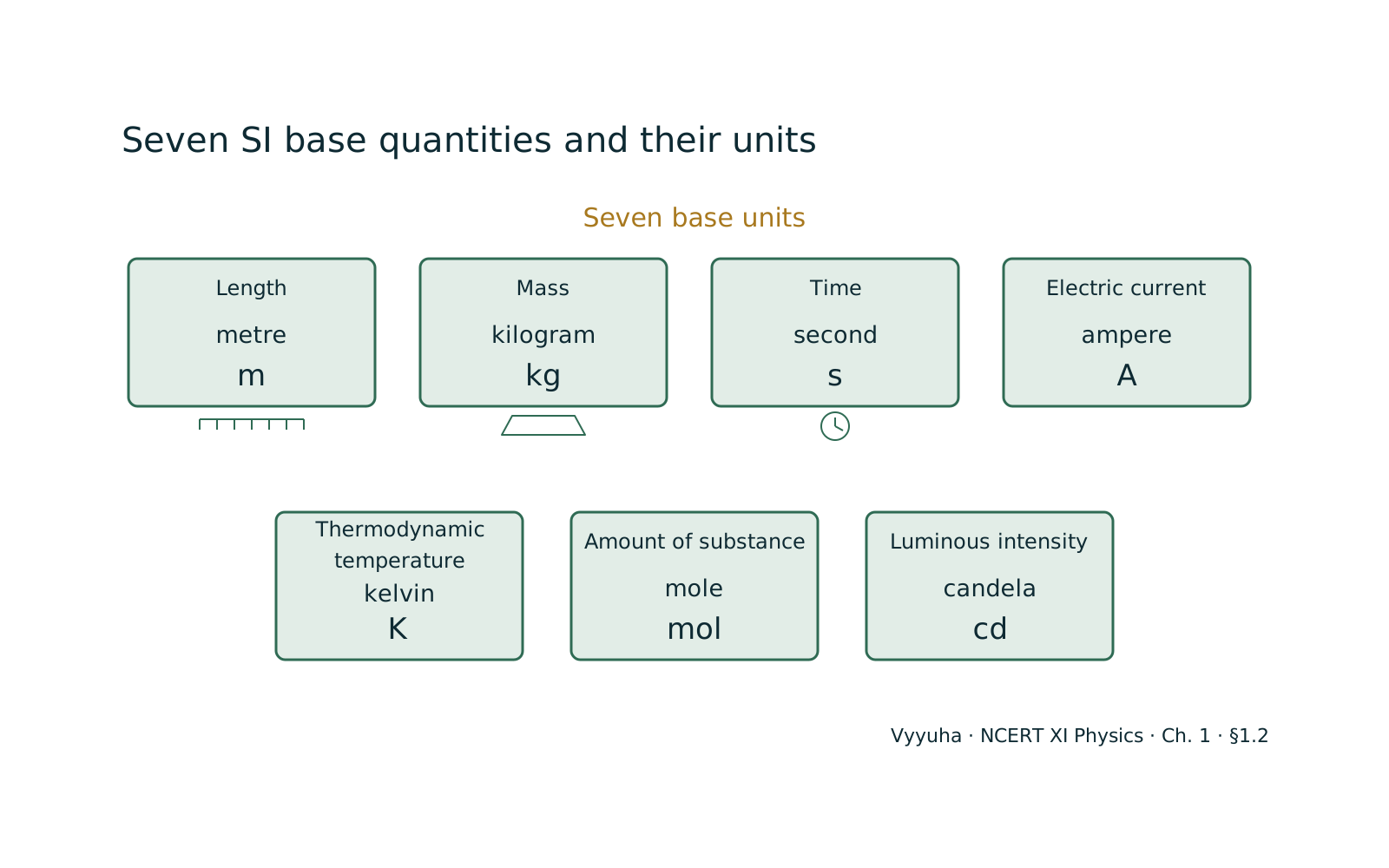
The SI system is founded upon seven independent base quantities, each with a precisely defined base unit. These definitions are crucial as they link the abstract concept of a physical quantity to a measurable, reproducible standard, often based on fundamental physical constants.
- Length: Meter (m)
* Definition: The meter is defined by taking the fixed numerical value of the speed of light in vacuum, , to be when expressed in the unit m/s, where the second is defined in terms of the caesium frequency . * Realization: This definition effectively means that a meter is the distance light travels in a vacuum in of a second. It's a highly stable and reproducible standard.
- Mass: Kilogram (kg)
* Definition: The kilogram is defined by taking the fixed numerical value of the Planck constant, , to be when expressed in the unit J\cdot s, which is equal to kg\cdot m/s, where the meter and the second are defined in terms of and .
* Realization: This definition, adopted in 2019, links the kilogram to a fundamental constant, replacing the previous physical artifact (the International Prototype of the Kilogram). It's realized using instruments like the Kibble balance.
- Time: Second (s)
* Definition: The second is defined by taking the fixed numerical value of the caesium frequency, , the unperturbed ground-state hyperfine transition frequency of the caesium-133 atom, to be when expressed in the unit Hz, which is equal to s. * Realization: This definition forms the basis of atomic clocks, providing an extremely precise and stable measure of time.
- Electric Current: Ampere (A)
* Definition: The ampere is defined by taking the fixed numerical value of the elementary charge, , to be when expressed in the unit C, which is equal to A\cdot s, where the second is defined in terms of . * Realization: This definition, also adopted in 2019, links the ampere to the charge of a single electron, a fundamental constant.
- Thermodynamic Temperature: Kelvin (K)
* Definition: The kelvin is defined by taking the fixed numerical value of the Boltzmann constant, , to be when expressed in the unit J/K, which is equal to kg\cdot m/s\cdot K, where the kilogram, meter and second are defined in terms of , and . * Realization: This definition, adopted in 2019, links temperature to the average kinetic energy of particles, a fundamental concept in statistical mechanics.
- Amount of Substance: Mole (mol)
* Definition: The mole is defined by taking the fixed numerical value of the Avogadro constant, , to be when expressed in the unit mol. * Realization: This definition, adopted in 2019, links the mole directly to a specific number of elementary entities, making it a count of particles.
- Luminous Intensity: Candela (cd)
* Definition: The candela is defined by taking the fixed numerical value of the luminous efficacy of monochromatic radiation of frequency Hz, , to be when expressed in the unit lm\cdot W, which is equal to cd\cdot sr\cdot W, or cd\cdot sr\cdot kg, where the kilogram, meter and second are defined in terms of , and .
* Realization: This unit quantifies the power emitted by a light source in a particular direction, weighted by the human eye's sensitivity.
Derived Units and Supplementary Units
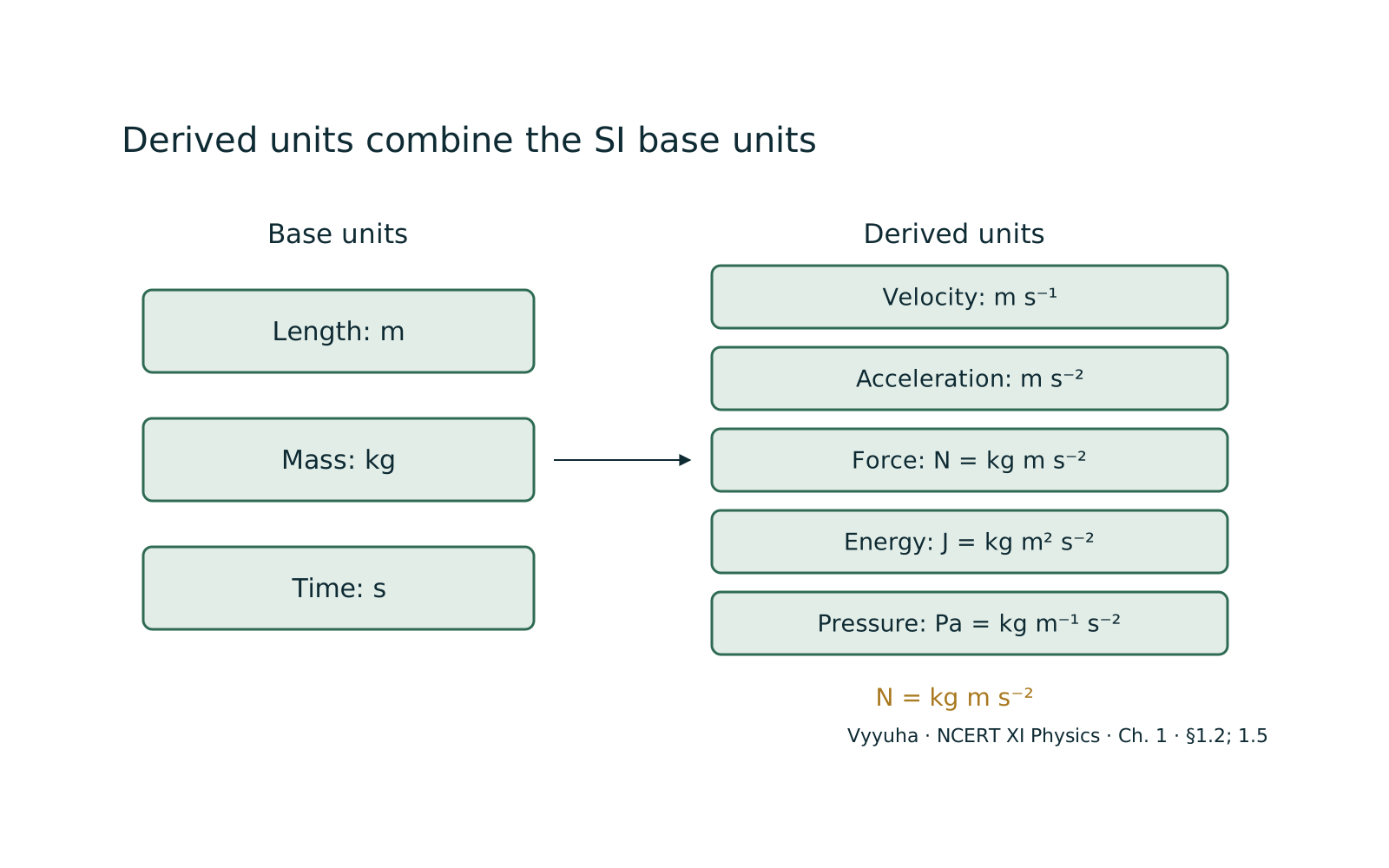
Derived units are formed by algebraically combining the base units. Examples include:
- Force: — Newton (N) = kg\cdot m/s
- Energy/Work: — Joule (J) = N\cdot m = kg\cdot m/s
- Power: — Watt (W) = J/s = kg\cdot m/s
- Pressure: — Pascal (Pa) = N/m = kg/(m\cdot s)
- Frequency: — Hertz (Hz) = s
- Electric Charge: — Coulomb (C) = A\cdot s
- Electric Potential: — Volt (V) = J/C = kg\cdot m/(A\cdot s)
Historically, there were also two 'supplementary units':
- Plane Angle: Radian (rad): — Defined as the angle subtended at the center of a circle by an arc equal in length to the radius. It is a dimensionless unit (m/m).
- Solid Angle: Steradian (sr): — Defined as the solid angle subtended at the center of a sphere by a portion of the surface whose area is equal to the square of the radius of the sphere. It is also a dimensionless unit (m/m).
While still widely used, the CGPM has clarified that these are considered derived units, specifically dimensionless derived units.
SI Prefixes
To express very large or very small quantities conveniently, SI uses a system of decimal prefixes. These prefixes are powers of 10 and are attached directly to the unit name.
| Prefix | Symbol | Factor | Example |
|---|---|---|---|
| Yotta | Y | Yottameter (Ym) | |
| Zetta | Z | Zettagram (Zg) | |
| Exa | E | Exajoule (EJ) | |
| Peta | P | Petawatt (PW) | |
| Tera | T | Terabyte (TB) | |
| Giga | G | Gigahertz (GHz) | |
| Mega | M | Megavolt (MV) | |
| Kilo | k | Kilogram (kg) | |
| Hecto | h | Hectometer (hm) | |
| Deca | da | Decameter (dam) | |
| (none) | (1) | Meter (m) | |
| Deci | d | Decimeter (dm) | |
| Centi | c | Centimeter (cm) | |
| Milli | m | Millisecond (ms) | |
| Micro | Microampere (A) | ||
| Nano | n | Nanometer (nm) | |
| Pico | p | Picofarad (pF) | |
| Femto | f | Femtosecond (fs) | |
| Atto | a | Attometer (am) | |
| Zepto | z | Zeptosecond (zs) | |
| Yocto | y | Yoctogram (yg) |
Advantages of SI Units:
- Universality: — Adopted by almost all countries, facilitating international collaboration.
- Coherence: — Derived units are formed without numerical factors, simplifying calculations.
- Rationality: — Only one unit for each physical quantity (e.g., Joule for all forms of energy).
- Decimal System: — Prefixes based on powers of 10 make conversions straightforward.
- Absolute: — Definitions are based on fundamental physical constants, ensuring stability and reproducibility.
Common Misconceptions and NEET-Specific Angle:
- Kilogram as a base unit: — Students often confuse 'gram' as the base unit because of prefixes. Remember, 'kilogram' (kg) is the base unit for mass, not gram (g).
- Dimensionless units: — Radian and steradian are dimensionless but are distinct units. They are derived units, not base units.
- Unit consistency: — In NEET problems, always ensure all quantities are converted to their respective SI units before performing calculations. Forgetting this is a common source of error. For example, if speed is given in km/h, convert it to m/s before using it in formulas involving other SI units.
- Understanding definitions: — While memorizing exact definitions might not be directly tested, understanding the concept behind each base unit's definition (e.g., meter based on speed of light, second on atomic transitions) helps in appreciating the precision of modern physics.
- Derived unit composition: — Be able to break down any derived unit into its fundamental SI base units. This is a common question type in NEET, often involving dimensional analysis.
- Prefix conversions: — Rapid and accurate conversion between prefixed units (e.g., mm to nm, \mu F to pF) is essential for numerical problems.
Often confused with
Side-by-side differences the NEET paper likes to test.
| Aspect | SI Units | Other Unit Systems (CGS, MKS, FPS) |
|---|---|---|
| System Name | International System of Units (SI) | CGS (Centimeter-Gram-Second), MKS (Meter-Kilogram-Second), FPS (Foot-Pound-Second) |
| Base Units (Length, Mass, Time) | Meter (m), Kilogram (kg), Second (s) | CGS: Centimeter (cm), Gram (g), Second (s); MKS: Meter (m), Kilogram (kg), Second (s); FPS: Foot (ft), Pound (lb), Second (s) |
| Coherence | Highly coherent; derived units formed without numerical factors. | CGS: Coherent within its mechanical units, but often requires factors for electromagnetic units (e.g., Gaussian CGS). MKS: Precursor to SI, coherent for mechanical units. FPS: Less coherent, often requires conversion factors. |
| Universality/Adoption | Globally adopted standard for science, technology, and commerce. | CGS: Historically used in some scientific fields, now largely superseded by SI. MKS: Largely superseded by SI. FPS: Primarily used in the United States for everyday measurements. |
| Number of Base Units | Seven (including electrical, temperature, amount of substance, luminous intensity). | Typically three for mechanical quantities (length, mass, time); CGS and MKS extended to include electrical units but less systematically than SI. |
| Definition Basis | Based on fundamental physical constants (post-2019 redefinition). | Historically based on physical artifacts or specific phenomena, less precise and reproducible than modern SI definitions. |
The SI system stands out due to its comprehensive nature, coherence, and universal adoption, making it the preferred system for scientific and technical work worldwide. Unlike CGS, MKS, and FPS, which primarily focused on mechanical units and often lacked a fully coherent framework for electromagnetism or other fields, SI provides a unified system of seven base units and consistently derived units.
Its modern definitions, rooted in fundamental physical constants, ensure unparalleled precision and reproducibility, overcoming the limitations of older systems that relied on physical prototypes or less rigorous definitions.
For NEET, understanding SI is paramount, as all problems and solutions are expected to be in SI units.
Why it is tested: For NEET, understanding SI units is fundamental. While historical systems like CGS or FPS might be mentioned for context, all calculations and conceptual questions will invariably use SI units. The key relevance is to ensure students can correctly identify SI base and derived units, perform conversions within the SI system (using prefixes), and maintain unit consistency in all numerical problems. Questions often involve identifying the correct SI unit for a given physical quantity or expressing a derived unit in terms of base units.
Questions students ask
6 answered on this topic.
What are the seven base units of the SI system and what quantities do they measure?
The seven base units of the SI system are the fundamental building blocks of all measurements. They are: meter (m) for length, kilogram (kg) for mass, second (s) for time, ampere (A) for electric current, kelvin (K) for thermodynamic temperature, mole (mol) for amount of substance, and candela (cd) for luminous intensity. Each of these units is precisely defined based on fundamental physical constants, ensuring their universal and reproducible nature.
How do derived units differ from base units in the SI system?
Base units are independent units for fundamental physical quantities that cannot be expressed in terms of other units. Derived units, on the other hand, are formed by combining base units through multiplication or division.
For example, the meter is a base unit, but the unit for speed, meters per second (m/s), is a derived unit. Similarly, the Newton (N) for force is derived from kilograms, meters, and seconds (kg\cdot m/s).
All physical quantities apart from the seven base quantities have derived units.
Why is the kilogram, and not the gram, the base unit for mass in the SI system?
This is a historical anomaly. When the metric system was first developed, the gram was initially considered the base unit. However, the original prototype for mass was a cylinder of platinum-iridium alloy, which was defined as one kilogram. To avoid changing the established standard and to maintain coherence with other units, the kilogram was formally adopted as the base unit for mass. All other mass units are then derived using prefixes relative to the kilogram (e.g., 1 gram = kg).
What is the significance of SI prefixes, and how are they used?
SI prefixes are crucial for expressing very large or very small quantities conveniently without using cumbersome powers of ten. They are symbols that represent specific powers of 10 and are attached directly to the unit name.
For instance, 'kilo' (k) means , so 1 kilometer (km) is meters. 'Nano' (n) means , so 1 nanometer (nm) is meters. This system simplifies numerical representation and makes unit conversions straightforward, enhancing clarity in scientific and engineering contexts.
Are radian and steradian considered base units or derived units in SI?
Historically, radian (for plane angle) and steradian (for solid angle) were classified as 'supplementary units'. However, the General Conference on Weights and Measures (CGPM) clarified in 1995 that these are to be considered dimensionless derived units.
They are dimensionless because they are ratios of two lengths (for radian, arc length/radius) or two areas (for steradian, surface area/radius), making their fundamental dimensions . Despite being dimensionless, they are distinct units used to specify angular measures.
Why are the definitions of SI units periodically revised?
The definitions of SI units are revised to keep pace with advancements in scientific understanding and technological capabilities. Initially, some units were defined based on physical artifacts (like the original kilogram prototype) or specific experimental setups, which could be prone to drift or difficult to reproduce with ultimate precision.
Modern revisions, particularly those in 2019, link all base units to fundamental physical constants (like the speed of light, Planck constant, elementary charge). This makes the definitions inherently stable, universally accessible, and allows for their realization with the highest possible accuracy anywhere in the world, fostering greater precision in science and technology.