Velocity and Acceleration — Explained
Detailed Explanation
The study of motion, without considering the forces causing it, is known as kinematics. Velocity and acceleration are two fundamental kinematic quantities that allow us to precisely describe how an object's position changes over time. These concepts are crucial for understanding everything from the trajectory of a projectile to the motion of planets.
1. Conceptual Foundation: Describing Motion
Motion is inherently about change in position. To quantify this change, we first need to establish a reference frame. Once a reference point (origin) and a set of coordinate axes are defined, an object's position can be specified.
As an object moves, its position vector changes. The path length covered is the distance, a scalar quantity. The change in position vector, from initial to final point, is the displacement, a vector quantity.
Velocity and acceleration are derived from these fundamental ideas.
2. Key Principles and Definitions
- Speed: — Speed is a scalar quantity that measures how fast an object is moving, irrespective of direction. It is the rate at which distance is covered.
* Average Speed: Total distance covered divided by the total time taken. \( \text{Average Speed} = \frac{\text{Total Distance}}{\text{Total Time}} \) * Instantaneous Speed: The magnitude of the instantaneous velocity at any given moment.
- Velocity: — Velocity is a vector quantity that describes both the speed and direction of an object's motion. It is the rate of change of displacement.
* Average Velocity (\( \vec{v}_{avg} \)): Defined as the total displacement (change in position) divided by the total time interval over which the displacement occurred.
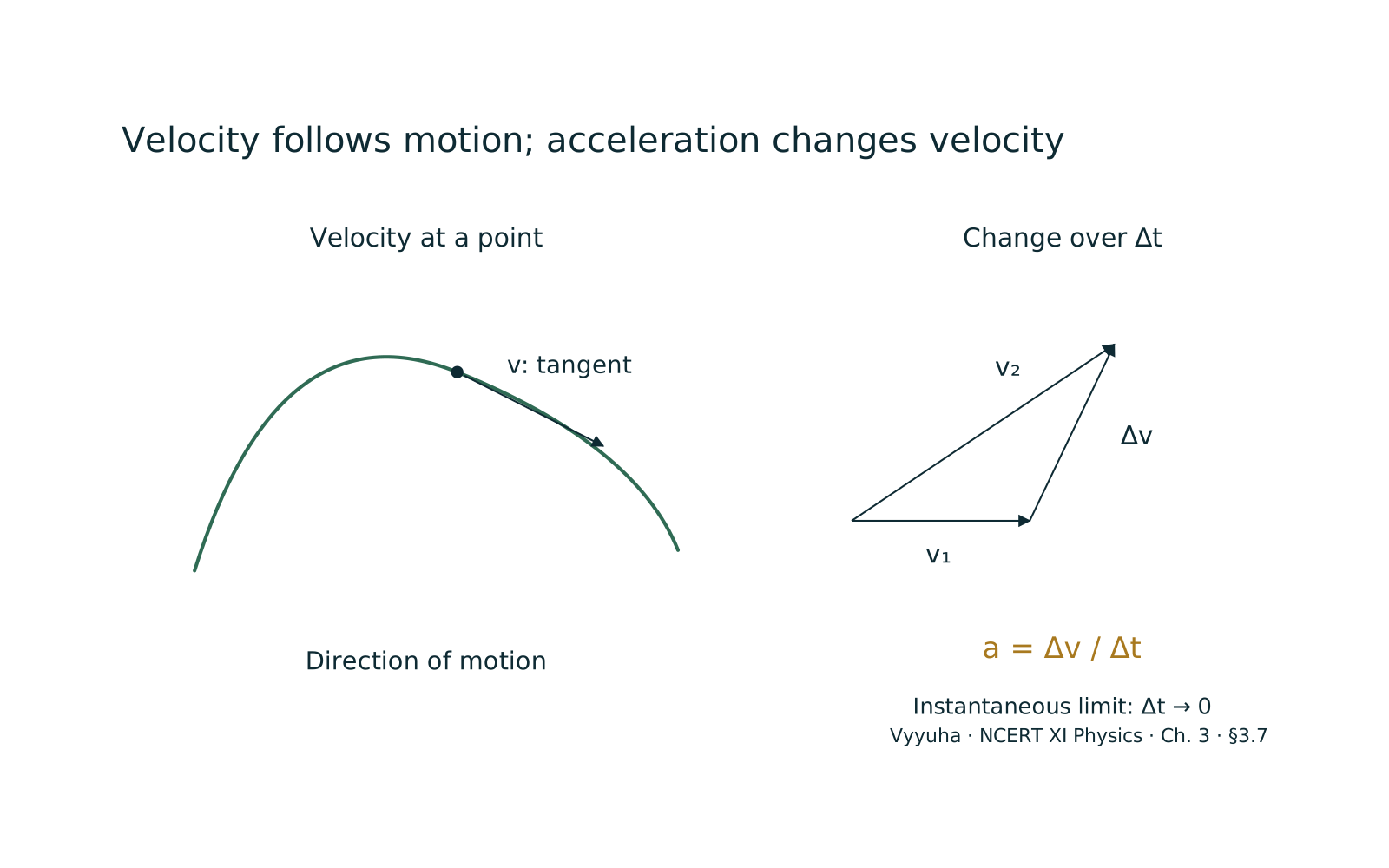
* Instantaneous Velocity (\( \vec{v} \)): This is the velocity of an object at a specific instant in time. It is the limit of the average velocity as the time interval approaches zero. Mathematically, it is the first derivative of the position vector with respect to time.
The direction of instantaneous velocity is always tangent to the path of motion.
- Acceleration: — Acceleration is a vector quantity that describes the rate of change of an object's velocity. An object accelerates if its speed changes, its direction changes, or both.
* Average Acceleration (\( \vec{a}_{avg} \)): Defined as the total change in velocity divided by the total time interval over which the change occurred.
* Instantaneous Acceleration (\( \vec{a} \)): This is the acceleration of an object at a specific instant in time. It is the limit of the average acceleration as the time interval approaches zero.
Mathematically, it is the first derivative of the velocity vector with respect to time, or the second derivative of the position vector with respect to time.
If position is \( x(t) \), then \( a(t) = \frac{d^2x}{dt^2} \).
3. Derivations and Graphical Interpretations
- From Position to Velocity to Acceleration (Calculus Approach):
If an object's position is given as a function of time, \( x(t) \), then: Instantaneous velocity: \( v(t) = \frac{dx}{dt} \) (the slope of the position-time graph). Instantaneous acceleration: \( a(t) = \frac{dv}{dt} = \frac{d}{dt} \left( \frac{dx}{dt} \right) = \frac{d^2x}{dt^2} \) (the slope of the velocity-time graph).
- From Acceleration to Velocity to Position (Integration Approach):
Conversely, if acceleration is known, we can find velocity and position by integration: Change in velocity: \( \Delta v = \int a(t) dt \) (the area under the acceleration-time graph). Change in position (displacement): \( \Delta x = \int v(t) dt \) (the area under the velocity-time graph).
- Graphical Analysis:
* Position-Time (x-t) Graph: * Slope represents instantaneous velocity. A steeper slope means higher speed. A horizontal line means zero velocity (at rest). A straight line with a non-zero slope means constant velocity (zero acceleration).
A curved line means changing velocity (non-zero acceleration). * Velocity-Time (v-t) Graph: * Slope represents instantaneous acceleration. A steeper slope means higher acceleration. A horizontal line means constant velocity (zero acceleration).
A straight line with a non-zero slope means constant acceleration. A curved line means changing acceleration. * Area under the curve represents displacement. Area above the x-axis is positive displacement, below is negative.
* Acceleration-Time (a-t) Graph: * Area under the curve represents change in velocity. Area above the x-axis means increase in velocity (in the positive direction), below means decrease.
4. Real-World Applications
- Automotive Industry: — Car manufacturers design engines to provide specific acceleration profiles. Speedometers measure instantaneous speed, while cruise control maintains constant velocity (zero acceleration).
- Sports: — Athletes analyze their velocity and acceleration to optimize performance, e.g., sprinters' initial acceleration, projectile motion in basketball or javelin throw.
- Aerospace: — Rocket launches involve precise control of acceleration to achieve desired orbital velocities. Aircraft use accelerometers for navigation and flight control.
- Safety: — Understanding acceleration is critical in designing safety features like airbags, which aim to reduce the acceleration (and thus the force) experienced by occupants during a collision.
- Weather Forecasting: — Tracking the velocity and acceleration of weather systems helps predict their path and intensity.
5. Common Misconceptions
- Speed vs. Velocity: — Often used interchangeably in everyday language, but in physics, velocity includes direction. A car moving at a constant speed around a curve has changing velocity and thus is accelerating.
- Zero Velocity vs. Zero Acceleration: — An object can have zero velocity at an instant (e.g., at the peak of its trajectory when thrown upwards) but still be accelerating (due to gravity). Conversely, an object can have constant velocity (non-zero) and zero acceleration.
- Negative Acceleration means Slowing Down: — Not always. If an object is moving in the negative direction (e.g., left or downwards) and its acceleration is also negative, it is actually speeding up in the negative direction. Negative acceleration means acceleration is in the negative direction, which could be opposite to velocity (slowing down) or in the same direction as velocity (speeding up).
- Acceleration is always in the direction of motion: — No. Acceleration is in the direction of the change in velocity. When a ball is thrown upwards, its velocity is upwards, but acceleration (due to gravity) is downwards.
6. NEET-Specific Angle
For NEET, a strong grasp of graphical analysis (x-t, v-t, a-t graphs) is paramount. Questions frequently involve interpreting these graphs to find displacement, velocity, or acceleration, or to sketch one graph given another.
Calculus-based problems, especially involving polynomial functions for position or velocity, are common. Understanding the vector nature of velocity and acceleration, particularly in scenarios where direction changes (even if speed is constant), is also a frequent testing point.
Pay close attention to the signs of velocity and acceleration, as they indicate direction and whether an object is speeding up or slowing down. Mastering the relationship between average and instantaneous quantities, and their graphical representations, is key to scoring well in this section.
Often confused with
Side-by-side differences the NEET paper likes to test.
| Aspect | Velocity and Acceleration | Speed and Velocity |
|---|---|---|
| Definition | Speed: Rate of covering distance. | Velocity: Rate of change of displacement. |
| Nature | Speed: Scalar quantity (magnitude only). | Velocity: Vector quantity (magnitude and direction). |
| Change | Speed changes if magnitude of velocity changes. | Velocity changes if magnitude or direction (or both) change. |
| Can be zero? | Instantaneous speed cannot be negative. Average speed is always non-negative. | Instantaneous velocity can be positive, negative, or zero. Average velocity can be zero if displacement is zero. |
| Relation to path | Depends on the actual path length (distance). | Depends on the straight-line path from start to end (displacement). |
The primary distinction between speed and velocity lies in their vector nature. Speed quantifies 'how fast' an object is moving, considering only the magnitude of its motion. Velocity, however, provides a more complete description by including 'how fast' and 'in what direction'.
This means an object can maintain a constant speed but have a changing velocity if its direction of motion alters, leading to acceleration. For NEET, recognizing this vector difference is crucial, especially in problems involving turns or circular motion where speed might be constant but velocity is not.
Why it is tested: For NEET, understanding the vector nature of velocity versus the scalar nature of speed is fundamental. Questions often test this distinction, particularly in scenarios where an object's direction changes, even if its speed remains constant. This concept is vital for correctly identifying instances of acceleration and for interpreting motion graphs. It forms the basis for understanding more complex topics like projectile motion and circular motion.
Questions students ask
5 answered on this topic.
What is the difference between speed and velocity?
Speed is a scalar quantity that measures how fast an object is moving, defined as the distance covered per unit time. It only has magnitude. For example, a car traveling at 60 km/h. Velocity, on the other hand, is a vector quantity that describes both the speed and the direction of an object's motion.
It is defined as the displacement per unit time. So, a car traveling at 60 km/h North has a specific velocity. If the car turns East but maintains 60 km/h, its speed remains constant, but its velocity changes because its direction has changed.
Can an object have zero velocity but non-zero acceleration?
Yes, absolutely. A classic example is an object thrown vertically upwards. At the very peak of its trajectory, just before it starts falling back down, its instantaneous velocity is momentarily zero. However, throughout its entire flight (both upwards and downwards), it is continuously under the influence of gravity, meaning it experiences a constant downward acceleration of approximately \( 9.8 \text{ m/s}^2 \). So, at that instant of zero velocity, its acceleration is definitely non-zero.
What does it mean if acceleration is negative?
Negative acceleration simply means that the acceleration vector is pointing in the negative direction, as defined by your chosen coordinate system. It does not automatically mean the object is slowing down.
If an object is moving in the positive direction (positive velocity) and its acceleration is negative, then it is indeed slowing down (decelerating). However, if an object is already moving in the negative direction (negative velocity) and its acceleration is also negative, then it is actually speeding up in the negative direction.
The key is to compare the directions of velocity and acceleration: if they are opposite, the object slows down; if they are in the same direction, it speeds up.
How can I distinguish between average and instantaneous values?
Average values (like average velocity or average acceleration) describe the overall motion or change over a finite time interval. They are calculated by dividing the total change (displacement or velocity change) by the total time taken.
Instantaneous values, however, describe the motion or change at a specific, single moment in time. They are obtained by taking the limit of the average value as the time interval approaches zero, which mathematically corresponds to the derivative of the quantity with respect to time.
Think of average as a summary of a trip, and instantaneous as what your speedometer shows right now.
Why is graphical analysis important for velocity and acceleration?
Graphical analysis provides a powerful visual tool to understand and solve problems related to motion. Position-time (x-t) graphs, velocity-time (v-t) graphs, and acceleration-time (a-t) graphs allow us to quickly interpret relationships.
For instance, the slope of an x-t graph gives velocity, and the slope of a v-t graph gives acceleration. The area under a v-t graph gives displacement, and the area under an a-t graph gives change in velocity.
This visual representation often simplifies complex problems and is a frequently tested skill in NEET.