Kinematic Equations — Explained
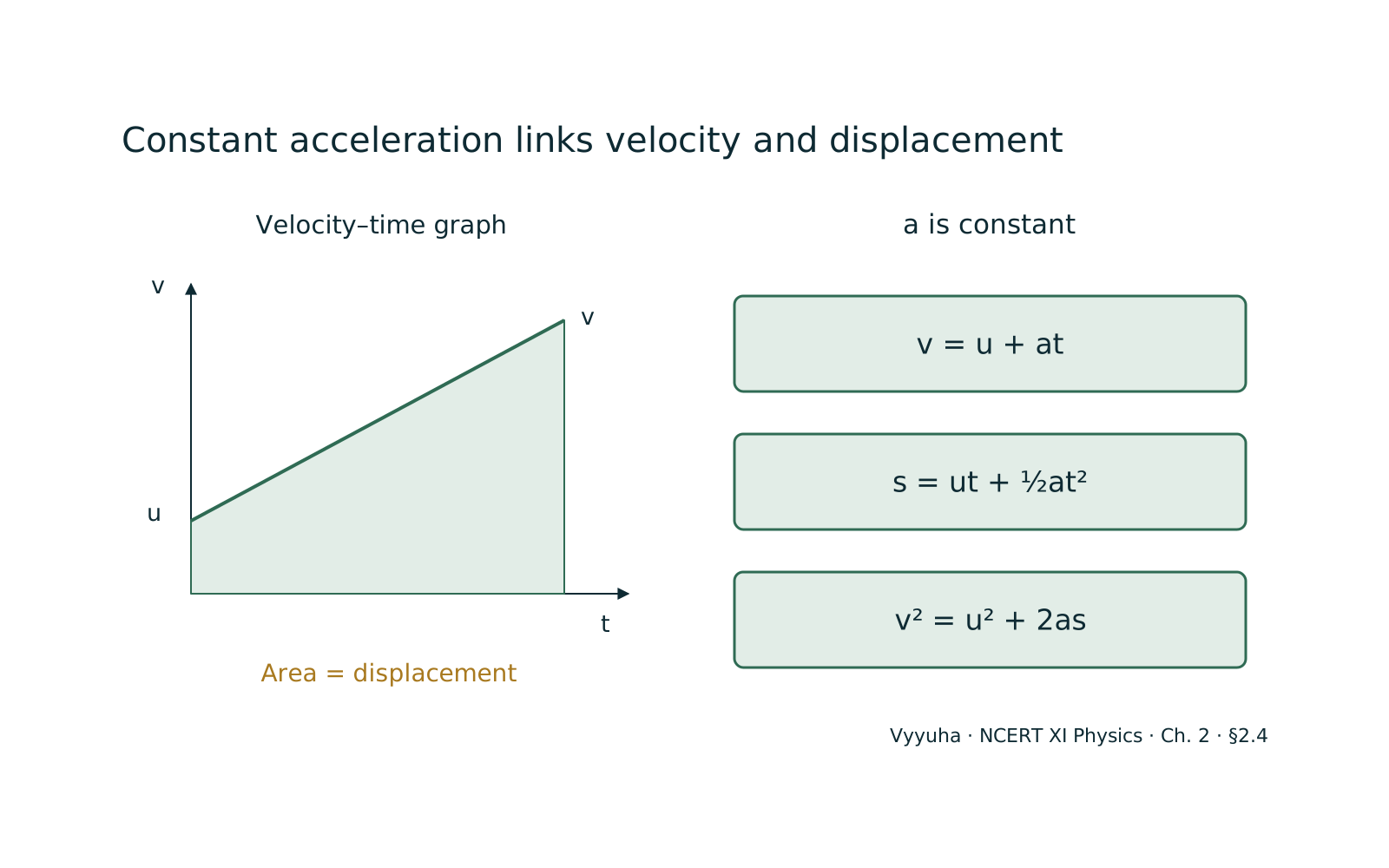
Detailed Explanation
Kinematic equations form the bedrock of understanding motion in classical mechanics, particularly for scenarios involving constant acceleration. They provide a quantitative framework to describe and predict the trajectory of objects without delving into the forces causing the motion (which is the domain of dynamics). Mastering these equations is non-negotiable for any NEET aspirant.
Conceptual Foundation
Before diving into the equations, let's revisit the fundamental concepts:
- Position — The location of an object in space, often represented by a coordinate ( or ).
- Displacement ($s$) — The change in position of an object. It's a vector quantity, meaning it has both magnitude and direction. , where is final position and is initial position.
- Velocity ($v$) — The rate of change of displacement. It's also a vector quantity. Average velocity is . Instantaneous velocity is the velocity at a specific moment in time, given by the derivative of position with respect to time, .
- Speed — The magnitude of velocity. It's a scalar quantity.
- Acceleration ($a$) — The rate of change of velocity. It's a vector quantity. Average acceleration is . Instantaneous acceleration is the acceleration at a specific moment, given by the derivative of velocity with respect to time, .
The kinematic equations are specifically derived under the assumption that acceleration () is constant. This simplifies the calculus involved and allows for algebraic solutions.
Key Principles and Derivations
There are three primary kinematic equations, and a fourth useful one for displacement in the second. Let's derive them step-by-step.
Variables Used:
- : Initial velocity
- : Final velocity
- : Constant acceleration
- : Time interval
- : Displacement
1. First Kinematic Equation: Relating $v$, $u$, $a$, and $t$
By definition, acceleration is the rate of change of velocity. If acceleration is constant, we can write:
2. Second Kinematic Equation: Relating $s$, $u$, $a$, and $t$
For an object moving with constant acceleration, its average velocity can be expressed as the arithmetic mean of its initial and final velocities:
3. Third Kinematic Equation: Relating $v$, $u$, $a$, and $s$
This equation is useful when time () is not known or not required. We can derive it by combining the first two equations. From the first equation, , we can express as:
4. Displacement in the $n^{th}$ Second ($s_n$)
Sometimes, we need to find the displacement covered only during a specific second (e.g., the 5th second). This is not the total displacement after 5 seconds, but the displacement between seconds and seconds.
Displacement in the second () is the total displacement after seconds () minus the total displacement after seconds (). Using :
Real-World Applications
Kinematic equations are widely applicable:
- Free Fall — Objects falling under gravity experience constant acceleration ( downwards). These equations can predict the time to hit the ground, final velocity, or height from which an object was dropped.
- Vehicle Motion — Analyzing a car accelerating from a traffic light, braking to a stop, or a train speeding up on a straight track.
- Sports — Calculating the trajectory of a shotput or a long jump (though 2D kinematics is needed, the principles are the same for each dimension).
- Engineering — Designing safe braking systems, calculating required runway length for aircraft, or analyzing the motion of parts in machinery.
Common Misconceptions and Pitfalls
- Non-Constant Acceleration — The most critical mistake is applying these equations when acceleration is not constant. If acceleration varies, calculus (integration) is required.
- Sign Conventions — Direction matters! It's crucial to consistently define a positive direction (e.g., upwards or rightwards). If initial velocity is positive, and acceleration is in the opposite direction (e.g., braking), acceleration must be negative. Displacement can also be negative if the final position is behind the initial position.
* Example: A ball thrown upwards. If 'up' is positive, initial velocity is positive, but acceleration due to gravity (negative because gravity acts downwards).
- Confusing Distance and Displacement — In straight-line motion, if an object changes direction, the total distance covered will be greater than the magnitude of its displacement. Kinematic equations directly calculate displacement (), not total distance.
- Units — Always ensure all quantities are in consistent units (e.g., meters, seconds, m/s, m/s). Mixing km/h with m/s will lead to incorrect answers.
- Initial Conditions — Carefully read the problem to identify the correct initial velocity (). 'Starts from rest' means . 'Comes to a stop' means .
NEET-Specific Angle
NEET questions often test your ability to:
- Choose the correct equation — Given three variables, identify which equation will directly solve for the fourth, minimizing steps.
- Apply sign conventions correctly — Especially in problems involving gravity or braking.
- Interpret graphs — Relate graphs to acceleration (slope) and displacement (area under curve). A straight line on a graph indicates constant acceleration, making kinematic equations applicable.
- Solve multi-stage problems — A problem might involve two phases of motion (e.g., acceleration, then constant velocity, then deceleration). You'll need to apply kinematic equations to each phase separately, using the final velocity of one phase as the initial velocity for the next.
- Relative motion — While not directly kinematic equations, understanding how these equations apply to individual objects is a prerequisite for relative motion problems.
- Free fall variations — Questions involving objects dropped from height, thrown upwards, or falling from a moving platform are common. Remember .
Often confused with
Side-by-side differences the NEET paper likes to test.
| Aspect | Kinematic Equations | Motion with Constant Velocity |
|---|---|---|
| Acceleration | Constant Acceleration Motion | Constant Velocity Motion |
| Velocity | Changes uniformly over time ($v = u + at$) | Remains constant ($v = u$) |
| Equations Used | Kinematic equations ($v=u+at$, $s=ut+\frac{1}{2}at^2$, $v^2=u^2+2as$) | Simple distance formula ($s = vt$) |
| Graphical Representation (v-t graph) | Straight line with non-zero slope | Horizontal straight line (zero slope) |
| Graphical Representation (x-t graph) | Parabolic curve | Straight line with non-zero slope |
The fundamental difference lies in the acceleration. In constant acceleration motion, velocity changes linearly with time, requiring the full set of kinematic equations. In contrast, constant velocity motion is a special case where acceleration is zero, simplifying the kinematic equations to just (since ).
Understanding this distinction is crucial for selecting the appropriate formulas and interpreting motion graphs. Constant velocity motion is essentially a subset of constant acceleration motion where .
Why it is tested: For NEET, distinguishing between these two types of motion is critical for correctly applying the relevant formulas and interpreting motion graphs. Many problems involve phases of both constant velocity and constant acceleration, requiring students to switch between these conceptual frameworks.
Questions students ask
5 answered on this topic.
When can I use kinematic equations?
You can use kinematic equations exclusively when the acceleration of the object is constant. This is a crucial condition. If the acceleration is changing over time, these simple algebraic equations are not applicable, and you would need to use calculus (integration) to solve for position and velocity. Always check the problem statement for keywords like 'constant acceleration,' 'uniform acceleration,' or scenarios like free fall where acceleration due to gravity is constant.
What is the difference between distance and displacement in the context of kinematic equations?
Kinematic equations primarily deal with displacement (), which is a vector quantity representing the straight-line change in position from the start to the end point, including direction. Distance, on the other hand, is a scalar quantity representing the total path length covered.
For motion in a straight line without a change in direction, the magnitude of displacement is equal to the distance. However, if an object moves forward and then backward, its total distance will be greater than the magnitude of its displacement.
Be careful to interpret as displacement.
How do I handle negative signs in kinematic equations?
Negative signs are critical and represent direction. You must consistently define a positive direction (e.g., upwards, rightwards, or in the direction of initial motion). Then, any vector quantity (velocity, acceleration, displacement) acting in the opposite direction will be negative.
For instance, if 'up' is positive, then acceleration due to gravity () is . If a car is braking, its acceleration is opposite to its velocity, so it would be negative if velocity is positive.
What if an object starts from rest or comes to a stop?
These are common initial or final conditions that simplify problems. 'Starts from rest' means the initial velocity () is . 'Comes to a stop' or 'comes to rest' means the final velocity () is . Always look for these phrases in problem statements as they provide crucial information about one of the kinematic variables.
Can kinematic equations be used for motion in two or three dimensions?
Yes, but they are applied separately to each independent dimension. For example, in projectile motion (2D), you would apply kinematic equations to the horizontal motion (where acceleration is usually zero, assuming no air resistance) and separately to the vertical motion (where acceleration is due to gravity, ). The key is that the time () is common to both dimensions, linking them together. Each dimension must have constant acceleration for the equations to apply.