Uniform Circular Motion
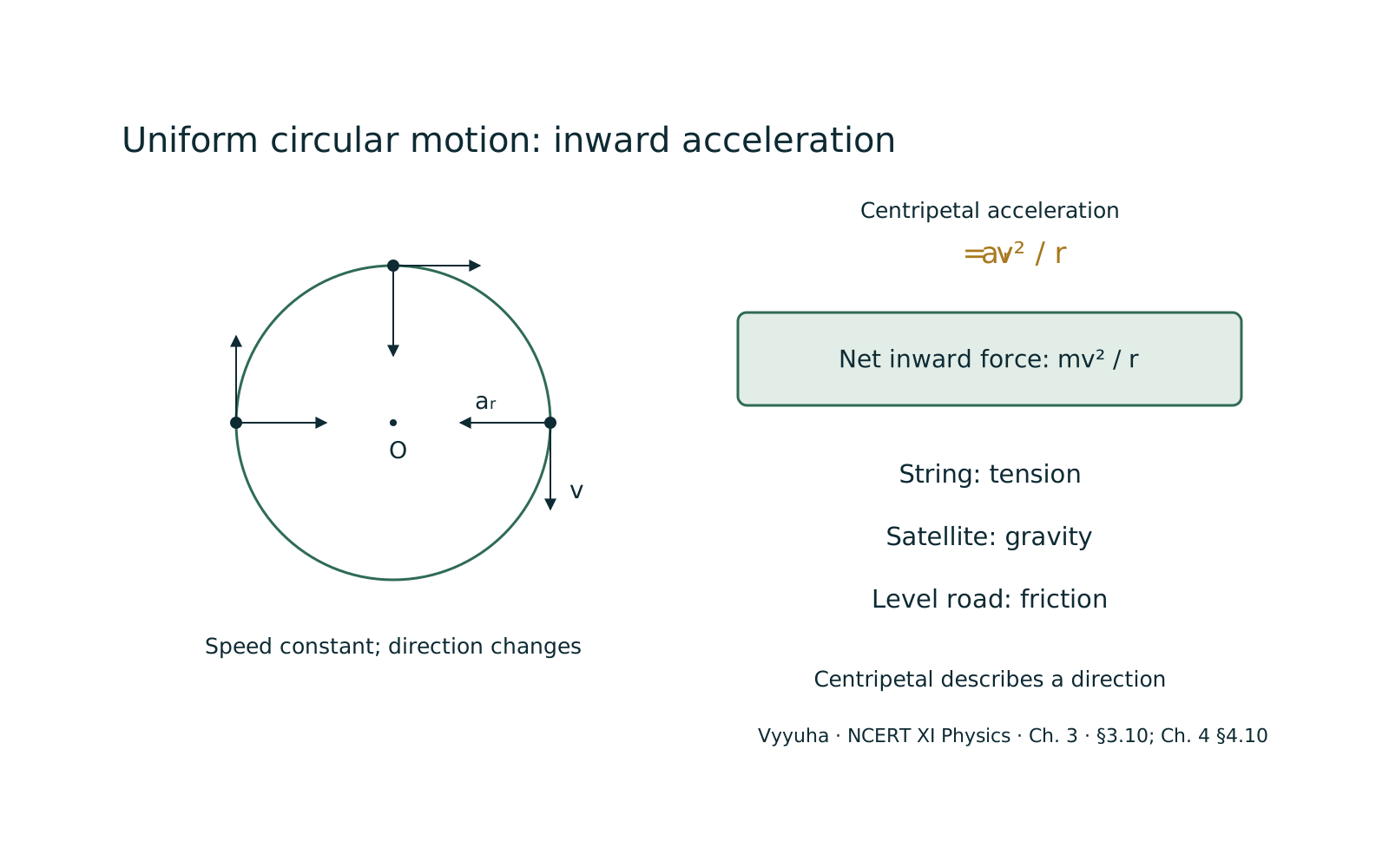
Uniform Circular Motion (UCM) describes the movement of an object along a circular path at a constant speed. While the magnitude of the velocity vector (speed) remains invariant, its direction continuously changes, always tangential to the circular path. This continuous change in direction implies the presence of an acceleration, known as centripetal acceleration, which is always directed towards …
Quick Summary
Uniform Circular Motion (UCM) describes an object moving along a circular path at a constant speed. Despite constant speed, the object's velocity is continuously changing because its direction is always tangential to the circle.
This change in velocity means the object is accelerating, and this acceleration is called centripetal acceleration (). Centripetal acceleration is always directed towards the center of the circle and has a magnitude of , where is linear speed, is the radius, and is angular speed.
According to Newton's second law, a net force, known as centripetal force (), must act on the object to cause this acceleration. This force is also directed towards the center and has a magnitude of .
It's crucial to remember that centripetal force is not a new fundamental force but rather the net effect of existing forces (like tension, friction, or gravity) that provides the necessary inward pull.
Key kinematic quantities include angular displacement (), angular velocity (), period (), and frequency (). The linear speed is related to angular speed by .
Full explanation
Uniform Circular Motion (UCM) is a fundamental concept in kinematics, describing the motion of an object along a circular path at a constant speed. While seemingly simple, it introduces crucial ideas about vectors, acceleration, and forces that are distinct from linear motion and vital for understanding more complex physical phenomena.
Conceptual Foundation
- Circular Path: — The trajectory of the object is a perfect circle. This means the distance from the object to a fixed central point (the radius, ) remains constant.
- Constant Speed: — The magnitude of the object's velocity, its speed (), does not change. The object covers equal arc lengths in equal time intervals.
- Changing Velocity: — Despite constant speed, the object's velocity is not constant. Velocity is a vector quantity, possessing both magnitude and direction. In UCM, the direction of the velocity vector is always tangential to the circular path at the object's instantaneous position. As the object moves, this tangential direction continuously changes, indicating a change in velocity.
- Acceleration: — A change in velocity (either magnitude or direction or both) implies acceleration. Since the direction of velocity is constantly changing in UCM, there must be an acceleration. This acceleration is called centripetal acceleration ().
Key Principles and Laws
A. Kinematic Quantities in UCM
- Radius Vector ($\vec{r}$): — A vector from the center of the circle to the object's position. Its magnitude is the radius , and its direction changes continuously.
- Linear Velocity ($\vec{v}$): — Always tangential to the circular path and perpendicular to the radius vector. Its magnitude is constant (), but its direction continuously changes.
- Angular Displacement ($\Delta\theta$): — The angle swept by the radius vector in a given time. Measured in radians.
- Angular Velocity ($\omega$): — The rate of change of angular displacement. It's a vector quantity, with its direction given by the right-hand thumb rule (perpendicular to the plane of motion). For UCM, is constant in magnitude and direction.
- Period ($T$): — The time taken for one complete revolution.
- Frequency ($f$): — The number of revolutions per unit time.
B. Relation Between Linear and Angular Quantities
- Linear speed and angular speed: — The linear speed of a point on the circumference is related to the angular speed and radius by:
- Linear displacement and angular displacement: — For a small angular displacement , the arc length is given by:
C. Centripetal Acceleration
As established, the changing direction of velocity necessitates an acceleration. This centripetal acceleration () is always directed towards the center of the circle and is perpendicular to the instantaneous linear velocity vector. Its magnitude is given by:
Substituting , we can also express it in terms of angular velocity:
So, the magnitude of centripetal acceleration is .
D. Centripetal Force
According to Newton's Second Law of Motion, if an object is accelerating, there must be a net force acting on it in the direction of acceleration. This force, responsible for causing centripetal acceleration, is called centripetal force (). It is also directed towards the center of the circle.
Substituting the expressions for :
It is crucial to understand that centripetal force is not a new fundamental force. Instead, it is the net force provided by other fundamental forces (like tension, friction, gravity, normal force, or electromagnetic force) that acts towards the center and causes the circular motion. For example, when a car takes a turn, the static friction between the tires and the road provides the necessary centripetal force. For a satellite orbiting Earth, gravity provides the centripetal force.
Derivations
Derivation of Centripetal Acceleration ($a_c = v^2/r$)
Consider an object moving in a circle of radius with constant speed . Let the object be at point A at time with velocity and at point B at time with velocity . Both and have magnitude . The angle between the position vectors and is . The angle between and is also .
From the definition of acceleration, .
To find , we can use vector subtraction. Construct a vector triangle with , , and . Since , this is an isosceles triangle. For a very small (and thus small ), the arc length AB is approximately . Also, the chord length AB is approximately .
Consider the triangle formed by the velocity vectors. The magnitude of can be approximated as for small . This is because the change in velocity is primarily due to the change in direction. The direction of points towards the center of the circle.
So, the magnitude of acceleration is .
From similar triangles (position vector triangle and velocity vector triangle), we have:
Substituting :
Derivation of Centripetal Force ($F_c = mv^2/r$)
This derivation is straightforward from Newton's Second Law of Motion (). Since we have derived the centripetal acceleration , the centripetal force required to produce this acceleration for an object of mass is simply:
And using , we also get:
Real-World Applications
UCM is ubiquitous in nature and technology:
- Planetary and Satellite Motion: — Planets orbit the sun, and satellites orbit Earth in approximately circular paths. The gravitational force provides the necessary centripetal force.
- Vehicles on Curved Roads: — When a car takes a turn, the static friction between the tires and the road provides the centripetal force. On banked roads, a component of the normal force also contributes.
- Amusement Park Rides: — Ferris wheels, merry-go-rounds, and centrifuges all involve UCM, where tension, normal force, or friction provide the centripetal force.
- Atoms (Bohr Model): — In the classical Bohr model of the atom, electrons are depicted as orbiting the nucleus in circular paths, with the electrostatic force providing the centripetal force.
- Centrifuges: — Used in laboratories to separate substances of different densities by spinning them rapidly, creating a large centripetal force.
Common Misconceptions
- Constant Velocity vs. Constant Speed: — The most common mistake is confusing constant speed with constant velocity. In UCM, speed is constant, but velocity is not due to changing direction.
- Centrifugal Force: — Often misunderstood as a real force pulling an object outwards. Centrifugal force is a fictitious or pseudo force that appears to act on an object in a rotating (non-inertial) frame of reference. From an inertial frame, there is only an inward centripetal force. The 'outward push' felt in a turning car is due to inertia – the tendency of your body to continue moving in a straight line while the car turns inwards.
- Centripetal Force as a New Force: — Centripetal force is not a fundamental force like gravity or electromagnetism. It is the role played by an existing force (or net force) that causes circular motion.
- Acceleration Direction: — Some students mistakenly think acceleration is tangential. In UCM, acceleration is always centripetal (towards the center).
NEET-Specific Angle
For NEET, UCM questions often test conceptual understanding as well as problem-solving skills involving calculations. Key areas to focus on include:
- Vector Nature: — Understanding the directions of velocity, acceleration, and force vectors is crucial. Velocity is tangential, acceleration and force are centripetal.
- Formulas: — Memorizing and correctly applying , , and is essential. Also, relations involving period () and frequency ().
- Identifying the Centripetal Force: — In problem scenarios (e.g., car on a turn, stone on a string, satellite), correctly identifying which physical force (friction, tension, gravity, normal force) provides the centripetal force is a common question type.
- Banking of Roads: — A slightly advanced application where components of normal force and friction provide the centripetal force. Derivations for optimum speed and maximum safe speed are important.
- Vertical Circular Motion: — While UCM assumes constant speed, vertical circular motion involves varying speed due to gravity. However, understanding the forces at the top and bottom points (where centripetal force is still required) is a direct extension of UCM principles.
- Relative Motion in Rotating Frames: — Though less common for NEET, understanding the concept of fictitious forces (like centrifugal force) in non-inertial frames helps clarify the distinction from real forces.
Key Concepts
In circular motion, an object's position can be described by its linear coordinates or by its angular…
Centripetal acceleration is the hallmark of circular motion. Its existence is solely due to the continuous…
Centripetal force is not a new fundamental force but the net force that *provides* the necessary inward pull…
Often confused with
Side-by-side differences the NEET paper likes to test.
| Aspect | Uniform Circular Motion | Non-Uniform Circular Motion |
|---|---|---|
| Speed | Constant | Varies (changes) |
| Linear Velocity Magnitude | Constant | Varies |
| Angular Velocity Magnitude | Constant | Varies |
| Centripetal Acceleration ($a_c$) | Constant magnitude ($v^2/r$ or $romega^2$) | Varies in magnitude (as $v$ or $\omega$ changes) |
| Tangential Acceleration ($a_t$) | Zero | Non-zero (causes change in speed) |
| Net Acceleration | Only centripetal ($a_c$) | Vector sum of centripetal ($a_c$) and tangential ($a_t$) |
| Net Force | Only centripetal ($F_c = mv^2/r$) | Vector sum of centripetal and tangential forces |
The fundamental distinction between Uniform Circular Motion (UCM) and Non-Uniform Circular Motion (NUCM) lies in the constancy of speed. In UCM, the object's speed remains constant, meaning there is no tangential acceleration; only centripetal acceleration acts, changing the direction of velocity.
Conversely, in NUCM, the object's speed changes, implying the presence of a tangential acceleration in addition to the centripetal acceleration. This tangential acceleration is responsible for altering the magnitude of the velocity, while the centripetal acceleration still changes its direction.
Consequently, the net acceleration and net force in NUCM are the vector sums of their tangential and centripetal components, making the analysis more complex.
Why it is tested: For NEET, understanding this difference is crucial for accurately analyzing problems. While UCM is a foundational concept, NUCM (especially vertical circular motion) is a common extension that tests a deeper understanding of how forces and accelerations combine when speed is not constant. Questions often involve identifying the components of acceleration or force in different scenarios.
Questions students ask
5 answered on this topic.
What is the primary difference between uniform linear motion and uniform circular motion?
In uniform linear motion, an object moves in a straight line with constant speed, meaning its velocity (both magnitude and direction) remains constant. Therefore, its acceleration is zero. In contrast, uniform circular motion involves an object moving in a circular path with constant speed.
While the speed is constant, the direction of its velocity continuously changes, always tangential to the circle. This continuous change in direction implies a non-zero acceleration, specifically centripetal acceleration, directed towards the center of the circle.
If an object is moving with constant speed, how can it be accelerating?
Acceleration is defined as the rate of change of velocity. Velocity is a vector quantity, possessing both magnitude (speed) and direction. Even if the magnitude of velocity (speed) remains constant, a change in its direction constitutes a change in velocity.
In uniform circular motion, the object's direction of motion is continuously changing as it traces the circular path. This continuous change in direction, even with constant speed, means the object is accelerating.
This acceleration is always directed towards the center of the circle.
Is centripetal force a fundamental force of nature?
No, centripetal force is not a fundamental force of nature like gravity, electromagnetism, or the strong and weak nuclear forces. Instead, 'centripetal force' is a label given to any net force that acts towards the center of a circular path and is responsible for causing an object to move in a circle.
It is always provided by an existing fundamental force or a combination of forces. For example, tension in a string, friction on a road, or gravitational attraction can all act as centripetal forces.
What is the difference between centripetal force and centrifugal force?
Centripetal force is a real force acting on an object, directed towards the center of the circular path, necessary to maintain circular motion. It is observed from an inertial (non-accelerating) frame of reference.
Centrifugal force, on the other hand, is a fictitious or pseudo force. It appears to act outwards from the center when an observer is in a non-inertial (accelerating, rotating) frame of reference.
It's an apparent force that arises from inertia, not an actual interaction between objects.
Can an object in uniform circular motion have zero net force?
No, an object in uniform circular motion cannot have zero net force. According to Newton's First Law, an object with zero net force will either remain at rest or continue in uniform linear motion (constant velocity).
Since uniform circular motion involves a continuous change in the direction of velocity, it implies acceleration (centripetal acceleration). By Newton's Second Law (), any acceleration must be caused by a non-zero net force, which in this case is the centripetal force directed towards the center of the circle.
Revise in 30 seconds
- Linear Speed: —
- Angular Velocity: —
- Period: —
- Frequency: —
- Centripetal Acceleration: —
- Centripetal Force: —
- Velocity: — Tangential, direction changes.
- Acceleration: — Centripetal (towards center), perpendicular to velocity.
- Force: — Centripetal (towards center), provided by other forces (Tension, Friction, Gravity, Normal Force).
C-V-A-F: Constant Velocity? No! Always Force towards center! (Reminds that speed is constant, but velocity changes, requiring centripetal acceleration and force.)