Static Friction — Explained
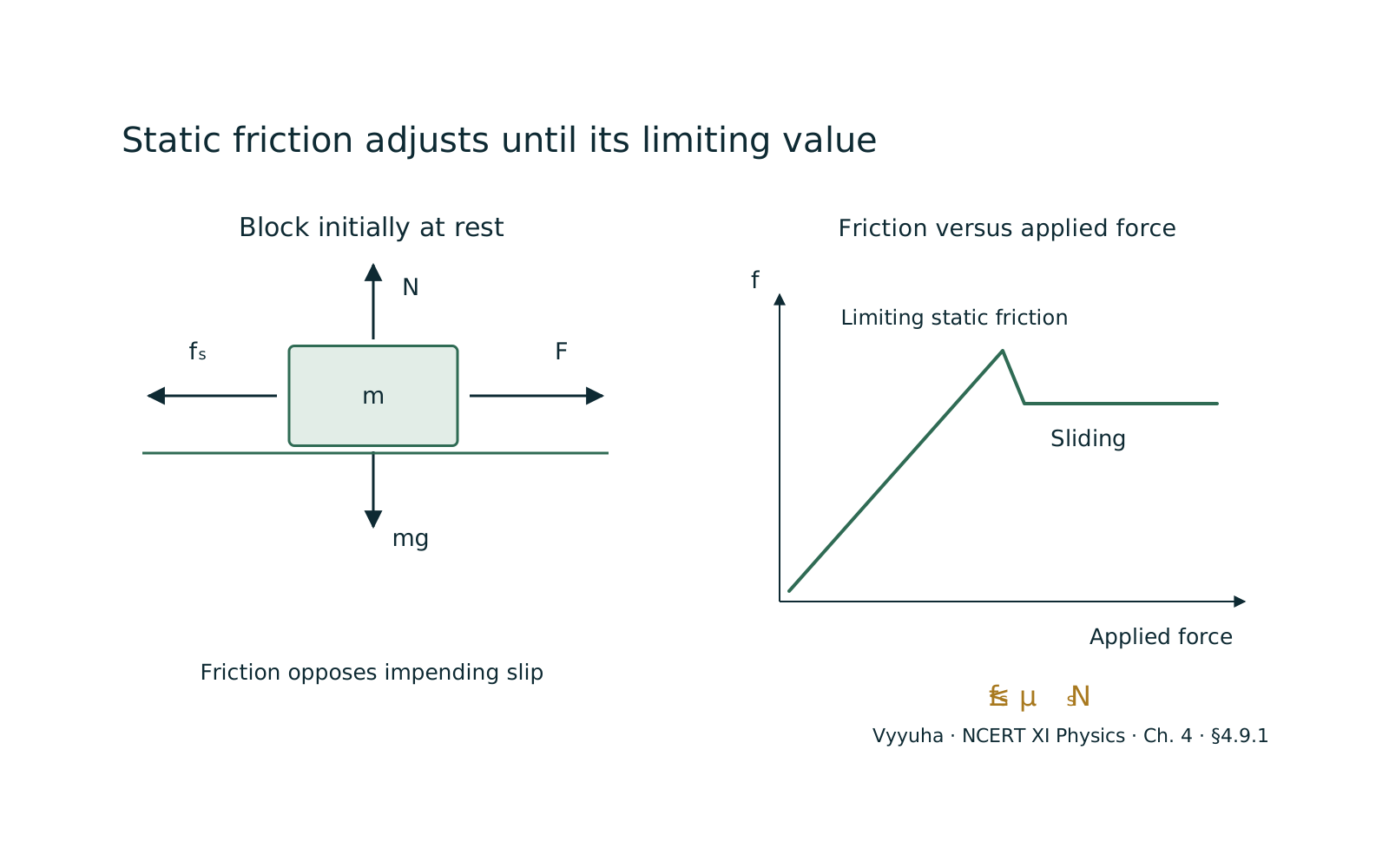
Detailed Explanation
Static friction is a fundamental concept in mechanics, describing the resistive force that prevents relative motion between two surfaces in contact when an external force attempts to initiate such motion. It is a crucial force that allows us to walk, hold objects, and prevents things from sliding down inclined planes.
Conceptual Foundation: The Nature of Friction
At a macroscopic level, surfaces might appear smooth, but at a microscopic level, they are rough, possessing numerous peaks and valleys. When two surfaces are brought into contact, only a fraction of their apparent area actually touches. These points of actual contact are where the forces of friction originate. The primary mechanisms contributing to static friction are:
- Interlocking of Irregularities: — The microscopic bumps and valleys on one surface can interlock with those on the other surface, creating mechanical resistance to sliding. To initiate motion, these interlocks must be broken or overcome.
- Adhesive Forces: — At the points of actual contact, intermolecular attractive forces (adhesion) can develop between the atoms and molecules of the two surfaces. These 'cold welds' effectively bond the surfaces together, requiring a certain force to break them and allow sliding.
Static friction is a 'self-adjusting' force. This means its magnitude is not constant but varies in response to the applied external force. If you apply a small force to an object at rest on a surface, static friction will develop an equal and opposite force, keeping the object stationary. As you increase , also increases, always matching in magnitude and opposing its direction, until a maximum limit is reached.
Key Principles and Laws of Static Friction
- Direction: — Static friction always acts parallel to the surfaces in contact and in a direction opposite to the tendency of relative motion (or impending motion). If an object tends to move right, static friction acts left.
- Self-Adjusting Nature: — The magnitude of static friction is variable. It ranges from zero up to a maximum value, .
- Limiting Static Friction: — The maximum value of static friction, , is called the limiting static friction. This is the threshold force that must be overcome to initiate motion. It is found to be directly proportional to the normal force pressing the surfaces together.
- Independence of Area of Contact (within limits): — For a given normal force, the limiting static friction is largely independent of the apparent area of contact, provided the normal force is distributed over a reasonable area. This is because the actual microscopic contact area is often proportional to the normal force, compensating for changes in apparent area.
Derivations and Related Concepts
A. Angle of Friction ($\phi_s$)
Consider an object on a horizontal surface. When an external force is applied, static friction opposes it. The normal force acts perpendicular to the surface, and the weight acts downwards.
The resultant force of the normal reaction and the friction force is called the resultant contact force . The angle this resultant contact force makes with the normal force when the object is on the verge of motion (i.
e., static friction is at its maximum, ) is called the angle of friction.
From the free-body diagram: In the right-angled triangle formed by , , and :
B. Angle of Repose ($\theta_r$)
Consider an object placed on an inclined plane. As the angle of inclination of the plane with the horizontal is gradually increased, the component of gravity acting down the incline, , increases. The static friction acts up the incline, opposing this tendency to slide. The normal force is .
The object remains at rest as long as . When the object is on the verge of sliding down, reaches its maximum value, . At this critical angle, , the forces are balanced: Dividing by :
It is numerically equal to the angle of static friction. This concept is vital in engineering (e.g., designing conveyor belts, stability of slopes).
Real-World Applications
- Walking: — When you walk, your foot pushes backward on the ground. Static friction from the ground pushes your foot forward, propelling you. Without static friction, you would slip.
- Holding Objects: — When you hold a glass, the static friction between your fingers and the glass prevents it from slipping down.
- Braking a Car: — When you apply brakes, the tires try to slide relative to the road. Static friction between the tires and the road provides the stopping force. If the brakes lock and the tires skid, static friction is replaced by kinetic friction, which is less effective.
- Inclined Planes: — Objects like ramps, slides, and even natural slopes rely on static friction to prevent objects from sliding down prematurely.
Common Misconceptions
- Friction always opposes motion: — This is incorrect. Friction opposes relative motion or the tendency of relative motion. For example, when a car accelerates, static friction on the drive wheels pushes the car forward. The wheels push backward on the road, and the road pushes forward on the wheels.
- Friction is always detrimental: — While friction causes energy loss and wear, it is absolutely essential for most forms of locomotion and stability. Without friction, nothing would stay put, and movement would be impossible.
- Static friction is constant: — As explained, static friction is self-adjusting and varies from zero up to its maximum limiting value.
NEET-Specific Angle and Problem Solving
For NEET, questions on static friction often involve:
- Identifying the state of motion: — Is the object at rest, on the verge of motion, or already moving? This determines whether static or kinetic friction applies.
- Calculating maximum static friction: — . This is crucial for determining if an object will move.
- Free-body diagrams: — Drawing accurate free-body diagrams is paramount. Identify all forces (gravity, normal force, applied force, friction force) and their directions.
- Equilibrium conditions: — For objects at rest or on the verge of motion, apply Newton's first law (, ).
- Inclined planes: — Problems involving objects on inclined planes are very common. Remember to resolve forces along and perpendicular to the incline.
- Blocks in contact: — Scenarios with multiple blocks, where friction acts between different surfaces, require careful analysis of each block separately.
Mastering static friction involves not just memorizing formulas but deeply understanding its self-adjusting nature and applying vector analysis to solve problems systematically. Always check if the calculated static friction required to maintain equilibrium is less than or equal to the maximum possible static friction. If it exceeds , the object will move, and kinetic friction will then act.
Often confused with
Side-by-side differences the NEET paper likes to test.
| Aspect | Static Friction | Kinetic Friction |
|---|---|---|
| State of Surfaces | At rest relative to each other (impending motion) | In relative motion |
| Magnitude | Variable; self-adjusting, $0 \le f_s \le \mu_s N$ | Relatively constant for a given normal force, $f_k = \mu_k N$ |
| Maximum Value | Has a maximum value, $f_{s,max} = \mu_s N$ | No maximum value, it's a constant value once motion starts |
| Coefficient | Coefficient of static friction ($\mu_s$) | Coefficient of kinetic friction ($\mu_k$) |
| Relationship between Coefficients | N/A | Generally, $\mu_s > \mu_k$ |
| Purpose | Prevents motion from starting | Opposes ongoing motion |
Static friction acts to prevent the initiation of relative motion between surfaces, adjusting its magnitude up to a maximum limit defined by the coefficient of static friction (). Kinetic friction, conversely, acts to oppose existing relative motion, maintaining a relatively constant magnitude determined by the coefficient of kinetic friction ().
A key distinction is that is almost always greater than , meaning it takes more force to get an object moving than to keep it moving at a constant velocity. Static friction is crucial for starting motion (e.
g., walking), while kinetic friction is relevant once motion has begun (e.g., sliding).
Why it is tested: For NEET, understanding the distinction between static and kinetic friction is fundamental. Questions frequently involve scenarios where students must determine which type of friction is acting, calculate its magnitude, and apply the correct coefficient. Misidentifying the type of friction or confusing their properties is a common source of error. Problems often involve transitioning from static to kinetic friction, such as an object starting to slide down an incline or a block being pushed across a floor.
Questions students ask
6 answered on this topic.
What is the primary difference between static and kinetic friction?
The fundamental difference lies in the state of motion. Static friction acts when surfaces are at rest relative to each other, preventing the initiation of motion. Kinetic friction, on the other hand, acts when surfaces are already in relative motion, opposing that ongoing motion.
Static friction is a 'holding' force, while kinetic friction is a 'dragging' force. Typically, the maximum static friction is greater than kinetic friction, meaning it takes more force to start an object moving than to keep it moving.
Why is static friction called 'self-adjusting'?
Static friction is self-adjusting because its magnitude is not fixed; it varies to match the applied external force, up to a certain maximum limit. If you push an object with a small force, static friction will exert an equal and opposite force to keep it stationary. If you increase your push, static friction also increases to maintain equilibrium. This continues until the applied force exceeds the maximum possible static friction, at which point the object begins to move.
Does the area of contact affect static friction?
For practical purposes and within reasonable limits, the maximum static friction is largely independent of the apparent area of contact. This is a common misconception. While a larger apparent area might seem to offer more resistance, the actual microscopic contact area (where adhesive bonds and interlocking occur) is often proportional to the normal force, not the apparent area. So, as long as the normal force is constant, the maximum static friction remains approximately the same.
What is the coefficient of static friction ($\mu_s$) and what does it depend on?
The coefficient of static friction () is a dimensionless constant that quantifies the 'stickiness' or 'roughness' between two surfaces. It represents the ratio of the maximum static friction to the normal force (). It primarily depends on the nature of the two materials in contact (e.g., wood on steel, rubber on concrete) and the condition of their surfaces (e.g., dry, wet, polished, rough). It does not depend on the normal force or the apparent area of contact.
Can static friction ever cause motion?
Yes, absolutely! While static friction opposes relative motion between surfaces, it can be the cause of an object's overall motion. For instance, when you walk, your foot pushes backward on the ground. Static friction from the ground pushes your foot (and thus your body) forward. Similarly, a car accelerates because the static friction between its drive wheels and the road pushes the car forward. Without static friction, these actions would result in slipping, not propulsion.
What is the significance of the angle of repose in real-world scenarios?
The angle of repose is the maximum angle a granular material (like sand, gravel, or flour) can be piled without slumping. In physics, it's the maximum angle of inclination of a plane at which an object will just begin to slide. Its significance is immense in civil engineering (designing stable slopes for embankments, roads, and foundations), agriculture (storage of grains), and mining (stability of spoil heaps). Understanding it helps prevent landslides and ensures structural integrity.