Friction
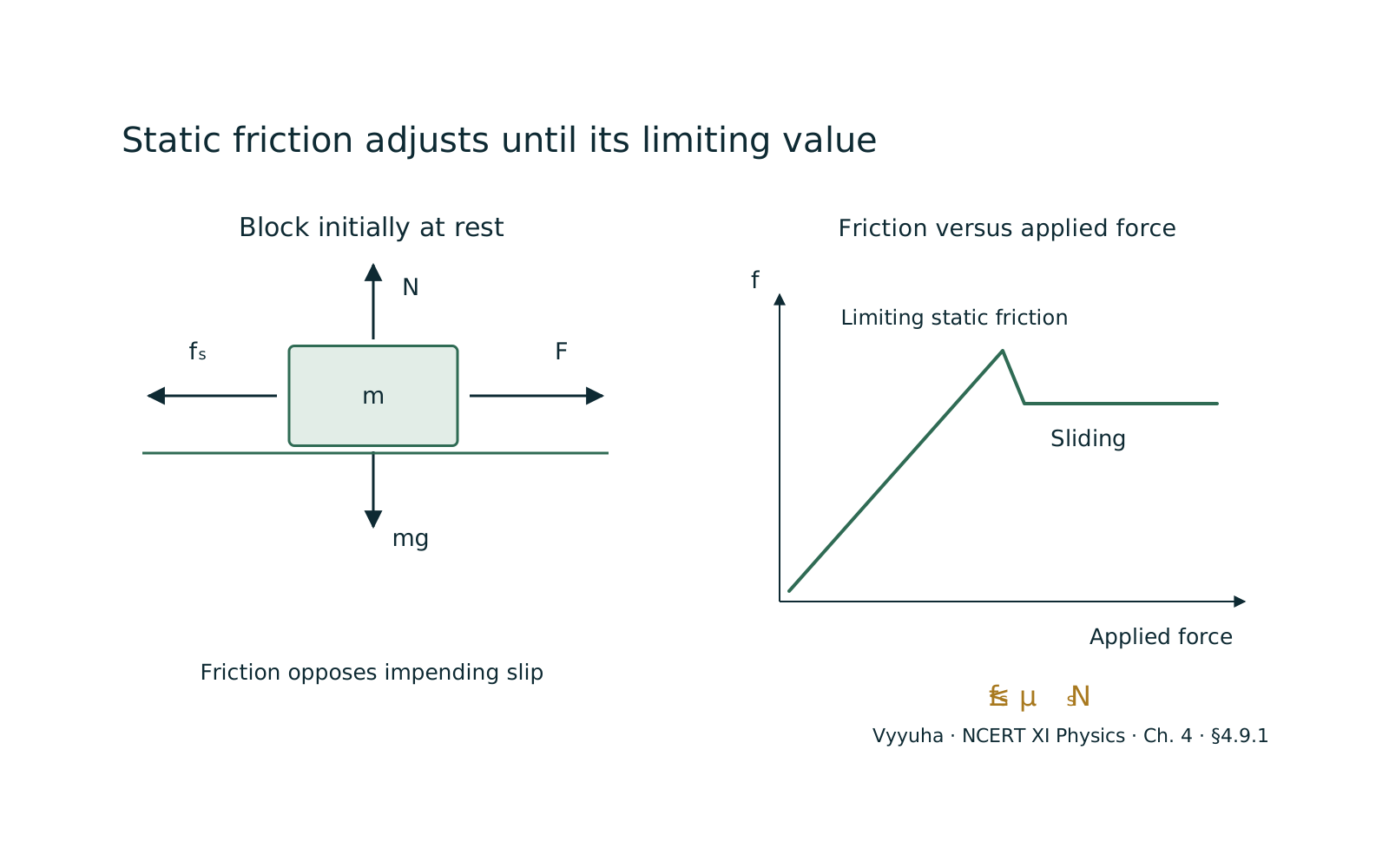
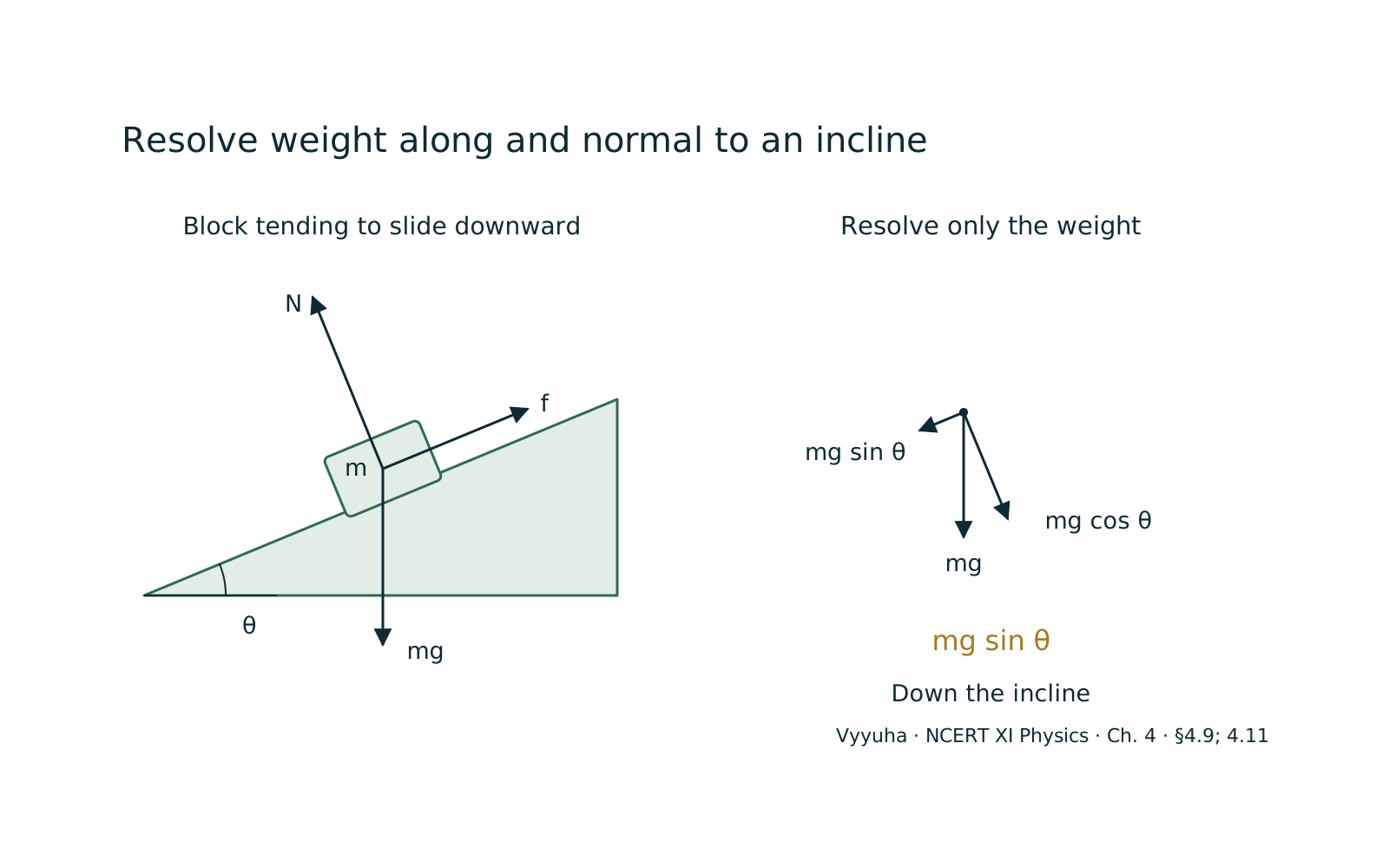
Friction is a contact force that opposes the relative motion or the tendency of relative motion between two surfaces in contact. It arises due to the microscopic irregularities present on the surfaces, as well as adhesive forces between the molecules of the contacting materials. This force acts tangentially to the surfaces at their point of contact and is crucial for many everyday phenomena, from …
Quick Summary
Friction is a contact force that opposes the relative motion or tendency of motion between two surfaces. It arises from microscopic irregularities and adhesive forces at the contact interface. The two main types are static friction (), which prevents motion, and kinetic friction (), which acts during motion.
Static friction is self-adjusting, increasing up to a maximum value (), where is the coefficient of static friction and is the normal force. Kinetic friction is generally constant () and typically less than maximum static friction ().
Rolling friction () is even smaller, explaining the efficiency of wheels. The angle of friction is the angle between the resultant contact force and the normal force when motion is impending, and its tangent equals .
The angle of repose is the maximum angle of inclination of a plane at which an object just begins to slide, and its tangent also equals . Friction is crucial for many daily activities like walking and braking, and its magnitude is largely independent of the apparent area of contact.
Full explanation
Friction, at its core, is a contact force that emerges when two surfaces are either in relative motion or attempting to be in relative motion. It's a ubiquitous phenomenon, fundamental to our everyday existence, yet often misunderstood. Let's delve into its intricacies.
Conceptual Foundation: The Microscopic View
While surfaces may appear smooth to the naked eye, a microscopic examination reveals a landscape of peaks and valleys, or asperities. When two surfaces are brought into contact, these asperities interlock.
The actual area of contact, where these asperities touch, is typically much smaller than the apparent area of contact. When an external force attempts to slide one surface over another, these interlocking asperities resist the motion.
To initiate or sustain motion, these interlocks must be broken or deformed. Furthermore, intermolecular attractive forces (adhesive forces) between the molecules of the contacting surfaces also contribute significantly to friction, especially for very smooth surfaces or at high pressures.
These adhesive bonds need to be broken for relative motion to occur.
Key Principles and Laws of Friction
Friction is broadly categorized into static friction, kinetic friction, and rolling friction.
1. Static Friction ($f_s$)
Static friction is the force that opposes the tendency of relative motion between two surfaces in contact. It acts when there is no actual relative motion. Its key characteristics are:
- Self-adjusting nature: — The magnitude of static friction is not constant. It adjusts itself to be exactly equal and opposite to the applied external force, up to a certain maximum limit. If you push a block with a small force, static friction matches it. If you increase the force, static friction increases too, preventing motion.
- Maximum Static Friction ($f_{s,max}$): — There's a limit to how much static friction can oppose an applied force. Once the applied force exceeds this maximum value, the object begins to move. This maximum static friction is directly proportional to the normal force () pressing the surfaces together.
2. Kinetic Friction ($f_k$)
Kinetic friction (also called dynamic friction or sliding friction) is the force that opposes the actual relative motion between two surfaces that are sliding past each other. Its characteristics are:
- Constant magnitude (approximately): — Once an object is in motion, the kinetic friction force is generally constant and independent of the relative speed (for moderate speeds). It is also largely independent of the apparent area of contact.
- Proportional to Normal Force: — Similar to static friction, kinetic friction is directly proportional to the normal force ().
3. Rolling Friction ($f_r$)
Rolling friction occurs when an object rolls over a surface. It's significantly smaller than kinetic friction. This is why wheels are so efficient. The primary cause of rolling friction is the deformation of the surfaces at the point of contact, creating a small resistance to rolling. The coefficient of rolling friction () is typically much smaller than .
Angle of Friction and Angle of Repose
Angle of Friction ($\theta$)
Consider a block resting on a horizontal surface. When an external force is applied horizontally, static friction opposes it. The resultant of the normal force and the maximum static friction is called the resultant contact force .
The angle that this resultant contact force makes with the normal force when the object is just about to move is called the angle of friction. From the force triangle:
Angle of Repose ($\alpha$)
Imagine a block placed on an inclined plane. As the angle of inclination of the plane is gradually increased, there will be a specific angle at which the block just begins to slide down. This angle is called the angle of repose.
At the verge of sliding, the component of gravity along the incline, , is balanced by the maximum static friction, . The normal force is . So, .
Real-World Applications
Friction is not just a resistive force; it's an enabling force:
- Walking and Running: — Without friction between our shoes and the ground, we couldn't push ourselves forward. We would slip.
- Braking Systems: — Car brakes rely on friction to convert kinetic energy into heat, slowing down and stopping the vehicle.
- Driving: — The friction between tires and the road allows vehicles to accelerate, turn, and brake.
- Holding Objects: — We can grip objects because of friction between our hands and the object's surface.
- Machinery: — While friction causes wear and tear and energy loss in machines, it's also essential for belts, gears, and clutches to transmit power. Lubricants are used to reduce undesirable friction.
Common Misconceptions
- Friction always opposes motion: — This is partially true. Friction opposes relative motion or the tendency of relative motion between surfaces. When you walk, static friction on your foot pushes you forward, enabling motion, even though it opposes the tendency of your foot to slip backward.
- Friction depends on the apparent area of contact: — This is a common trap. The laws of friction state that friction is largely independent of the apparent area of contact. While increasing the apparent area might seem to increase the number of interlocking asperities, it also reduces the pressure at each contact point, leading to a complex interplay that often results in the net frictional force remaining relatively constant.
- Friction is always bad: — While friction causes energy loss (as heat) and wear in machines, it is absolutely essential for most forms of locomotion, gripping, and braking. Without friction, our world would be unmanageable.
NEET-Specific Angle
For NEET aspirants, understanding friction goes beyond definitions. You must be adept at applying friction concepts in various problem-solving scenarios:
- Blocks on Inclined Planes: — Calculating the minimum force required to push a block up/down an incline, or determining if a block will slide down naturally. This involves resolving forces along and perpendicular to the incline.
- Connected Bodies: — Problems involving two or more blocks connected by strings, with friction acting on one or all blocks. Free-body diagrams are crucial here.
- Circular Motion with Friction: — Friction provides the necessary centripetal force for a car to take a turn on a flat road or for a coin to stay on a rotating turntable. Calculating maximum safe speeds or minimum coefficients of friction.
- Variable Forces: — Situations where the applied force changes, and you need to determine when static friction transitions to kinetic friction.
- Work Done by Friction: — Friction is a non-conservative force, and the work done by it is always negative, leading to a loss of mechanical energy (converted to heat).
Mastering friction requires a strong grasp of Newton's Laws of Motion, free-body diagrams, and vector resolution. Pay close attention to whether static or kinetic friction is acting, as their magnitudes are different. Always identify the normal force correctly, as it's the direct determinant of the frictional force's magnitude.
Key Concepts
Understanding when to apply static versus kinetic friction is critical. Static friction acts when an object…
The angle of repose is a direct measure of the coefficient of static friction. It's the steepest angle an…
Friction plays a crucial role in enabling circular motion, particularly for vehicles on unbanked roads or…
Often confused with
Side-by-side differences the NEET paper likes to test.
| Aspect | Friction | Kinetic Friction |
|---|---|---|
| Definition | Opposes the *tendency* of relative motion. | Opposes the *actual* relative motion. |
| State of Motion | Acts when surfaces are at rest relative to each other. | Acts when surfaces are sliding relative to each other. |
| Magnitude | Self-adjusting; varies from $0$ to a maximum value ($f_{s,max} = \mu_s N$). | Approximately constant for a given normal force ($f_k = \mu_k N$). Independent of speed (at moderate speeds). |
| Coefficient | Coefficient of static friction ($\mu_s$). | Coefficient of kinetic friction ($\mu_k$). Generally, $\mu_k < \mu_s$. |
| Initiation vs. Continuation | Must be overcome to *start* motion. | Acts to *resist* motion once it has started. |
The primary distinction between static and kinetic friction lies in the state of relative motion between the surfaces. Static friction acts when there is no actual sliding, preventing an object from moving, and its magnitude is variable up to a maximum.
Kinetic friction, conversely, acts when surfaces are already in relative motion, and its magnitude is generally constant and less than the maximum static friction. This difference is crucial for understanding why it takes more effort to initiate movement than to sustain it.
Why it is tested: For NEET, understanding the difference between static and kinetic friction is fundamental. Questions frequently test the application of these concepts, especially in scenarios where an object is on the verge of motion versus already moving. Incorrectly applying $\mu_s$ instead of $\mu_k$ (or vice versa) is a common error that leads to wrong answers in numerical problems. It's also important for conceptual questions about the nature of friction.
Questions students ask
5 answered on this topic.
What is the fundamental cause of friction?
The fundamental cause of friction lies in two primary factors. Firstly, it's due to the microscopic irregularities, or asperities, present on even seemingly smooth surfaces. These tiny peaks and valleys interlock when surfaces are in contact, resisting relative motion.
Secondly, intermolecular adhesive forces between the atoms and molecules of the contacting surfaces contribute significantly. When surfaces are pressed together, these attractive forces form 'cold welds' at the actual contact points, which must be broken for motion to occur.
Both mechanical interlocking and adhesive forces combine to produce the observed frictional resistance.
Why is static friction generally greater than kinetic friction?
Static friction is typically greater than kinetic friction because when surfaces are at rest relative to each other, the microscopic asperities have more time and opportunity to settle into each other and form stronger adhesive bonds.
To initiate motion, these stronger interlocks and bonds must be broken. Once motion begins, the surfaces are constantly 'bouncing' and 'skipping' over each other, reducing the time available for strong bonds to form and break.
The actual contact points are continuously changing, leading to a lower average resistance, hence a smaller kinetic friction.
Does friction depend on the area of contact?
No, friction does not significantly depend on the apparent area of contact between surfaces, provided the normal force remains constant. This is a common misconception. While a larger apparent area might seem to offer more points of contact, the actual microscopic area of contact remains relatively small and is primarily determined by the normal force.
If you increase the apparent area, the pressure at each microscopic contact point decreases, and vice-versa, leading to a compensatory effect that keeps the total frictional force largely independent of the apparent area.
Can friction ever be zero?
In an ideal theoretical scenario, if two perfectly smooth and rigid surfaces were in contact in a vacuum, friction could approach zero. However, in the real world, due to the inherent microscopic irregularities of surfaces and the presence of intermolecular adhesive forces, achieving absolutely zero friction is practically impossible.
Even in highly lubricated systems or with air bearings, some residual friction always exists. Superfluidity, like that of liquid helium, exhibits zero viscosity (internal friction), but this is a different phenomenon than friction between solid surfaces.
How does lubrication reduce friction?
Lubrication reduces friction by introducing a thin layer of fluid (the lubricant) between the two solid surfaces. This fluid layer prevents direct metal-to-metal contact, effectively replacing the solid-solid friction with fluid-fluid friction, which is significantly lower.
The lubricant fills the microscopic valleys on the surfaces, smoothing out the interface and reducing the interlocking of asperities. Additionally, the lubricant molecules themselves have lower intermolecular attractive forces compared to the solid surfaces, further reducing the resistance to relative motion.
This allows surfaces to slide past each other with much less effort and wear.
Revise in 30 seconds
- Friction: — Force opposing relative motion/tendency.
- Static Friction ($f_s$): — . Self-adjusting.
- Kinetic Friction ($f_k$): — . Constant (for moderate speeds).
- Coefficients: — (static), (kinetic). Always .
- Normal Force ($N$): — Perpendicular to surface, determines friction magnitude.
- Angle of Friction ($\theta$): — .
- Angle of Repose ($\alpha$): — . Angle at which object just slides down incline.
- Direction: — Opposes relative motion, not always overall motion.
- Independence: — Independent of apparent contact area.
For Really Interesting Concepts, Think Inclined Objects, Normal forces!
Friction: Forces Resisting Interaction Contact Together, Inclines, Opposing Normal.
Static Max: Stop Moving, Always X-tra force to start. Kinetic Constant: Keep Continuing, Consistent force to maintain.