Newton's Second Law
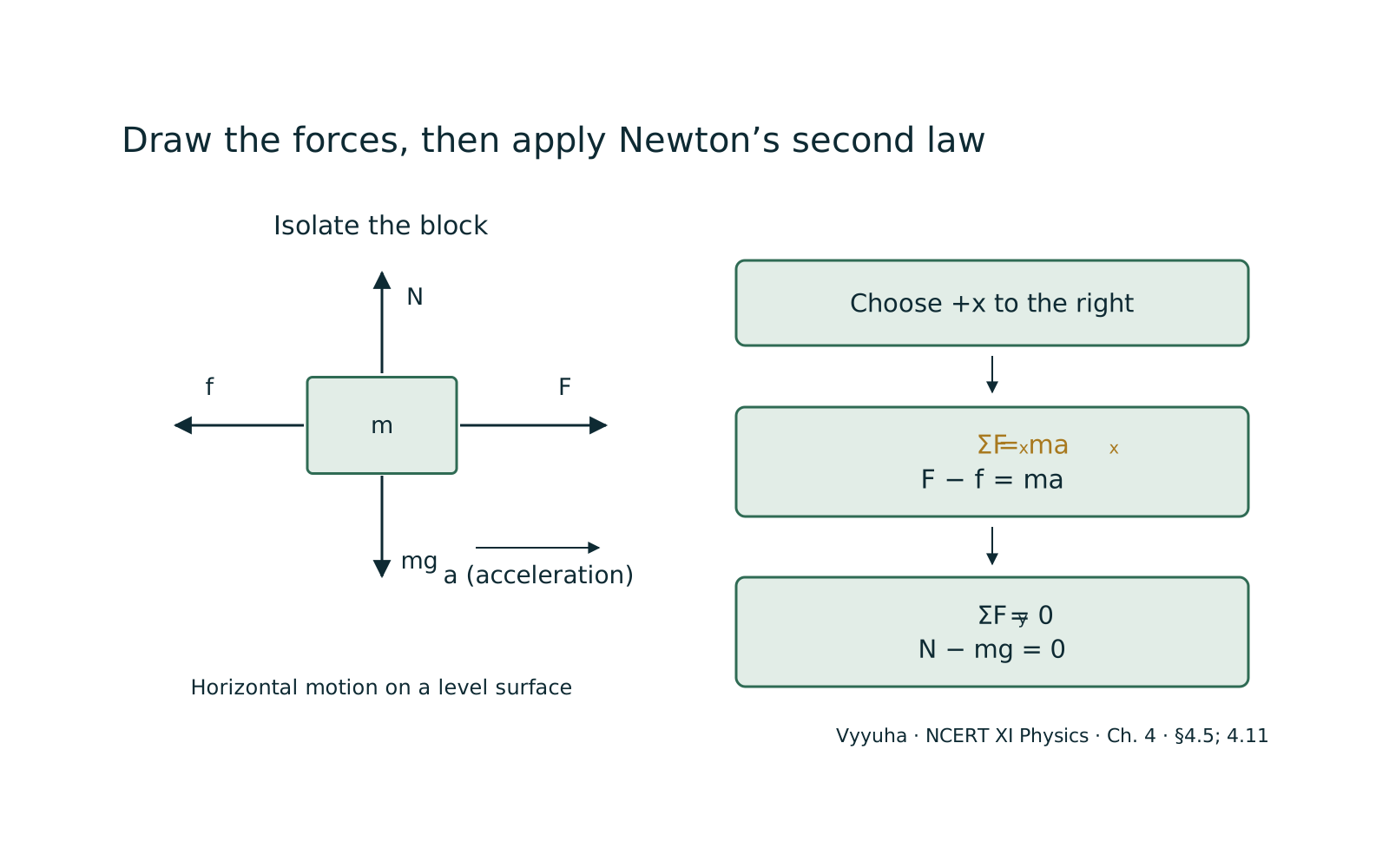
Newton's Second Law of Motion states that the rate of change of momentum of a body is directly proportional to the net external force applied on it, and this change in momentum takes place in the direction of the net force. Mathematically, this is expressed as , where is the net external force, and is the linear momentum o…
Quick Summary
Newton's Second Law of Motion is a fundamental principle in physics that quantifies the relationship between force, mass, and acceleration. It states that the net external force acting on an object is directly proportional to the rate of change of its linear momentum.
For objects with constant mass, this simplifies to the well-known equation , where is the net force, is the mass, and is the acceleration.
This law highlights that a net force causes an object to accelerate in the direction of the force, and the magnitude of this acceleration is inversely proportional to the object's mass. The SI unit of force is the Newton (N), defined as .
The law is valid only in inertial frames of reference and is crucial for analyzing the dynamics of moving objects, forming the basis for solving a wide range of problems in mechanics, including those involving multiple bodies, pulleys, and inclined planes.
Full explanation
Newton's Second Law of Motion is arguably the most crucial of Newton's three laws, as it provides a quantitative definition of force and establishes the fundamental relationship between force and the resulting motion of an object. While Newton's First Law introduces the concept of inertia and defines an inertial frame, and the Third Law describes action-reaction pairs, the Second Law allows us to calculate precisely how an object's motion changes under the influence of forces.
Conceptual Foundation
Before delving into the mathematical formulation, it's essential to understand the concepts that underpin the Second Law. The law builds upon the idea of inertia from the First Law, which states that an object at rest stays at rest and an object in motion stays in motion with the same speed and in the same direction unless acted upon by an unbalanced force.
Newton's Second Law quantifies what happens when such an unbalanced force does act. It introduces the concept of momentum, which is a measure of an object's 'quantity of motion'. Linear momentum () is defined as the product of an object's mass () and its velocity ():
The unit of momentum is kilogram-meter per second (kg·m/s).
Key Principles and Laws
Newton's Second Law states that the net external force acting on an object is equal to the rate of change of its linear momentum. Mathematically, this is expressed as:
Derivation of $\vec{F} = mvec{a}$
For most problems encountered in NEET, we deal with objects whose mass remains constant. In such cases, we can substitute into the Second Law equation:
Therefore, for a constant mass system, Newton's Second Law simplifies to the widely recognized form:
- Direct Proportionality — The acceleration () of an object is directly proportional to the net force () acting on it. If you double the net force, you double the acceleration.
- Inverse Proportionality — The acceleration () of an object is inversely proportional to its mass (). If you double the mass, the acceleration is halved for the same net force.
- Direction — The direction of the acceleration is always in the same direction as the net force.
- Vector Nature — Both force and acceleration are vector quantities. This means that when multiple forces act on an object, we must find their vector sum (the net force) before applying the equation.
Units of Force
The SI unit of force is the Newton (N). From , we can define 1 Newton as the force required to accelerate a mass of 1 kilogram by 1 meter per second squared.
Inertial Frames of Reference
It is crucial to remember that Newton's Second Law, like the First Law, is strictly valid only in inertial frames of reference. An inertial frame is a reference frame in which an object with no net force acting on it experiences no acceleration (i.
e., it remains at rest or moves with constant velocity). Essentially, an inertial frame is one that is either at rest or moving with constant velocity relative to a distant 'fixed' star. Earth, while rotating and revolving, is often approximated as an inertial frame for many practical purposes, especially over short durations and distances, but technically it is a non-inertial frame.
Real-World Applications
Newton's Second Law is ubiquitous in our daily lives and in various fields of science and engineering:
- Sports — A baseball player hits a ball. The force applied by the bat determines the ball's acceleration and thus its speed. A heavier bat (more mass) can apply more force, or a faster swing can apply more force, both leading to greater acceleration of the ball.
- Automobiles — The engine generates a force that propels the car. The car's acceleration depends on the engine's thrust and the car's mass. Braking applies a force in the opposite direction, causing deceleration.
- Rocket Propulsion — While often explained using Newton's Third Law (action-reaction of expelling gases), the acceleration of the rocket itself is governed by the Second Law. The net force on the rocket (thrust minus gravity and air resistance) causes its acceleration. Here, the mass of the rocket changes as fuel is consumed, so the more general form is more appropriate.
- Falling Objects — An object falling under gravity experiences a gravitational force (). Neglecting air resistance, the net force is , leading to an acceleration (acceleration due to gravity).
Common Misconceptions
- Force causes velocity, not acceleration — A very common mistake is to think that force causes velocity. According to Newton's Second Law, force causes acceleration (a change in velocity). If a constant force acts on an object, its velocity will continuously change (it will speed up or slow down). If an object is moving at a constant velocity, the net force on it is zero, not that there is no force.
- Mass vs. Weight — Mass () is an intrinsic property of an object, a measure of its inertia. Weight () is the force of gravity acting on an object, . While related, they are distinct concepts. Newton's Second Law uses mass.
- Net Force vs. Individual Forces — The equation refers to the net force, which is the vector sum of all individual forces acting on the object. Students often mistakenly use just one of the forces instead of the resultant force.
- Action-Reaction Pairs and Net Force — Newton's Third Law states that forces come in pairs. However, the action and reaction forces never act on the same body. The net force on a body is calculated by summing all forces acting on that specific body.
NEET-Specific Angle
For NEET aspirants, mastering Newton's Second Law is fundamental. Questions often involve:
- Free-Body Diagrams (FBDs) — Drawing accurate FBDs is the first and most critical step. Identify all forces (gravity, normal force, tension, friction, applied force) acting on each object in the system.
- Systems of Blocks — Problems involving two or more blocks connected by strings or in contact, often on horizontal or inclined surfaces. You need to apply to each block separately and solve simultaneous equations.
- Pulleys — Pulleys change the direction of forces. Ideal pulleys are massless and frictionless. Tension in a string passing over an ideal pulley is uniform.
- Inclined Planes — Decomposing forces (gravity, normal) into components parallel and perpendicular to the incline is essential.
- Friction — Incorporating static and kinetic friction forces into FBDs and applying them correctly based on the state of motion.
- Variable Force/Mass — Though less common in basic NEET questions, some advanced problems might involve forces that vary with time or position, or systems where mass changes (e.g., rocket propulsion, though often simplified). In such cases, the general form is used, which might require integration.
- Pseudo Forces — When analyzing motion from a non-inertial frame of reference (e.g., an accelerating elevator or a rotating frame), fictitious or pseudo forces (like centrifugal force or Coriolis force) must be introduced to make Newton's Second Law applicable in that frame. While not directly part of the law itself, understanding when and how to use them is crucial for certain problems.
A strong grasp of vector addition, trigonometry for force decomposition, and careful application of to each component of motion (e.g., x and y directions independently) are key to success in NEET problems related to Newton's Second Law.
Key Concepts
Linear momentum is a fundamental concept in physics, defined as the product of an object's mass () and its…
The net force, also known as the resultant force, is the vector sum of all individual external forces acting…
Newton's Second Law, in its simplified form , establishes a direct…
Often confused with
Side-by-side differences the NEET paper likes to test.
| Aspect | Newton's Second Law | Newton's First Law of Motion |
|---|---|---|
| Statement | An object at rest stays at rest, and an object in motion stays in motion with the same speed and in the same direction unless acted upon by an unbalanced force. | The rate of change of momentum of a body is directly proportional to the net external force applied on it, and this change in momentum takes place in the direction of the net force ($\vec{F}_{\text{net}} = \frac{dvec{p}}{dt}$ or $\vec{F}_{\text{net}} = mvec{a}$ for constant mass). |
| Focus | Defines inertia and establishes the concept of an inertial frame of reference. Describes conditions for zero acceleration. | Quantifies the relationship between force and acceleration. Describes what happens when there is a non-zero net force. |
| Mathematical Form | Implies $\vec{F}_{\text{net}} = 0 \implies \vec{a} = 0$. | $\vec{F}_{\text{net}} = mvec{a}$ (for constant mass). |
| Nature | Qualitative law, defining the concept of force and inertia. | Quantitative law, allowing calculation of force, mass, or acceleration. |
| Relationship | Can be considered a special case of the Second Law where the net force is zero. | More general law from which the First Law can be derived. |
Newton's First Law primarily introduces the concept of inertia and defines an inertial frame, stating that objects maintain their state of motion in the absence of a net force. It's a qualitative description of equilibrium.
In contrast, Newton's Second Law provides a quantitative relationship, , explaining how a non-zero net force causes an object to accelerate. The First Law can be seen as a specific condition of the Second Law where the net force is zero, leading to zero acceleration.
Why it is tested: For NEET, understanding the distinction is crucial for conceptual questions. The First Law helps identify situations of equilibrium (constant velocity or rest), while the Second Law is applied to analyze dynamic situations where acceleration occurs. Both are foundational for solving problems in Laws of Motion.
Questions students ask
5 answered on this topic.
What is the difference between Newton's First and Second Law?
Newton's First Law, also known as the Law of Inertia, describes what happens when the net force on an object is zero: it maintains its state of motion (rest or constant velocity). It essentially defines an inertial frame of reference.
The Second Law, on the other hand, describes what happens when there is a non-zero net force: it quantifies the resulting acceleration. The First Law is a special case of the Second Law where , which implies (if ).
So, the Second Law is more general and provides a quantitative relationship.
Why is $\vec{F} = mvec{a}$ considered a vector equation?
The equation is a vector equation because both force () and acceleration () are vector quantities, meaning they have both magnitude and direction. Mass () is a scalar quantity.
The vector nature implies that the direction of the net force acting on an object is always the same as the direction of the acceleration it produces. When solving problems, this means we often need to resolve forces and accelerations into their component vectors (e.
g., x and y components) and apply the equation independently for each direction.
Does Newton's Second Law apply to objects moving at constant velocity?
Yes, it does. If an object is moving at a constant velocity, its acceleration () is zero. According to Newton's Second Law, , if , then . This means that if an object is moving at a constant velocity, the net force acting on it must be zero. This is consistent with Newton's First Law. So, the Second Law correctly predicts the condition for constant velocity motion.
What is an inertial frame of reference, and why is it important for Newton's Second Law?
An inertial frame of reference is a frame where an object with no net force acting on it experiences no acceleration (i.e., it remains at rest or moves with constant velocity). In simpler terms, it's a non-accelerating reference frame.
Newton's Second Law, , is strictly valid only in inertial frames. If you try to apply it in a non-inertial (accelerating) frame, you would need to introduce fictitious or 'pseudo' forces to make the equation hold true.
For NEET, most problems assume an inertial frame unless explicitly stated otherwise, or if the problem involves pseudo forces.
Can Newton's Second Law be used for systems with changing mass, like a rocket?
Yes, but in its more general form: . When the mass of a system changes over time (e.g., a rocket expelling fuel, or a raindrop growing as it falls), the simpler form is not directly applicable because is not constant.
In such cases, we must use the rate of change of momentum, where both mass and velocity can be functions of time. This general form correctly accounts for the momentum carried away by the expelled mass (like rocket exhaust) or added mass.
Revise in 30 seconds
- Newton's Second Law —
- For constant mass —
- Linear Momentum —
- Units — Force (Newton, N), Mass (kilogram, kg), Acceleration (m/s), Momentum (kg·m/s)
- Key Principle — Net force causes acceleration in its direction, inversely proportional to mass.
- FBDs — Essential for identifying all forces and their directions.
For My Acceleration, Force Must Act! (F=ma)