Dynamics of Uniform Circular Motion
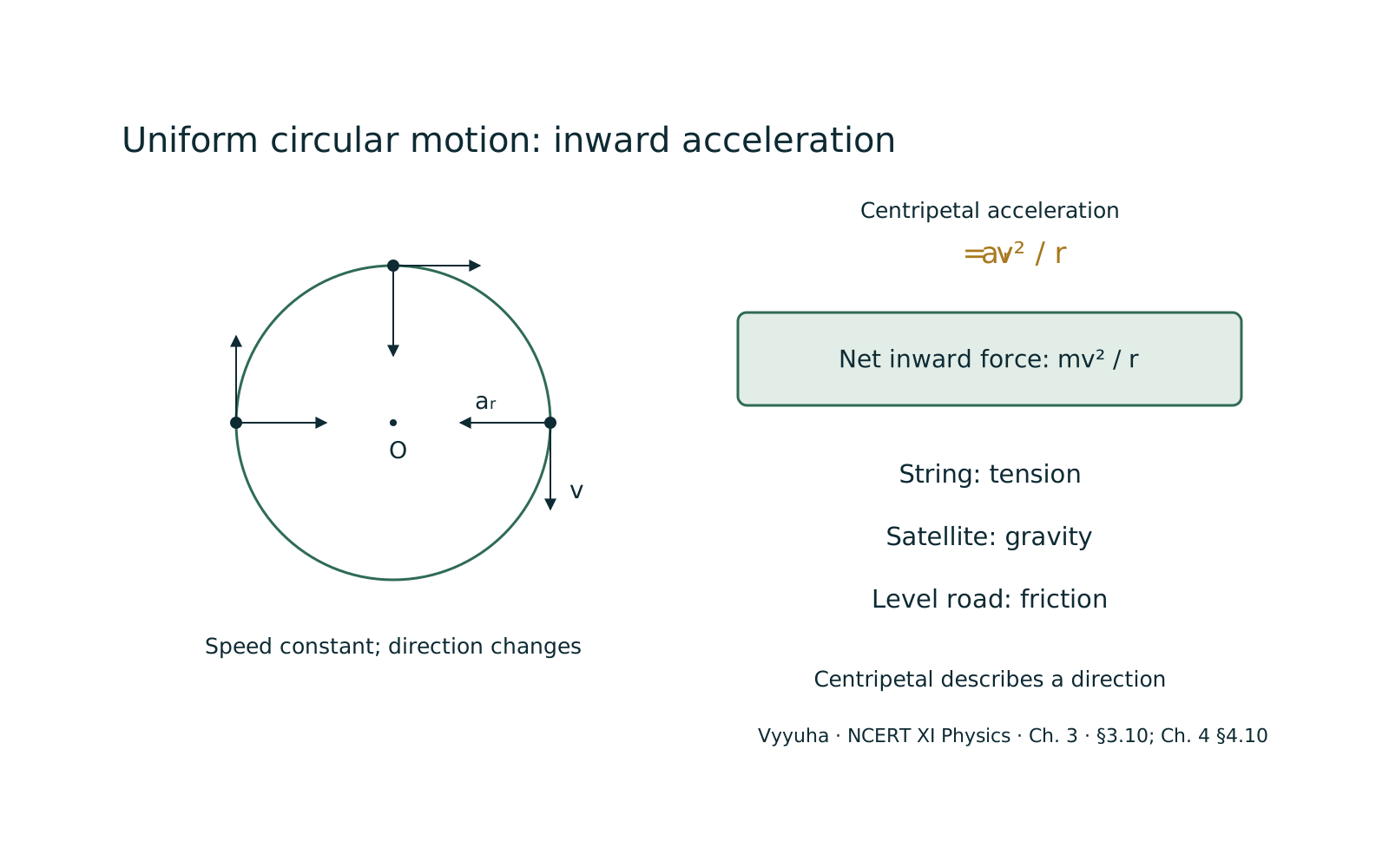
Uniform Circular Motion (UCM) describes the movement of an object along a circular path at a constant speed. While the magnitude of its velocity (speed) remains constant, the direction of its velocity continuously changes. This continuous change in direction implies that the object is undergoing acceleration, known as centripetal acceleration. According to Newton's second law, this acceleration mu…
Quick Summary
Uniform Circular Motion (UCM) describes an object moving in a circular path at a constant speed. Despite constant speed, the object's velocity is continuously changing direction, making it an accelerated motion.
This acceleration, known as centripetal acceleration (), is always directed towards the center of the circle. According to Newton's Second Law, this acceleration requires a net force, called centripetal force (), also directed towards the center.
This force is not a new fundamental force but rather a role played by existing forces like tension, friction, or gravity. Key applications include banking of roads, where a component of the normal force provides centripetal force, and vertical circular motion, where tension or normal force varies due to gravity.
Understanding UCM is crucial for analyzing diverse physical phenomena and solving related problems in NEET.
Full explanation
The dynamics of uniform circular motion (UCM) delve into the forces responsible for an object's movement along a circular path at a constant speed. While the kinematics of UCM describe the motion itself (velocity, acceleration), dynamics explains why this motion occurs, specifically identifying the forces involved.
1. Conceptual Foundation: The Nature of Velocity and Acceleration in UCM
An object in UCM maintains a constant speed, , but its velocity vector, , is continuously changing direction. At any point on the circle, the velocity vector is tangential to the path. Since acceleration is defined as the rate of change of velocity (), a changing velocity (even if only in direction) implies the presence of acceleration.
This acceleration, crucial for maintaining the circular path, is always directed towards the center of the circle and is known as centripetal acceleration.
2. Key Principles and Laws: Newton's Second Law
Newton's Second Law states that the net force acting on an object is directly proportional to its mass and acceleration, and is in the same direction as the acceleration (). For UCM, since the acceleration is centripetal (directed towards the center), the net force must also be directed towards the center. This net force is called the centripetal force, .
3. Derivations:
- **Derivation of Centripetal Acceleration ():**
Consider an object moving in a circle of radius with constant speed . Let the object be at point A at time with velocity and at point B at time with velocity . Both and have magnitude . The change in velocity is .
Geometrically, if we place the tails of and at a common origin, the vector points towards the center of the circle. As , the angle between the position vectors and (and also between and ) becomes infinitesimally small. The magnitude of can be approximated as .
From similar triangles (one formed by position vectors and the other by velocity vectors), we have:
The magnitude of centripetal acceleration is .
Alternatively, using angular velocity , we can write:
- **Derivation of Centripetal Force ():**
Applying Newton's Second Law, , and since is centripetal acceleration:
4. Real-World Applications and Examples:
- Horizontal Circular Motion (e.g., stone on a string, car on a flat turn):
* Stone on a string: The tension in the string provides the necessary centripetal force. If the string breaks, vanishes, and the stone flies off tangentially. * Car on a flat road turn: The static friction between the tires and the road provides the centripetal force.
If the speed is too high or the friction is too low (e.g., icy road), the car skids outwards because the required centripetal force exceeds the maximum static friction ().
- Vertical Circular Motion (e.g., roller coaster loop, bucket of water swung vertically):
The centripetal force is provided by a combination of tension (or normal force) and gravity. The required centripetal force changes throughout the loop. * At the top (highest point): Both tension/normal force () and gravity () act downwards, towards the center.
* At the bottom (lowest point): Tension/normal force () acts upwards (towards center), and gravity () acts downwards (away from center).
- Banking of Roads:
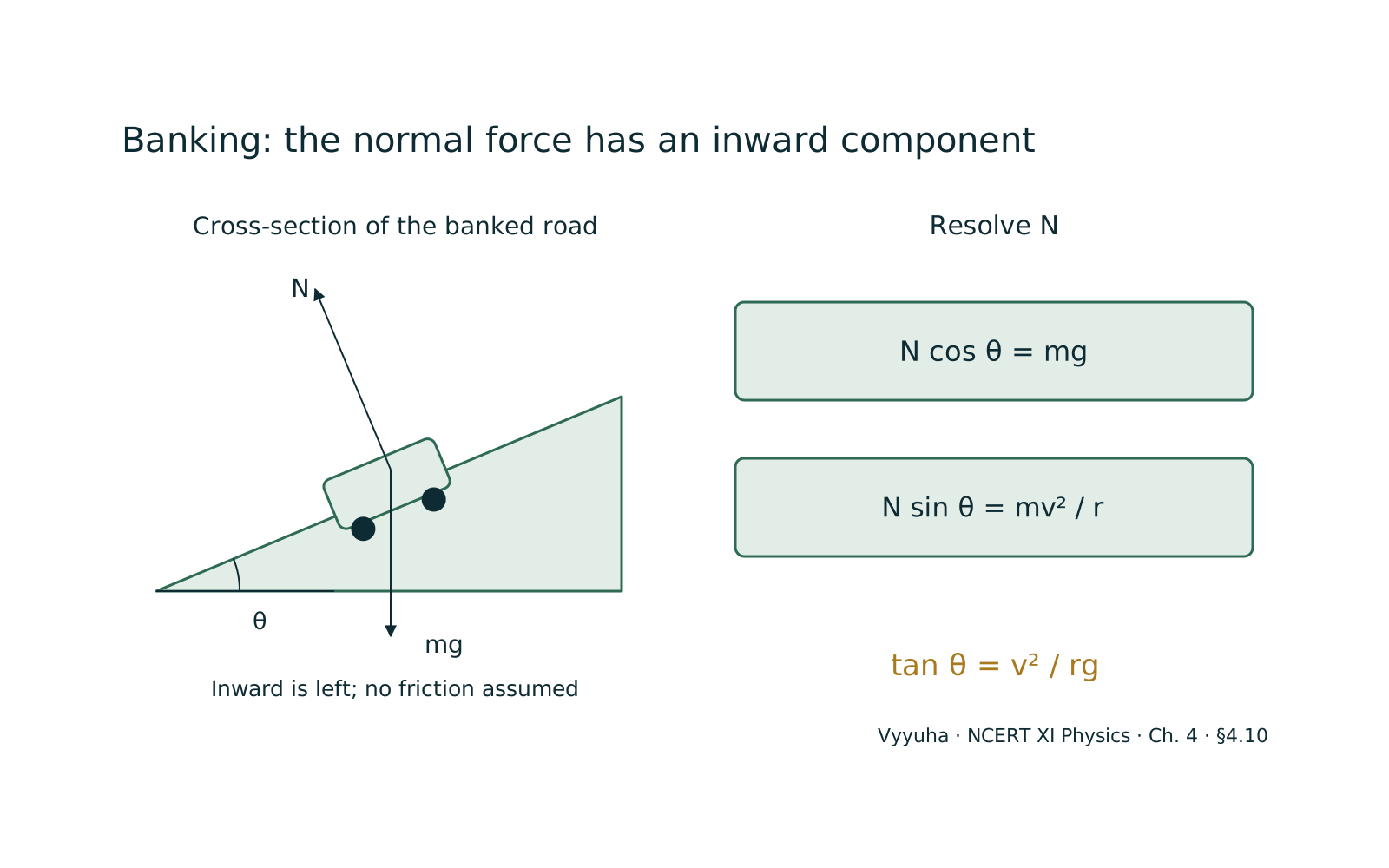
To allow vehicles to take turns at higher speeds without relying solely on friction, roads are banked (tilted inwards). This provides a component of the normal force that acts as the centripetal force.
* Ideal Banking (no friction): The normal force has a vertical component balancing gravity () and a horizontal component providing the centripetal force.
This gives the ideal banking angle for a given speed and radius . * Banking with Friction: When friction is present, it can act either up or down the incline, depending on whether the vehicle is trying to slip up or down.
This allows for a range of safe speeds. * Maximum safe speed (): Friction acts down the incline (aids centripetal force).
* Minimum safe speed (): Friction acts up the incline (opposes centripetal force).
- Conical Pendulum: — A mass attached to a string revolves in a horizontal circle, with the string making a constant angle with the vertical. The tension in the string provides both the vertical component to balance gravity () and the horizontal component for centripetal force (). From these, we can find the speed and the time period , where is the length of the string.
5. Common Misconceptions:
- Centrifugal Force as a Real Force: — Centrifugal force is often described as an outward force experienced by an object in circular motion. However, it is a fictitious or pseudo force, observed only in a non-inertial (rotating) frame of reference. In an inertial frame, there is only the inward centripetal force. The 'feeling' of being pushed outwards is due to inertia – the object's tendency to continue in a straight line, while the centripetal force pulls it inwards.
- Constant Velocity in UCM: — While speed is constant, velocity is not, because its direction continuously changes. Therefore, UCM is an accelerated motion.
- Centripetal Force is a New Type of Force: — Centripetal force is not a fundamental force like gravity or electromagnetism. It is the net force (or a component of an existing force) that acts as the inward force required for circular motion.
6. NEET-Specific Angle:
NEET questions on UCM often test the ability to identify the source of centripetal force in various scenarios (tension, friction, normal force, gravity). Numerical problems typically involve calculating centripetal acceleration/force, maximum/minimum speeds for specific conditions (e.
g., banking, vertical loops), or time periods for conical pendulums. A strong understanding of free-body diagrams and vector resolution is essential. Pay close attention to the direction of forces and components, especially in vertical circular motion and banking problems.
Remember that energy conservation can often be combined with dynamics principles in more complex problems, particularly in vertical loops.
Key Concepts
Centripetal acceleration, denoted , is the acceleration an object experiences when moving in a circular…
According to Newton's Second Law, an acceleration must be caused by a net force. Since centripetal…
Banking of roads is a practical application of UCM dynamics designed to enhance safety for vehicles taking…
Often confused with
Side-by-side differences the NEET paper likes to test.
| Aspect | Dynamics of Uniform Circular Motion | Non-Uniform Circular Motion |
|---|---|---|
| Speed | Constant | Varies (changes) |
| Velocity Magnitude | Constant | Varies (changes) |
| Velocity Direction | Continuously changes | Continuously changes |
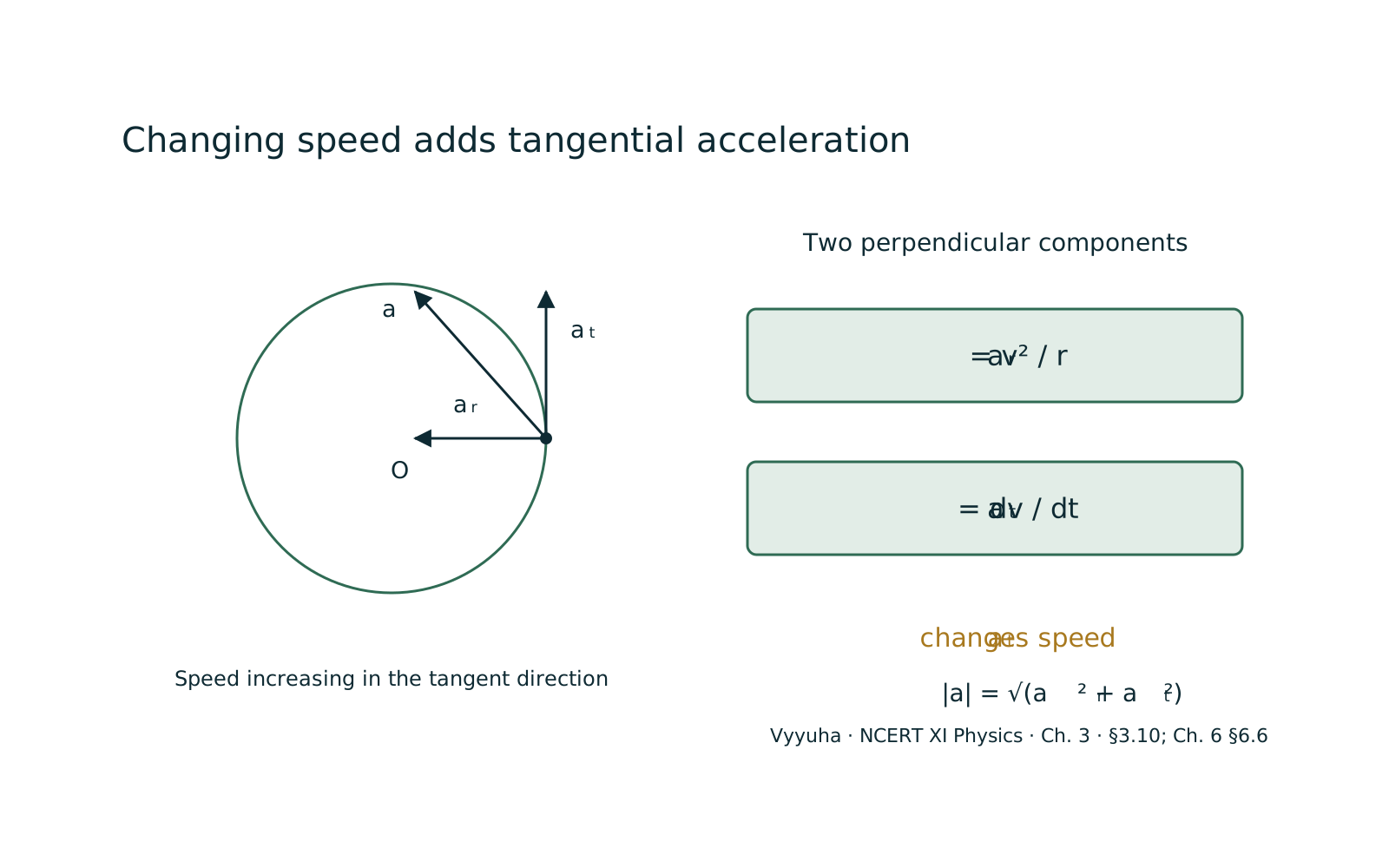
| Acceleration Components | Only centripetal (radial) acceleration ($a_c = v^2/r$) | Both centripetal (radial) acceleration ($a_c = v^2/r$) and tangential acceleration ($a_t = dv/dt$) |
| Net Acceleration Direction | Always towards the center | Not necessarily towards the center; it's the vector sum of $a_c$ and $a_t$ |
| Net Force Direction | Always towards the center (centripetal force) | Not necessarily towards the center; it's the vector sum of centripetal and tangential forces |
| Kinetic Energy | Constant | Varies (changes) |
Uniform Circular Motion (UCM) is characterized by constant speed and only centripetal acceleration, which is always directed towards the center. The net force, the centripetal force, also points towards the center.
In contrast, Non-Uniform Circular Motion involves a changing speed, meaning there's both centripetal acceleration (due to changing direction) and tangential acceleration (due to changing speed). Consequently, the net acceleration and net force are not always directed towards the center but are the vector sum of their radial and tangential components.
This distinction is crucial for analyzing energy changes and the complete dynamics of circular motion.
Why it is tested: For NEET, understanding the distinction is fundamental. Questions often test whether a student can identify the presence of tangential acceleration or changing kinetic energy, which are hallmarks of non-uniform circular motion. Recognizing when speed is constant versus changing helps in correctly applying the relevant formulas and force equations, especially in problems involving vertical loops or varying speeds on a banked curve.
Questions students ask
6 answered on this topic.
What is the difference between speed and velocity in Uniform Circular Motion?
In Uniform Circular Motion (UCM), an object moves along a circular path at a constant speed. This means the magnitude of its velocity remains unchanged. However, velocity is a vector quantity, possessing both magnitude and direction.
As the object traverses the circular path, its direction of motion is continuously changing, always tangential to the circle. Therefore, even though the speed is constant, the velocity is not constant because its direction is always varying.
This continuous change in velocity's direction is precisely why an object in UCM experiences acceleration.
Is Uniform Circular Motion an accelerated motion? If so, why?
Yes, Uniform Circular Motion is indeed an accelerated motion. Acceleration is defined as the rate of change of velocity. While the speed (magnitude of velocity) in UCM is constant, the direction of the velocity vector is continuously changing.
Since velocity is a vector quantity, a change in its direction, even without a change in its magnitude, constitutes a change in velocity. This continuous change in velocity means the object is accelerating.
This acceleration, known as centripetal acceleration, is always directed towards the center of the circular path.
What is centripetal force, and is it a fundamental force?
Centripetal force is the net force required to keep an object moving in a circular path. It is always directed towards the center of the circle, perpendicular to the object's instantaneous velocity. It is not a fundamental force like gravity, electromagnetic force, or nuclear forces.
Instead, it is a role played by existing fundamental forces or combinations thereof. For example, tension in a string, friction between tires and road, gravitational attraction, or the normal force can all act as the centripetal force, providing the necessary inward pull to maintain circular motion.
Explain the concept of 'banking of roads' in the context of UCM.
Banking of roads refers to the tilting of a road's surface inwards at a turn. This is done to provide the necessary centripetal force for vehicles to navigate the curve safely, especially at higher speeds, without excessive reliance on friction.
When a road is banked, the normal force exerted by the road on the vehicle has a horizontal component directed towards the center of the turn. This horizontal component of the normal force, potentially aided or opposed by friction, provides the centripetal force.
Ideal banking allows a vehicle to take a turn at a specific speed even without friction, relying solely on the normal force's component.
What is the difference between centripetal and centrifugal force?
Centripetal force is a real, inward-directed force acting on an object to keep it in circular motion, observed from an inertial (non-accelerating) frame of reference. It is the cause of centripetal acceleration.
Centrifugal force, on the other hand, is a fictitious or pseudo force. It is an apparent outward force experienced by an observer in a non-inertial (rotating) frame of reference. It arises from the object's inertia, its tendency to move in a straight line, rather than from a direct physical interaction.
In an inertial frame, there is no outward centrifugal force; the object simply tries to move tangentially, and the centripetal force pulls it inwards.
How does the tension in a string vary in vertical circular motion?
In vertical circular motion, the tension in the string (or normal force for a loop-the-loop) varies significantly due to the influence of gravity. At the lowest point of the circle, gravity acts downwards, away from the center, while tension acts upwards, towards the center.
Thus, tension must be greater than the centripetal force required to counteract gravity and provide the net inward force (). At the highest point, both gravity and tension act downwards, towards the center.
Here, tension is less, as gravity assists in providing the centripetal force (). The tension is maximum at the bottom and minimum at the top.
Revise in 30 seconds
- UCM Definition: — Constant speed, changing velocity (direction).
- Centripetal Acceleration: — , directed towards center.
- Centripetal Force: — , directed towards center (net force).
- Angular Velocity: — .
- Max Speed (Flat Road): — .
- Ideal Banking Angle: — .
- Vertical Circle (Bottom): — .
- Vertical Circle (Top): — .
- Min Speed (Vertical Top): — .
- Conical Pendulum: — , .
To remember the centripetal force formula, think: 'My Vehicle Squared over Road' for . Or, for the direction: Centripetal Force Centers Forward. (Centripetal Force Centers the motion Forward).