Work by Constant Force — Explained
Detailed Explanation
The concept of work is one of the most fundamental ideas in physics, serving as a bridge between force and energy. While in everyday language 'work' might imply effort or activity, in physics, it has a very specific and quantitative meaning. For NEET UG, a deep understanding of work done by a constant force is crucial, as it forms the basis for understanding energy conservation, power, and more complex scenarios involving variable forces.
Conceptual Foundation: Work as Energy Transfer
At its core, work is a mechanism for energy transfer. When a force does work on an object, it either adds energy to the object (positive work) or removes energy from it (negative work). This energy transfer manifests as changes in the object's kinetic energy, potential energy, or internal energy. For work to be done, two conditions must be met:
- A force must act on an object.
- The object must undergo a displacement.
Furthermore, there must be a component of the force along the direction of the displacement. If a force acts but there is no displacement, or if the force is always perpendicular to the displacement, no work is done by that force.
Key Principles and Laws: The Dot Product Definition
The most precise definition of work done by a constant force causing a displacement is given by the scalar product (or dot product) of these two vectors:
- is the magnitude of the force vector .
- is the magnitude of the displacement vector .
- is the angle between the direction of the force vector and the direction of the displacement vector .
Derivations and Cases of Work
Let's break down the formula to understand its implications:
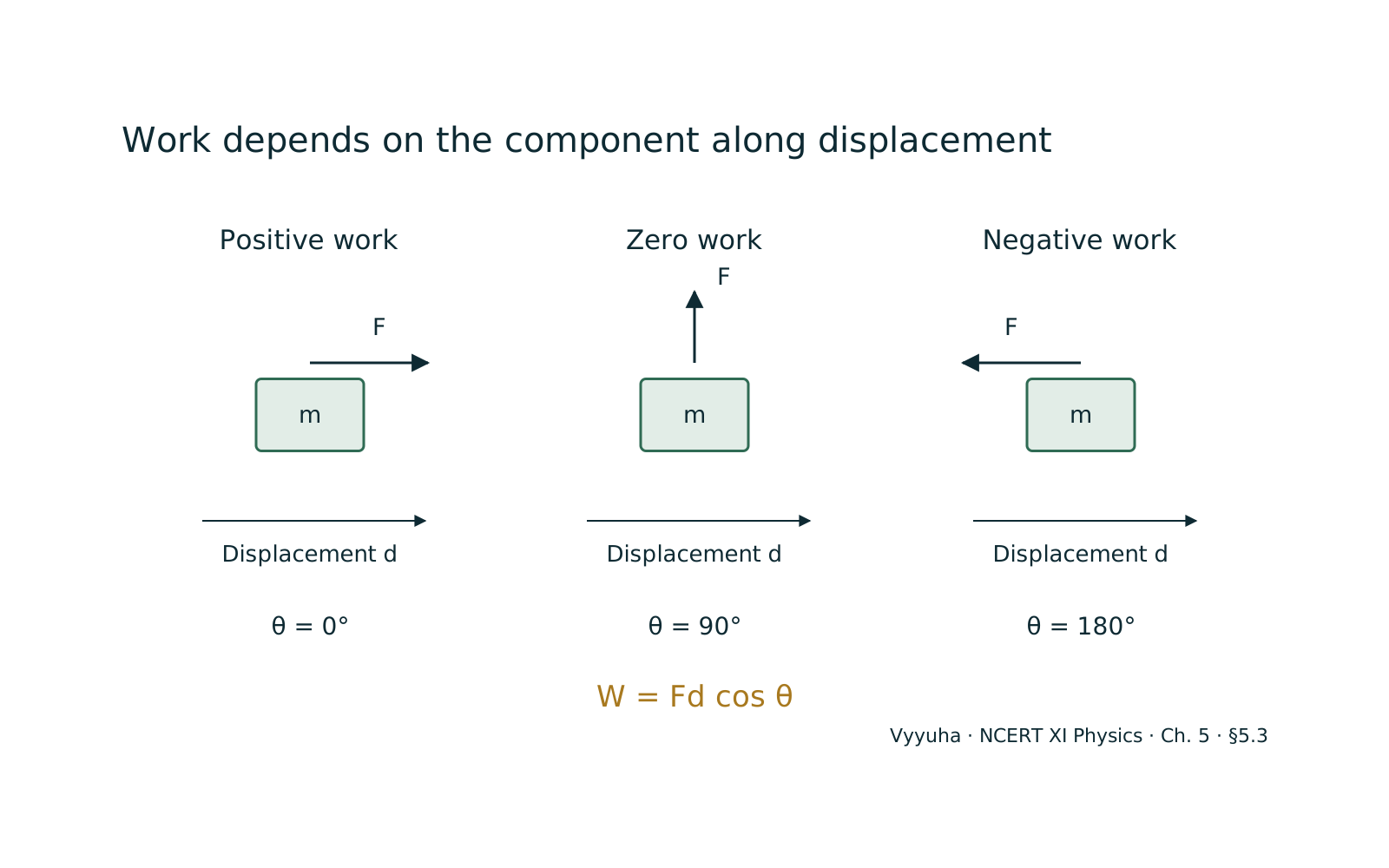
1. Positive Work ($\theta < 90^\circ$):
When the angle between the force and displacement is acute (between and ), is positive. This means the force has a component in the direction of motion, and thus, positive work is done. The force adds energy to the object. Examples include:
- Pushing a box horizontally across a floor in the direction of motion.
- Lifting an object against gravity (work done by the lifting force).
- A car accelerating (work done by the engine's propulsive force).
2. Negative Work ($\theta > 90^\circ$):
When the angle is obtuse (between and ), is negative. This implies the force has a component opposing the direction of motion, and negative work is done. The force removes energy from the object. Examples include:
- Work done by friction when an object slides across a surface. Friction always opposes motion, so , and .
- Work done by air resistance on a moving object.
- Work done by gravity when an object is lifted upward (gravity acts downward, displacement is upward, so ).
3. Zero Work ($\theta = 90^\circ$):
When the angle is exactly , . In this case, no work is done by the force, even if there is a force and a displacement. This happens when the force is perpendicular to the displacement. Examples include:
- Work done by the normal force on an object moving horizontally. The normal force acts perpendicular to the surface, while displacement is parallel to it.
- Work done by the centripetal force on an object moving in a circular path at constant speed. The centripetal force is always directed towards the center (perpendicular to the tangential displacement).
- Work done by gravity on an object moving horizontally (e.g., carrying a bag across a room at constant height).
Units and Dimensions
The SI unit of work is the Joule (J). One Joule is defined as the work done when a force of one Newton (N) causes a displacement of one meter (m) in the direction of the force. So, . Other units include:
- Erg (CGS unit): .
- Electron-volt (eV): Used in atomic and nuclear physics.
The dimensional formula for work is derived from . Since , its dimensions are . Multiplying by displacement , we get the dimensions of work as . This is the same as the dimensional formula for energy, reinforcing the idea that work is a form of energy transfer.
Real-World Applications
- Lifting objects: — When you lift a book from the floor to a shelf, you do positive work against gravity. The force you apply is upward, and the displacement is upward. Gravity, however, does negative work.
- Pushing a cart: — If you push a shopping cart, the force you apply does positive work, increasing the cart's kinetic energy.
- Braking a vehicle: — The friction force exerted by the brakes on the wheels does negative work, reducing the vehicle's kinetic energy and bringing it to a stop.
- Walking: — When you walk on a level surface, the normal force from the ground does no work on you because it's perpendicular to your horizontal displacement. The static friction force from the ground, which propels you forward, does positive work.
Common Misconceptions
- Work vs. Effort: — Students often confuse physical effort or fatigue with work done in physics. As discussed, pushing a stationary wall requires effort but results in zero work.
- Work done by all forces: — It's crucial to specify 'work done by a specific force'. An object might have multiple forces acting on it, each doing positive, negative, or zero work. The net work done is the sum of work done by all individual forces.
- Direction of force vs. direction of motion: — The angle is between the force vector and the displacement vector, not necessarily the velocity vector. While often aligned, it's important to consider the actual displacement.
- Work-Energy Theorem: — While closely related, work and energy are distinct concepts. Work is the process of energy transfer, while energy is the capacity to do work. The Work-Energy Theorem states that the net work done on an object equals the change in its kinetic energy (). This theorem is a powerful tool for solving problems involving work and energy.
NEET-Specific Angle
For NEET, questions on work by a constant force often involve:
- Direct application of $W = Fd \cos\theta$: — Calculating work given force, displacement, and angle. This requires careful identification of .
- Identifying forces doing zero work: — Recognizing situations where normal force, tension (in certain cases), or centripetal force do no work.
- Calculating work done by specific forces: — For example, work done by gravity, friction, or an applied force.
- Problems involving multiple forces: — Calculating the net work done by summing the work done by individual forces.
- Graphical interpretation: — Understanding that for a constant force, work is simply the area under the Force-displacement graph (a rectangle).
- Connecting work to the Work-Energy Theorem: — Using to find changes in speed or displacement. This is a very common type of problem.
Mastering these aspects requires not just memorizing the formula but developing a strong conceptual understanding of force, displacement, and their vector nature, along with careful attention to the direction of each vector involved.
Often confused with
Side-by-side differences the NEET paper likes to test.
| Aspect | Work by Constant Force | Work by Variable Force |
|---|---|---|
| Definition | Force remains constant in magnitude and direction throughout the displacement. | Force changes in magnitude, direction, or both, during the displacement. |
| Calculation Method | Simple scalar product: $W = \vec{F} \cdot \vec{d} = Fd \cos\theta$. | Requires integration: $W = \int \vec{F} \cdot d\vec{r}$. For 1D, $W = \int F(x) dx$. |
| Graphical Representation (F vs. d) | Area under the F-d graph is a rectangle (or trapezoid if component is considered). | Area under the F-d graph is calculated by integration, often for a curve. |
| Complexity | Relatively simpler, direct application of formula. | More complex, often requiring calculus (integration) or approximation methods. |
| Examples | Work done by gravity near Earth's surface, work done by a constant push/pull. | Work done by a spring (Hooke's Law), work done by gravitational force over large distances, work done by electric force. |
The fundamental distinction between work done by a constant force and work done by a variable force lies in the nature of the force itself and, consequently, the mathematical approach required for its calculation.
A constant force maintains its magnitude and direction, allowing for a straightforward calculation using the dot product of force and displacement. In contrast, a variable force changes over the path of motion, necessitating the use of integration to sum up the infinitesimal amounts of work done over each tiny segment of displacement.
This difference is crucial for NEET aspirants as it dictates the problem-solving strategy, from simple multiplication to advanced calculus.
Why it is tested: For NEET UG, understanding the distinction is vital. While constant force problems are direct applications of $W=Fd\cos\theta$, variable force problems introduce the concept of integration, particularly for forces like springs ($F=-kx$). NEET frequently tests both, often requiring students to identify the type of force and apply the correct method. It's a foundational concept for the Work-Energy Theorem and conservation of energy.
Questions students ask
5 answered on this topic.
What is the difference between work and energy?
Work and energy are intimately related but distinct concepts. Energy is the capacity of a system to do work, or to cause change. It's a property of an object or system. Work, on the other hand, is the process by which energy is transferred from one system to another, or transformed from one form to another.
When work is done on an object, its energy changes. The SI unit for both is the Joule, highlighting their close relationship, but conceptually, one is a state (energy) and the other is a process (work).
Can work be negative? What does negative work signify?
Yes, work can absolutely be negative. Negative work occurs when the force acting on an object has a component that opposes the direction of the object's displacement. Mathematically, this happens when the angle between the force and displacement vectors is greater than (i.
e., obtuse). Physically, negative work signifies that the force is removing energy from the object or system, often causing it to slow down. A classic example is the work done by friction, which always opposes motion and thus does negative work.
When is work done considered zero, even if a force is applied?
Work done by a force is zero under two primary conditions. Firstly, if there is no displacement, no work is done, regardless of how much force is applied (e.g., pushing a stationary wall). Secondly, if the force applied is perpendicular to the direction of displacement, then also no work is done.
This is because the cosine of is zero. Examples include the work done by the normal force on a horizontally moving object, or the work done by the centripetal force on an object moving in a uniform circular motion.
Is work a scalar or vector quantity? Why?
Work is a scalar quantity. Although it is calculated from two vector quantities (force and displacement), their product is a scalar product (dot product), which by definition yields a scalar. A scalar quantity has only magnitude and no direction. This means that when we talk about work, we only care about 'how much' work is done, not 'in what direction' it is done. This is consistent with work being a measure of energy transfer, which is also a scalar.
How does the angle between force and displacement affect the work done?
The angle between the force vector and the displacement vector is critical in determining the amount and type of work done. The work done is proportional to . If , , yielding maximum positive work.
If , is positive, resulting in positive work. If , , resulting in zero work. If , is negative, resulting in negative work.
Finally, if , , yielding maximum negative work. The angle thus dictates the effectiveness and nature of energy transfer.