Nomenclature — Explained
Detailed Explanation
The sheer diversity of life on Earth is astounding, with millions of species identified and many more yet to be discovered. To bring order to this biological richness, scientists developed systems for classification and naming.
Nomenclature is the cornerstone of this effort, providing a standardized, universal language for referring to organisms. Without it, biological communication would be mired in ambiguity, as common names vary geographically, linguistically, and even within the same region for different life stages or forms of an organism.
Conceptual Foundation: The Need for Universal Names
Historically, organisms were known by local or common names. While these names served local communication, they presented significant problems for scientific study:
- Variability: — A single organism might have many common names (e.g., 'sparrow' refers to different birds in different regions). Conversely, a single common name might refer to multiple different organisms (e.g., 'lily' can refer to many unrelated plants).
- Language Barriers: — Common names are language-specific, hindering international scientific collaboration.
- Lack of Precision: — Common names often don't reflect evolutionary relationships or specific characteristics, leading to confusion about what exactly is being discussed.
- Redundancy: — Different common names for the same organism in different places lead to unnecessary duplication of effort in research.
To overcome these challenges, a universal system of scientific nomenclature became imperative. This system needed to be precise, unambiguous, universally applicable, and stable.
Key Principles and Laws: The Codes of Nomenclature
The development of a universal naming system culminated in the establishment of various international codes of nomenclature, each governing a specific group of organisms. These codes are dynamic, evolving with new discoveries and scientific consensus, but their core principles remain:
- International Code of Nomenclature for algae, fungi, and plants (ICN, formerly ICBN): — Governs the naming of plants, fungi, and certain protists.
- International Code of Zoological Nomenclature (ICZN): — Governs the naming of animals.
- International Code of Nomenclature of Prokaryotes (ICNP, formerly ICNB): — Governs the naming of bacteria and archaea.
- International Committee on Taxonomy of Viruses (ICTV): — Governs the naming and classification of viruses.
While the specific rules vary slightly between codes, the overarching principle is the same: to provide a unique and stable scientific name for every taxon.
Binomial Nomenclature: The Linnaean System
The most influential contribution to nomenclature came from Carolus Linnaeus in the 18th century, who formalized the 'Binomial Nomenclature' system in his work Species Plantarum (1753) and Systema Naturae (1758). This system assigns a two-part scientific name to each species, consisting of:
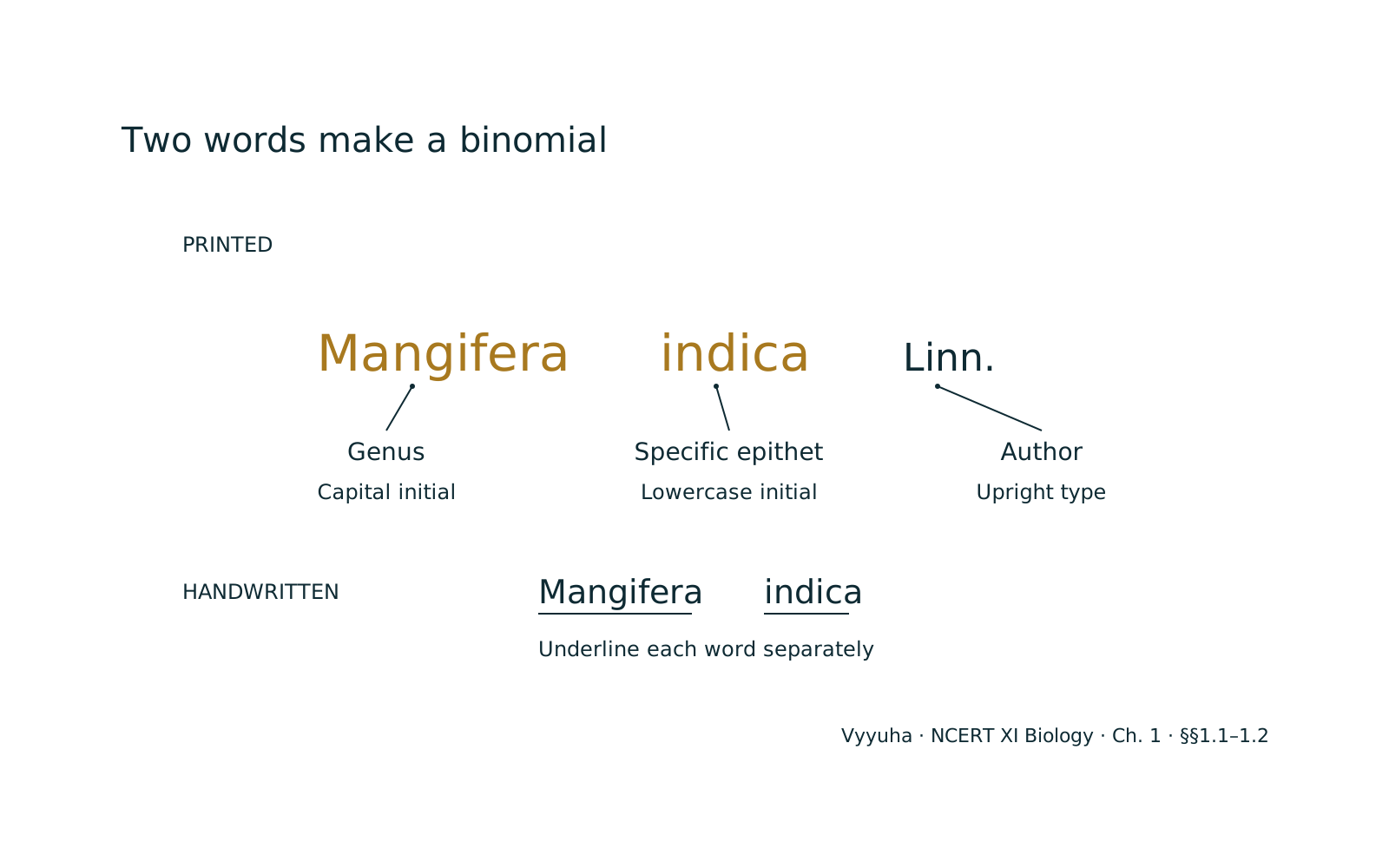
- Generic Name (Genus): — The first part, always capitalized, represents the genus to which the species belongs. A genus can include one or more species that are closely related.
- Specific Epithet (Species Name): — The second part, never capitalized, identifies the particular species within that genus. It is often descriptive or honors a person or place.
Rules of Binomial Nomenclature (as per ICN/ICZN, commonly tested in NEET):
- Latin Origin: — Scientific names are generally derived from Latin or are Latinized, ensuring universality and stability.
- Italicization: — When typed or printed, scientific names are always italicized (e.g., Mangifera indica). When handwritten, they are underlined separately (e.g., \underline{Mangifera} \underline{indica}).
- Capitalization: — The generic name (first word) starts with a capital letter, while the specific epithet (second word) starts with a small letter (e.g., Panthera leo, not Panthera Leo).
- Author Citation (Optional but important): — The name of the discoverer or person who first described the species can be written in an abbreviated form after the scientific name, without italicization (e.g., Mangifera indica Linn. or Mangifera indica L.). This indicates the authority for the name.
- Uniqueness: — Each species has a unique binomial name. No two species can have the same generic name and specific epithet combination.
- Priority: — If an organism is given multiple names over time, the earliest validly published name (according to the rules of the respective code) takes precedence. This is known as the 'Principle of Priority'.
- Type Specimen: — For each species, a 'type specimen' (a preserved physical example) is designated. This specimen serves as the reference point for the scientific name, ensuring consistency in identification.
- Tautonyms (Zoology only): — In zoological nomenclature, it is permissible for the generic name and specific epithet to be identical (e.g., Naja naja for the Indian cobra). This is not allowed in botanical nomenclature.
- Trinomial Nomenclature: — For subspecies, a third name (subspecific epithet) is added (e.g., Corvus splendens splendens for the Indian house crow). This is more common in zoology.
Real-World Applications:
- Global Communication: — Enables scientists worldwide to discuss the same organism unambiguously, regardless of their native language.
- Conservation Efforts: — Crucial for identifying and tracking endangered species, facilitating international conservation programs.
- Medicine and Agriculture: — Accurate identification of pathogens, pests, and beneficial organisms is vital for developing treatments, managing crops, and understanding disease vectors.
- Biodiversity Studies: — Essential for cataloging, understanding, and monitoring the vast diversity of life on Earth.
- Evolutionary Biology: — Scientific names, especially at higher taxonomic ranks, often reflect evolutionary relationships, aiding in phylogenetic studies.
Common Misconceptions:
- Nomenclature is Classification: — While closely related, nomenclature is the naming aspect, while classification is the grouping of organisms based on shared characteristics. Nomenclature provides the labels for the groups established by classification.
- Species Name is the Second Word: — The 'species name' is the entire binomial (genus + specific epithet), not just the specific epithet. The second word is the 'specific epithet'.
- Capitalizing Specific Epithet: — A common error is to capitalize the specific epithet, which is incorrect. Only the generic name is capitalized.
- Underlining vs. Italicizing: — Students often forget to italicize or underline scientific names, which is a mandatory rule.
- Static System: — Nomenclature is not static; names can change due to new taxonomic research, reclassification, or discovery of older valid names (Principle of Priority).
NEET-Specific Angle:
For NEET, the focus on nomenclature typically revolves around:
- Understanding the rules of binomial nomenclature: — Capitalization, italicization/underlining, author citation.
- Identifying correct scientific names: — Given options, selecting the correctly written one.
- Knowing the full scientific names of common organisms: — E.g., Mangifera indica (mango), Solanum tuberosum (potato), Panthera leo (lion), Homo sapiens (human).
- Understanding the purpose and significance of nomenclature: — Why it's needed, its advantages over common names.
- Distinguishing between nomenclature and classification.
- Basic knowledge of the international codes (ICN, ICZN).
Mastering these aspects will ensure a strong foundation in taxonomy and help secure marks in related questions.
Often confused with
Side-by-side differences the NEET paper likes to test.
| Aspect | Nomenclature | Common Names |
|---|---|---|
| Universality | Scientific Names (e.g., *Mangifera indica*) | Common Names (e.g., Mango) |
| Language Dependence | Universal (Latin/Latinized) | Language-specific (e.g., 'Aam' in Hindi, 'Maanga' in Tamil) |
| Precision/Ambiguity | Unique and unambiguous for each species | Often ambiguous; one name for multiple species, multiple names for one species |
| Stability | Highly stable, governed by international codes | Unstable, can change regionally or over time |
| Reflection of Relationship | Generic name often indicates evolutionary relationships | Rarely reflects true biological relationships |
| Formatting Rules | Strict rules (capitalization, italicization/underlining) | No formal rules |
Scientific names, established through systematic nomenclature, offer a universal, precise, and stable way to identify organisms, overcoming the inherent limitations of common names. While common names are useful for everyday communication, their variability across regions and languages, coupled with their ambiguity (one name for many species, many names for one species), makes them unsuitable for scientific discourse.
Scientific names, governed by international codes and typically Latinized, ensure that every species has a unique identifier, facilitating clear and accurate global communication among biologists and contributing to the stability of biological knowledge.
Why it is tested: For NEET, understanding the distinction between scientific and common names is fundamental. Questions often test the advantages of scientific nomenclature over common names, or the rules associated with writing scientific names, which directly stem from these differences. It underpins the entire concept of 'The Living World' chapter.
Questions students ask
6 answered on this topic.
What is the primary purpose of scientific nomenclature?
The primary purpose of scientific nomenclature is to provide a unique, universally accepted, and unambiguous name for every known organism. This eliminates confusion arising from regional common names, language barriers, and the lack of precision in vernacular terms. It ensures that scientists globally can refer to the exact same species, facilitating accurate communication, data sharing, and collaboration in biological research, conservation, and other related fields.
Who is considered the 'Father of Taxonomy' and what was his major contribution to nomenclature?
Carolus Linnaeus, a Swedish botanist, is widely regarded as the 'Father of Taxonomy'. His major contribution to nomenclature was the formalization and popularization of the Binomial Nomenclature system. Through his seminal works like Species Plantarum and Systema Naturae, he consistently applied the two-part naming system (genus and specific epithet) to classify and name a vast number of plants and animals, laying the foundation for modern biological nomenclature.
Why are scientific names typically in Latin or Latinized?
Scientific names are predominantly in Latin or Latinized for several compelling reasons. Latin is a 'dead language,' meaning it is no longer spoken as a native language and thus does not evolve or change over time. This ensures the stability and permanence of scientific names. Additionally, using a classical language provides a neutral ground, avoiding favoritism towards any modern language and making the names universally understandable to scholars across different linguistic backgrounds.
What is the difference between a generic name and a specific epithet?
The generic name is the first part of a scientific name, representing the genus to which an organism belongs. It is always capitalized (e.g., Mangifera). The specific epithet is the second part of the scientific name, identifying the particular species within that genus. It is never capitalized (e.g., indica). Together, the generic name and specific epithet form the unique binomial name for a species (e.g., Mangifera indica).
Can two different species have the same scientific name?
No, according to the rules of international codes of nomenclature (ICN, ICZN), no two different species can have the exact same scientific name (i.e., the same combination of generic name and specific epithet). This principle of uniqueness is fundamental to avoiding ambiguity and ensuring that each scientific name refers to one and only one specific biological entity, thereby maintaining clarity in biological communication.
What is the significance of italicizing or underlining scientific names?
Italicizing (when typed) or separately underlining (when handwritten) scientific names is a mandatory convention in binomial nomenclature. This formatting serves to distinguish scientific names from the surrounding text, immediately signaling to the reader that they are encountering a formal biological name. It emphasizes their Latin origin and their status as universally recognized identifiers, reinforcing the standardized nature of biological communication.