Work — Explained
Detailed Explanation
Work, in the realm of physics, is a fundamental concept that bridges the ideas of force, displacement, and energy. Unlike the colloquial understanding of 'work' as any strenuous activity, its scientific definition is precise and quantitative. It represents the mechanism by which energy is transferred to or from an object by means of a force acting over a displacement.
Conceptual Foundation
At its core, work is done when a force causes a displacement of an object. If an object moves, but no force acts on it, no work is done. Conversely, if a force acts on an object, but it does not move, no work is done. Furthermore, the direction of the force relative to the direction of displacement is crucial. Only the component of the force that is parallel to the displacement contributes to the work done.
Consider a constant force acting on an object, causing a displacement . The work done by this force is defined as the dot product of the force vector and the displacement vector:
- is the magnitude of the force.
- is the magnitude of the displacement.
- is the angle between the force vector and the displacement vector .
Key Principles and Laws
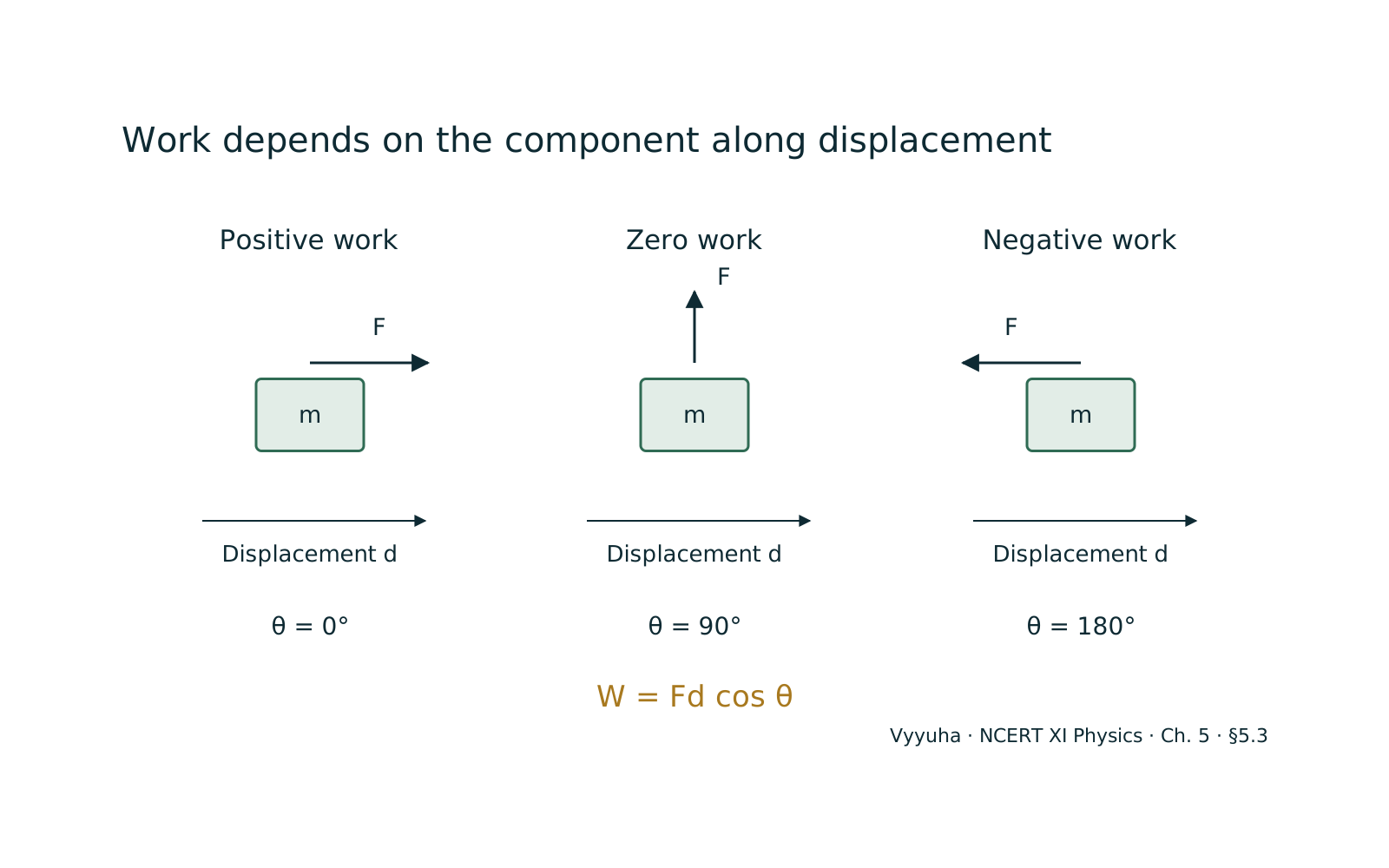
- Positive Work: — When the force and displacement are in the same general direction (), is positive, and thus work done is positive. This means the force is adding energy to the system. Example: Pushing a box forward, gravity doing work on a falling object.
- Negative Work: — When the force and displacement are in opposite directions (), is negative, and work done is negative. This means the force is removing energy from the system. Example: Friction acting on a moving object, an object being lifted against gravity.
- Zero Work: — When the force is perpendicular to the displacement (), , and work done is zero. This implies the force does not contribute to the object's motion in the direction of displacement. Example: The centripetal force on an object moving in a circle, the normal force on an object sliding horizontally, carrying a bag horizontally.
Work-Energy Theorem
One of the most profound principles involving work is the Work-Energy Theorem. It states that the net work done on an object by all forces acting on it is equal to the change in its kinetic energy. Mathematically:
This theorem is incredibly powerful as it directly links the dynamics of forces and motion to the concept of energy.
Derivations and Calculations
A. Work done by a Constant Force
As discussed, for a constant force causing a displacement , the work done is simply . This applies to many straightforward scenarios in NEET problems, such as pushing a block on a horizontal surface or lifting an object at a constant velocity.
B. Work done by a Variable Force
Many forces in nature are not constant; they change with position. Examples include the force exerted by a spring (Hooke's Law, ) or the gravitational force between two masses at varying distances. When the force varies, we cannot simply use . Instead, we must use integration.
If a variable force acts along the x-axis, and the object moves from to , the work done is given by:
This is a common way to solve problems involving variable forces in NEET, especially when the force-displacement relationship is linear or piecewise linear.
C. Work done by Specific Forces
- Gravitational Force: — For an object of mass lifted vertically by a height , the work done by gravity is (negative because gravity acts downwards, opposite to upward displacement). If the object falls, . Importantly, work done by gravity is path-independent, making gravity a conservative force.
- Spring Force: — For an ideal spring with spring constant , stretched or compressed by a distance from its equilibrium position, the force exerted by the spring is . The work done by the spring when it moves from to is:
- Frictional Force: — Friction always opposes relative motion. Thus, the work done by kinetic friction is always negative. For a constant kinetic friction force over a displacement , .
Real-World Applications
Work is omnipresent in our daily lives and in engineering:
- Lifting and Moving Objects: — Cranes do work to lift heavy loads, and engines do work to move vehicles.
- Sports: — Athletes do work when they push off the ground, throw a ball, or lift weights.
- Machines: — All machines, from simple levers to complex engines, operate by doing work to transfer or transform energy.
- Thermodynamics: — Work is a key concept in thermodynamics, where it describes energy transfer between a system and its surroundings, often through volume changes (e.g., expansion of gas in an engine).
Common Misconceptions
- Work vs. Effort: — Just because you exert effort doesn't mean you're doing physical work. Holding a heavy object stationary requires effort but no work is done on the object as there's no displacement.
- Work is always positive: — Work can be positive, negative, or zero. Negative work is crucial for understanding energy dissipation (like friction) or energy storage (like lifting against gravity).
- Work is a vector: — Work is a scalar quantity. It has magnitude but no direction. The dot product of two vectors (force and displacement) always yields a scalar.
- Work done by a force is independent of path: — This is true only for conservative forces (like gravity or spring force). For non-conservative forces (like friction), the work done depends on the path taken.
NEET-Specific Angle
For NEET aspirants, a deep understanding of work is critical. Questions often involve:
- Calculating work done by constant forces: — This requires careful attention to the angle between force and displacement.
- Work done by variable forces: — Often tested using graphical analysis (area under F-x curve) or simple integration for linear force functions.
- Application of the Work-Energy Theorem: — This is a very common problem type, where you relate the net work done to changes in kinetic energy. It often simplifies problems that would be complex using Newton's laws directly.
- Work done by specific forces: — Gravitational work, frictional work, and spring work are frequently tested. Remember the sign conventions.
- Distinguishing between work done by different forces: — For example, work done by the applied force vs. work done by friction vs. work done by gravity on the same object.
- Conceptual questions: — Identifying scenarios where work is positive, negative, or zero.
Mastering these aspects, along with a clear grasp of units and dimensions, will equip you to tackle a wide range of work-related problems in the NEET exam.
Often confused with
Side-by-side differences the NEET paper likes to test.
| Aspect | Work | Energy |
|---|---|---|
| Definition | Work: The process of transferring energy from one system to another or changing energy within a system by means of a force causing displacement. | Energy: The capacity or ability of a system to do work or produce heat. It's a property of an object or system. |
| Nature | Work: A process or an action. | Energy: A state or a property. |
| Measurement | Work: Measured as $W = \vec{F} \cdot \vec{d}$ (for constant force) or $W = \int \vec{F} \cdot d\vec{r}$ (for variable force). | Energy: Measured in various forms (kinetic, potential, thermal, etc.), e.g., $K = \frac{1}{2}mv^2$, $U_g = mgh$, $U_s = \frac{1}{2}kx^2$. |
| Sign | Work: Can be positive, negative, or zero, indicating energy gain, loss, or no change due to the force. | Energy: Typically considered positive (e.g., kinetic energy is always positive). Potential energy can be negative depending on the choice of reference point. |
| Relationship | Work: The means by which energy is transferred or transformed. Net work done equals change in kinetic energy ($W_{net} = \Delta K$). | Energy: What is transferred or transformed by work. It is conserved in an isolated system. |
While both work and energy are scalar quantities measured in Joules, they represent different aspects of physical phenomena. Energy is the inherent capacity of a system to perform work, a property it possesses.
Work, on the other hand, is the actual process of transferring or transforming that energy due to the action of a force over a distance. Work is a dynamic process that changes the energy state of a system, whereas energy is the static measure of that state.
Understanding this distinction is crucial for correctly applying principles like the Work-Energy Theorem and the Law of Conservation of Energy.
Why it is tested: NEET relevance: This distinction is fundamental. Many conceptual questions in NEET test the understanding of when work is done and how it relates to changes in different forms of energy (kinetic, potential). Misconceptions often arise from confusing the two, leading to incorrect application of energy conservation principles or the Work-Energy Theorem. A clear grasp helps in analyzing energy transformations in various physical systems.
Questions students ask
6 answered on this topic.
What is the difference between work and energy?
Work and energy are intimately related but distinct concepts. Energy is the capacity to do work, or the ability of a system to perform actions. It's a property of an object or a system. Work, on the other hand, is the process by which energy is transferred from one system to another, or transformed from one form to another within a system, due to the action of a force causing displacement.
Think of energy as a bank account balance, and work as a deposit or withdrawal. Both are measured in Joules, highlighting their close relationship.
Can work be negative? If so, what does it mean?
Yes, work can absolutely be negative. Negative work occurs when the force acting on an object has a component that is opposite to the direction of the object's displacement. This means the force is actively opposing the motion.
For example, when friction acts on a sliding object, it does negative work, causing the object to slow down and lose kinetic energy. Similarly, when you lift an object, the gravitational force does negative work because it acts downwards while the displacement is upwards, effectively removing kinetic energy from the object if it's slowing down, or storing it as potential energy.
When is work done zero, even if a force is applied?
Work done can be zero under two primary conditions. Firstly, if there is no displacement, no work is done, regardless of how much force is applied (e.g., pushing a stationary wall). Secondly, if the force applied is perpendicular to the direction of displacement, the work done is zero.
A classic example is the centripetal force acting on an object moving in a circular path; this force is always directed towards the center, perpendicular to the instantaneous displacement, hence it does no work.
Similarly, carrying a briefcase horizontally does no work against gravity, as the upward force you exert is perpendicular to your horizontal motion.
How is work calculated for a variable force?
When a force is not constant but varies with position, the simple formula is insufficient. Instead, work is calculated by integrating the force over the displacement. For a force acting along the x-axis, the work done from to is .
Graphically, this integral represents the area under the Force-displacement () curve. This method is crucial for forces like those exerted by springs, which increase linearly with displacement, or more complex force fields.
What is the Work-Energy Theorem and why is it important?
The Work-Energy Theorem is a fundamental principle in mechanics stating that the net work done on an object by all forces acting on it is equal to the change in its kinetic energy. Mathematically, .
This theorem is incredibly important because it provides a direct link between the forces acting on an object and its change in motion (specifically, its speed). It often simplifies problem-solving, allowing us to determine speeds or displacements without explicitly using Newton's second law and kinematics, especially when forces are variable or paths are complex.
Is work a scalar or vector quantity?
Work is a scalar quantity. Although it is calculated from two vector quantities (force and displacement), their dot product results in a scalar. This means work has magnitude but no direction. It simply tells us the amount of energy transferred or changed, without specifying a direction for that transfer. This is consistent with energy itself being a scalar quantity.