Power — Explained
Detailed Explanation
Power is a fundamental concept in physics that quantifies the rate at which work is performed or energy is transferred. While work and energy tell us about the total amount of effort or capacity for doing work, power introduces the crucial element of time, indicating how quickly these processes occur. This distinction is vital for understanding the performance and efficiency of various physical systems.
1. Conceptual Foundation: The Rate of Doing Work
At its core, power is the time rate of doing work. If a certain amount of work, , is done over a time interval, , the average power, , is given by:
For instance, an electric heater converts electrical energy into thermal energy at a certain rate, which is its power rating. A motor converts electrical energy into mechanical work at a certain rate.
2. Instantaneous Power vs. Average Power
Just like velocity can be average or instantaneous, power also has these two forms:
- Average Power ($P_{avg}$): — This is the total work done divided by the total time taken for that work. It gives an overall measure of how quickly work was done over a specific duration.
- Instantaneous Power ($P_{inst}$): — This refers to the power at a specific moment in time. If the rate of doing work is not constant, instantaneous power becomes more relevant. It is defined as the derivative of work with respect to time:
3. Relation to Force and Velocity
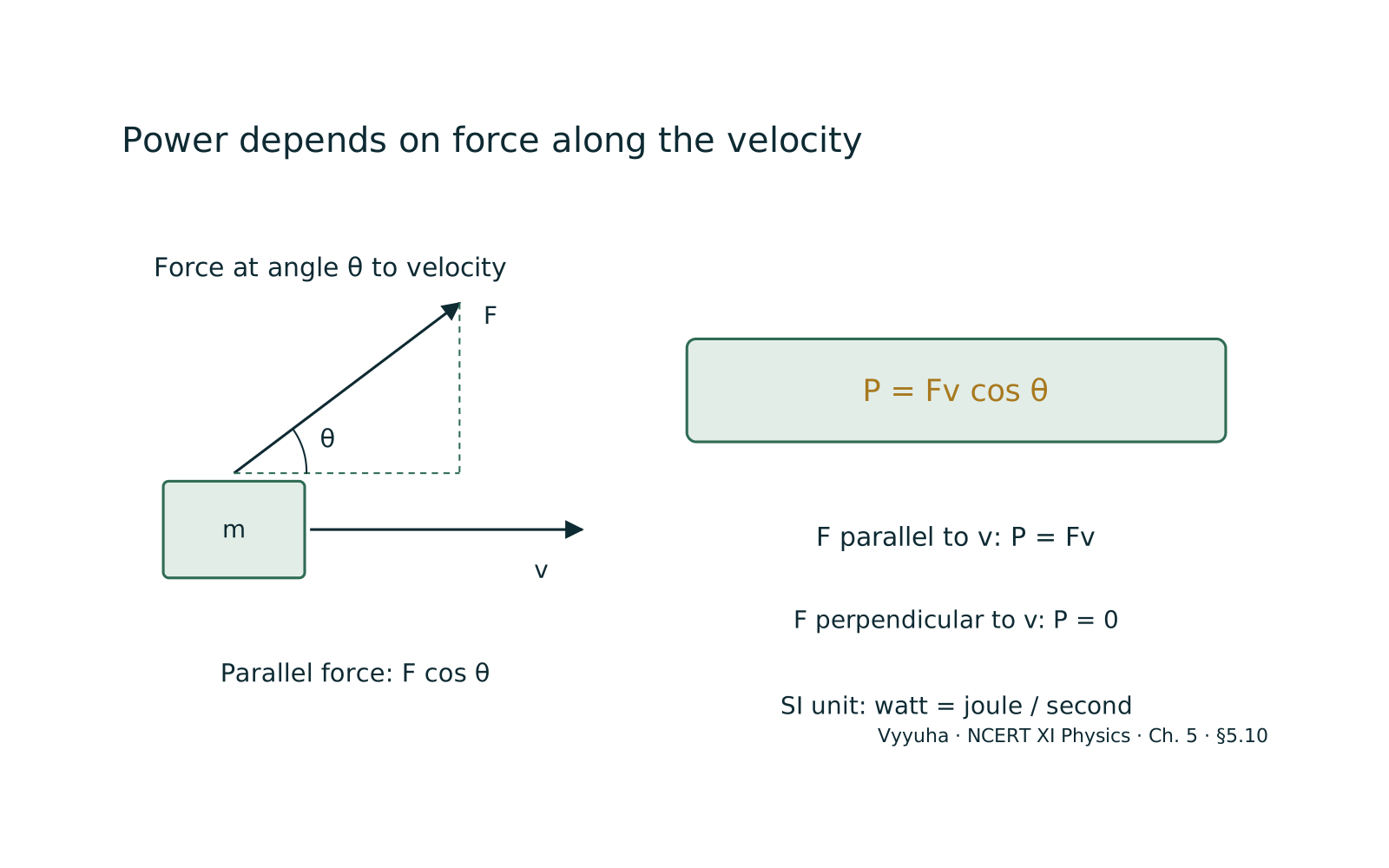
One of the most important expressions for instantaneous power relates it directly to the force applied and the velocity of the object on which the force is acting. We know that for a small displacement , the infinitesimal work done by a constant force is .
Substituting this into the definition of instantaneous power:
If the force and velocity are in the same direction, . If they are perpendicular, , meaning no work is done and thus no power is generated in that direction.
This formula is extremely useful in problems involving moving objects, such as vehicles, elevators, or projectiles.
4. Units of Power
- SI Unit: Watt (W)
The SI unit of power is the watt (W), named after James Watt, the developer of the steam engine. One watt is defined as one joule of work done per second:
- Other Units:
* Horsepower (hp): An older unit still widely used, especially for engines and motors. (often approximated as ). There are slight variations (e.
g., mechanical horsepower, metric horsepower), but for NEET, is generally accepted. * Foot-pound per minute (ft-lb/min): An imperial unit, .
* Kilowatt-hour (kWh): It's crucial to note that kilowatt-hour is a unit of energy, not power. It represents the energy consumed by a device of 1 kW power operating for 1 hour. $1\,\text{kWh} = 1000\,\text{W} \times 3600\,\text{s} = 3.
6 \times 10^6\,\text{J}$. This unit is commonly used for electricity billing.
5. Efficiency of Machines
No real machine is 100% efficient; some energy is always lost, typically as heat due to friction or air resistance. The efficiency () of a machine is defined as the ratio of the useful output power () to the total input power (), often expressed as a percentage:
6. Real-World Applications
Power is a concept with vast applications across various fields:
- Automotive Industry: — Engine power (horsepower or kilowatts) determines a vehicle's acceleration and top speed capabilities. More powerful engines can do work (change kinetic energy) faster.
- Electrical Appliances: — The power rating (in watts) of appliances like light bulbs, refrigerators, and air conditioners indicates how much electrical energy they consume per second. This directly impacts electricity bills.
- Human Physiology: — The power output of athletes is a measure of their physical performance. For example, a weightlifter generates high power during a quick lift, while a marathon runner sustains moderate power for an extended period.
- Renewable Energy: — The power output of solar panels or wind turbines indicates how much electrical energy they can generate per unit time, crucial for assessing their viability.
- Industrial Machinery: — The power of motors and pumps determines their capacity to move materials, lift loads, or drive other machinery.
7. Common Misconceptions
- Power vs. Energy: — A common mistake is to confuse power with energy. Energy is the capacity to do work, while power is the rate at which that work is done. A small light bulb (low power) left on for a long time can consume more total energy than a high-power appliance used for a short duration. Think of a 100W bulb (power) versus 1 kWh (energy).
- Power vs. Force: — While related by velocity (), power and force are distinct. A large force applied to a stationary object (zero velocity) results in zero power. Conversely, a small force can generate significant power if it acts over a very high velocity.
- Power is always positive: — Power can be negative if the force and velocity are in opposite directions, meaning the force is doing negative work (e.g., friction slowing down an object). In such cases, the object is losing energy.
8. NEET-Specific Angle and Problem-Solving Strategies
For NEET, questions on power often involve:
- Direct calculation: — Using or .
- Work-Energy Theorem: — Problems where work done changes kinetic or potential energy, and then power is calculated from the rate of this change.
- Efficiency: — Calculating output power, input power, or efficiency of a machine.
- Variable Force/Velocity: — For non-constant forces or velocities, understanding instantaneous power and sometimes requiring integration (though less common for NEET, average power over varying conditions is more typical).
- Graphical Analysis: — Interpreting P-t graphs (area under P-t graph gives work/energy) or F-v graphs (product gives power).
- Lifting Objects: — Calculating power required to lift objects against gravity, often at a constant velocity, where .
When tackling power problems, always identify whether average or instantaneous power is required. Pay close attention to units and ensure consistency. Remember that power is a scalar quantity, even though it's derived from vector quantities (force and velocity).
Often confused with
Side-by-side differences the NEET paper likes to test.
| Aspect | Power | Work and Energy |
|---|---|---|
| Definition | Power: Rate at which work is done or energy is transferred. | Work: Energy transferred when a force causes displacement. Energy: Capacity to do work. |
| Formula | Power: $P = W/t$ (average), $P = dW/dt = \vec{F} \cdot \vec{v}$ (instantaneous). | Work: $W = \vec{F} \cdot \vec{d}$. Energy: Various forms (e.g., $E_k = \frac{1}{2}mv^2$, $U_g = mgh$). |
| SI Unit | Power: Watt (W), where $1\,\text{W} = 1\,\text{J/s}$. | Work & Energy: Joule (J). |
| Time Dependence | Power: Explicitly time-dependent (rate). | Work & Energy: Not explicitly time-dependent (total amount). |
| Scalar/Vector | Power: Scalar quantity. | Work & Energy: Scalar quantities. |
| Significance | Power: Measures how quickly a task is completed or energy is utilized. | Work & Energy: Measures the total effort or capacity for change. |
The primary distinction between power, work, and energy lies in their relationship with time. Work and energy quantify the total amount of effort expended or the total capacity to do work, respectively, without regard for how long the process takes.
Both are measured in Joules. Power, however, introduces the time factor, defining the rate at which work is done or energy is transferred. It tells us how quickly an energy transformation occurs. Thus, while doing the same amount of work, a higher power output means the work is completed in less time.
This rate-based understanding is crucial for analyzing machine performance and efficiency.
Why it is tested: NEET relevance: Understanding these differences is crucial for conceptual clarity and problem-solving. Many NEET questions test the ability to distinguish between these concepts, especially when dealing with efficiency, energy consumption, and the performance of engines or lifting mechanisms. Confusing them is a common source of error.
Questions students ask
6 answered on this topic.
What is the fundamental difference between work, energy, and power?
Work is the process of energy transfer due to a force acting over a distance. Energy is the capacity to do work. Power, on the other hand, is the rate at which work is done or energy is transferred. So, while work and energy tell you 'how much' was done or 'how much' capacity exists, power tells you 'how fast' it was done.
For example, lifting a 10 kg mass by 1 meter requires the same amount of work (and changes its potential energy by the same amount) whether you do it in 1 second or 10 seconds. However, the power exerted is much higher in the 1-second scenario.
Can power be negative? What does it signify?
Yes, power can be negative. Power is given by the dot product of force and velocity, . If the force acting on an object is in the opposite direction to its velocity, the angle between and is , and .
In this case, . Negative power signifies that the force is doing negative work on the object, meaning it is removing energy from the object or slowing it down. Examples include friction acting on a moving object or a brake system.
Why is kilowatt-hour (kWh) a unit of energy and not power?
Kilowatt-hour (kWh) is a unit of energy because it is the product of power (kilowatt) and time (hour). Power is the rate of energy consumption or production. If you multiply a rate by a duration, you get the total quantity. So, represents the total energy consumed by a device with a power rating of 1 kilowatt operating for 1 hour. It's commonly used for electricity billing because it quantifies the total energy used over a period, not the instantaneous rate of usage.
How does efficiency relate to power in real-world machines?
Efficiency is a measure of how effectively a machine converts input power into useful output power. No real machine is 100% efficient; some energy is always lost, typically as heat due to friction, air resistance, or electrical resistance.
For example, an engine might consume fuel (input energy) to produce mechanical work (output energy). The ratio of the useful mechanical power output to the total chemical power input from the fuel, multiplied by 100%, gives its efficiency.
Higher efficiency means less energy is wasted, leading to better performance and lower operating costs.
What is the significance of the formula $P = \vec{F} \cdot \vec{v}$?
The formula is incredibly significant because it provides a direct way to calculate the instantaneous power being delivered by a force to an object, given its instantaneous velocity.
It highlights that only the component of the force parallel to the velocity contributes to the power. If a force acts perpendicular to the direction of motion (like the centripetal force on an object moving in a circle at constant speed), it does no work and thus generates no power.
This formula is widely used in analyzing the dynamics of moving systems, from vehicles to fluids.
How does power relate to lifting objects against gravity?
When lifting an object of mass against gravity at a constant velocity , the force required is equal to the object's weight, . Since the force and velocity are in the same direction (upwards), the power required is . This formula is crucial for calculating the power output of motors or humans lifting loads, such as in elevators, cranes, or even climbing stairs. If the object is accelerating, the force would be , and the power would be .