Bryophytes — Explained
Detailed Explanation
Bryophytes represent a pivotal evolutionary step in the colonization of land by plants. As the first true land plants, they faced the challenges of desiccation, gravity, and reproduction in a terrestrial environment, yet they retain strong ties to their aquatic ancestry. Their non-vascular nature dictates many of their characteristics and ecological niches.
I. General Characteristics of Bryophytes:
- Habitat: — Primarily terrestrial, but restricted to moist and shady places. Some are aquatic (e.g., Riccia fluitans).
- Plant Body: — The main plant body is a haploid (n) gametophyte, which is free-living and photosynthetic. It can be thalloid (undifferentiated, flat, dorsiventral, e.g., many liverworts and hornworts) or leafy and erect (e.g., mosses). They lack true roots, stems, and leaves.
- Anchoring Structures: — Instead of roots, they possess multicellular or unicellular rhizoids for anchorage and absorption of water and minerals, though absorption is primarily through the general surface.
- Vascular Tissue: — Absent. This limits their size and necessitates moist habitats for water absorption and transport via cell-to-cell diffusion.
- Reproduction: — Exhibits heterogamy (anisogamy or oogamy). Sexual reproduction requires water for the transfer of male gametes.
- Life Cycle: — Characterized by heteromorphic alternation of generations, with the gametophyte being the dominant, independent phase and the sporophyte being dependent on the gametophyte.
- Embryo Formation: — They are embryophytes, meaning they form a multicellular embryo within the archegonium after fertilization, a key adaptation for land life.
II. Classification of Bryophytes:
Bryophytes are divided into three classes:
A. Hepaticopsida (Liverworts):
- Examples: — Marchantia, Riccia, Pellia
- Characteristics:
Plant body is typically thalloid, dorsiventral, and closely appressed to the substrate. Some are leafy with tiny leaf-like appendages in two rows on the stem-like structure. Rhizoids are unicellular and unbranched.
Asexual reproduction occurs by fragmentation of thalli or by the formation of gemmae (green, multicellular, asexual buds) in gemma cups located on the thalli. Sexual reproduction involves antheridia (male sex organs) and archegonia (female sex organs) produced on specialized structures called antheridiophores and archegoniophores, respectively (e.
g., Marchantia). Sporophyte is simple, consisting of a foot, seta, and capsule. It is short-lived and entirely dependent on the gametophyte. Spores are dispersed with the help of elaters (sterile, hygroscopic cells).
B. Bryopsida (Mosses):
- Examples: — Funaria (common moss), Sphagnum (peat moss), Polytrichum
- Characteristics:
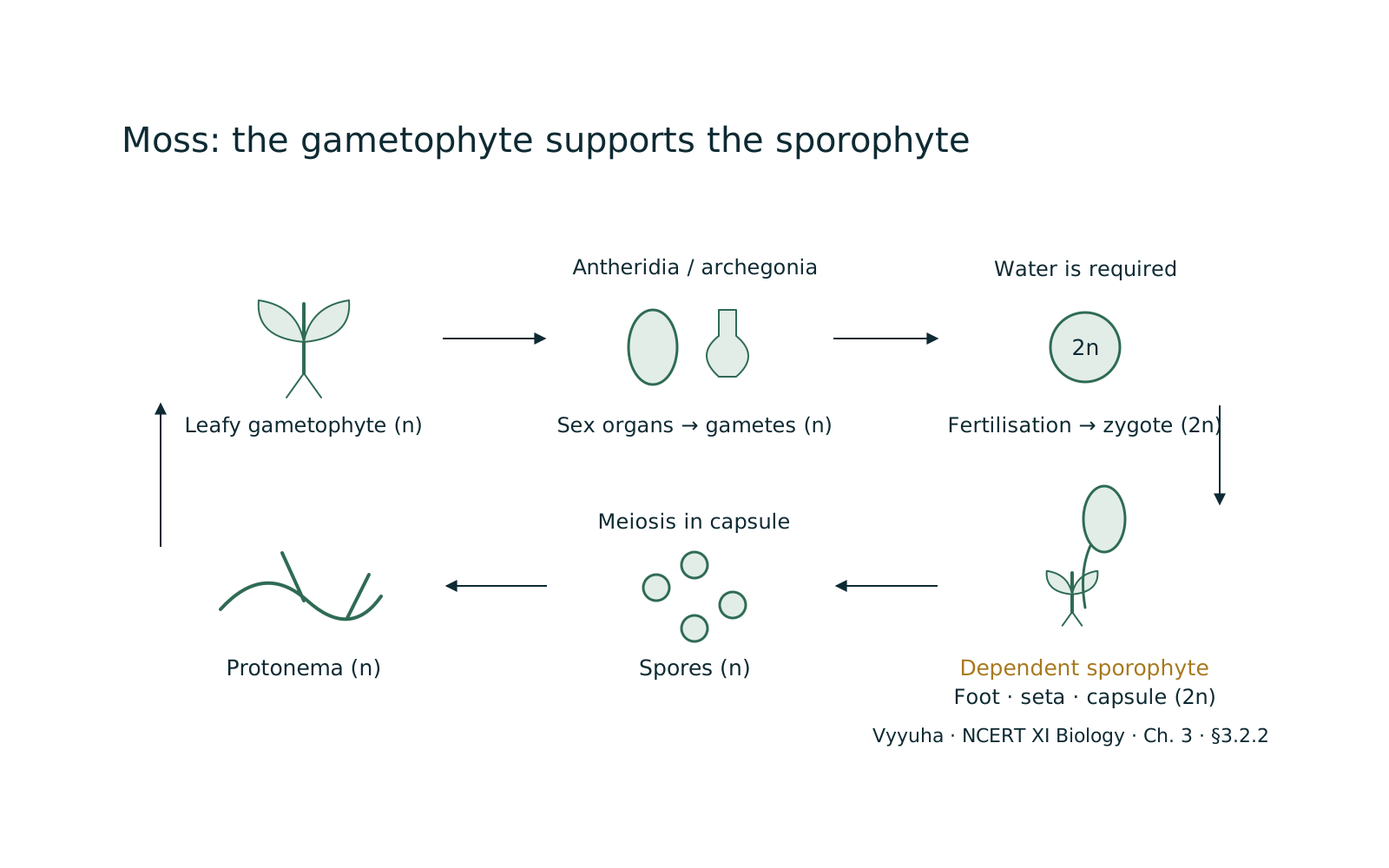
The gametophyte phase is more elaborate, consisting of two stages: the protonema stage and the leafy stage. Protonema: A creeping, green, branched, filamentous stage that develops directly from a spore.
It bears buds which develop into the leafy gametophyte. * Leafy Stage: Consists of an upright, slender axis bearing spirally arranged leaves. It is attached to the soil by multicellular, branched rhizoids.
Asexual reproduction by fragmentation and budding in the secondary protonema. Sexual reproduction involves antheridia and archegonia produced at the apex of the leafy shoots. They are often protected by perichaetial leaves.
Sporophyte is more differentiated and complex than in liverworts, consisting of a foot, a longer seta, and a capsule (spore case). It is partially dependent on the gametophyte for nutrition. Spore dispersal is aided by a sophisticated mechanism involving a peristome (a ring of teeth-like structures around the mouth of the capsule) which helps in gradual spore release.
C. Anthocerotopsida (Hornworts):
- Examples: — Anthoceros, Notothylas
- Characteristics:
Gametophyte is a dorsiventral, flattened thallus, similar to some liverworts. Rhizoids are unicellular and unbranched. * A unique feature is the presence of a single large chloroplast per cell, often with a pyrenoid, resembling algal cells.
* Often have symbiotic association with nitrogen-fixing cyanobacteria (e.g., Nostoc) in mucilage cavities within the thallus. * Sporophyte is distinctive, elongated and horn-shaped, hence the name 'hornworts'.
It is partially photosynthetic due to the presence of chloroplasts and stomata, but still dependent on the gametophyte for water and minerals. * The sporophyte has an indeterminate growth, continuously producing spores from its base.
It possesses a meristematic zone between the foot and the capsule. * Spores are dispersed with the help of pseudoelaters (sterile cells, unlike true elaters, they are not spirally thickened).
III. Life Cycle and Alternation of Generations:
Bryophytes exhibit a heteromorphic alternation of generations, where a dominant, free-living gametophyte (n) alternates with a smaller, dependent sporophyte (2n).
- Gametophyte (n): — This is the prominent, photosynthetic plant body. It produces sex organs: antheridia (male, producing biflagellate antherozoids) and archegonia (female, flask-shaped, producing a single egg). Both are typically multicellular and jacketed.
- Fertilization: — Water is crucial. Antherozoids are released from antheridia and swim through the water film to reach the archegonium, where they fuse with the egg (syngamy) to form a diploid zygote (2n).
- Sporophyte (2n): — The zygote develops into a multicellular embryo within the archegonium, which then differentiates into the sporophyte. The sporophyte consists of a foot (for anchorage and absorption from gametophyte), a seta (stalk), and a capsule (sporangium). The sporophyte remains attached to and derives nutrition from the gametophyte.
- Meiosis: — Inside the capsule, spore mother cells (2n) undergo meiosis to produce haploid (n) spores.
- Spore Germination: — Spores are dispersed (often by wind) and, upon landing in a suitable moist environment, germinate to produce a new gametophyte. In mosses, this involves an intermediate filamentous stage called the protonema, from which the leafy gametophyte develops.
IV. Reproduction:
- Asexual Reproduction:
* Fragmentation: Common in thalloid forms (e.g., Riccia, Marchantia). Pieces of the thallus break off and grow into new plants. * Gemmae: Multicellular, green, asexual buds produced in gemma cups (e.g., Marchantia). They detach and germinate to form new gametophytes. * Budding: In mosses, secondary protonema can produce buds that develop into new leafy gametophytes.
- Sexual Reproduction: — As described in the life cycle, involving antheridia, archegonia, biflagellate antherozoids, and an egg, with water being essential for fertilization.
V. Ecological and Economic Importance:
- Pioneer Colonizers: — Bryophytes, especially mosses and lichens, are often the first organisms to colonize barren rocks, burnt areas, and volcanic lava. They contribute to soil formation by breaking down rocks and accumulating organic matter, paving the way for higher plants.
- Soil Erosion Control: — They form dense mats on the soil surface, preventing soil erosion, especially on slopes, by holding soil particles together and reducing the impact of raindrops.
- Water Retention: — Mosses, particularly Sphagnum (peat moss), have a remarkable capacity to absorb and hold water (up to 18 times their dry weight). This property makes them important in maintaining soil moisture and regulating water cycles in bogs and wetlands.
- Peat Formation: — Sphagnum contributes significantly to the formation of peat, a fossil fuel. Peat is used as fuel, as packing material for trans-shipment of living material (due to its water-holding capacity), and as a soil conditioner.
- Ecological Indicators: — Their presence or absence can indicate environmental conditions, such as air quality (some species are sensitive to pollution).
- Food Source: — While not a primary food source for humans, some animals and insects feed on bryophytes.
VI. Common Misconceptions & NEET-Specific Angle:
- 'Amphibians of the Plant Kingdom': — This term is crucial for NEET. It refers to their dependence on water for sexual reproduction, despite living on land. They are a transitional group.
- Dominant Gametophyte: — Unlike pteridophytes, gymnosperms, and angiosperms where the sporophyte is dominant, in bryophytes, the gametophyte is the main, independent plant body.
- Sporophyte Dependency: — The sporophyte is not free-living; it is attached to and derives nutrition from the gametophyte. This is a key distinguishing feature.
- Lack of True Vascular Tissues: — Emphasize the absence of xylem and phloem and its implications for size and habitat.
- Rhizoids vs. Roots: — Rhizoids are simple, multicellular or unicellular structures for anchorage, not true roots with vascular tissue and complex absorption functions.
- Evolutionary Significance: — Bryophytes represent the first successful land plants, demonstrating adaptations like cuticle, stomata (in sporophyte of hornworts/mosses), and embryo formation, while still retaining primitive features like flagellated sperm and water-dependent fertilization.
Often confused with
Side-by-side differences the NEET paper likes to test.
| Aspect | Bryophytes | Algae and Pteridophytes |
|---|---|---|
| Habitat | Algae: Primarily aquatic (freshwater and marine). | Bryophytes: Terrestrial, but restricted to moist, shady places (amphibious). |
| Plant Body | Algae: Simple thalloid, undifferentiated, no true roots, stems, leaves. | Bryophytes: Thalloid or leafy, no true roots, stems, leaves; rhizoids for anchorage. |
| Vascular Tissue | Algae: Absent. | Bryophytes: Absent (non-vascular). |
| Dominant Phase | Algae: Gametophyte (haploid). | Bryophytes: Gametophyte (haploid). |
| Sporophyte Dependency | Algae: No distinct sporophyte generation in many; if present, often independent. | Bryophytes: Sporophyte is dependent on the gametophyte. |
| Embryo Formation | Algae: No embryo formation. | Bryophytes: Embryo formed (embryophytes). |
| Reproduction | Algae: Asexual (fragmentation, spores), Sexual (isogamy, anisogamy, oogamy). Water essential. | Bryophytes: Asexual (fragmentation, gemmae), Sexual (oogamy). Water essential for fertilization. |
Bryophytes occupy an intermediate position between simpler algae and more complex pteridophytes. While sharing the aquatic dependence for reproduction and a dominant gametophyte with algae, bryophytes show key terrestrial adaptations like multicellular sex organs and embryo formation, which are absent in algae.
However, unlike pteridophytes, bryophytes lack true vascular tissues and their sporophyte remains dependent on the gametophyte. Pteridophytes, in contrast, are the first vascular land plants with a dominant, independent sporophyte, representing a significant evolutionary leap towards full terrestrialization.
Why it is tested: For NEET, understanding these differences is crucial for classifying organisms and tracing evolutionary trends in the plant kingdom. Questions often test the unique combination of features in bryophytes that distinguish them from both their algal ancestors and their pteridophyte descendants, particularly regarding vascular tissue, dominant life cycle phase, and water dependency for reproduction.
Questions students ask
6 answered on this topic.
Why are bryophytes called the 'amphibians of the plant kingdom'?
Bryophytes are termed 'amphibians of the plant kingdom' because, despite living on land, they are entirely dependent on water for sexual reproduction. Their male gametes (antherozoids) are flagellated and require a film of water to swim and reach the female gametes (eggs) located within the archegonium.
This necessity for external water for fertilization mirrors the life cycle of amphibians, which also require water for breeding, even though they spend a significant portion of their lives on land. This dependence restricts bryophytes to moist, shady habitats.
What is the dominant phase in the life cycle of bryophytes?
The dominant phase in the life cycle of bryophytes is the gametophyte. This is the free-living, photosynthetic, and often larger plant body that we typically observe. It is haploid (n) and responsible for producing gametes.
In contrast, the sporophyte, which is diploid (2n) and produces spores, is smaller, short-lived, and remains attached to, and nutritionally dependent on, the gametophyte. This dominance of the gametophyte is a key distinguishing feature of bryophytes compared to higher plants.
Do bryophytes have true roots, stems, and leaves?
No, bryophytes do not possess true roots, stems, and leaves. These structures are characteristic of vascular plants (pteridophytes, gymnosperms, angiosperms) which have specialized vascular tissues (xylem and phloem).
Bryophytes have simpler, root-like structures called rhizoids, which primarily function in anchorage rather than extensive water and nutrient absorption. Their stem-like and leaf-like structures are also simple and lack vascular tissues, hence they are referred to as 'thalloid' or 'leafy' structures, not true organs.
What is the ecological importance of *Sphagnum* moss?
Sphagnum, commonly known as peat moss, holds significant ecological and economic importance. Ecologically, it forms vast peat bogs, which are crucial carbon sinks, helping regulate global climate. It has an exceptional water-holding capacity, absorbing up to 18 times its dry weight, which helps maintain soil moisture and prevents desiccation in its habitat.
Economically, dried Sphagnum is used as a fuel source (peat), as a packing material for transporting living plants and perishable goods due to its absorbent properties, and as a soil conditioner to improve water retention and aeration in gardens.
How do bryophytes reproduce asexually?
Bryophytes employ several methods for asexual reproduction. Fragmentation is common, where parts of the thallus or plant body break off and develop into new individuals. Another prominent method, especially in liverworts like Marchantia, is the formation of gemmae.
These are green, multicellular, asexual buds that develop in small cups called gemma cups on the gametophyte. When detached, gemmae germinate to form new plants. In mosses, secondary protonema can also produce buds that grow into new leafy gametophytes, contributing to their spread.
What is a protonema and in which bryophyte group is it prominent?
A protonema is a filamentous, creeping, green, and often branched structure that represents the juvenile stage of the gametophyte in mosses. It develops directly from the germination of a haploid spore.
From this primary protonema, buds arise, which then develop into the upright, leafy gametophyte, which is the more familiar form of a moss plant. This protonemal stage is particularly prominent and well-developed in mosses (Bryopsida), serving as an important stage for vegetative propagation and establishing new colonies.