Angiosperms — Explained
Detailed Explanation
Angiosperms, the flowering plants, represent the pinnacle of plant evolution, dominating terrestrial ecosystems across the globe. Their unparalleled success is attributed to a suite of advanced features, primarily the flower, fruit, and the unique process of double fertilization. Understanding these characteristics is fundamental for any NEET aspirant.
Conceptual Foundation
Angiosperms emerged approximately 140 million years ago during the early Cretaceous period and rapidly diversified, outcompeting many other plant groups. Their evolutionary success can be traced to several key innovations:
- Efficient Reproduction: — The flower, a highly specialized reproductive shoot, allows for targeted and efficient pollination, often mediated by animals. This contrasts sharply with the less efficient wind pollination prevalent in gymnosperms.
- Seed Protection and Dispersal: — The development of the ovary into a fruit provides robust protection for the developing seeds and facilitates diverse dispersal mechanisms, enhancing the chances of offspring survival and colonization of new habitats.
- Nutrient Provisioning: — Double fertilization leads to the formation of endosperm, a dedicated nutritive tissue that supports the embryo's development, ensuring a strong start for the new plant.
- Vascular Efficiency: — Angiosperms possess highly efficient vascular tissues, including vessels in xylem, which allow for rapid water transport and support their diverse growth forms.
Key Principles and Life Cycle
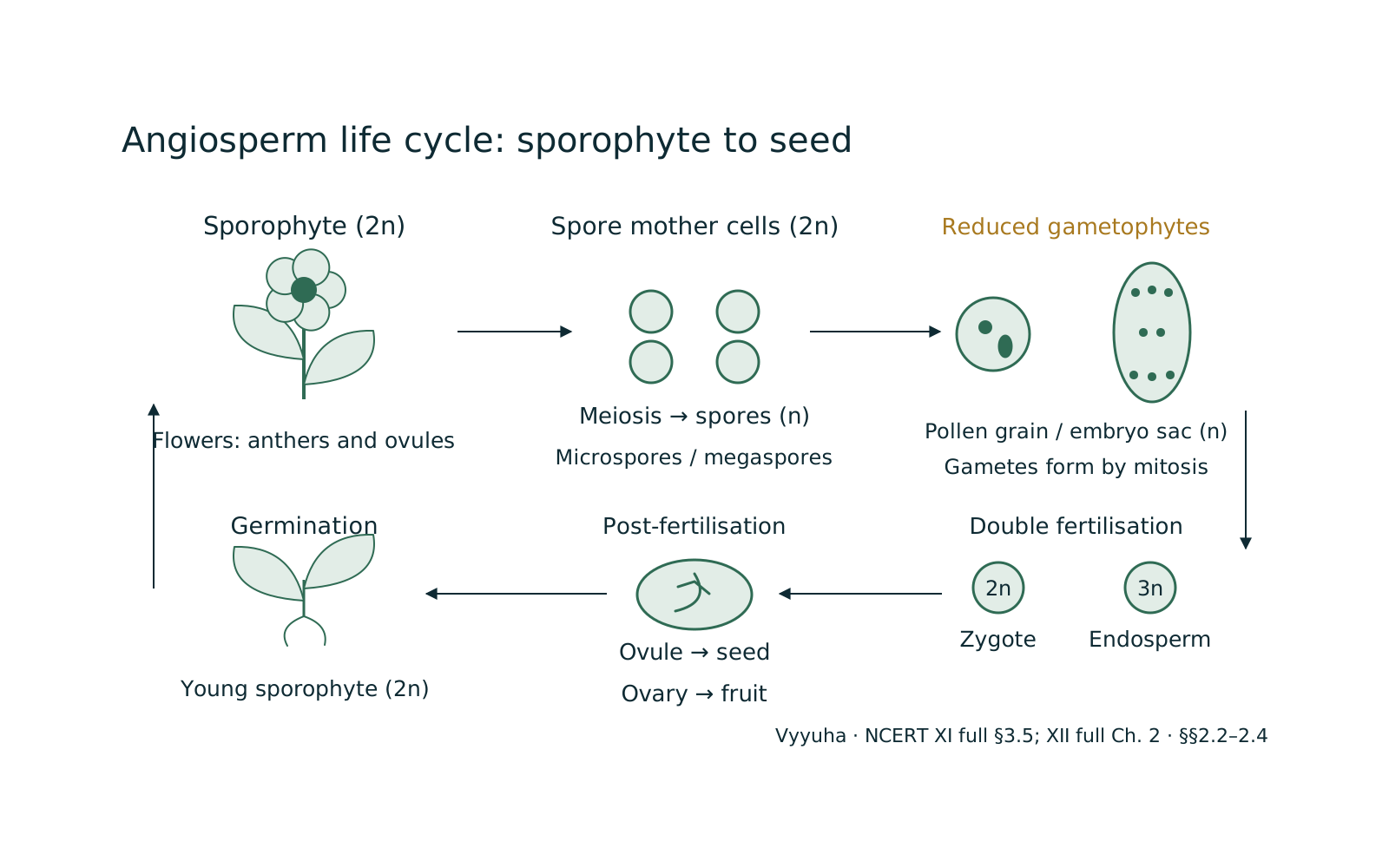
The life cycle of angiosperms, like all plants, exhibits alternation of generations, but with a dominant sporophytic phase and a highly reduced gametophytic phase. The sporophyte (the plant we typically see) is diploid () and produces spores, while the gametophyte is haploid () and produces gametes.
1. The Flower: The Reproductive Unit
The flower is a modified shoot, typically consisting of four whorls of floral organs, usually arranged concentrically on the thalamus (receptacle): * Calyx: Outermost whorl, composed of sepals, typically green and protective.
* Corolla: Whorl inside the calyx, composed of petals, often brightly colored to attract pollinators. * Androecium: Male reproductive whorl, composed of stamens. Each stamen consists of a filament and an anther.
The anther contains microsporangia, which produce pollen grains (male gametophytes). * Gynoecium (Pistil/Carpel): Female reproductive whorl, composed of one or more carpels. Each carpel has an ovary, style, and stigma.
The ovary contains ovules, which house the megasporangium (nucellus) and eventually the female gametophyte (embryo sac).
2. Microsporogenesis and Male Gametophyte Development:
Inside the anther, diploid microspore mother cells undergo meiosis to form haploid microspores. Each microspore develops into a pollen grain (the male gametophyte). A mature pollen grain typically has two cells: a larger vegetative cell and a smaller generative cell. The generative cell later divides to form two male gametes.
3. Megasporogenesis and Female Gametophyte Development:
Inside the ovule, a diploid megaspore mother cell undergoes meiosis to form four haploid megaspores. Usually, only one functional megaspore survives, while the other three degenerate. The functional megaspore undergoes three successive mitotic divisions to form an eight-nucleate, seven-celled embryo sac (the female gametophyte).
This embryo sac typically contains: An egg cell (female gamete) Two synergids (flanking the egg cell) Three antipodal cells A large central cell with two polar nuclei.
4. Pollination:
* The transfer of pollen grains from the anther to the stigma. This can be self-pollination (within the same flower or plant) or cross-pollination (between different plants of the same species), mediated by wind, water, or animals.
5. Fertilization (Double Fertilization):
Upon landing on a compatible stigma, the pollen grain germinates, forming a pollen tube that grows through the style and enters the ovule, usually through the micropyle. The pollen tube carries two male gametes.
Inside the embryo sac, a unique process called double fertilization occurs: * Syngamy: One male gamete fuses with the egg cell to form a diploid zygote (). The zygote develops into the embryo.
* Triple Fusion: The other male gamete fuses with the two polar nuclei in the central cell to form a triploid () primary endosperm nucleus (PEN). The PEN develops into the endosperm, which provides nourishment to the developing embryo.
6. Post-Fertilization Changes:
The ovule develops into a seed. The ovary develops into a fruit. The zygote develops into an embryo. The primary endosperm nucleus develops into the endosperm.
Classification: Monocots vs. Dicots
Angiosperms are broadly classified into two major groups:
1. Monocotyledons (Monocots):
* Embryo: Possess a single cotyledon (seed leaf). * Roots: Typically have a fibrous root system. * Stem: Vascular bundles are scattered, and usually lack secondary growth. * Leaves: Parallel venation. * Flowers: Floral parts are typically in multiples of three (trimerous). * Examples: Grasses, corn, wheat, rice, lilies, orchids, palms.
2. Dicotyledons (Dicots):
* Embryo: Possess two cotyledons. * Roots: Typically have a taproot system. * Stem: Vascular bundles are arranged in a ring, and often exhibit secondary growth (increase in girth). * Leaves: Reticulate (net-like) venation. * Flowers: Floral parts are typically in multiples of four or five (tetramerous or pentamerous). * Examples: Beans, peas, roses, sunflowers, mango, banyan.
Real-World Applications
Angiosperms are indispensable to human life and the global ecosystem:
- Food Source: — They provide nearly all our food crops (cereals, legumes, fruits, vegetables, nuts, spices, oils).
- Medicine: — Many medicinal plants are angiosperms (e.g., Cinchona for quinine, Digitalis for heart conditions).
- Timber and Fiber: — Provide wood for construction, furniture, and paper, as well as fibers like cotton and flax.
- Aesthetics and Ornamentals: — Flowers and ornamental plants are valued for their beauty and cultural significance.
- Ecological Roles: — They form the base of many food webs, provide habitat, regulate climate, and contribute to nutrient cycling and soil formation.
Common Misconceptions
- Angiosperms vs. Gymnosperms: — A common mistake is confusing the two. Remember, angiosperms have 'enclosed seeds' within a fruit and produce 'flowers,' while gymnosperms have 'naked seeds' and produce 'cones.'
- Double Fertilization: — Students sometimes misunderstand that double fertilization involves two separate fusion events: one forming the zygote (embryo) and the other forming the endosperm. It's not just one fertilization event followed by a division.
- Endosperm Ploidy: — The endosperm in angiosperms is typically triploid (), resulting from the fusion of one male gamete () with two polar nuclei (). This is distinct from the haploid endosperm found in gymnosperms.
- Flower vs. Inflorescence: — A flower is a single reproductive unit, while an inflorescence is a cluster of flowers arranged on a floral axis.
NEET-Specific Angle
For NEET, focus on the unique features of angiosperms: the structure of a typical flower, the detailed process of microsporogenesis and megasporogenesis, the events of pollination and double fertilization, and the post-fertilization changes leading to seed and fruit formation.
Pay close attention to the ploidy levels of various structures (e.g., sporophyte , gametophyte , zygote , endosperm ). The differences between monocots and dicots are frequently tested, often through examples or characteristic features.
Diagrams of floral parts, embryo sac, and pollen grain are crucial. Questions often involve identifying parts of the flower, tracing the development of gametes, or understanding the significance of double fertilization and fruit formation.
Often confused with
Side-by-side differences the NEET paper likes to test.
| Aspect | Angiosperms | Gymnosperms |
|---|---|---|
| Seeds | Enclosed within a fruit (angio-sperma) | Naked, not enclosed within an ovary/fruit (gymno-sperma) |
| Reproductive Structure | Flowers | Cones (strobili) |
| Fertilization | Double fertilization (forms zygote and endosperm) | Single fertilization (forms zygote only) |
| Endosperm Ploidy | Triploid ($3n$), formed after fertilization | Haploid ($n$), formed before fertilization (part of female gametophyte) |
| Vascular Tissue | Xylem contains vessels and tracheids; Phloem contains sieve tubes and companion cells (more efficient) | Xylem primarily contains tracheids; Phloem contains sieve cells and albuminous cells (less efficient) |
| Pollination | Primarily animal-mediated, also wind and water | Primarily wind-mediated |
| Life Cycle Dominance | Dominant sporophyte, highly reduced gametophyte | Dominant sporophyte, reduced but more prominent gametophyte than angiosperms |
Angiosperms and gymnosperms are both seed-bearing plants, but their fundamental difference lies in seed protection. Angiosperms, or flowering plants, enclose their seeds within a fruit, a product of their unique flower structure and double fertilization process, which also yields a triploid endosperm.
Gymnosperms, conversely, bear 'naked' seeds, typically on cones, and undergo single fertilization to produce a haploid endosperm. These distinctions in reproductive strategy, vascular tissue efficiency, and reliance on pollinators have led to angiosperms' widespread ecological dominance.
Why it is tested: NEET relevance: Understanding the fundamental differences between angiosperms and gymnosperms is crucial for questions on plant classification, evolutionary trends, and specific reproductive processes. Questions often test the ploidy of endosperm, presence/absence of flowers/fruits, and the type of fertilization.
Questions students ask
6 answered on this topic.
What is the primary distinguishing feature of angiosperms compared to other plant groups?
The most significant distinguishing feature of angiosperms is the presence of flowers and fruits. Flowers are specialized reproductive structures that house the reproductive organs, facilitating efficient pollination.
Fruits, which develop from the ovary after fertilization, enclose and protect the seeds. This enclosure of seeds within a fruit ('angio' means enclosed, 'sperma' means seed) is unique to angiosperms and provides superior protection and dispersal mechanisms compared to the 'naked' seeds of gymnosperms.
Explain the concept of 'double fertilization' in angiosperms.
Double fertilization is a unique and defining characteristic of angiosperms. It involves two distinct fusion events occurring simultaneously within the embryo sac. First, one male gamete (sperm) fuses with the egg cell to form a diploid zygote (), which will develop into the embryo.
Second, the other male gamete fuses with the two polar nuclei located in the central cell to form a triploid primary endosperm nucleus (). This primary endosperm nucleus then develops into the endosperm, a nutritive tissue that provides food for the developing embryo.
What is the ploidy level of the endosperm in angiosperms and how is it formed?
The endosperm in angiosperms is typically triploid (). It is formed through the process of triple fusion, which is part of double fertilization. During triple fusion, one of the two male gametes (haploid, ) released by the pollen tube fuses with the two polar nuclei (each haploid, ) present in the central cell of the embryo sac.
This fusion of three haploid nuclei results in the formation of a triploid primary endosperm nucleus (PEN), which subsequently develops into the endosperm, serving as a food reserve for the embryo.
How do monocots and dicots differ in their characteristics?
Monocots and dicots are the two main classes of angiosperms, differing in several key characteristics. Monocots typically have one cotyledon in their embryo, parallel venation in leaves, fibrous root systems, and floral parts in multiples of three.
Examples include grasses and lilies. Dicots, conversely, possess two cotyledons, reticulate (net-like) venation in leaves, taproot systems, and floral parts in multiples of four or five. Examples include beans and roses.
These differences are crucial for identification and classification.
What is the significance of fruit formation in angiosperms?
Fruit formation is highly significant for the success of angiosperms. Firstly, the fruit provides protection to the developing seeds from environmental hazards, pathogens, and herbivores. Secondly, and perhaps more importantly, fruits play a crucial role in seed dispersal.
Various fruit types have evolved mechanisms to facilitate dispersal by wind, water, or animals, ensuring that seeds are carried away from the parent plant, reducing competition, and allowing the species to colonize new territories, thereby enhancing its survival and spread.
Why are angiosperms considered the most evolved plant group?
Angiosperms are considered the most evolved plant group due to several advanced adaptations. Their flowers allow for highly efficient and often targeted pollination, leading to greater reproductive success.
The development of fruits provides superior seed protection and diverse dispersal mechanisms. Double fertilization ensures efficient nutrient provisioning to the embryo via the endosperm. They also possess highly efficient vascular tissues, including vessels in xylem, which support their complex structures and allow them to thrive in a wide range of environments, leading to their ecological dominance and vast diversity.