Flower
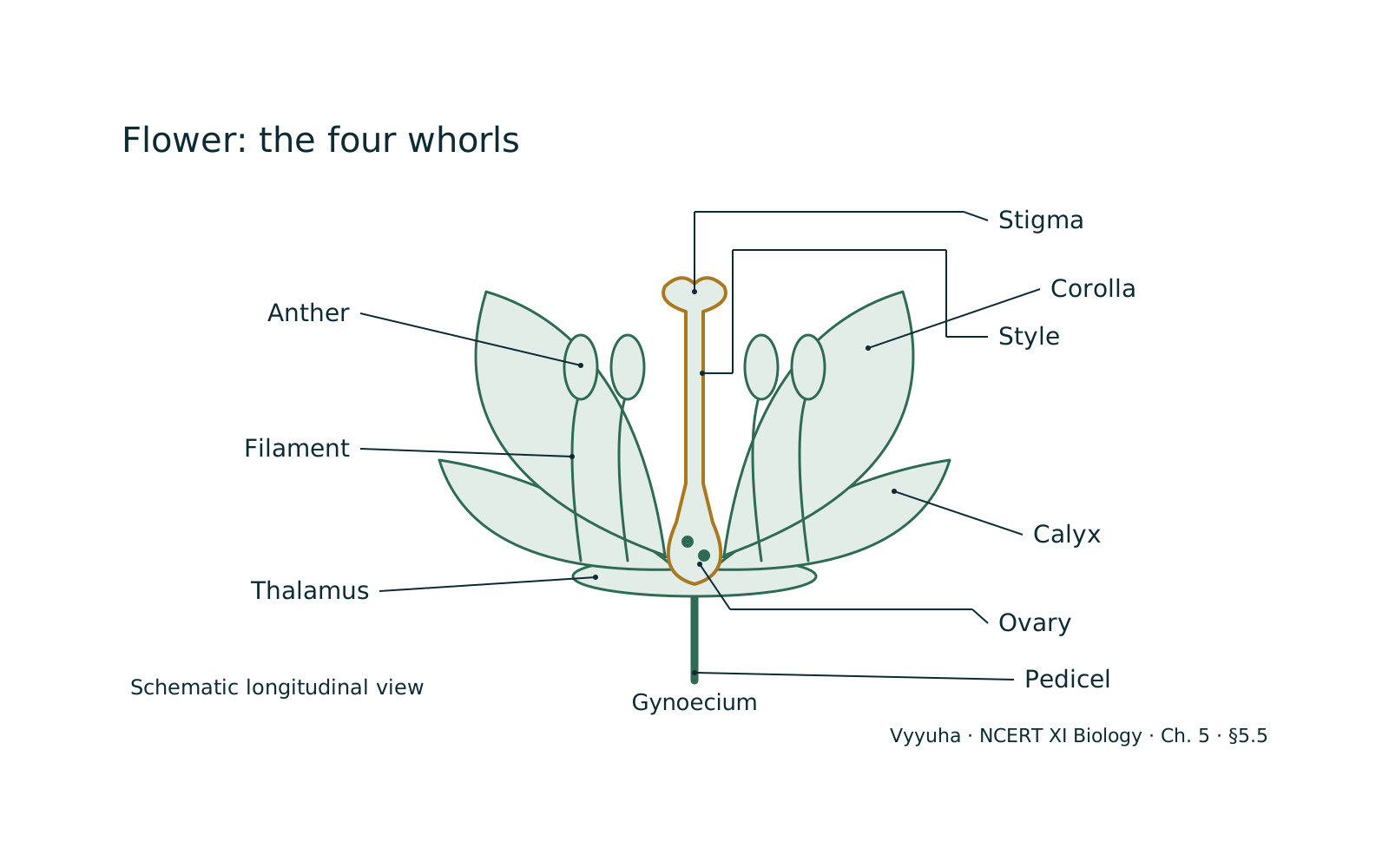
The flower, botanically defined, is a highly specialized and condensed reproductive shoot of angiosperms, modified for sexual reproduction. It is essentially a determinate shoot bearing sporophylls (modified leaves that bear sporangia) arranged in whorls on a shortened axis called the thalamus or receptacle. Its primary biological function is to facilitate the union of male and female gametes thro…
Quick Summary
The flower is the reproductive unit of angiosperms, essentially a modified shoot. It typically consists of four whorls arranged on a thalamus: the outermost calyx (sepals) for protection, the corolla (petals) for attracting pollinators, the male androecium (stamens) producing pollen, and the female gynoecium (carpels) containing ovules.
Flowers can be complete (all four whorls) or incomplete, and perfect (both androecium and gynoecium) or imperfect. \n\nFloral symmetry can be actinomorphic (radial) or zygomorphic (bilateral).
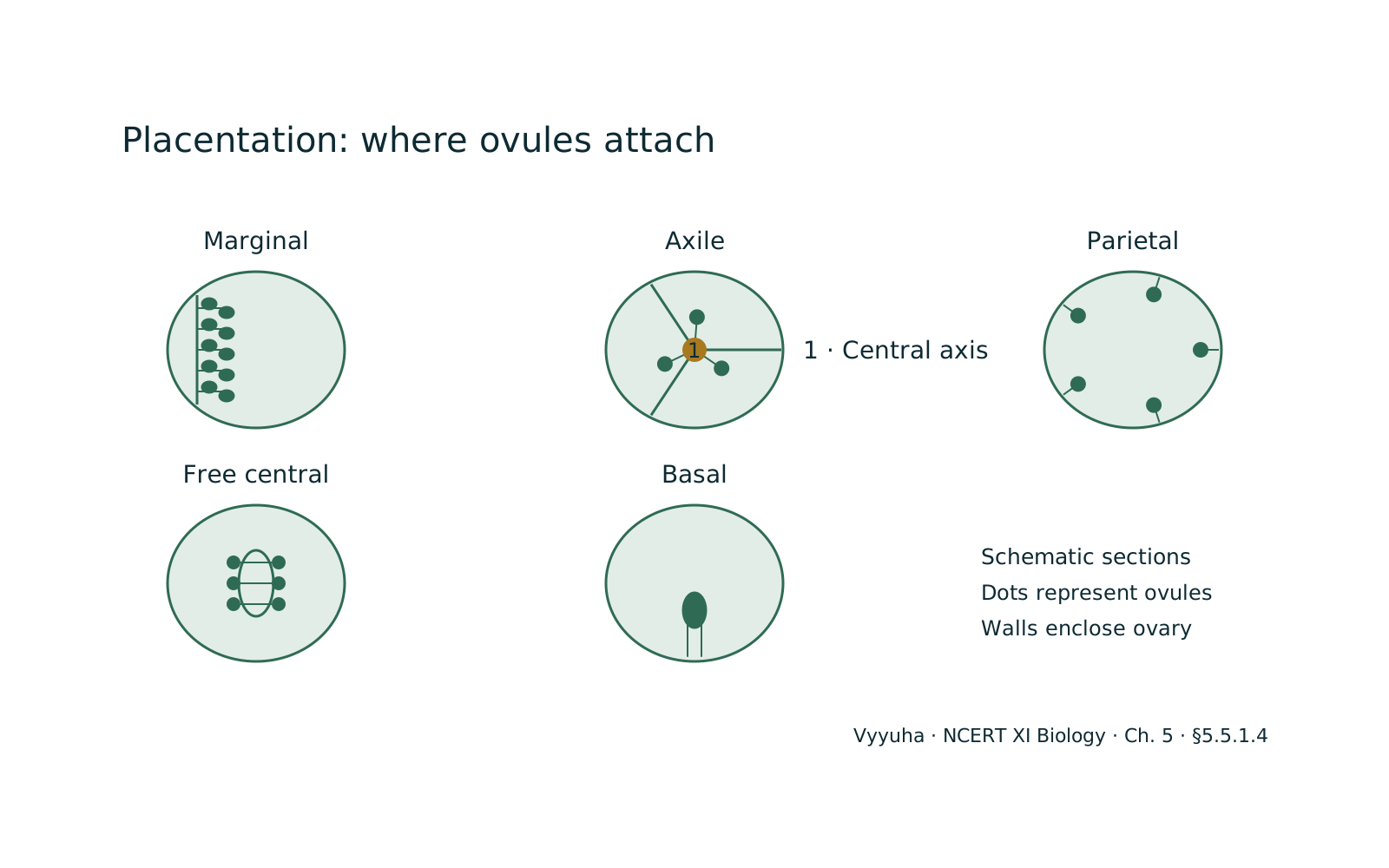
The position of the ovary relative to other floral parts determines if it's superior (hypogynous), half-inferior (perigynous), or inferior (epigynous). The arrangement of ovules within the ovary is called placentation, with types like marginal, axile, parietal, free central, and basal.
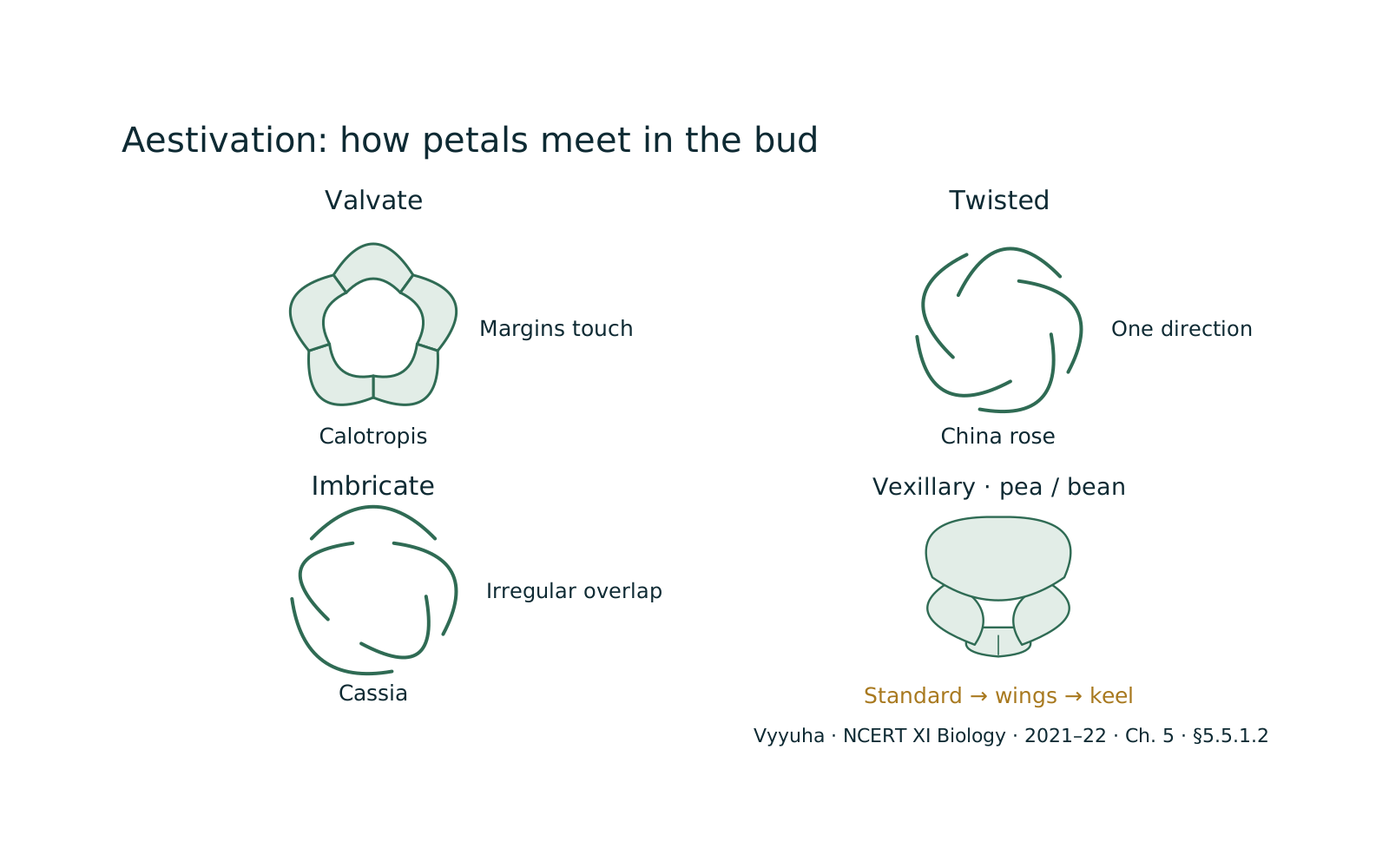
The arrangement of sepals/petals in the bud is aestivation (valvate, twisted, imbricate, vexillary). These features are crucial for plant classification and understanding reproductive strategies.
Full explanation
The flower, a marvel of evolutionary adaptation, stands as the defining characteristic of angiosperms (flowering plants). It is not merely an aesthetic display but a highly specialized reproductive structure, essentially a modified shoot designed to ensure the perpetuation of the species.
Understanding its intricate morphology is fundamental for NEET aspirants, as it forms the basis for plant classification, reproductive biology, and ecological interactions.\n\nConceptual Foundation: The Flower as a Modified Shoot\nFrom an evolutionary perspective, a flower is considered a compressed and specialized shoot.
The floral parts – sepals, petals, stamens, and carpels – are homologous to leaves, but have undergone significant modification to perform reproductive functions. The axis of this shoot is the thalamus or receptacle, which is typically condensed, bringing the floral appendages into close proximity.
This condensation allows for efficient pollination and protection of the developing reproductive structures. The flower's development is determinate, meaning its growth is limited once the floral parts are formed, unlike vegetative shoots which can grow indefinitely.
\n\nKey Principles and Laws of Floral Morphology\n\n1. Parts of a Typical Flower: A complete, bisexual flower typically consists of four whorls, arranged concentrically on the thalamus:\n * Calyx: The outermost whorl, composed of units called sepals.
Sepals are usually green and leaf-like, primarily functioning to protect the flower bud. They can be free (polysepalous, e.g., mustard) or fused (gamosepalous, e.g., cotton).\n * Corolla: The second whorl, made up of petals.
Petals are often brightly colored, scented, and sometimes possess nectar guides to attract pollinators. Like sepals, they can be free (polypetalous, e.g., rose) or fused (gamopetalous, e.g., petunia).
The arrangement of sepals or petals in the floral bud relative to other members of the same whorl is called aestivation. Common types include:\n * Valvate: Margins just touch without overlapping (e.
g., Calotropis, mustard).\n * Twisted: One margin of the appendage overlaps the next one, and so on, in a regular direction (e.g., china rose, lady's finger, cotton).\n * Imbricate: Margins overlap but not in a particular direction (e.
g., Cassia, Gulmohar).\n * Vexillary (Papilionaceous): The largest petal (standard or vexillum) overlaps two lateral petals (wings or alae), which in turn overlap the two smallest anterior petals (keel or carina).
Characteristic of Fabaceae (e.g., pea, bean).\n * Androecium: The male reproductive whorl, composed of stamens. Each stamen consists of a filament (stalk) and an anther (bilobed structure containing pollen sacs).
Pollen grains, containing male gametes, are produced in the anthers. Stamens can be free or united. Union can be:\n * Monoadelphous: Filaments united into one bundle, anthers free (e.g., china rose).
\n * Diadelphous: Filaments united into two bundles, anthers free (e.g., pea, bean).\n * Polyadelphous: Filaments united into more than two bundles, anthers free (e.g., citrus).\n * Epipetalous: Stamens attached to petals (e.
g., brinjal, Datura).\n * Epiphyllous: Stamens attached to perianth (e.g., lily).\n * Gynoecium: The female reproductive whorl, located centrally, composed of one or more carpels. Each carpel consists of an ovary (basal swollen part containing ovules), a style (elongated tube connecting ovary to stigma), and a stigma (receptive tip for pollen).
Gynoecium can be:\n * Apocarpous: Carpels are free (e.g., lotus, rose).\n * Syncarpous: Carpels are fused (e.g., mustard, tomato). \n The arrangement of ovules within the ovary is called placentation.
Key types include:\n * Marginal: Ovules develop on the ridge along the ventral suture of a unilocular ovary (e.g., pea, Fabaceae).\n * Axile: Ovules attached to a central axis in a multilocular ovary (e.
g., china rose, tomato, lemon, Solanaceae, Liliaceae).\n * Parietal: Ovules develop on the inner wall of the ovary or on peripheral part. Ovary is unilocular but becomes two-chambered due to false septum formation (e.
g., mustard, Argemone).\n * Free Central: Ovules borne on a central axis, septa are absent (e.g., Dianthus, Primrose).\n * Basal: Ovule develops at the base of the ovary (e.g., sunflower, marigold, Asteraceae).
\n\n2. Floral Symmetry: Describes how a flower can be divided into identical halves.\n * Actinomorphic (Radial Symmetry): Can be divided into two equal halves by any radial plane passing through the center (e.
g., mustard, Datura, chilli, Solanaceae, Liliaceae).\n * Zygomorphic (Bilateral Symmetry): Can be divided into two equal halves by only one specific vertical plane (e.g., pea, Gulmohar, bean, Cassia, Fabaceae).
\n * Asymmetric (Irregular): Cannot be divided into two equal halves by any plane (e.g., Canna).\n\n3. Position of Ovary (Relative to other floral parts): This determines the flower's classification as hypogynous, perigynous, or epigynous.
\n * Hypogynous (Superior Ovary): Gynoecium is at the topmost position, while other parts are below it. Ovary is free and above the attachment point of other floral parts (e.g., mustard, china rose, brinjal, Solanaceae, Liliaceae).
\n * Perigynous (Half-inferior Ovary): Ovary is situated in the center, and other floral parts arise from the rim of the thalamus, almost at the same level (e.g., plum, rose, peach).\n * Epigynous (Inferior Ovary): The margins of the thalamus grow upwards, enclosing the ovary completely and fusing with its wall.
Other floral parts arise above the ovary (e.g., guava, cucumber, ray florets of sunflower, Asteraceae).\n\nFloral Formula and Floral Diagram\nThese are symbolic representations used to describe the floral characteristics of a plant in a concise manner.
\n* Floral Formula: Uses symbols to represent the symmetry, sex, number of parts in each whorl, their fusion, and ovary position. \n Br or Ebr: Bracteate or Ebracteate\n % or : Zygomorphic or Actinomorphic\n * or or : Male, Female, or Bisexual\n K: Calyx (sepals), C: Corolla (petals), A: Androecium (stamens), G: Gynoecium (carpels)\n Numbers indicate count (e.
g., K5 for 5 sepals). Parentheses ( ) indicate fusion (e.g., C(5) for 5 fused petals). A line below G indicates superior ovary (G_ ), a line above G indicates inferior ovary (), and a line in front of G indicates half-inferior ovary (G- ).
\n* Floral Diagram: A graphical representation showing the arrangement of floral parts, their number, and their relation to one another and to the mother axis. It's a cross-section of the flower, providing a visual understanding of aestivation, placentation, and cohesion/adhesion.
\n\nReal-World Applications and Significance\nFlowers are not just for academic study; they are vital to human civilization and ecosystems:\n* Agriculture and Food Security: Flowers are precursors to fruits and seeds, which are staple foods (e.
g., wheat, rice, corn, fruits like mango, apple). Understanding floral biology is crucial for crop breeding, improving yield, and developing pest-resistant varieties.\n* Horticulture and Aesthetics: The beauty and fragrance of flowers are highly valued.
They are cultivated for ornamental purposes, used in landscaping, floral arrangements, and perfumes, contributing significantly to the economy.\n* Medicine and Industry: Many medicinal plants derive their therapeutic properties from compounds found in their flowers (e.
g., saffron stigmas, clove buds). Flowers are also sources of dyes, essential oils, and other industrial products.\n* Ecology: Flowers play a central role in ecosystems by facilitating pollination, a critical process for the reproduction of most plant species.
They support diverse pollinator populations (insects, birds, bats), which in turn contribute to biodiversity.\n\nCommon Misconceptions\n* Complete vs. Perfect Flower: A complete flower has all four whorls (calyx, corolla, androecium, gynoecium).
A perfect flower has both essential whorls (androecium and gynoecium), meaning it is bisexual. A flower can be perfect but incomplete (e.g., if it lacks petals). A complete flower is always perfect.\n* **Unisexual vs.
Bisexual:** Unisexual flowers have either stamens or carpels, but not both. Bisexual flowers have both. Plants can be monoecious (both male and female flowers on the same plant, e.g., maize) or dioecious (male and female flowers on different plants, e.
g., papaya).\n* Ovary Position: Students often confuse superior/inferior ovary with the overall position of the flower on the plant. It strictly refers to the position of the ovary relative to the attachment point of other floral parts on the thalamus.
\n* Aestivation: Distinguishing between imbricate and twisted aestivation can be tricky. Twisted shows a regular, directional overlap, while imbricate is irregular.\n\nNEET-Specific Angle\nNEET questions on flowers frequently test knowledge of specific examples for different types of aestivation, placentation, ovary position, and floral symmetry.
Memorizing examples for each category (e.g., China rose for twisted aestivation, pea for vexillary aestivation and marginal placentation, mustard for parietal placentation and actinomorphic symmetry) is crucial.
Floral formulas and diagrams of common families like Fabaceae, Solanaceae, and Liliaceae are also high-yield areas. Understanding the functional significance of each floral part and its evolutionary context helps in answering conceptual questions.
Pay close attention to the terminology and its precise meaning, as subtle differences can lead to incorrect answers. For instance, knowing that a 'perianth' is formed when calyx and corolla are not distinct (e.
g., lily) is important.
Key Concepts
Aestivation describes the arrangement of sepals or petals in a floral bud. It's a key diagnostic feature for…
Placentation is the arrangement of ovules within the ovary, determining how seeds are positioned and…
The position of the ovary relative to the attachment points of the other floral parts (sepals, petals,…
Often confused with
Side-by-side differences the NEET paper likes to test.
| Aspect | Flower | Monocot Flower vs. Dicot Flower |
|---|---|---|
| Number of Floral Parts (Merism) | Usually trimerous (parts in multiples of 3, e.g., 3 sepals, 3 petals, 6 stamens). | Usually tetramerous or pentamerous (parts in multiples of 4 or 5, e.g., 4 or 5 sepals, 4 or 5 petals). |
| Perianth | Often present; calyx and corolla are not distinct, forming tepals (e.g., lily). | Calyx and corolla are usually distinct and differentiated. |
| Vascular Bundles in Stem | Scattered. | Arranged in a ring. |
| Root System | Fibrous root system. | Tap root system. |
| Pollen Grains | Monosulcate (single furrow or pore). | Trisulcate (three furrows or pores). |
Monocot and dicot flowers exhibit fundamental differences reflecting their broader plant classification. Monocot flowers are typically trimerous, meaning their floral parts (sepals, petals, stamens) are in multiples of three, and often have an undifferentiated perianth.
Dicot flowers, in contrast, are commonly tetramerous or pentamerous, with distinct calyx and corolla. These floral characteristics, alongside other vegetative features like leaf venation and root systems, are critical for distinguishing between these two major groups of flowering plants.
Why it is tested: For NEET, understanding the distinguishing features between monocot and dicot flowers is crucial. Questions often involve identifying a plant as monocot or dicot based on its floral formula, merism, or the presence/absence of a distinct perianth. This knowledge helps in classifying plant families and predicting other morphological characteristics, which are frequently tested.
Questions students ask
6 answered on this topic.
What is the primary function of a flower?
The primary function of a flower is sexual reproduction in angiosperms. It serves as the site for the formation of male and female gametes, their subsequent fusion through pollination and fertilization, and ultimately the development of fruits and seeds.
The various parts of the flower, such as petals, stamens, and carpels, are all specialized to facilitate this complex process, ensuring the genetic continuity and propagation of the plant species. Without flowers, most angiosperms would not be able to produce offspring.
Explain the difference between actinomorphic and zygomorphic symmetry in flowers.
Floral symmetry describes how a flower can be divided into identical halves. An actinomorphic flower (also known as radially symmetrical) can be divided into two equal halves by any vertical plane passing through its center, much like a star or a circle.
Examples include mustard, Datura, and chilli. In contrast, a zygomorphic flower (bilaterally symmetrical) can only be divided into two equal halves by a single, specific vertical plane, similar to a human face or a butterfly.
Examples include pea, Gulmohar, and bean. This difference often relates to specific pollinator interactions.
What is placentation, and why is it important?
Placentation refers to the arrangement of ovules within the ovary of a flower. The ovules are attached to a cushion-like structure called the placenta. This arrangement is crucial because it directly influences how seeds will develop and be dispersed, impacting the plant's reproductive success.
Different types of placentation, such as marginal, axile, parietal, free central, and basal, are characteristic features of various plant families and are used in plant identification and classification.
Understanding placentation helps in comprehending fruit development.
Differentiate between a complete and an incomplete flower.
A complete flower is one that possesses all four floral whorls: the calyx (sepals), corolla (petals), androecium (stamens), and gynoecium (carpels). For example, a hibiscus flower is complete. An incomplete flower, on the other hand, lacks one or more of these four whorls. For instance, a flower that lacks petals or stamens would be considered incomplete. This distinction is important for botanical classification and understanding the evolutionary adaptations of different plant species.
What is aestivation, and name its types?
Aestivation refers to the mode of arrangement of sepals or petals in the floral bud with respect to the other members of the same whorl. It's how these parts are folded or overlapped before the flower opens.
The main types of aestivation are: \n1. Valvate: Margins of sepals/petals just touch each other without overlapping (e.g., Calotropis). \n2. Twisted: One margin of the appendage overlaps the next one in a regular, consistent direction (e.
g., China rose, cotton). \n3. Imbricate: Margins overlap, but not in any particular regular direction (e.g., Cassia, Gulmohar). \n4. Vexillary (Papilionaceous): A specific type where the largest petal (standard) overlaps two lateral petals (wings), which in turn overlap two smallest anterior petals (keel) (e.
g., pea, bean).
What is the significance of the floral formula and floral diagram?
The floral formula and floral diagram are concise ways to represent the morphological features of a flower. The floral formula uses symbols to denote symmetry, sex, number of parts in each whorl (calyx, corolla, androecium, gynoecium), their fusion, and ovary position.
It's a quick, alphanumeric summary. The floral diagram is a graphical, cross-sectional representation showing the arrangement, number, and interrelationships of floral parts, including aestivation and placentation.
Both tools are invaluable for botanical classification, identification of plant families, and for quickly conveying complex floral structures in a standardized manner, which is particularly useful in NEET for family characteristics.
Revise in 30 seconds
- Flower — Modified reproductive shoot of angiosperms.\n- Parts: Calyx (sepals), Corolla (petals), Androecium (stamens), Gynoecium (carpels).\n- Aestivation: Arrangement of sepals/petals in bud.\n * Valvate: Touch (e.g., Calotropis)\n Twisted: Regular overlap (e.g., China rose)\n Imbricate: Irregular overlap (e.g., Cassia)\n * Vexillary: Standard, wings, keel (e.g., Pea)\n- Placentation: Ovule arrangement in ovary.\n Marginal: Ventral suture (e.g., Pea)\n Axile: Central axis, multilocular (e.g., China rose, Tomato)\n * Parietal: Inner wall (e.g., Mustard, Argemone)\n * Free Central: Central axis, no septa (e.g., Dianthus)\n * Basal: Base of ovary (e.g., Sunflower)\n- Ovary Position: \n Hypogynous (Superior): G_ (e.g., Mustard, China rose)\n Perigynous (Half-inferior): G- (e.g., Plum, Rose)\n * Epigynous (Inferior): (e.g., Guava, Sunflower ray florets)\n- Symmetry: \n * Actinomorphic (Radial): (e.g., Mustard, Datura)\n * Zygomorphic (Bilateral): % (e.g., Pea, Gulmohar)\n- Stamen Cohesion/Adhesion: \n Monoadelphous: Filaments in one bundle (e.g., China rose)\n Diadelphous: Filaments in two bundles (e.g., Pea)\n Polyadelphous: Filaments in many bundles (e.g., Citrus)\n Epipetalous: Stamens on petals (e.g., Brinjal)\n * Epiphyllous: Stamens on perianth (e.g., Lily)\n- Gynoecium: Apocarpous (free carpels, e.g., Rose), Syncarpous (fused carpels, e.g., Tomato).
To remember placentation types and examples: \n\nMy People Always Choose To Live Peacefully Making All Dreams Free People Be Strong.\n\n* Marginal: Pea\n* Axile: China rose, Tomato, Lemon\n* Parietal: Mustard, Argemone\n* Free Central: Dianthus, Primrose\n* Basal: Sunflower, Marigold