Tissues — Explained
Detailed Explanation
The intricate architecture and remarkable resilience of plants are fundamentally rooted in the organization of their cells into specialized tissues. Just as in animals, the concept of 'division of labor' is paramount in plants, where different groups of cells are dedicated to specific functions, optimizing the plant's overall efficiency and survival. This hierarchical organization, from cells to tissues, and then to tissue systems and organs, is a core principle of plant anatomy.
Conceptual Foundation: The Necessity of Tissues
Single-celled organisms perform all life functions within one cell. However, multicellular organisms like plants face a challenge: how to grow large, withstand environmental stresses, and efficiently transport resources over distances.
The evolution of tissues provided the solution. By grouping cells with similar structures and functions, plants could achieve greater size, complexity, and specialization. For instance, some cells could specialize in photosynthesis, others in water transport, and yet others in providing structural support, leading to a highly efficient and adaptable organism.
Key Principles: Differentiation and Specialization
All plant cells originate from meristematic cells, which are undifferentiated and capable of continuous division. Through a process called differentiation, these meristematic cells undergo changes in their structure and function, becoming specialized to form various permanent tissues.
This specialization allows for a division of labor, where each tissue type performs a unique role, contributing to the plant's overall physiology. For example, parenchyma cells differentiate to store food, collenchyma cells to provide flexible support, and xylem elements to conduct water.
Classification of Plant Tissues
Plant tissues are broadly classified into two main categories based on their ability to divide:
- Meristematic Tissues (Meristems) — These are regions of active cell division, responsible for plant growth.
- Permanent Tissues — These are derived from meristematic tissues, have lost the power of division, and are specialized to perform specific functions.
1. Meristematic Tissues
Meristems are the 'growth engines' of the plant. Their cells are typically small, isodiametric (roughly spherical), densely packed, have thin cell walls, dense cytoplasm, and prominent nuclei, often lacking vacuoles or having very small ones. They are continuously dividing, producing new cells that then differentiate.
Types of Meristems based on position:
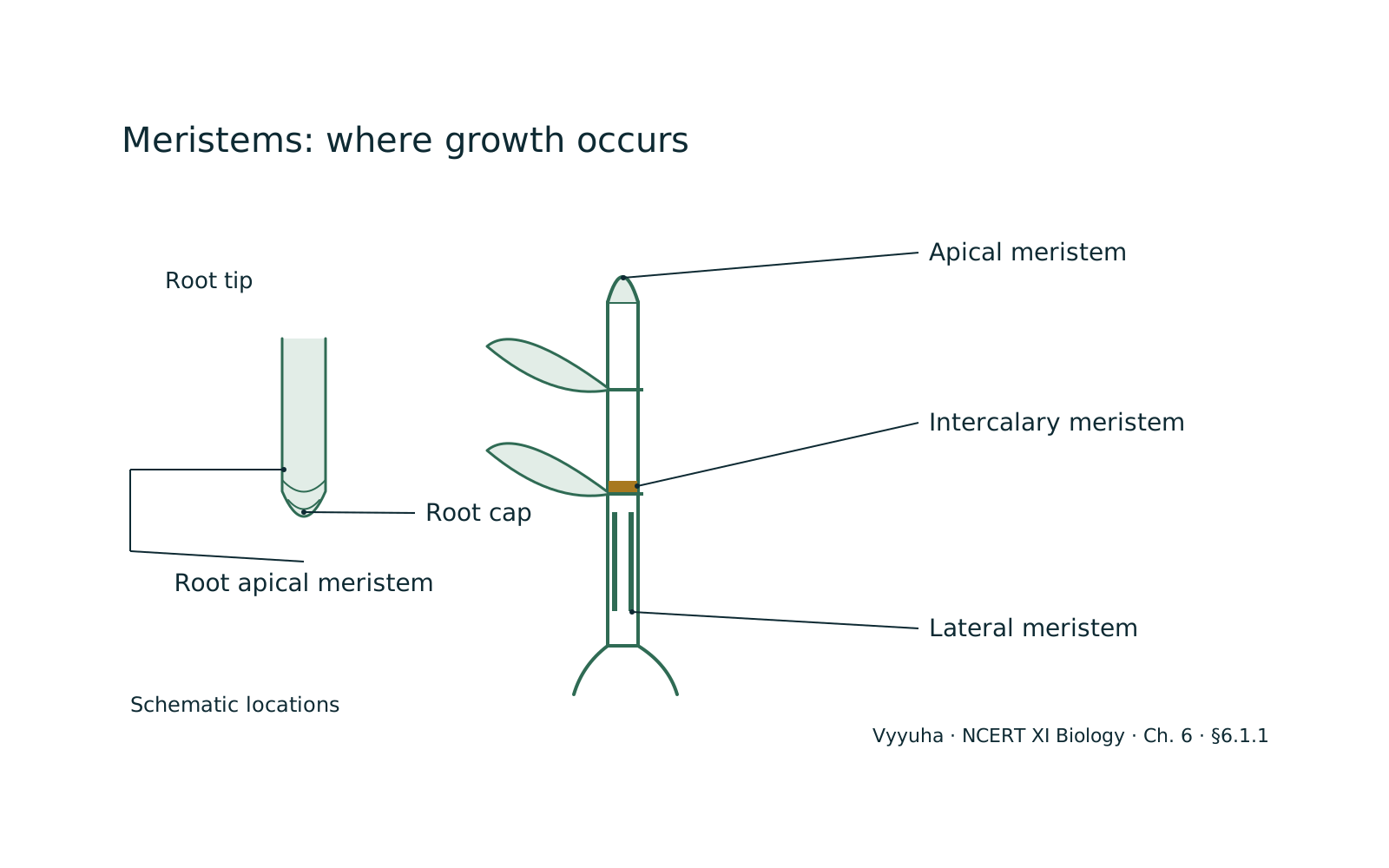
- Apical Meristems — Located at the tips of roots and shoots. They are responsible for primary growth, which increases the length of the plant. The shoot apical meristem produces the stem and leaves, while the root apical meristem produces the root cap and the main body of the root.
- Intercalary Meristems — Found between mature tissues, particularly at the base of internodes (e.g., in grasses) or at the base of leaves. They are also responsible for primary growth, allowing for elongation of organs and regeneration of parts removed by grazing herbivores.
- Lateral Meristems — Located along the sides of the stem and root, parallel to the longitudinal axis. They are responsible for secondary growth, which increases the girth or thickness of the plant. Examples include:
* Vascular Cambium: Produces secondary xylem (wood) towards the inside and secondary phloem towards the outside. * Cork Cambium (Phellogen): Produces cork (phellem) towards the outside and secondary cortex (phelloderm) towards the inside, forming the periderm (bark).
2. Permanent Tissues
These tissues are composed of cells that have undergone differentiation and maturation, losing their capacity to divide. They are specialized for functions such as protection, support, storage, and transport.
A. Simple Permanent Tissues: Composed of only one type of cell.
- Parenchyma — The most abundant and fundamental tissue in plants.
* Structure: Cells are generally isodiametric, thin-walled (cellulose), living, and often have a large central vacuole. They can be spherical, oval, round, polygonal, or elongated. * Location: Found in the cortex of roots, pith of stems, mesophyll of leaves, and pulp of fruits.
* Functions: Primary functions include storage of food (starch, fats, proteins), water, and waste products. When containing chloroplasts (chlorenchyma), they perform photosynthesis. They also aid in secretion, buoyancy (aerenchyma in aquatic plants), and provide turgor support.
- Collenchyma — Provides flexible mechanical support to young, growing parts of the plant.
* Structure: Cells are living, elongated, and have unevenly thickened cell walls (pectin and cellulose) at the corners. They often contain chloroplasts. * Location: Typically found in the epidermis of dicot stems (hypodermis), petioles, and leaf margins. Absent in roots and monocots. * Functions: Provides mechanical support and flexibility to growing organs, allowing them to bend without breaking. Also performs photosynthesis if chloroplasts are present.
- Sclerenchyma — Provides rigid mechanical support and protection to mature parts of the plant.
* Structure: Cells are dead at maturity, highly lignified (thickened with lignin) cell walls, and have narrow lumens (cell cavities). Two main types: * Fibers: Long, narrow, pointed cells, often occurring in bundles (e.
g., jute, flax, hemp). * Sclereids (Stone cells): Short, isodiametric, oval, or cylindrical cells with extremely thick, lignified walls and very narrow lumens. Found in fruit walls of nuts, pulp of fruits (guava, pear, sapota), and seed coats of legumes.
* Location: Found in various parts of the plant where strength is needed, such as vascular bundles, hard seed coats, and fruit walls. * Functions: Provides mechanical strength, rigidity, and protection to plant organs.
B. Complex Permanent Tissues: Composed of more than one type of cell, working together as a functional unit.
- Xylem — The primary water-conducting tissue.
* Components: Xylem is composed of four different types of elements: * Tracheids: Elongated, tube-like cells with tapering ends. Dead at maturity, lignified walls, and pits. Primarily responsible for water and mineral transport in gymnosperms and pteridophytes, and also provide some mechanical support.
* Vessels (Tracheae): Much wider, cylindrical tube-like structures formed by rows of cells (vessel members) placed end to end, forming a continuous pipe. Dead at maturity, lignified walls, and perforated end walls.
Efficient water transport in angiosperms. * Xylem Parenchyma: Living, thin-walled cells, primarily involved in storage of food (starch, fats) and radial conduction of water. * Xylem Fibers: Dead, sclerenchymatous cells with thick, lignified walls, providing mechanical support.
* Functions: Conducts water and dissolved minerals from roots to all aerial parts of the plant. Also provides mechanical support.
- Phloem — The primary food-conducting tissue.
* Components: Phloem is composed of four different types of elements: * Sieve Tube Elements: Long, tube-like structures arranged longitudinally, forming a continuous channel. Living cells but lack a nucleus at maturity.
Their end walls are perforated, forming 'sieve plates' for efficient food transport. * Companion Cells: Specialized parenchyma cells closely associated with sieve tube elements. They are living, nucleated, and regulate the activities of the enucleated sieve tube elements through plasmodesmatal connections.
* Phloem Parenchyma: Living, thin-walled cells, involved in storage of food materials (resins, latex, mucilage) and lateral conduction of food. * Phloem Fibers (Bast Fibers): Sclerenchymatous cells, dead at maturity, providing mechanical support.
Absent in primary phloem but present in secondary phloem. * Functions: Translocates organic food materials (sugars, primarily sucrose) synthesized in the leaves to other parts of the plant, including storage organs and growing regions.
Real-World Applications and NEET-Specific Angle
Understanding plant tissues is fundamental to various fields, from agriculture (e.g., understanding crop growth and nutrient uptake) to forestry (wood properties) and even biotechnology (tissue culture). For NEET, the focus is on:
- Identification — Recognizing different tissue types from diagrams or descriptions of their cellular characteristics.
- Location — Knowing where each tissue type is typically found within the plant (e.g., apical meristem at root/shoot tips, collenchyma in dicot hypodermis).
- Function — Associating each tissue with its primary role (e.g., xylem for water transport, sclerenchyma for support).
- Cellular Characteristics — Distinguishing between living/dead cells, wall composition (cellulose, pectin, lignin), presence/absence of nucleus, vacuoles, etc.
- Differences — Clearly differentiating between similar-sounding tissues (e.g., parenchyma vs. collenchyma vs. sclerenchyma, tracheids vs. vessels, sieve tube elements vs. companion cells).
- Primary vs. Secondary Growth — Understanding which meristems contribute to length (primary) and which to girth (secondary).
Common Misconceptions
- All permanent tissues are dead — Incorrect. Parenchyma, collenchyma, sieve tube elements, and companion cells are living at maturity. Only sclerenchyma, tracheids, and vessels are dead at maturity.
- Meristems are only at tips — Incorrect. Intercalary meristems are found between mature tissues, and lateral meristems are found along the sides, contributing to growth.
- Xylem and phloem are simple tissues — Incorrect. They are complex tissues because they are made of more than one type of cell working together.
- Collenchyma provides rigid support — Incorrect. Collenchyma provides flexible support, allowing for bending without breaking. Sclerenchyma provides rigid support.
- All cells in a tissue are identical — While cells in simple permanent tissues are of one type, cells in complex permanent tissues are of multiple types, all contributing to a common function.
By mastering these distinctions and functional roles, NEET aspirants can confidently tackle questions related to plant anatomy and physiology.
Often confused with
Side-by-side differences the NEET paper likes to test.
| Aspect | Tissues | Parenchyma, Collenchyma, and Sclerenchyma |
|---|---|---|
| Cell Type at Maturity | Parenchyma: Living | Collenchyma: Living |
| Cell Wall Thickness | Parenchyma: Thin and uniform | Collenchyma: Unevenly thickened (at corners) |
| Cell Wall Composition | Parenchyma: Cellulose | Collenchyma: Cellulose and Pectin |
| Primary Function | Parenchyma: Storage, photosynthesis, secretion | Collenchyma: Flexible mechanical support |
| Location | Parenchyma: Cortex, pith, mesophyll, fruit pulp | Collenchyma: Hypodermis of dicot stems, petioles, leaf margins (absent in roots/monocots) |
| Presence of Intercellular Spaces | Parenchyma: Often present | Collenchyma: Generally absent or very small |
These three simple permanent tissues – parenchyma, collenchyma, and sclerenchyma – represent a spectrum of structural and functional specialization in plants. Parenchyma, with its living, thin-walled cells, is the most versatile, involved in metabolic activities like storage and photosynthesis.
Collenchyma, also living, provides flexible support to growing parts through its unevenly thickened, pectin-rich walls. Sclerenchyma, characterized by dead, heavily lignified cells, offers rigid, robust mechanical strength and protection to mature plant structures.
Understanding these distinctions is key to comprehending how plants maintain their form, grow, and perform vital functions.
Why it is tested: NEET relevance: High. Questions frequently test the ability to differentiate between these tissues based on their cellular characteristics, functions, and locations. Misidentification of cell wall composition or whether cells are living/dead at maturity are common traps.
Questions students ask
5 answered on this topic.
What is the fundamental difference between meristematic and permanent tissues?
The fundamental difference lies in their cellular activity and developmental stage. Meristematic tissues consist of undifferentiated cells that retain the power of continuous cell division, driving plant growth.
They are metabolically active and typically have thin walls and dense cytoplasm. Permanent tissues, on the other hand, are derived from meristematic tissues, but their cells have undergone differentiation, lost the ability to divide, and become specialized to perform specific functions like support, storage, or transport.
Their cell walls are often thicker and more complex, reflecting their specialized roles.
Why are xylem and phloem considered complex tissues, unlike parenchyma?
Xylem and phloem are classified as complex tissues because they are composed of more than one type of cell, all working together to achieve a common function. Xylem, for instance, contains tracheids, vessels, xylem parenchyma, and xylem fibers, each contributing to water conduction and support.
Similarly, phloem comprises sieve tube elements, companion cells, phloem parenchyma, and phloem fibers, all involved in food translocation. In contrast, simple permanent tissues like parenchyma are made up of only one type of cell, uniformly performing its designated role.
What is the significance of the uneven thickening in collenchyma cell walls?
The uneven thickening of collenchyma cell walls, primarily at the corners due to deposition of pectin and cellulose, is crucial for its function. This unique structural feature provides flexible mechanical support to young, growing parts of the plant, such as young stems and petioles.
Unlike the rigid support of sclerenchyma, collenchyma allows these organs to bend and sway with wind or other forces without breaking, accommodating the ongoing growth and elongation of the plant part.
It's a balance between strength and elasticity.
How do root apical meristem and shoot apical meristem differ in their protective structures?
Both root apical meristem (RAM) and shoot apical meristem (SAM) are responsible for primary growth, increasing plant length. However, they differ in their protective mechanisms. The RAM is covered by a root cap, a thimble-like structure that protects the delicate meristematic cells from abrasion as the root pushes through the soil.
The SAM, located at the stem tip, is protected by young, developing leaves (leaf primordia) that enclose it, shielding it from mechanical damage and desiccation. This difference reflects their distinct environments and growth strategies.
Explain the role of companion cells in phloem function.
Companion cells are specialized parenchyma cells that are intimately associated with sieve tube elements in the phloem. While sieve tube elements are the primary conduits for food transport, they lose their nucleus at maturity, becoming enucleated.
Companion cells, which are living and nucleated, are believed to control the metabolic activities of the adjacent sieve tube elements. They load and unload sugars into and out of the sieve tubes, facilitating the efficient translocation of food throughout the plant.
Their close connection via plasmodesmata ensures a coordinated effort in nutrient distribution.