Stoichiometry and Stoichiometric Calculations — Explained
Detailed Explanation
Stoichiometry, derived from the Greek words 'stoicheion' (element) and 'metron' (measure), is the bedrock of quantitative chemistry. It allows us to predict and verify the amounts of substances consumed and produced in chemical reactions.
Without a firm grasp of stoichiometry, understanding concepts like reaction yields, limiting reagents, and solution concentrations would be impossible. For NEET aspirants, mastering stoichiometry is not just about solving problems; it's about developing a fundamental chemical intuition that underpins much of physical and inorganic chemistry.
Conceptual Foundation
The entire edifice of stoichiometry rests upon two fundamental laws:
- Law of Conservation of Mass — This law, articulated by Antoine Lavoisier, states that in any closed system, the mass of the reactants consumed must equal the mass of the products formed. Atoms are merely rearranged, not created or destroyed. This means that a balanced chemical equation, which represents the conservation of atoms, is absolutely essential for stoichiometric calculations.
- Law of Definite Proportions (or Law of Constant Composition) — Proposed by Joseph Proust, this law states that a given chemical compound always contains its component elements in fixed proportions by mass, regardless of its source or method of preparation. For example, water () always consists of hydrogen and oxygen in a mass ratio. This law ensures that the molecular formula and molar mass of a compound are consistent, allowing us to convert between mass and moles reliably.
Key Principles and Laws Applied in Stoichiometry
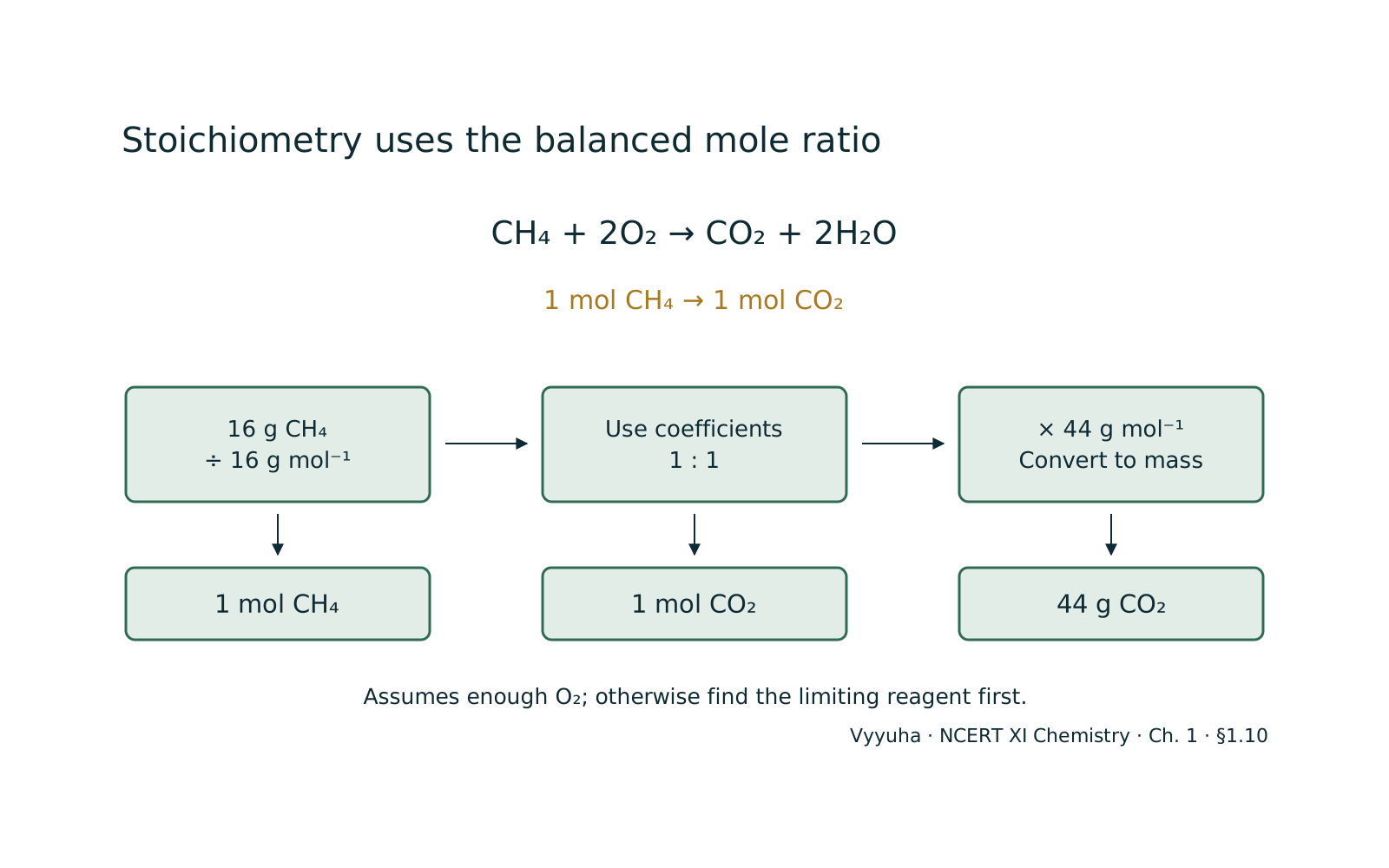
- Balanced Chemical Equation — This is the starting point. The coefficients in a balanced equation represent the relative number of moles (or molecules/formula units) of reactants and products. For instance, in the reaction , the mole ratio of is .
- Mole Concept — The mole is the central unit connecting macroscopic quantities (mass, volume) to microscopic quantities (number of particles). One mole of any substance contains Avogadro's number () of particles and has a mass equal to its molar mass (in grams). The mole concept allows us to convert:
* Mass to moles: * Moles to mass: * Number of particles to moles: * Moles to number of particles:
- Molar Volume of a Gas — At Standard Temperature and Pressure (STP, or and or ), one mole of any ideal gas occupies . This is crucial for mass-volume and volume-volume calculations involving gases.
- Avogadro's Law — For reactions involving gases at constant temperature and pressure, the volumes of reacting gases and gaseous products bear a simple whole-number ratio to one another, which is the same as their mole ratio in the balanced equation. This simplifies volume-volume calculations directly.
Types of Stoichiometric Calculations and Derivations (Methods)
General Approach for Stoichiometric Problems:
- Write and Balance the Chemical Equation — This is non-negotiable. An unbalanced equation will lead to incorrect mole ratios and thus incorrect answers.
- Convert Given Quantities to Moles — Use molar mass (for solids/liquids) or molar volume/ideal gas law (for gases) to convert masses or volumes of known substances into moles.
- Use Mole Ratios — Apply the stoichiometric coefficients from the balanced equation to find the moles of the desired substance (reactant or product).
- Convert Moles to Desired Units — Convert the calculated moles back into mass, volume, or number of particles as required by the problem.
Let's illustrate with specific types:
1. Mass-Mass Calculations:
- Problem — Given mass of A, find mass of B.
- Steps — Mass A Moles A Moles B Mass B.
- Example — How much is needed to react completely with of to form and ? ()
* Equation: (Balanced) * Moles * From equation, reacts with . So, Moles * Mass
2. Mass-Volume Calculations (for gases at STP):
- Problem — Given mass of A, find volume of gaseous B at STP.
- Steps — Mass A Moles A Moles B Volume B.
- Example — What volume of at STP is produced from the complete combustion of of ? ()
* Equation: (Balanced) * Moles * From equation, produces . So, Moles * Volume
3. Volume-Volume Calculations (for gases at constant T, P):
- Problem — Given volume of gaseous A, find volume of gaseous B.
- Steps — Volume A Volume B (direct application of Avogadro's Law).
- Example — What volume of gas is formed when of gas reacts completely with gas at the same temperature and pressure?
* Equation: (Balanced) * From equation, produces . So, Volume
4. Limiting Reagent Problems:
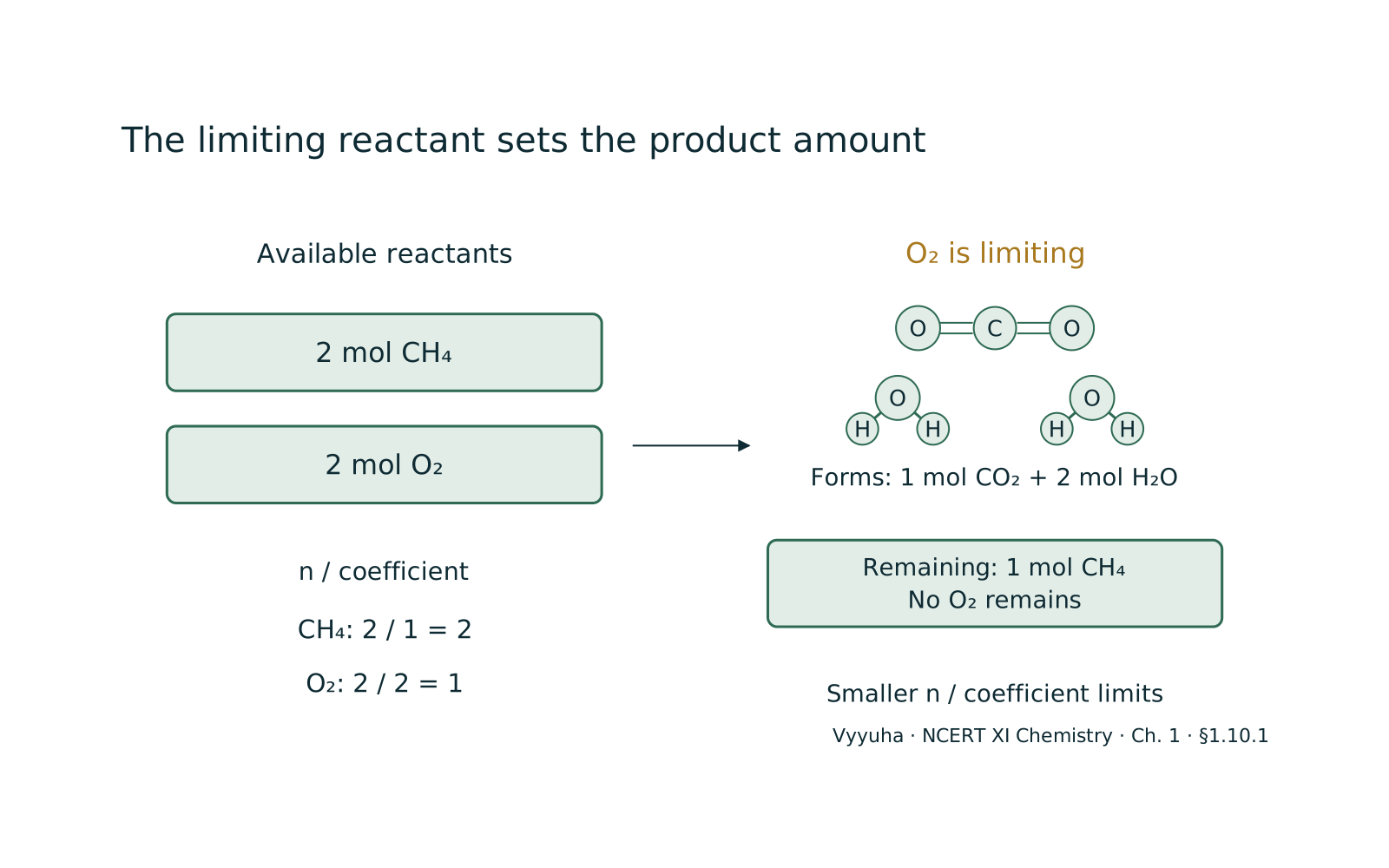
- When reactants are not present in stoichiometric ratios, one reactant will be consumed completely before the others. This is the limiting reagent, and it determines the maximum amount of product that can be formed.
- Steps
1. Convert given amounts of all reactants to moles. 2. For each reactant, calculate the moles of product that could be formed if that reactant were completely consumed (using mole ratios). 3. The reactant that yields the least amount of product is the limiting reagent. The amount of product calculated from the limiting reagent is the theoretical yield.
- Example — If of reacts with of to form water, which is the limiting reagent and how much water is formed?
* Equation: * Moles * Moles * If is limiting: * If is limiting: $0.
3125\,\text{mol},O_2 \times \frac{2\,\text{mol},H_2O}{1\,\text{mol},O_2} = 0.625\,\text{mol},H_2OO_20.625\,\text{mol}O_2H_2O = 0.
625\,\text{mol} \times 18\,\text{g/mol} = 11.
5. Percentage Yield:
- In practical experiments, the actual amount of product obtained (actual yield) is often less than the theoretical maximum (theoretical yield) due to side reactions, incomplete reactions, or loss during purification.
Real-World Applications
Stoichiometry is not just an academic exercise; it's fundamental to countless real-world processes:
- Industrial Chemistry — Chemical engineers use stoichiometry to design and optimize industrial processes, ensuring maximum product yield and minimal waste. For example, in the Haber process for ammonia synthesis, precise stoichiometric control of nitrogen and hydrogen inputs is critical.
- Environmental Chemistry — Calculating pollutant concentrations, assessing the impact of emissions, and designing remediation strategies rely on stoichiometric principles. For instance, determining how much acid rain is produced from sulfur dioxide emissions.
- Pharmaceutical Industry — Drug synthesis requires exact stoichiometric control to produce pure compounds in desired quantities.
- Food Science — Understanding the chemical reactions involved in food processing, preservation, and nutrition. For example, calculating the amount of leavening agent needed in baking.
- Combustion Analysis — Determining the empirical formula of organic compounds by analyzing the masses of and produced upon combustion.
Common Misconceptions and NEET-Specific Angle
NEET aspirants often stumble on stoichiometry due to several common pitfalls:
- Failure to Balance the Equation — This is the most frequent and fatal error. Always double-check the balancing.
- Confusing Mass with Moles — Directly using mass in mole ratios is incorrect. All calculations must pass through the mole concept.
- Incorrect Molar Mass Calculation — Errors in calculating the molar mass of compounds lead to incorrect mole conversions.
- Ignoring Limiting Reagent — In problems where amounts of all reactants are given, assuming they are in stoichiometric proportion is a mistake. Always identify the limiting reagent.
- Unit Inconsistency — Mixing grams with kilograms, or liters with milliliters without proper conversion. Always ensure units are consistent.
- Misapplication of Molar Volume — Remembering that is only valid for ideal gases at STP. For other conditions, the Ideal Gas Law () must be used.
For NEET, speed and accuracy are paramount. Practice is key. Develop a systematic approach for each problem type. Pay close attention to the wording of questions, especially when multiple reactants are given (indicating a potential limiting reagent problem) or when percentage yield is mentioned. Often, questions will combine stoichiometry with other topics like solution concentration (molarity), redox reactions, or gas laws, requiring an integrated understanding.
Often confused with
Side-by-side differences the NEET paper likes to test.
| Aspect | Stoichiometry and Stoichiometric Calculations | Theoretical Yield vs. Actual Yield |
|---|---|---|
| Definition | The maximum amount of product that can be formed from given reactants, calculated stoichiometrically. | The amount of product actually obtained from a chemical reaction in an experiment. |
| Calculation Basis | Based on balanced chemical equations and the limiting reagent. | Based on experimental observation and measurement. |
| Value | Represents the ideal, 100% efficient outcome. | Almost always less than or equal to the theoretical yield. |
| Factors Affecting | Only determined by the amounts of reactants and stoichiometry. | Affected by incomplete reactions, side reactions, purification losses, experimental errors, temperature, pressure, etc. |
Theoretical yield is a calculated maximum, representing the ideal outcome of a reaction based on perfect stoichiometry. It's what we expect to get. Actual yield, conversely, is the experimentally measured quantity of product, reflecting the real-world inefficiencies and losses inherent in any chemical process.
The comparison between these two, expressed as percentage yield, provides a crucial measure of a reaction's practical efficiency and is vital for optimizing chemical synthesis in both laboratory and industrial settings.
Why it is tested: For NEET, understanding the distinction is vital for solving problems involving percentage yield, which frequently appear. It tests a student's ability to apply theoretical calculations and interpret practical outcomes, a core skill in experimental chemistry.
Questions students ask
5 answered on this topic.
Why is balancing a chemical equation so crucial for stoichiometric calculations?
Balancing a chemical equation is the absolute first and most critical step in any stoichiometric calculation because it ensures adherence to the Law of Conservation of Mass. An unbalanced equation implies that atoms are either created or destroyed, which is chemically impossible.
The coefficients in a balanced equation provide the exact mole ratios between reactants and products. Without these correct ratios, any subsequent calculation involving mass, moles, or volume will be fundamentally flawed, leading to incorrect predictions of reactant consumption or product formation.
What is the difference between theoretical yield and actual yield?
Theoretical yield is the maximum amount of product that can be formed from a given amount of reactants, assuming the reaction goes to completion with 100% efficiency and no losses. It is calculated purely based on stoichiometry.
Actual yield, on the other hand, is the amount of product actually obtained when the reaction is performed in a laboratory or industrial setting. It is almost always less than the theoretical yield due to factors like incomplete reactions, side reactions, purification losses, or experimental errors.
How do I identify the limiting reagent in a reaction?
To identify the limiting reagent, you must first convert the given amounts of all reactants into moles. Then, for each reactant, calculate the amount of product (or the amount of another reactant consumed) that would be formed if that specific reactant were completely used up, using the mole ratios from the balanced equation. The reactant that produces the smallest amount of product is the limiting reagent. It dictates the maximum possible yield of the reaction.
Can stoichiometry be applied to reactions involving solutions?
Absolutely! Stoichiometry is extensively applied to reactions in solutions. In such cases, the amounts of reactants are often expressed in terms of concentration (like molarity) and volume. You would use the formula to convert the given solution data into moles, and then proceed with the standard mole ratio calculations from the balanced equation. This is a common type of problem in NEET, often combined with titration concepts.
What is the significance of the molar volume of a gas at STP in stoichiometric calculations?
The molar volume of a gas at STP () provides a convenient conversion factor between the volume of a gas and its number of moles, specifically under standard conditions ( and ). This simplifies calculations involving gaseous reactants or products, allowing for direct conversion from moles to volume or vice versa without needing the Ideal Gas Law, provided the reaction occurs at STP. It's a shortcut that saves time in competitive exams like NEET.