Newton's First Law — Explained
Detailed Explanation
Newton's First Law of Motion, often dubbed the Law of Inertia, is the foundational pillar upon which the entire edifice of classical mechanics rests. It's not just a statement about how objects behave; it's a profound redefinition of motion itself, distinguishing it from the earlier, less accurate views that dominated scientific thought for centuries.
Conceptual Foundation: From Aristotle to Galileo
For nearly two millennia, the prevailing view on motion was largely influenced by the Greek philosopher Aristotle. Aristotle believed that a continuous force was required to keep an object in motion. If the force ceased, the object would naturally return to its 'natural state' of rest.
This idea seemed to align with everyday observations: push a cart, and it moves; stop pushing, and it stops. However, this view failed to account for the underlying forces like friction and air resistance that are always present in our terrestrial environment.
It was Galileo Galilei in the 17th century who first challenged this Aristotelian dogma. Through ingenious thought experiments and observations, Galileo proposed that if friction and air resistance were entirely absent, an object set in motion would continue to move indefinitely with constant velocity.
He imagined a ball rolling down an inclined plane, then up another. If the second plane had a shallower incline, the ball would roll further to reach its original height. If the second plane were perfectly horizontal, the ball would, in theory, roll forever, never reaching its original height.
Galileo's work laid the intellectual groundwork for Newton, introducing the concept of inertia – the inherent resistance of an object to changes in its state of motion.
Newton synthesized Galileo's insights into his First Law, formally stating that every body continues in its state of rest, or of uniform motion in a straight line, unless it is compelled to change that state by forces impressed upon it.
Key Principles and Laws Embodied in Newton's First Law
- Inertia: — This is the central concept. Inertia is the natural tendency of an object to resist changes in its state of motion. A massive object has more inertia than a less massive one, meaning it's harder to get a heavy object moving from rest, and harder to stop it once it's in motion. Mass is a quantitative measure of inertia. The greater the mass, the greater the inertia.
- State of Rest or Uniform Motion: — The law treats 'rest' and 'uniform motion in a straight line' (i.e., constant velocity) as equivalent states. Both imply that the object's velocity is not changing. This is a crucial departure from Aristotle, who saw rest as a 'natural' state and motion as something requiring continuous effort.
- Net External Force: — The change in an object's state of motion (i.e., its velocity) only occurs if there is an 'unbalanced external force' acting on it. An 'external force' is a force originating from outside the system or object under consideration. An 'unbalanced' force, also known as a 'net force' or 'resultant force,' means that the vector sum of all external forces acting on the object is not zero. If the net external force () is zero, then the object's acceleration () is zero, which means its velocity () is constant. Mathematically, if , then . This constant velocity can be zero (object at rest) or a non-zero constant vector (object in uniform motion).
- Inertial Frames of Reference: — The First Law implicitly defines an inertial frame of reference. An inertial frame is a reference frame in which Newton's First Law holds true. In such a frame, an object with no net force acting on it will indeed have zero acceleration. Frames that are accelerating (e.g., a car accelerating, a rotating carousel) are non-inertial frames, and in these frames, objects can appear to accelerate without any apparent external force (these are often attributed to 'fictitious forces' like centrifugal force). For NEET, it's generally assumed that the Earth's surface is an approximately inertial frame for most practical problems, although technically it's non-inertial due to Earth's rotation and revolution.
Real-World Applications
Newton's First Law isn't just an abstract concept; it governs countless everyday phenomena:
- Seatbelts in Cars: — When a car suddenly stops, your body, due to inertia, tends to continue moving forward at the car's original speed. A seatbelt applies a force to stop your body, preventing you from hitting the dashboard or windshield.
- Dusting a Carpet: — When you beat a dusty carpet, the carpet moves rapidly, but the dust particles, due to their inertia, tend to remain at rest. This difference in motion causes the dust to separate from the carpet.
- Objects in a Moving Vehicle: — If you place an object on the dashboard of a car and the car suddenly turns left, the object tends to continue moving in its original straight-line path (due to inertia) and appears to slide to the right relative to the car.
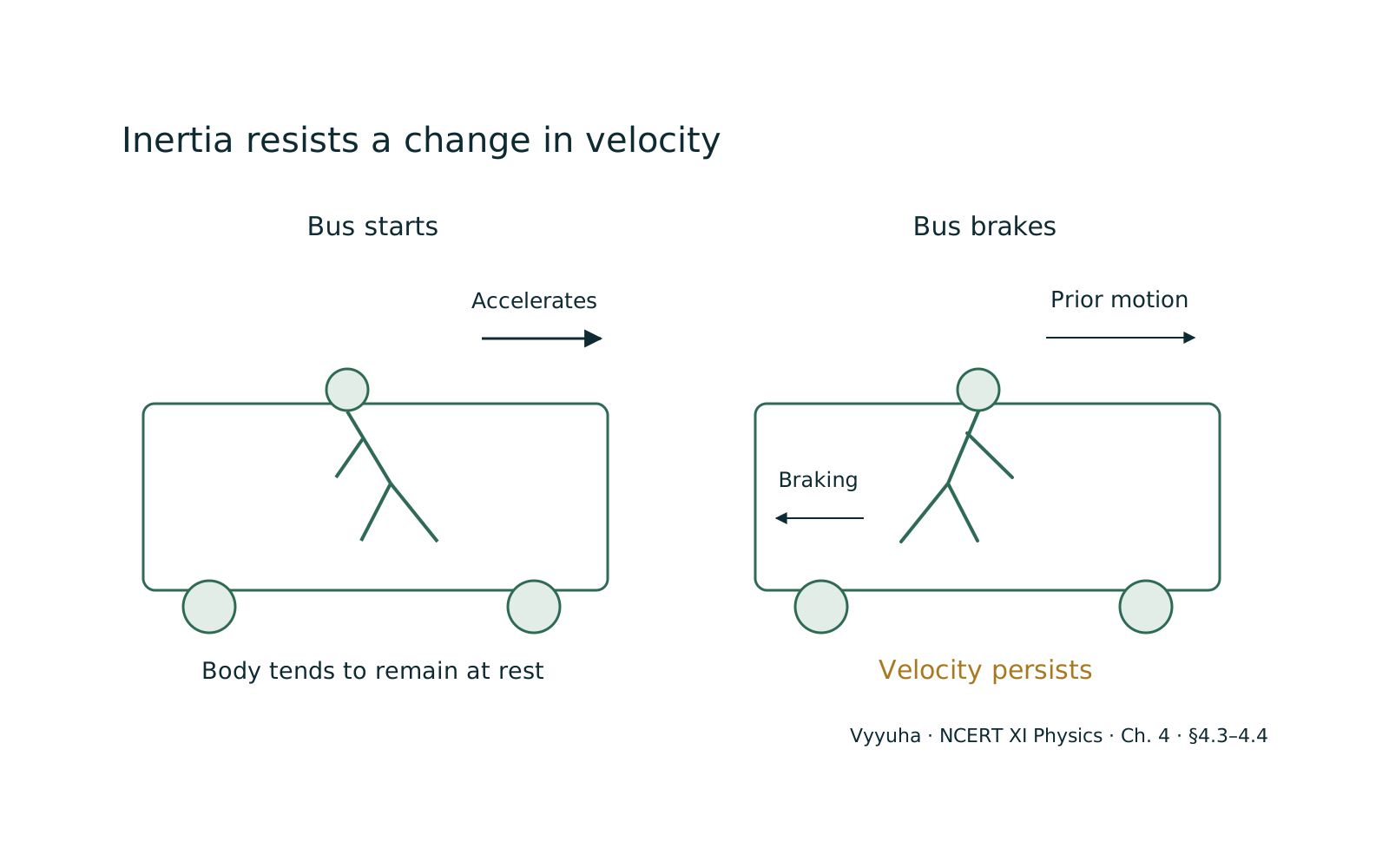
- Starting and Stopping a Bus: — When a bus suddenly starts, passengers tend to fall backward because their bodies, initially at rest, resist the forward motion of the bus. When the bus suddenly stops, passengers tend to fall forward because their bodies, initially in motion, resist the sudden stop.
- Hammer Head Tightening: — To tighten a hammerhead onto its handle, you strike the end of the handle against a hard surface. The handle stops, but the hammerhead, due to its inertia, continues to move downwards, seating itself more firmly.
Common Misconceptions
- Force is always needed to keep an object moving: — This is the Aristotelian fallacy. In the absence of resistive forces (like friction and air resistance), an object in motion requires no force to maintain its constant velocity. Force is only needed to change its velocity (i.e., to accelerate it).
- Inertia is a force: — Inertia is a property of matter (resistance to change in motion), not a force itself. Mass is the measure of inertia.
- Objects naturally slow down: — Objects only slow down because of external forces like friction, air resistance, or other resistive forces. If these were absent, objects would maintain their velocity.
- Misunderstanding 'unbalanced force': — Students sometimes confuse 'force' with 'unbalanced force.' An object can have multiple forces acting on it, but if they cancel out (vector sum is zero), the object's state of motion will not change.
NEET-Specific Angle
For NEET aspirants, understanding Newton's First Law is crucial for several reasons:
- Foundation for Second Law: — The First Law is a special case of the Second Law (). If , then , implying constant velocity. It helps in defining what 'force' actually does – it causes acceleration.
- Equilibrium Problems: — Many NEET problems involve objects in equilibrium, meaning they are either at rest or moving with constant velocity. In such scenarios, the net external force acting on the object is zero. This understanding is vital for solving problems involving forces on inclined planes, pulleys, and connected bodies where acceleration is zero.
- Identifying Inertial Frames: — While most problems assume an inertial frame, a conceptual question might test your understanding of what constitutes an inertial vs. non-inertial frame and the implications for Newton's laws.
- Conceptual Questions on Inertia: — Questions often test the direct application of inertia in everyday situations, requiring you to identify the correct explanation based on the law.
- Distinguishing Mass and Weight: — The First Law helps reinforce that mass is a measure of inertia, while weight is a force (gravitational pull) and can change depending on the gravitational field, whereas mass remains constant.
Mastering Newton's First Law means deeply appreciating that changes in motion are always due to external influences, and that objects inherently resist these changes. It's the starting point for analyzing any dynamic system.
Often confused with
Side-by-side differences the NEET paper likes to test.
| Aspect | Newton's First Law | Aristotle's View of Motion |
|---|---|---|
| Natural State | Newton's First Law: Both rest and uniform motion (constant velocity) are natural states in the absence of net force. | Aristotle's View: Rest is the natural state for objects; motion requires a continuous external force. |
| Requirement for Motion | Newton's First Law: No force is required to maintain uniform motion; force is only needed to *change* motion (i.e., cause acceleration). | Aristotle's View: A continuous force is required to keep an object moving. If the force ceases, the object stops. |
| Role of Friction/Resistance | Newton's First Law: Friction and air resistance are external forces that cause objects to slow down or stop, not an inherent tendency. | Aristotle's View: Did not explicitly account for friction as a force; slowing down was seen as a natural return to rest. |
| Concept of Inertia | Newton's First Law: Central concept; objects possess inertia, resisting changes to their state of motion. | Aristotle's View: No concept of inertia as a property resisting change in motion; rather, objects had a tendency to return to rest. |
The fundamental distinction between Newton's First Law and Aristotle's view of motion lies in their understanding of an object's 'natural state.' Aristotle believed that rest was the natural state for all objects, and continuous force was required to sustain any motion.
In contrast, Newton's First Law, building on Galileo's insights, posits that both rest and uniform motion (constant velocity) are natural states for an object when no net external force acts upon it. Newton's law correctly identifies that forces are only required to change an object's state of motion, not to maintain it, thereby introducing the crucial concept of inertia.
Why it is tested: For NEET, understanding this historical context helps solidify the conceptual basis of Newton's laws. It clarifies why the First Law was revolutionary and how it correctly explains phenomena that Aristotle's model could not, especially regarding the role of friction and the true nature of inertia. Questions might indirectly test this understanding by presenting scenarios that challenge Aristotelian thinking.
Questions students ask
5 answered on this topic.
What is the primary difference between Newton's First Law and Aristotle's view of motion?
Aristotle believed that a continuous force was necessary to keep an object in motion, and that objects naturally sought a state of rest. Newton's First Law, however, states that an object will maintain its state of motion (either rest or uniform velocity) unless acted upon by an unbalanced external force.
This means that in the absence of external forces like friction, an object in motion would continue moving indefinitely without any applied force. The key difference lies in the natural state of motion: Aristotle saw rest as natural, while Newton saw both rest and constant velocity as natural states in the absence of net force.
Can Newton's First Law be considered a special case of Newton's Second Law?
Yes, absolutely. Newton's Second Law is mathematically expressed as , where is the net external force, is the mass, and is the acceleration.
If the net external force acting on an object is zero, then according to the Second Law, its acceleration must also be zero (assuming ). Zero acceleration implies that the object's velocity is constant.
This constant velocity can be zero (object at rest) or a non-zero constant (object in uniform motion). This is precisely what Newton's First Law states, making it a direct consequence or a special case of the Second Law.
What is an 'inertial frame of reference' and why is it important for Newton's First Law?
An inertial frame of reference is a coordinate system in which Newton's First Law holds true. In simpler terms, it's a frame where an object with no net external force acting on it will experience no acceleration.
If you observe an object from an inertial frame and see it accelerating, you can be sure there's a net force causing that acceleration. Conversely, if you see it moving at constant velocity or at rest, you know the net force is zero.
Non-inertial frames (like an accelerating car or a rotating platform) introduce 'fictitious forces' that make objects appear to accelerate without a real physical force, thus Newton's laws, in their simplest form, don't directly apply without modifications.
The First Law essentially defines the conditions under which the laws of motion are valid.
Is inertia a force? How is it related to mass?
No, inertia is not a force. Inertia is an intrinsic property of matter, representing its resistance to any change in its state of motion. It's the 'laziness' of an object to accelerate. Mass is the quantitative measure of inertia.
The more massive an object is, the greater its inertia, meaning a larger force is required to produce a given acceleration, or it will be harder to stop it once it's moving. For example, it's much harder to push a heavy truck than a small toy car because the truck has significantly more mass, and thus more inertia.
Why do passengers lurch forward when a bus suddenly stops?
This phenomenon is a direct consequence of Newton's First Law of Motion, specifically the concept of inertia. When the bus is moving, the passengers inside it are also moving forward at the same velocity as the bus.
When the bus suddenly applies brakes, a force is exerted on the bus, causing it to decelerate. However, the passengers' bodies, due to their inertia, tend to resist this change in motion and continue moving forward at their original velocity.
Since the bus seats and floor stop, but the passengers' upper bodies continue to move forward, they lurch forward relative to the bus, until an external force (like the seatbelt, or the seat in front, or their own muscles) acts to stop them.