Newton's Third Law — Explained
Detailed Explanation
Newton's Third Law of Motion is a cornerstone of classical mechanics, providing a profound insight into the nature of forces and interactions. While Newton's First Law defines inertia and the concept of force, and his Second Law quantifies the relationship between force, mass, and acceleration, the Third Law completes the picture by explaining that forces never exist in isolation; they always occur in pairs as a result of interaction between two distinct objects.
Conceptual Foundation
Before delving into the Third Law, it's essential to recall that a force is a push or a pull that can cause an object to accelerate. Forces are vector quantities, possessing both magnitude and direction.
Newton's First Law tells us that an object at rest stays at rest, and an object in motion stays in motion with the same speed and in the same direction unless acted upon by an unbalanced force. Newton's Second Law, , quantifies this, stating that the net force acting on an object is directly proportional to its mass and the acceleration it experiences.
The Third Law, however, shifts our focus from a single object to the interaction between two objects.
Key Principles and Characteristics of Action-Reaction Pairs
Newton's Third Law states: 'To every action, there is always an equal and opposite reaction; or, the mutual actions of two bodies upon each other are always equal, and directed to contrary parts.'
Let's dissect this statement and understand the critical characteristics of these 'action-reaction' pairs:
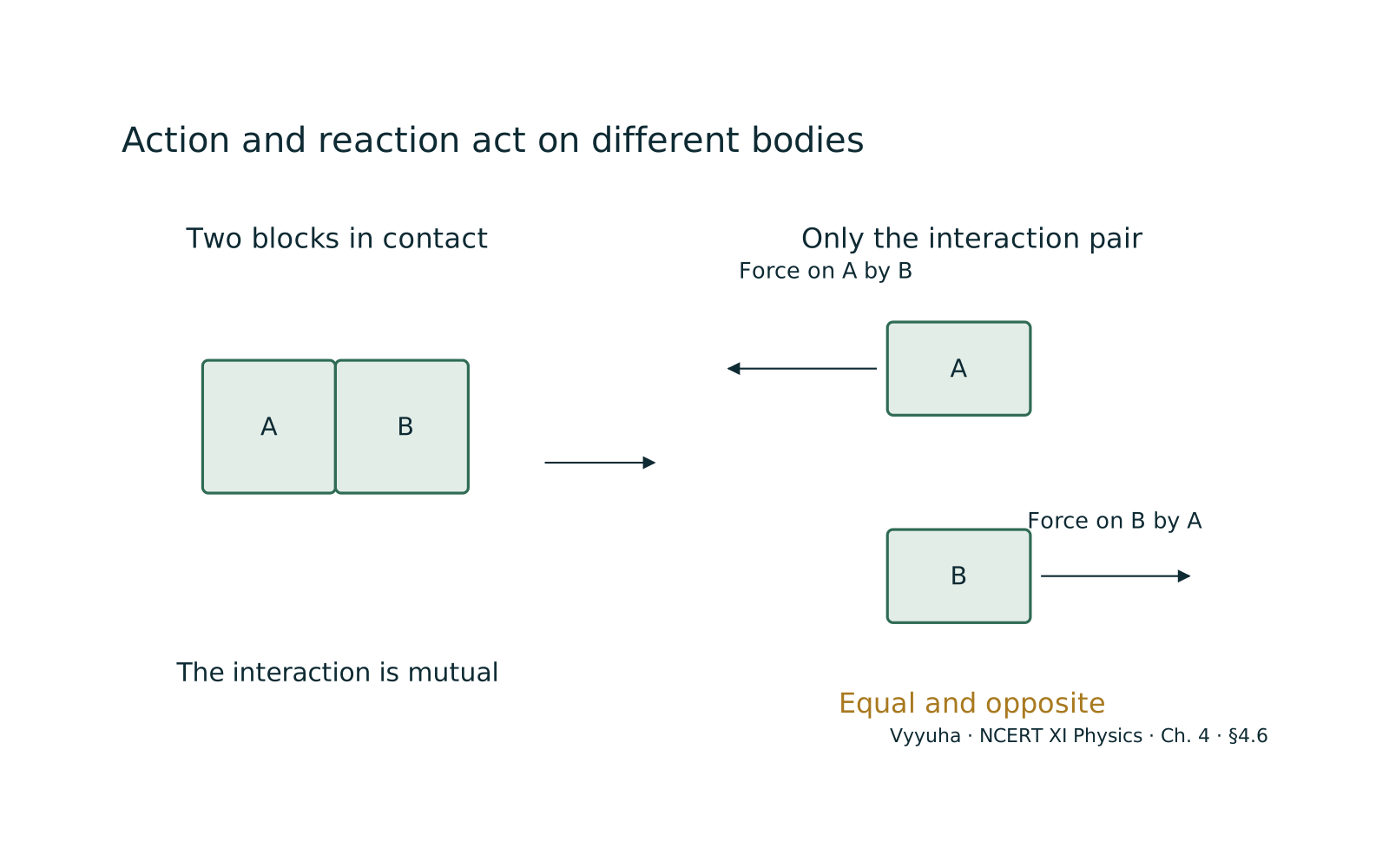
- Forces Always Occur in Pairs: — A single, isolated force cannot exist. Whenever an object A exerts a force on object B (the 'action'), object B simultaneously exerts a force on object A (the 'reaction'). These two forces constitute an action-reaction pair.
- Equal in Magnitude: — The magnitude (strength) of the action force is precisely equal to the magnitude of the reaction force. If object A pushes object B with a force of , then object B pushes object A with a force of , such that .
- Opposite in Direction: — The action and reaction forces always act in exactly opposite directions. Mathematically, this can be expressed as , where the negative sign indicates the opposite direction.
- Simultaneous Occurrence: — The action and reaction forces arise and cease to exist at the same instant. There is no time delay between them. As soon as the interaction begins, both forces are present.
- Act on Different Bodies: — This is the most crucial and often misunderstood characteristic. The action force acts on one body, and the reaction force acts on the other body involved in the interaction. For example, if you push a cart, your hand exerts a force on the cart (action), and the cart exerts a force on your hand (reaction). Because these forces act on different bodies, they can never cancel each other out. If they acted on the same body, the net force would always be zero, and no acceleration would ever occur, which contradicts everyday observations.
- Same Nature of Forces: — Action and reaction forces are always of the same type. If the action is a gravitational force, the reaction is also a gravitational force. If the action is an electromagnetic force (like a normal force or tension), the reaction is also an electromagnetic force. For instance, the Earth pulls an apple downwards (gravitational action), and the apple pulls the Earth upwards (gravitational reaction).
Derivations and Implications
While Newton's Third Law itself is a fundamental postulate and not derived from other principles, its implications are profound, particularly in the context of the conservation of linear momentum.
Consider an isolated system of two interacting particles, A and B. According to Newton's Third Law, the force exerted by A on B, , is equal in magnitude and opposite in direction to the force exerted by B on A, .
From Newton's Second Law, we know that force is the rate of change of momentum (). So, for particle A and B:
(Force on B due to A) (Force on A due to B)
Substituting these into the Third Law equation:
Rearranging the terms:
This can be written as:
This equation implies that the total momentum of the system () remains constant over time, provided there are no external forces acting on the system. This is the Law of Conservation of Linear Momentum, which is a direct consequence of Newton's Third Law. It states that in an isolated system, the total linear momentum remains conserved.
Real-World Applications
Newton's Third Law is ubiquitous in our daily lives and forms the basis for many technologies:
- Walking: — When you walk, your foot pushes backward on the ground (action). The ground, in turn, pushes forward on your foot (reaction), propelling you forward. Without friction, this interaction wouldn't be possible.
- Rocket Propulsion: — A rocket expels hot gases at high velocity downwards (action). The gases exert an equal and opposite force upwards on the rocket (reaction), pushing it into space.
- Swimming: — A swimmer pushes water backward with their hands and feet (action). The water pushes the swimmer forward with an equal and opposite force (reaction).
- Recoil of a Gun: — When a bullet is fired, the gun exerts a forward force on the bullet (action). The bullet exerts an equal and opposite backward force on the gun (reaction), causing the gun to recoil.
- Bird Flying: — A bird pushes air downwards with its wings (action). The air pushes the bird upwards with an equal and opposite force (reaction), allowing it to fly.
- Pushing a Wall: — As discussed, when you push a wall, the wall pushes back on you. If the wall didn't push back, your hand would simply pass through it.
- Jumping: — When you jump, you push down on the Earth (action). The Earth pushes up on you (reaction), launching you into the air.
Common Misconceptions
Students often make several mistakes when applying Newton's Third Law:
- Action-Reaction Pairs Cancel Out: — This is the most common misconception. Students mistakenly believe that since the forces are equal and opposite, they cancel each other out, resulting in no net force and thus no acceleration. However, this is incorrect because action and reaction forces always act on different bodies. For forces to cancel, they must act on the same body. For example, when you push a cart, the force you exert on the cart causes the cart to accelerate. The force the cart exerts on you does not affect the cart's motion; it affects your motion.
- Confusing Action-Reaction with Balanced Forces: — Balanced forces are two or more forces acting on the same object that sum up to zero, resulting in no acceleration (e.g., a book resting on a table, where gravity pulls it down and the normal force pushes it up). Action-reaction pairs, while equal and opposite, act on different objects and are part of an interaction, not necessarily leading to zero net force on either object individually.
- Identifying the Wrong Pair: — It's crucial to correctly identify the interacting bodies. If 'A exerts force on B', then the reaction is 'B exerts force on A'. For instance, the gravitational force of Earth on a book is an action. Its reaction is the gravitational force of the book on Earth, not the normal force of the table on the book (which is a different interaction pair).
NEET-Specific Angle
For NEET aspirants, understanding Newton's Third Law is vital for solving problems related to:
- Systems of Bodies: — Analyzing forces between connected blocks, ropes, pulleys, etc. Identifying internal action-reaction forces (like tension in a rope) and external forces.
- Conservation of Momentum: — Many problems involving collisions, explosions, or recoil directly apply the conservation of momentum, which, as shown, is a direct consequence of the Third Law.
- Free Body Diagrams (FBDs): — Correctly drawing FBDs requires identifying all forces acting on a specific body. The Third Law helps in understanding which forces are present due to interactions with other bodies.
- Conceptual Questions: — NEET often features conceptual questions testing the understanding of action-reaction pair characteristics, especially the 'acting on different bodies' aspect and differentiating them from balanced forces.
- Relative Motion: — Understanding how forces affect the motion of interacting bodies relative to each other.
Mastering Newton's Third Law involves not just memorizing the statement but deeply understanding its implications, especially the 'different bodies' clause, and applying it consistently to analyze interactions in various physical scenarios.
Often confused with
Side-by-side differences the NEET paper likes to test.
| Aspect | Newton's Third Law | Balanced Forces |
|---|---|---|
| Definition | Action-Reaction Pair (Newton's Third Law) | Balanced Forces |
| Objects Involved | Always involve two different interacting objects. | Always act on a single object. |
| Effect on Motion | Each force affects the motion of the object it acts upon. They do not cancel each other out. | Their vector sum is zero, resulting in no change in the object's state of motion (zero acceleration). |
| Origin | Arise from a single interaction between two bodies. | Can be from multiple interactions, but all forces act on the same body. |
| Example | You push a wall (action on wall), wall pushes you (reaction on you). | A book resting on a table: gravitational force pulling it down and normal force pushing it up (both on the book). |
The fundamental distinction between action-reaction pairs and balanced forces lies in the number of objects involved. Action-reaction pairs, as described by Newton's Third Law, always involve two distinct objects, with the action force acting on one and the reaction force acting on the other.
Consequently, they cannot cancel each other out. In contrast, balanced forces are multiple forces that all act on a single object, and their vector sum is zero, leading to no acceleration of that object.
Understanding this difference is crucial for correctly applying Newton's laws in problem-solving.
Why it is tested: NEET relevance: This distinction is frequently tested in conceptual questions. Students often confuse these two concepts, leading to errors in identifying forces on free-body diagrams or predicting motion. A clear understanding is vital for analyzing systems of bodies and applying Newton's laws correctly.
Questions students ask
5 answered on this topic.
Do action and reaction forces cancel each other out?
No, action and reaction forces do not cancel each each other out. This is a very common misconception. For forces to cancel, they must act on the same object. However, according to Newton's Third Law, action and reaction forces always act on different objects.
For example, when you push a wall, your hand exerts a force on the wall, and the wall exerts a force on your hand. The force on the wall causes the wall to experience a force (though it might not move due to other forces or its large mass), and the force on your hand causes your hand to experience a force.
These forces affect the motion or state of their respective objects, not each other.
What is the difference between action-reaction pairs and balanced forces?
The key difference lies in the objects they act upon. Action-reaction pairs, as per Newton's Third Law, are forces acting on two different objects involved in an interaction (e.g., Earth pulls apple, apple pulls Earth).
They are always equal in magnitude and opposite in direction. Balanced forces, on the other hand, are two or more forces acting on the same object that sum up to zero, resulting in no change in the object's state of motion (e.
g., gravitational force and normal force on a book resting on a table). While both involve forces that are equal and opposite, their application to different or the same objects is crucial.
Can action and reaction forces be of different types?
No, action and reaction forces are always of the same nature. If the action force is gravitational, the reaction force will also be gravitational. If the action force is electromagnetic (like a normal force, tension, or friction), the reaction force will also be electromagnetic.
For instance, the Earth exerts a gravitational pull on the Moon (action), and the Moon exerts an equal and opposite gravitational pull on the Earth (reaction). You won't find a gravitational action paired with a normal force reaction.
Does Newton's Third Law apply to non-contact forces like gravity?
Absolutely, Newton's Third Law applies universally to all types of forces, whether they are contact forces (like pushing, pulling, friction, normal force) or non-contact forces (like gravitational, electromagnetic, or nuclear forces).
For example, the Earth exerts a gravitational force on you, pulling you downwards. In turn, you exert an equal and opposite gravitational force on the Earth, pulling it upwards. Even though there's no physical contact, the interaction still involves an action-reaction pair.
How does Newton's Third Law explain the recoil of a gun?
When a gun is fired, the expanding gases inside the barrel exert a forward force on the bullet, propelling it out (this is the 'action' force). According to Newton's Third Law, the bullet simultaneously exerts an equal and opposite backward force on the gun (this is the 'reaction' force).
This backward force causes the gun to move backward, which is known as recoil. The magnitude of the recoil velocity depends on the mass of the gun relative to the mass of the bullet, as explained by the conservation of momentum, a direct consequence of the Third Law.