Conservation of Momentum — Explained
Detailed Explanation
The principle of conservation of momentum is one of the most fundamental laws in physics, providing a powerful tool for analyzing interactions between objects. It is deeply rooted in Newton's laws of motion and offers profound insights into the behavior of systems.
1. Conceptual Foundation: What is Momentum?
Before delving into conservation, it's crucial to understand momentum itself. Linear momentum () is defined as the product of an object's mass () and its velocity (). Mathematically, .
Since velocity is a vector, momentum is also a vector quantity, possessing both magnitude and direction. Its SI unit is kilogram-meter per second (kg·m/s). Momentum can be thought of as the 'quantity of motion' an object possesses.
A heavier object moving at the same speed has more momentum than a lighter one, and an object moving faster has more momentum than the same object moving slower.
Newton's second law of motion, in its more general form, states that the net external force () acting on an object is equal to the rate of change of its momentum (). So, . If the net external force acting on an object is zero, then , which implies that the momentum is constant. This is the simplest form of the conservation of momentum for a single object.
2. Key Principles and Derivation from Newton's Third Law
The true power of the conservation of momentum emerges when considering a system of multiple interacting objects. Consider an isolated system of two particles, A and B, interacting with each other. An 'isolated system' is one where no net external forces act on the system as a whole. The forces between particles A and B are internal forces.
According to Newton's third law of motion, when particle A exerts a force on particle B, particle B simultaneously exerts an equal and opposite force on particle A. That is, .
Now, let's apply Newton's second law to each particle: For particle A: For particle B:
Substituting : Rearranging, we get: This can be written as:
This equation implies that the total momentum of the system, , is constant over time. If the derivative of a quantity with respect to time is zero, that quantity must be constant.
Thus, for an isolated system, the total momentum is conserved: Or, This principle extends to any number of particles in an isolated system: .
3. Types of Collisions and Coefficient of Restitution
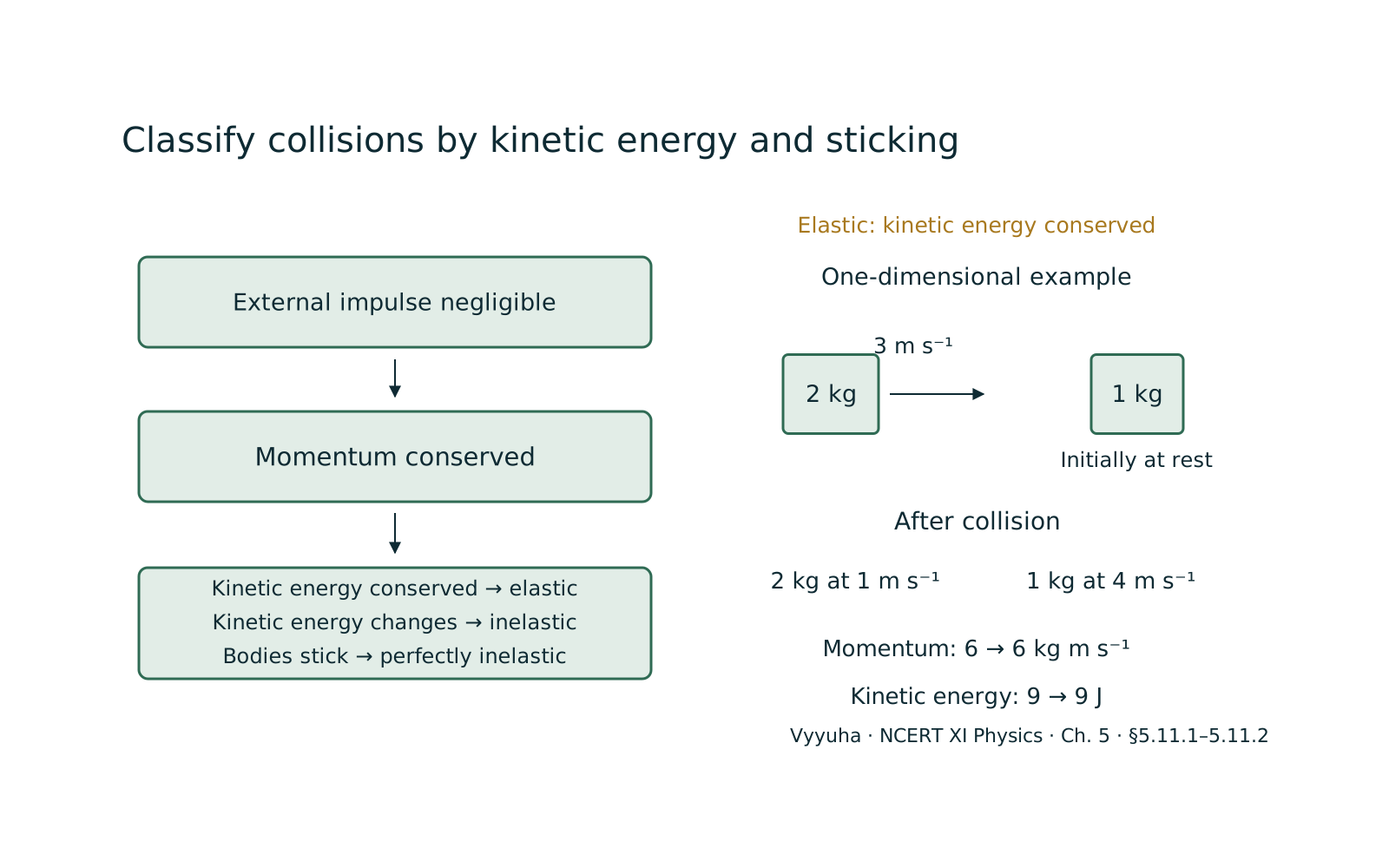
The conservation of momentum is universally applicable to all types of collisions, but the conservation of kinetic energy is not. This distinction leads to classifying collisions:
- Elastic Collisions: — In an elastic collision, both linear momentum and kinetic energy are conserved. This means the total kinetic energy of the system before the collision is equal to the total kinetic energy after the collision. Ideal elastic collisions occur when there is no loss of mechanical energy to heat, sound, or deformation. Examples include collisions between subatomic particles or perfectly hard billiard balls (an idealization).
* Momentum conservation: * Kinetic energy conservation:
- Inelastic Collisions: — In an inelastic collision, linear momentum is conserved, but kinetic energy is not conserved. Some kinetic energy is converted into other forms of energy, such as heat, sound, or energy used to deform the objects. Most real-world collisions are inelastic.
* Momentum conservation: * Kinetic energy:
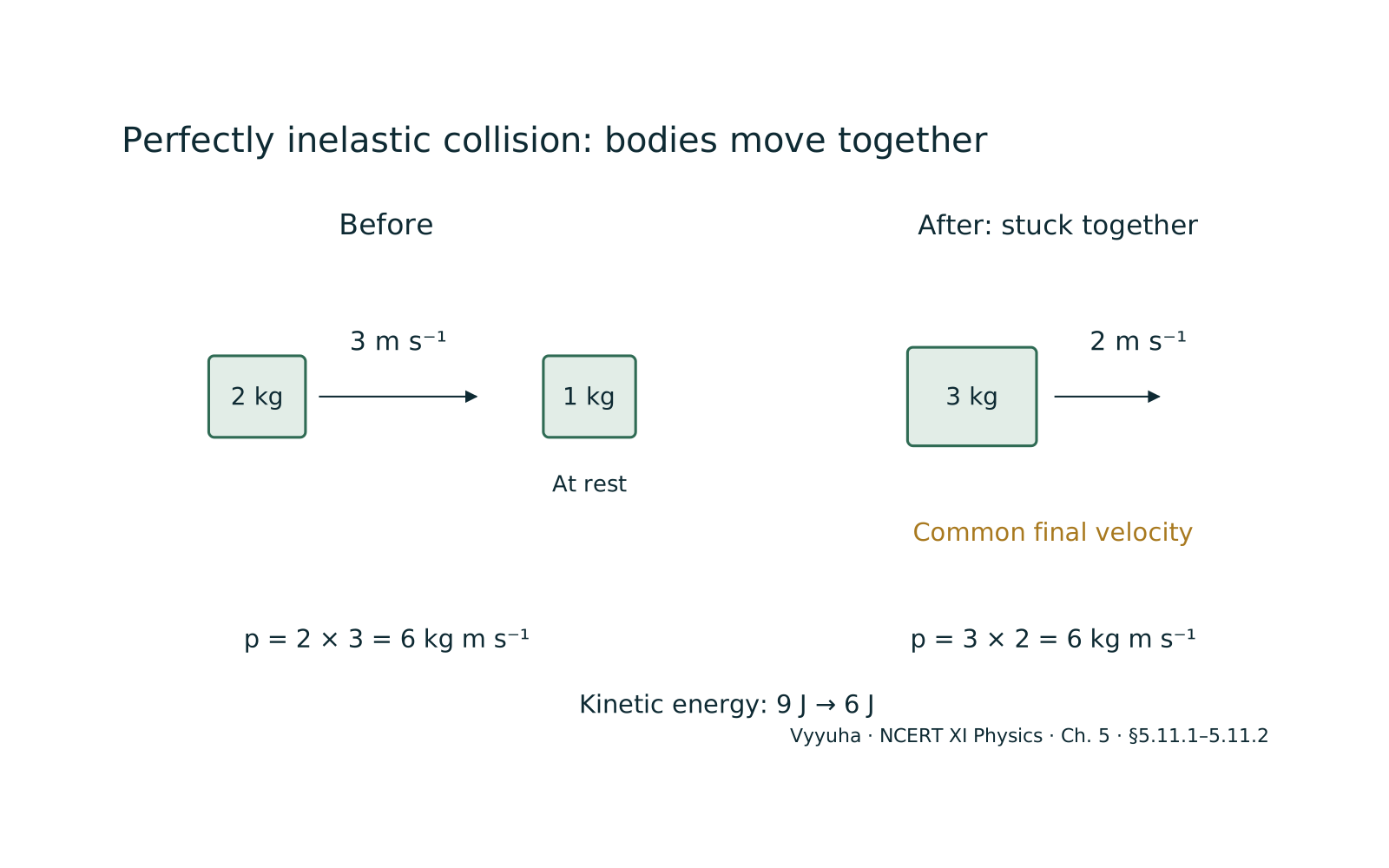
- Perfectly Inelastic Collisions: — This is a special type of inelastic collision where the colliding objects stick together and move as a single combined mass after the collision. This results in the maximum possible loss of kinetic energy while still conserving momentum.
* Momentum conservation:
**Coefficient of Restitution ():** This dimensionless quantity quantifies the elasticity of a collision. It is defined as the ratio of the relative speed of separation after collision to the relative speed of approach before collision.
- For elastic collisions, .
- For perfectly inelastic collisions, .
- For inelastic collisions, .
4. Real-World Applications
The conservation of momentum principle has numerous applications:
- Recoil of a Gun: — When a bullet is fired from a gun, the gun recoils backward. The total momentum of the gun-bullet system before firing (both at rest) is zero. After firing, the bullet moves forward with positive momentum, and the gun recoils backward with negative momentum such that the vector sum remains zero. .
- Rocket Propulsion: — Rockets work on the principle of conservation of momentum. Hot gases are expelled at high velocity backward (downward), creating a forward momentum for the rocket. The total momentum of the rocket-exhaust system remains conserved.
- Jet Engines: — Similar to rockets, jet engines expel hot gases backward to propel an aircraft forward.
- Explosions: — When an object explodes and breaks into multiple fragments, the total momentum of the fragments immediately after the explosion is equal to the momentum of the original object just before the explosion. If the object was initially at rest, the vector sum of the momenta of all fragments will be zero.
- Collisions in Sports: — From billiards to football, the outcomes of collisions are governed by momentum conservation.
5. Common Misconceptions
- Conservation of Momentum vs. Conservation of Kinetic Energy: — A frequent mistake is assuming that if momentum is conserved, kinetic energy must also be conserved. This is only true for elastic collisions. For inelastic collisions, kinetic energy is lost.
- Isolated System: — Students often forget the crucial condition of an 'isolated system' (zero net external force). If external forces like friction or gravity are significant, total momentum of the interacting objects alone is not conserved. However, if the external forces are included in the system (e.g., Earth in a falling object problem), then the momentum of the larger system can be conserved.
- Vector Nature: — Momentum is a vector. Students sometimes treat it as a scalar, leading to errors in direction. For 2D or 3D collisions, momentum must be conserved independently along perpendicular axes (e.g., x-axis and y-axis).
- Internal vs. External Forces: — Internal forces (like the forces between colliding objects) do not change the total momentum of the system. Only external forces can change the total momentum.
6. NEET-Specific Angle
For NEET, questions on conservation of momentum typically involve:
- One-dimensional collisions: — Calculating final velocities after elastic, inelastic, or perfectly inelastic collisions. Often involves a bullet-block system or two masses colliding.
- Two-dimensional collisions: — Less common but possible, requiring vector addition and resolution of momentum components along x and y axes.
- Explosions/Recoil: — Calculating velocities of fragments or recoil velocity of a gun.
- Conceptual questions: — Differentiating between elastic and inelastic collisions, understanding the role of internal/external forces, and the conditions for momentum conservation.
- Problems involving the coefficient of restitution: — Calculating or using it to find final velocities.
Mastering this topic requires a strong grasp of vector addition, careful application of the conservation principle, and a clear understanding of the different types of collisions and their energy implications.
Often confused with
Side-by-side differences the NEET paper likes to test.
| Aspect | Conservation of Momentum | Elastic vs. Inelastic Collisions |
|---|---|---|
| Momentum Conservation | Always conserved in an isolated system. | Always conserved in an isolated system. |
| Kinetic Energy Conservation | Conserved (total initial KE = total final KE). | Not conserved (total initial KE > total final KE; some lost to other forms). |
| Coefficient of Restitution ($e$) | $e = 1$ | $0 \le e < 1$ (specifically $e=0$ for perfectly inelastic). |
| Deformation/Heat Loss | No permanent deformation; no energy loss to heat/sound. | Permanent deformation often occurs; energy lost to heat, sound, deformation. |
| Relative Velocity | Relative speed of approach = relative speed of separation. | Relative speed of approach > relative speed of separation. |
| Example | Collisions between ideal gas molecules, billiard balls (idealized). | Car crashes, bullet embedding in a block, dropping a ball that doesn't bounce to its original height. |
The primary distinction between elastic and inelastic collisions lies in the conservation of kinetic energy. While linear momentum is conserved in both types (assuming an isolated system), kinetic energy is only conserved in elastic collisions.
Inelastic collisions involve a loss of kinetic energy, which is converted into other forms like heat, sound, or deformation energy. The coefficient of restitution () provides a quantitative measure, with for elastic and for inelastic collisions, including for perfectly inelastic scenarios where objects stick together.
Why it is tested: NEET relevance: Understanding the difference is critical for solving collision problems. Students must identify the type of collision to correctly apply the conservation laws. Misapplying kinetic energy conservation to inelastic collisions is a common error. Questions often test the calculation of final velocities or energy loss based on collision type.
Questions students ask
5 answered on this topic.
What is the difference between momentum and kinetic energy?
Momentum () is a vector quantity representing the 'quantity of motion' and depends linearly on velocity. Kinetic energy () is a scalar quantity representing the energy of motion and depends on the square of velocity. While both depend on mass and velocity, they describe different physical aspects. Momentum is conserved in all types of collisions within an isolated system, but kinetic energy is only conserved in elastic collisions.
Why is momentum conserved only in an isolated system?
Momentum is conserved only in an isolated system because an isolated system is defined as one where the net external force acting on it is zero. According to Newton's second law, the rate of change of momentum of a system is equal to the net external force acting on it ().
If , then , which means the total momentum must be constant. External forces introduce an impulse that changes the system's total momentum.
Can momentum be conserved if kinetic energy is not conserved?
Yes, absolutely. This is the defining characteristic of inelastic collisions. In such collisions, the total linear momentum of the system is always conserved (assuming an isolated system), but a portion of the initial kinetic energy is converted into other forms of energy, such as heat, sound, or internal deformation energy. For example, when two cars collide and crumple, momentum is conserved, but kinetic energy is lost to the deformation and sound.
How does the conservation of momentum apply to explosions?
In an explosion, the forces causing the fragmentation are internal forces within the system (e.g., chemical reactions in a bomb). Therefore, if no external forces are acting on the object before and during the explosion, the total momentum of the system (the original object plus its fragments) remains conserved. If the object was initially at rest, its total momentum was zero. After the explosion, the vector sum of the momenta of all the fragments must still be zero.
What is the significance of the coefficient of restitution?
The coefficient of restitution () is a crucial parameter that quantifies the 'bounciness' or elasticity of a collision. It helps us classify collisions and predict the relative velocities of objects after impact.
An signifies a perfectly elastic collision where kinetic energy is conserved. An indicates a perfectly inelastic collision where objects stick together and there's maximum kinetic energy loss.
Values between 0 and 1 represent typical inelastic collisions, providing insight into how much kinetic energy is dissipated.