Laws of Chemical Combination — Explained
Detailed Explanation
The Laws of Chemical Combination represent a cornerstone of modern chemistry, providing the empirical foundation upon which the atomic theory and the concept of stoichiometry were built. Before the advent of these laws, chemistry was largely qualitative, focusing on observations without a rigorous quantitative framework. These laws transformed chemistry into a precise, measurable science.
1. Law of Conservation of Mass
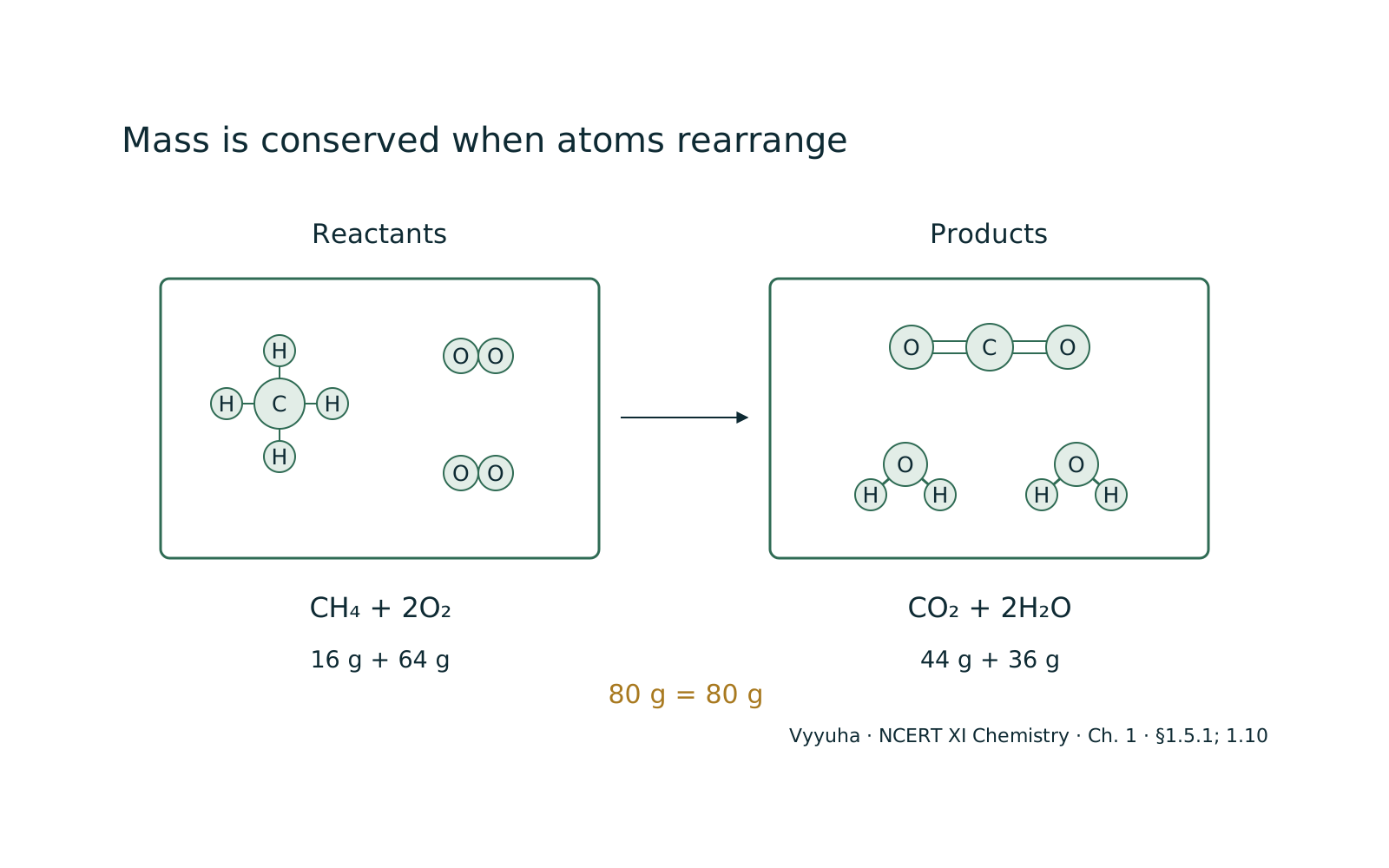
Conceptual Foundation: This law, formulated by Antoine Lavoisier in 1789, is arguably the most fundamental principle in chemistry. It states that 'matter can neither be created nor destroyed in a chemical reaction.
' This means that the total mass of the reactants involved in a chemical change must be exactly equal to the total mass of the products formed. Lavoisier's meticulous experiments, particularly his work on combustion in closed systems, demonstrated this principle conclusively, disproving the phlogiston theory.
Key Principles/Laws:
- Closed System: — The law holds true for reactions occurring in a closed system, where no matter can enter or leave. In open systems, gases might escape, or atmospheric gases might participate, making direct mass comparison challenging without accounting for all species.
- Nuclear Reactions Exception: — It's important to note that this law applies to chemical reactions. In nuclear reactions, mass can be converted into energy (as described by Einstein's ), so the law of conservation of mass as strictly defined for chemical reactions does not hold.
Derivations/Experimental Basis: Lavoisier performed experiments where he heated substances like mercury oxide in sealed containers. He observed that the mass of the container and its contents remained constant before and after the reaction, even though a new substance (mercury) and a gas (oxygen) were formed. This quantitative approach was revolutionary.
Real-World Applications:
- Balancing Chemical Equations: — The law of conservation of mass is the underlying principle for balancing chemical equations. The number of atoms of each element must be the same on both sides of the equation, ensuring mass conservation.
- Stoichiometric Calculations: — It allows chemists to predict the amount of product formed from a given amount of reactant, or vice-versa.
- Environmental Chemistry: — Understanding mass balance is crucial in analyzing pollutants and their transformations in ecosystems.
Common Misconceptions:
- Mass loss in open systems: — Students often confuse mass loss due to gas escape (e.g., burning wood, where smoke and ash are products) with actual destruction of mass. If all products, including gases, are collected and weighed, the mass is conserved.
2. Law of Definite Proportions (or Constant Composition)
Conceptual Foundation: Proposed by Joseph Proust in 1799, this law states that 'a given chemical compound always contains its component elements in fixed ratio by mass, irrespective of its source or method of preparation.' This means that every pure sample of a particular compound will have the same elemental composition by mass.
Key Principles/Laws:
- Pure Compounds: — This law applies strictly to pure chemical compounds. Mixtures do not adhere to this law as their composition can vary.
- Isotopes: — While the mass ratio of elements is constant, the exact isotopic composition might vary slightly depending on the source, but this variation is usually negligible for bulk chemical properties.
Derivations/Experimental Basis: Proust analyzed various samples of copper carbonate, some naturally occurring and some synthesized in the lab. He consistently found that copper carbonate always contained copper, carbon, and oxygen in the same mass proportions, regardless of its origin.
Real-World Applications:
- Quality Control: — Essential in industrial chemistry to ensure the purity and consistent composition of manufactured chemicals.
- Chemical Analysis: — Used to identify unknown compounds by determining their elemental composition.
- Defining Chemical Formulas: — The law directly supports the idea of fixed chemical formulas (e.g., , ).
Common Misconceptions:
- Allotropes: — Students might confuse allotropes (different forms of the same element, like diamond and graphite for carbon) or isomers (compounds with the same formula but different structures) with violations of this law. The law applies to a specific compound.
- Non-stoichiometric compounds: — Some compounds, particularly certain metal oxides and sulfides, are non-stoichiometric (e.g., ). These are exceptions to the law, but they are typically advanced topics and not common in introductory chemistry.
3. Law of Multiple Proportions
Conceptual Foundation: Formulated by John Dalton in 1803, this law was a crucial piece of evidence supporting his atomic theory. It states that 'if two elements can combine to form more than one compound, the masses of one element that combine with a fixed mass of the other element are in ratios of small whole numbers.'
Key Principles/Laws:
- Multiple Compounds: — This law specifically applies when two elements form two or more distinct compounds.
- Fixed Mass: — One element's mass is kept constant for comparison.
- Simple Whole-Number Ratio: — The ratios of the other element's masses must be simple whole numbers (e.g., 1:2, 2:3, 1:3).
Derivations/Experimental Basis: Dalton observed compounds like carbon monoxide (CO) and carbon dioxide (). In CO, 12g of C combines with 16g of O. In , 12g of C combines with 32g of O. The masses of oxygen (16g and 32g) that combine with a fixed mass of carbon (12g) are in the ratio 16:32, or 1:2. This simple ratio strongly suggested that elements combine in discrete, indivisible units (atoms).
Real-World Applications:
- Atomic Theory Validation: — Provided strong evidence for Dalton's atomic theory, particularly the idea that atoms combine in fixed, whole-number ratios.
- Predicting Compound Formulas: — Helps in understanding how different compounds can arise from the same two elements.
Common Misconceptions:
- Confusing with Law of Definite Proportions: — Students sometimes mix up this law with the Law of Definite Proportions. Definite proportions applies to one compound having a fixed ratio, while multiple proportions applies when two elements form multiple compounds, showing simple ratios between the variable element's masses.
4. Law of Reciprocal Proportions
Conceptual Foundation: Proposed by Jeremias Richter in 1792, this law is often considered more complex but is vital for understanding equivalent weights. It states that 'if two different elements combine separately with a fixed mass of a third element, the ratio of the masses in which they do so is either the same as or a simple multiple of the ratio of the masses in which they combine with each other.'
Key Principles/Laws:
- Three Elements: — Involves three different elements.
- Fixed Mass of Third Element: — Two elements react separately with a fixed mass of a third element.
- Ratio Comparison: — The ratio of masses of the first two elements in these separate reactions is compared to their mass ratio when they react directly with each other.
Derivations/Experimental Basis: Consider hydrogen (H), oxygen (O), and sulfur (S).
- Hydrogen combines with oxygen to form water (). Here, 2g H combines with 16g O (ratio H:O = 1:8).
- Hydrogen combines with sulfur to form hydrogen sulfide (). Here, 2g H combines with 32g S (ratio H:S = 1:16).
- If we fix the mass of hydrogen (e.g., 2g), then 16g of oxygen and 32g of sulfur combine with it. The ratio of masses of O:S is 16:32 or 1:2.
- Now, consider oxygen and sulfur combining directly to form sulfur dioxide () or sulfur trioxide (). In , 32g S combines with 32g O (ratio S:O = 1:1). The ratio of masses of O:S (1:2) from the first two reactions is a simple multiple of the ratio of masses of O:S (1:1) in (i.e., 1:2 is a simple multiple of 1:1). This law helps define equivalent weights.
Real-World Applications:
- Equivalent Weights: — Historically, this law was crucial in determining equivalent weights of elements before atomic masses were precisely known.
- Stoichiometry: — Provides a deeper understanding of how elements combine in various compounds.
Common Misconceptions:
- Complexity: — Its multi-element nature makes it seem more abstract. Focus on identifying the 'fixed mass' element and then comparing the ratios.
5. Gay-Lussac's Law of Gaseous Volumes
Conceptual Foundation: Discovered by Joseph Louis Gay-Lussac in 1808, this law applies specifically to reactions involving gases. It states that 'when gases react together, they do so in volumes that bear a simple whole-number ratio to one another, and to the volumes of the gaseous products (if any), provided that all volumes are measured under the same conditions of temperature and pressure.'
Key Principles/Laws:
- Gaseous Reactants/Products: — Applies only to substances in the gaseous state.
- Constant Temperature and Pressure: — The condition of constant temperature and pressure is critical for the volume ratios to hold true.
- Simple Whole-Number Ratio: — The ratios of volumes are always small whole numbers (e.g., 1:1, 1:2, 2:3).
Derivations/Experimental Basis: Gay-Lussac observed that:
- 1 volume of hydrogen + 1 volume of chlorine 2 volumes of hydrogen chloride (1:1:2)
- 2 volumes of hydrogen + 1 volume of oxygen 2 volumes of water vapor (2:1:2)
These simple, consistent ratios led him to formulate the law.
Real-World Applications:
- Avogadro's Hypothesis: — This law provided crucial experimental evidence that led Amedeo Avogadro to propose his hypothesis (equal volumes of all gases, under the same conditions of temperature and pressure, contain the same number of molecules).
- Stoichiometry of Gaseous Reactions: — Allows for direct volume-to-volume calculations in gaseous reactions, simplifying calculations compared to mass-based stoichiometry.
Common Misconceptions:
- Applying to solids/liquids: — This law is strictly for gases. Students sometimes mistakenly try to apply it to non-gaseous reactants or products.
- Ignoring temperature/pressure conditions: — The 'same conditions of temperature and pressure' clause is vital. If conditions change, the volume ratios will not be simple.
NEET-Specific Angle:
For NEET, understanding these laws is not just about memorizing definitions but applying them to solve problems. Questions often involve:
- Identifying the correct law — based on a given experimental observation.
- Numerical problems — based on the Law of Conservation of Mass (simple mass balance) or Law of Multiple Proportions (calculating ratios).
- Stoichiometric calculations — involving Gay-Lussac's Law for gaseous reactions.
- Conceptual questions — that test the understanding of the conditions under which each law applies (e.g., 'fixed mass' for multiple proportions, 'gases at constant T and P' for Gay-Lussac's law).
- Connecting these laws to Dalton's Atomic Theory — and the mole concept. These laws are the empirical evidence that supports the atomic theory, making them foundational for the entire chapter 'Some Basic Concepts of Chemistry'.
Often confused with
Side-by-side differences the NEET paper likes to test.
| Aspect | Laws of Chemical Combination | Law of Definite Proportions vs. Law of Multiple Proportions |
|---|---|---|
| Scope | Applies to a single, specific chemical compound. | Applies when two elements form two or more different chemical compounds. |
| Statement | A given compound always has its elements combined in a fixed mass ratio. | If two elements form multiple compounds, the masses of one element combining with a fixed mass of the other are in simple whole-number ratios. |
| Example | Water ($H_2O$) always has H:O mass ratio of 1:8. | Carbon and oxygen form CO (12g C:16g O) and $CO_2$ (12g C:32g O). For fixed 12g C, O masses (16g, 32g) are in 1:2 ratio. |
| Purpose/Implication | Defines the constant composition of a specific compound. | Explains how elements combine in discrete units (atoms) to form different compounds, supporting atomic theory. |
While both laws deal with the mass ratios of elements in compounds, their applications and implications differ significantly. The Law of Definite Proportions focuses on the invariant composition of one particular compound, asserting its unique and fixed elemental makeup.
In contrast, the Law of Multiple Proportions addresses the relationships between the compositions of multiple compounds formed from the same two elements, revealing simple whole-number ratios that were crucial evidence for the atomic theory.
Understanding this distinction is key to correctly applying these fundamental principles in chemical problem-solving and conceptual understanding.
Why it is tested: NEET relevance: This distinction is frequently tested in NEET through conceptual MCQs or problems requiring identification of the correct law based on given data. Students must clearly differentiate between scenarios involving a single compound's fixed ratio versus multiple compounds formed by the same elements.
Questions students ask
5 answered on this topic.
Why is the Law of Conservation of Mass considered so fundamental in chemistry?
The Law of Conservation of Mass is fundamental because it establishes that matter is neither created nor destroyed during ordinary chemical reactions. This principle underpins all stoichiometric calculations, ensuring that atoms are merely rearranged, not lost or gained.
It provides the basis for balancing chemical equations, which is essential for predicting reaction yields and understanding quantitative relationships in chemistry. Without this law, our ability to predict and control chemical processes would be severely limited, making chemistry a much less precise science.
Can the Law of Definite Proportions be violated? Are there any exceptions?
While the Law of Definite Proportions holds true for most pure, stoichiometric compounds, there are some notable exceptions. Non-stoichiometric compounds, also known as Berthollide compounds, do not have fixed elemental ratios.
Examples include certain metal oxides like where 'x' can vary slightly from 1 (e.g., ). These compounds have defects in their crystal lattice, leading to variable composition. Additionally, polymers, which are macromolecules, can have varying chain lengths, leading to slight variations in overall elemental ratios, though their repeating monomer units adhere to the law.
How does the Law of Multiple Proportions support Dalton's Atomic Theory?
The Law of Multiple Proportions provides strong quantitative evidence for Dalton's Atomic Theory. When two elements combine to form multiple compounds, and the masses of one element combining with a fixed mass of the other are in simple whole-number ratios, it implies that elements combine in discrete, indivisible units (atoms).
If atoms were infinitely divisible or combined in continuous ratios, such simple whole-number relationships would not be observed. This law suggests that atoms combine in small, fixed integer ratios to form molecules, a core tenet of Dalton's theory.
What is the significance of 'same conditions of temperature and pressure' in Gay-Lussac's Law?
The condition 'same conditions of temperature and pressure' is crucial for Gay-Lussac's Law because the volume of a gas is highly dependent on these factors. According to the ideal gas law (), volume (V) is directly proportional to the number of moles (n) and temperature (T), and inversely proportional to pressure (P).
If temperature and pressure are not constant, the volumes of reacting gases would not reflect their simple molar ratios, as their volumes would expand or contract independently due to changes in these external conditions.
Maintaining constant T and P ensures that volume ratios directly correspond to molecular (and thus molar) ratios.
Is Avogadro's Hypothesis considered one of the Laws of Chemical Combination?
Avogadro's Hypothesis, which states that equal volumes of all gases, under the same conditions of temperature and pressure, contain the same number of molecules, is not typically classified as one of the fundamental Laws of Chemical Combination itself.
Instead, it is a direct logical extension and explanation of Gay-Lussac's Law of Gaseous Volumes. Gay-Lussac's experimental observations of simple volume ratios led Avogadro to propose that these volume ratios correspond to simple molecular ratios.
Thus, Avogadro's hypothesis provides the atomic/molecular interpretation for Gay-Lussac's empirical law, bridging the gap between macroscopic gas volumes and microscopic particles.