Dalton's Atomic Theory — Explained
Detailed Explanation
Dalton's Atomic Theory stands as a monumental achievement in the history of chemistry, marking the transition from philosophical speculation about matter to a quantitative, experimentally verifiable scientific discipline.
Proposed by John Dalton in 1808, this theory provided the first comprehensive explanation for the composition of matter and the fundamental principles governing chemical reactions. Its profound impact stemmed from its ability to logically explain the empirically observed Laws of Chemical Combination, which had been established by scientists like Lavoisier and Proust.
Conceptual Foundation and Historical Context
Before Dalton, the idea of atoms existed as a philosophical concept, notably by ancient Greek thinkers like Democritus. However, these ideas lacked experimental backing. The late 18th and early 19th centuries saw the formulation of key chemical laws: the Law of Conservation of Mass (Lavoisier, 1789), stating that mass is neither created nor destroyed in a chemical reaction, and the Law of Definite Proportions (Proust, 1799), asserting that a given chemical compound always contains its component elements in fixed ratios by mass.
Dalton, through his meticulous experiments on gases and his understanding of these laws, sought to provide a theoretical framework that could explain these observations. His theory was revolutionary because it attributed specific properties to these hypothetical particles (atoms) and described their behavior in chemical processes.
Key Postulates of Dalton's Atomic Theory
Dalton's theory is articulated through a series of postulates:
- Matter consists of indivisible particles called atoms.
* This postulate proposed that matter is not continuous but is made up of discrete, fundamental units. Dalton envisioned atoms as solid, hard spheres, much like tiny billiard balls, that could not be broken down into simpler components. This idea was crucial for explaining the conservation of mass in reactions, as the atoms themselves were conserved.
- All atoms of a given element are identical in all respects, including mass, size, and chemical properties.
* According to Dalton, every atom of a particular element (e.g., all oxygen atoms) is exactly the same. They possess the same intrinsic characteristics. This explains why samples of a pure element always exhibit the same properties, regardless of their source. For instance, all samples of pure gold behave identically because they are composed of identical gold atoms.
- Atoms of different elements differ in all respects, including mass, size, and chemical properties.
* This postulate distinguishes one element from another. If atoms of different elements were identical, then all substances would behave the same way. The distinct properties of elements (e.g., hydrogen being a gas, iron being a solid metal) are attributed to the fundamental differences between their respective atoms. This difference in mass was particularly important for Dalton, as he attempted to determine relative atomic weights.
- Atoms cannot be created, destroyed, or subdivided in a chemical reaction.
* This postulate directly explains the Law of Conservation of Mass. In a chemical reaction, the total mass of the reactants equals the total mass of the products because the atoms themselves are merely rearranged, not created or destroyed. The number and type of atoms remain constant throughout the reaction. For example, if you burn wood, the ash, smoke, and gases produced collectively weigh the same as the original wood and the oxygen consumed.
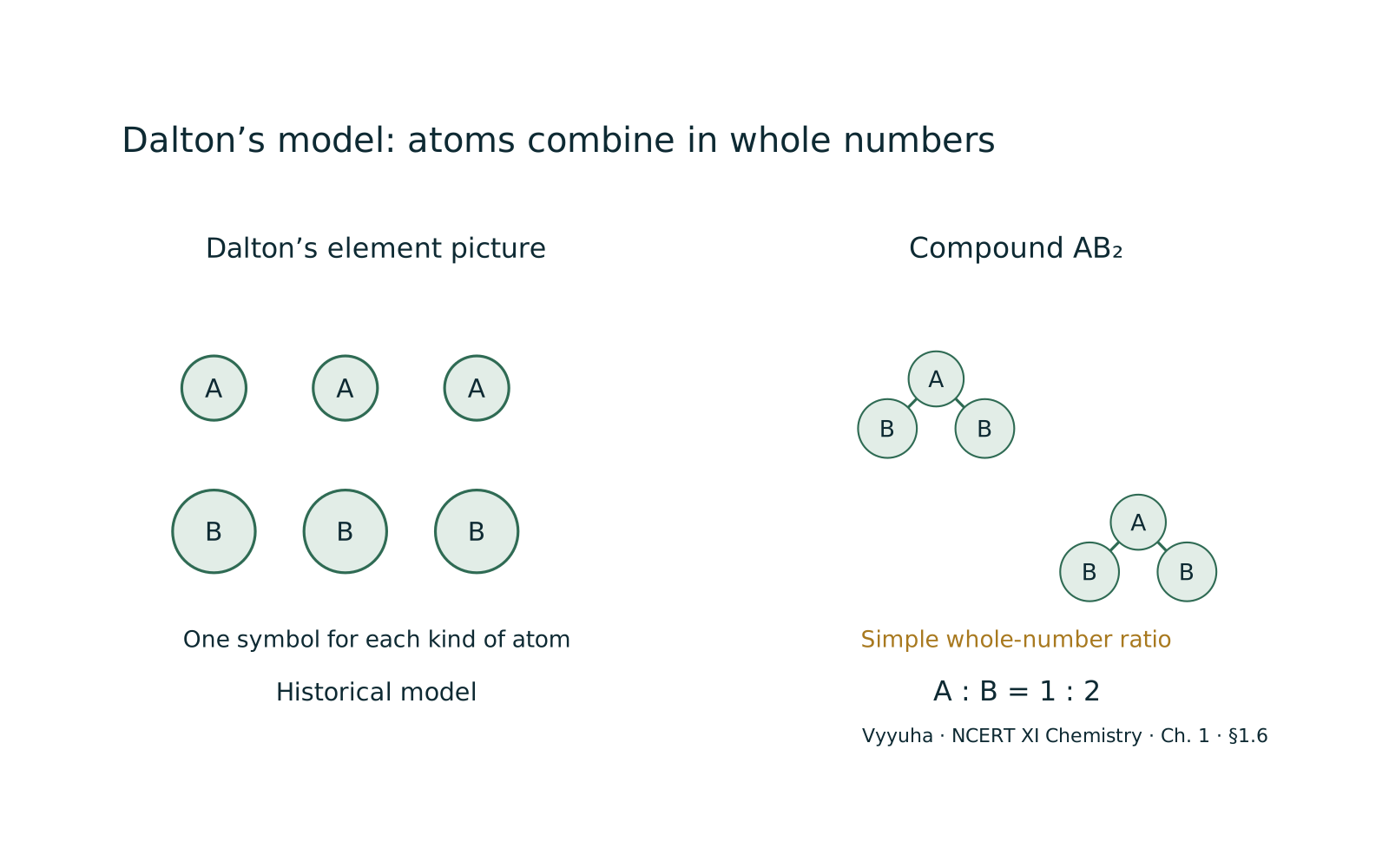
- Atoms of different elements combine in simple whole-number ratios to form chemical compounds.
* This is perhaps one of the most powerful postulates, as it explains the Law of Definite Proportions and the Law of Multiple Proportions. When elements combine to form a compound, their atoms join together in fixed, small integer ratios (e.
g., 1:1, 1:2, 2:3). This means that a specific compound always has the same elemental composition by number of atoms, and consequently, by mass. For example, water () always consists of two hydrogen atoms for every one oxygen atom, leading to a fixed mass ratio of hydrogen to oxygen.
Explanation of Laws of Chemical Combination
Dalton's theory provided a robust atomic-level explanation for the empirical laws:
- Law of Conservation of Mass: — Postulate 4 directly supports this. Since atoms are neither created nor destroyed, and their masses remain constant, the total mass of reactants must equal the total mass of products in any chemical reaction.
- Law of Definite Proportions: — Postulate 5 explains this. A compound is formed by the combination of atoms of different elements in fixed, simple whole-number ratios. Since each type of atom has a characteristic mass (Postulate 2 & 3), the mass ratio of elements in a given compound will always be constant.
- Law of Multiple Proportions: — This law states that when two elements combine to form more than one compound, the masses of one element that combine with a fixed mass of the other element are in simple whole-number ratios. Dalton's theory explains this beautifully. Consider carbon and oxygen forming carbon monoxide (CO) and carbon dioxide (). In CO, one carbon atom combines with one oxygen atom. In , one carbon atom combines with two oxygen atoms. If we fix the mass of carbon (one carbon atom), the masses of oxygen combining with it are in the ratio of 1:2 (one oxygen atom vs. two oxygen atoms), which is a simple whole-number ratio.
Limitations of Dalton's Atomic Theory
Despite its groundbreaking nature, subsequent scientific discoveries revealed several limitations in Dalton's original postulates:
- Atoms are not indivisible: — The discovery of subatomic particles (electrons by J.J. Thomson, protons by Rutherford, and neutrons by Chadwick) proved that atoms are indeed divisible and are composed of smaller particles. This directly contradicted Dalton's first postulate.
- Atoms of the same element are not always identical: — The discovery of isotopes showed that atoms of the same element can have different masses due to varying numbers of neutrons (e.g., Carbon-12 and Carbon-14). While they have the same number of protons and thus the same chemical properties, their masses differ, contradicting Dalton's second postulate.
- Atoms of different elements can be identical in mass: — The discovery of isobars demonstrated that atoms of different elements can have the same mass number (e.g., Argon-40 and Calcium-40). This contradicts Dalton's third postulate that atoms of different elements differ in all respects, including mass.
- Simple whole-number ratios are not always observed: — While many compounds follow simple ratios, complex organic molecules and polymers often involve very large and non-simple integer ratios. Furthermore, non-stoichiometric compounds exist where elemental ratios are not simple integers (e.g., ).
- Atoms can be created or destroyed (in nuclear reactions): — While true for chemical reactions, nuclear reactions (like fission and fusion) involve the transformation of one element into another, changing the identity of atoms and converting mass into energy, thus 'destroying' or 'creating' atoms in a sense that Dalton did not foresee.
Significance and Modern Perspective
Despite its limitations, Dalton's Atomic Theory remains a cornerstone of chemistry. It provided the essential conceptual framework that allowed chemistry to develop as a quantitative science. It introduced the idea of atoms as discrete entities with specific properties, paving the way for the periodic table, understanding chemical bonding, and the development of modern atomic theory.
Modern atomic theory has refined Dalton's ideas, incorporating quantum mechanics, subatomic particles, and nuclear physics, but the fundamental concept of elements being composed of unique atoms that combine in definite ratios persists as a core principle.
Often confused with
Side-by-side differences the NEET paper likes to test.
| Aspect | Dalton's Atomic Theory | Modern Atomic Theory |
|---|---|---|
| Divisibility of Atoms | Atoms are indivisible and indestructible. | Atoms are divisible into subatomic particles (protons, neutrons, electrons). |
| Identity of Atoms of Same Element | All atoms of a given element are identical in mass and properties. | Atoms of the same element can have different masses (isotopes) due to varying numbers of neutrons. |
| Identity of Atoms of Different Elements | Atoms of different elements differ in all respects, including mass. | Atoms of different elements can have the same mass (isobars) but differ in atomic number and chemical properties. |
| Conservation in Reactions | Atoms are conserved (neither created nor destroyed) in all processes. | Atoms are conserved in chemical reactions but can be transformed or destroyed in nuclear reactions (e.g., fission, fusion). |
| Nature of Atoms | Atoms are solid, hard spheres (like billiard balls). | Atoms have a complex internal structure with a dense nucleus and electron cloud, governed by quantum mechanics. |
Dalton's Atomic Theory, while revolutionary, presented a simplified view of atoms as indivisible, identical spheres for a given element. Modern Atomic Theory, built upon discoveries of subatomic particles, isotopes, and quantum mechanics, reveals atoms to be complex, divisible entities with internal structure.
It acknowledges that atoms of the same element can vary in mass (isotopes) and that atoms can be interconverted in nuclear processes, fundamentally refining Dalton's original postulates while retaining his core idea of elements being composed of unique atoms.
Why it is tested: For NEET, understanding the differences between Dalton's theory and modern atomic theory is crucial for conceptual clarity. Questions often test the limitations of Dalton's theory and how later discoveries (like isotopes or subatomic particles) challenged its postulates. This comparison helps students appreciate the evolution of scientific thought and the refinement of models based on new experimental evidence, which is a common theme in chemistry.
Questions students ask
6 answered on this topic.
What was the primary motivation behind Dalton's Atomic Theory?
Dalton's primary motivation was to provide a scientific explanation for the empirically observed Laws of Chemical Combination, specifically the Law of Conservation of Mass and the Law of Definite Proportions.
These laws described how matter behaves during chemical changes and how compounds are formed with fixed compositions. Dalton sought to explain these macroscopic observations by proposing a microscopic model of matter composed of atoms, whose properties and interactions would logically lead to these laws.
How did Dalton's theory explain the Law of Conservation of Mass?
Dalton's theory explained the Law of Conservation of Mass through its fourth postulate, which states that atoms cannot be created, destroyed, or subdivided in a chemical reaction. According to this, chemical reactions are simply rearrangements of existing atoms.
Since the number and type of atoms remain constant throughout the reaction, and each atom has a fixed mass, the total mass of the reactants must equal the total mass of the products. No mass is gained or lost because no atoms are gained or lost.
Which postulates of Dalton's theory were later proven incorrect, and why?
Two main postulates were later proven incorrect. Firstly, the postulate that atoms are indivisible was disproven by the discovery of subatomic particles (electrons, protons, neutrons). Secondly, the postulate that all atoms of a given element are identical in all respects (especially mass) was disproven by the discovery of isotopes, which are atoms of the same element with different numbers of neutrons and thus different masses.
How does Dalton's theory relate to the Law of Definite Proportions?
Dalton's fifth postulate directly explains the Law of Definite Proportions. It states that atoms of different elements combine in simple, whole-number ratios to form chemical compounds. Since each type of atom has a characteristic mass, this fixed numerical ratio of atoms translates into a fixed mass ratio of elements within any given compound. For example, in water (), two hydrogen atoms always combine with one oxygen atom, leading to a constant mass ratio of hydrogen to oxygen.
What is the significance of Dalton's Atomic Theory in the development of chemistry?
Dalton's Atomic Theory was profoundly significant because it provided the first quantitative and testable atomic model of matter. It moved chemistry beyond qualitative observations and philosophical ideas, establishing a foundational framework for understanding chemical reactions and the composition of substances. It paved the way for the concept of atomic weight, the periodic table, and ultimately, modern atomic theory, making it a cornerstone upon which much of modern chemistry is built.
Can Dalton's theory explain nuclear reactions?
No, Dalton's Atomic Theory cannot explain nuclear reactions. His theory explicitly states that atoms cannot be created, destroyed, or subdivided in a chemical reaction. Nuclear reactions, however, involve changes within the nucleus of an atom, leading to the transformation of one element into another (e.g., radioactive decay, nuclear fission, nuclear fusion). These processes involve the 'creation' or 'destruction' of atoms in a way that fundamentally contradicts Dalton's postulates.