The Living World — Explained
Detailed Explanation
The 'Living World' chapter lays the groundwork for the entire discipline of biology by addressing the fundamental question: What constitutes life? It delves into the unique attributes that differentiate living organisms from inanimate objects and introduces the systematic approach to studying the immense diversity of life on Earth.
Conceptual Foundation: What is Living?
Life, in its essence, is a complex organization of molecules exhibiting certain emergent properties. While there's no single, simple definition, a set of characteristics collectively defines a living organism:
- Growth: — This refers to an increase in mass and an increase in the number of individuals. In multicellular organisms, growth occurs by cell division. In plants, growth is continuous throughout their lifespan, while in animals, it is limited to a certain age. Unicellular organisms also grow by cell division. While growth is a characteristic of living organisms, it's not a defining property because non-living objects (like mountains, sand dunes, crystals) can also grow by the accumulation of material on their surface. However, growth in living organisms is intrinsic (from within), whereas in non-living objects, it is extrinsic (from outside).
- Reproduction: — This is the process by which living organisms produce offspring of their own kind. Reproduction ensures the continuation of a species. It can be asexual (e.g., budding in yeast, fragmentation in Spirogyra) or sexual (involving two parents). Like growth, reproduction is not a defining characteristic because some living organisms, such as mules, sterile worker bees, and infertile human couples, do not reproduce. Yet, they are undeniably living.
- Metabolism: — This is the sum total of all chemical reactions occurring within a living organism. These reactions involve both anabolism (constructive processes, e.g., photosynthesis) and catabolism (destructive processes, e.g., respiration). Metabolism is a defining characteristic of all living organisms without exception. No non-living object exhibits metabolism. Metabolic reactions can be demonstrated in vitro (outside the body in a test tube), but these isolated reactions are not considered living things themselves; rather, they are living reactions.
- Cellular Organization: — All living organisms are composed of one or more cells. The cell is the fundamental structural and functional unit of life. From the simplest bacteria to the most complex mammals, life begins at the cellular level. This is a defining characteristic, as no non-living entity possesses cellular organization.
- Consciousness: — This is the ability of an organism to sense its surroundings or environment and respond to these environmental stimuli. Stimuli can be physical, chemical, or biological. All organisms, from prokaryotes to complex eukaryotes, exhibit consciousness. Humans, uniquely, possess self-consciousness (awareness of oneself). Consciousness is considered a defining property of living organisms.
Key Principles: Diversity in the Living World
Our planet harbors an astonishing array of life forms, collectively known as biodiversity. The estimated number of species described ranges from 1.7 to 1.8 million, but many more are yet to be discovered. To study this vast diversity effectively, a standardized system of naming and classification is essential.
- Nomenclature: — The process of naming living organisms. Common names vary from region to region and language to language, leading to confusion. Therefore, a universal system is needed.
- Binomial Nomenclature: — Proposed by Carolus Linnaeus, this system provides a scientific name for every organism, consisting of two parts: the generic name (genus) and the specific epithet (species). For example, the scientific name for humans is Homo sapiens.
* Universal Rules of Nomenclature (ICBN for plants, ICZN for animals): Biological names are generally in Latin and written in italics. When handwritten, they are underlined separately. The first word represents the genus, and the second word denotes the specific epithet.
The generic name starts with a capital letter, while the specific epithet starts with a small letter. The name of the author (discoverer) appears after the specific epithet in an abbreviated form (e.
g., Mangifera indica Linn.).
Taxonomy and Systematics
- Taxonomy: — The scientific study of classifying organisms based on their characteristics. It involves four fundamental processes: characterization (understanding features), identification (recognizing the organism), classification (grouping into categories), and nomenclature (naming).
- Systematics: — A broader field than taxonomy, systematics deals with the classification of organisms based on their evolutionary relationships (phylogeny) along with their morphological, anatomical, and other characteristics. The term 'systematics' was coined by Linnaeus.
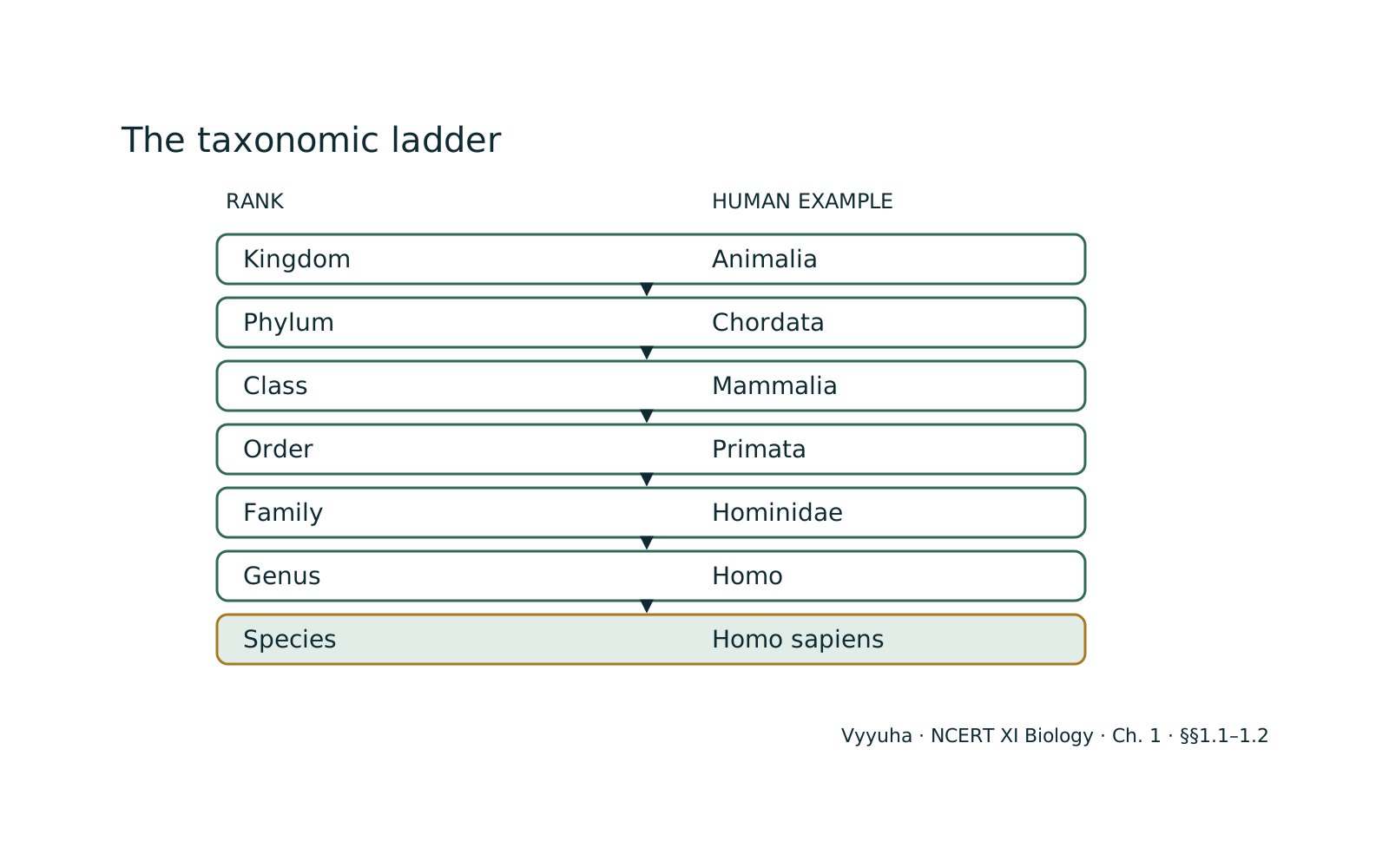
- Taxonomic Categories (Hierarchical Classification): — Organisms are classified into a hierarchy of categories, each representing a rank or taxon. This hierarchy moves from broader to more specific categories:
1. Kingdom: The highest category (e.g., Animalia, Plantae). 2. Phylum (for animals) / Division (for plants): A group of related classes (e.g., Chordata, Angiospermae). 3. Class: A group of related orders (e.
g., Mammalia, Dicotyledonae). 4. Order: A group of related families (e.g., Primata, Sapindales). 5. Family: A group of related genera (e.g., Hominidae, Anacardiaceae). 6. Genus: A group of related species (e.
g., Homo, Mangifera). 7. Species: The lowest obligate category, representing a group of individuals that can interbreed naturally to produce fertile offspring (e.g., sapiens, indica). As we move from species to kingdom, the number of common characteristics decreases, and the complexity of classification increases.
Taxonomical Aids
These are tools and techniques used to identify, classify, and study organisms. They are crucial for agricultural, forestry, industrial, and biodiversity research.
- Herbarium: — A storehouse of collected plant specimens that are dried, pressed, and preserved on sheets. These sheets are arranged according to a universally accepted system of classification. They provide quick reference systems for taxonomic studies.
- Botanical Gardens: — Specialized gardens that have collections of living plants for reference. Plants are grown for identification purposes, and each plant is labeled with its botanical/scientific name and its family.
- Museums: — Biological museums are generally set up in educational institutes (schools and colleges). They have collections of preserved plant and animal specimens for study and reference. Specimens are preserved in preservative solutions in jars or containers. Insects are preserved in insect boxes after collecting, killing, and pinning. Larger animals are usually stuffed and preserved.
- Zoological Parks (Zoos): — Places where wild animals are kept in protected environments under human care, allowing us to learn about their food habits and behavior. They provide conditions similar to their natural habitats.
- Key: — A taxonomical aid used for the identification of plants and animals based on similarities and dissimilarities. Keys are based on contrasting characters generally in a pair called a couplet. Each statement in the key is called a lead. Separate taxonomic keys are required for each taxonomic category (family, genus, species) for identification purposes. Keys are generally analytical in nature.
- Flora, Manuals, Monographs, and Catalogues:
* Flora: Contains the actual account of habitat and distribution of plants of a given area. They provide an index to the plant species found in a particular area. * Manuals: Provide information for identification of names of species found in a particular area. * Monographs: Contain comprehensive information on any one taxon. * Catalogues: Lists of species with brief descriptions.
Common Misconceptions & NEET-specific Angle:
NEET questions often test the understanding of 'defining' vs. 'non-defining' characteristics of life. Students frequently confuse growth and reproduction as defining features. Remember, metabolism, cellular organization, and consciousness are the true defining properties.
Another common area is the rules of binomial nomenclature and the correct sequence of taxonomic hierarchy. Memorizing examples for each taxonomic category (e.g., genus Panthera includes leo and tigris) and the specific functions of different taxonomic aids is crucial.
Questions on taxonomic keys, especially the terms 'couplet' and 'lead,' are also common. The chapter emphasizes the importance of systematic study of life, which forms the basis for understanding ecology, evolution, and even human health.
Often confused with
Side-by-side differences the NEET paper likes to test.
| Aspect | The Living World | Defining vs. Non-defining Characteristics of Life |
|---|---|---|
| Criterion | Defining Characteristic | Non-defining Characteristic |
| Universality | Present in ALL living organisms without exception, and absent in non-living entities. | May be present in some living organisms but not all, or may also be present in non-living entities. |
| Examples | Metabolism, Cellular Organization, Consciousness. | Growth, Reproduction. |
| Reason for exclusion (if applicable) | No exceptions or parallels in non-living world. | Growth can be extrinsic in non-living objects (e.g., mountains). Reproduction is not universal to all living individuals (e.g., sterile mules). |
The distinction between defining and non-defining characteristics is crucial for a precise understanding of life. Defining characteristics, such as metabolism, cellular organization, and consciousness, are universally present in all living organisms and are never found in non-living entities.
They represent the absolute criteria for life. In contrast, non-defining characteristics like growth and reproduction, while typical of living organisms, have exceptions. Growth can occur extrinsically in non-living things, and some living organisms are sterile.
This nuance is frequently tested in NEET to assess conceptual clarity.
Why it is tested: NEET relevance: High. This distinction is a core conceptual point frequently tested in MCQs to check a student's fundamental understanding of what constitutes life. Misconceptions here can lead to incorrect answers.
| Aspect | The Living World | Taxonomy vs. Systematics |
|---|---|---|
| Scope | Taxonomy: Deals with identification, nomenclature, and classification of organisms. | Systematics: Broader; includes taxonomy, but also studies evolutionary relationships among organisms. |
| Focus | Primarily focuses on grouping organisms based on observable characteristics. | Focuses on understanding the diversity of life in an evolutionary context (phylogeny). |
| Historical Context | Older concept, foundational for classification. | More modern concept, emerged with a deeper understanding of evolution. |
| Goal | To organize and name organisms. | To understand the evolutionary history and relationships that led to current biodiversity. |
While often used interchangeably, taxonomy and systematics have distinct scopes. Taxonomy is the fundamental science of classifying organisms, involving their characterization, identification, nomenclature, and grouping.
Systematics, on the other hand, is a more comprehensive field that encompasses taxonomy but extends its focus to include the evolutionary history and relationships (phylogeny) among different organisms.
Systematics seeks to understand the 'why' behind the classification, linking diversity to evolutionary processes, making it a broader and more dynamic discipline.
Why it is tested: NEET relevance: Medium to High. Questions might ask for direct definitions or subtle differences between the two terms, testing a student's grasp of the nuances in biological classification.
Questions students ask
6 answered on this topic.
Why is growth not considered a defining characteristic of living organisms?
While growth, defined as an increase in mass and number of individuals, is a prominent feature of living organisms, it is not considered a defining characteristic because it can also occur in non-living objects.
For example, mountains grow by the accumulation of material on their surface, and crystals increase in size. The key difference is that growth in living organisms is intrinsic (from within, due to cell division or increase in protoplasm), whereas in non-living objects, it is extrinsic (by external accretion).
Since a characteristic must be universally present in all living things and absent in all non-living things to be 'defining,' growth falls short due to its extrinsic manifestation in non-living entities.
What is the primary difference between taxonomy and systematics?
Taxonomy is the science of classifying organisms based on their characteristics, involving identification, nomenclature, and classification. It primarily focuses on grouping organisms. Systematics, on the other hand, is a broader field that not only includes taxonomy but also considers the evolutionary relationships (phylogeny) among organisms.
Systematics aims to understand the diversity of life in an evolutionary context, studying how different species are related through common ancestry. So, while taxonomy is about 'how to classify,' systematics is about 'how to classify and why they are related in that way.
Explain the significance of binomial nomenclature.
Binomial nomenclature is a universally accepted system of naming organisms using two parts: a generic name (genus) and a specific epithet (species). Its significance lies in providing a unique and unambiguous name for every organism across the globe.
This eliminates confusion caused by regional common names, which can vary widely or refer to multiple different species. A standardized scientific name ensures that scientists worldwide can communicate precisely about a particular organism, facilitating research, conservation efforts, and the exchange of biological information without linguistic or regional barriers.
What are the universal rules for writing scientific names?
The universal rules for writing scientific names, governed by bodies like ICBN (International Code of Botanical Nomenclature) and ICZN (International Code of Zoological Nomenclature), are: 1) Biological names are generally in Latin and written in italics when typed, or underlined separately when handwritten.
2) The first word in the name represents the genus, starting with a capital letter. 3) The second word is the specific epithet, starting with a small letter. 4) The name of the author (who first described the species) is written in an abbreviated form after the specific epithet, without being italicized or underlined (e.
g., Mangifera indica Linn.). These rules ensure consistency and clarity in scientific communication.
How does a taxonomic key help in identification of organisms?
A taxonomic key is an analytical tool used for the identification of organisms based on their similarities and dissimilarities. It operates on the principle of contrasting characters, typically presented in pairs called a 'couplet.
' Each statement within a couplet is referred to as a 'lead.' By choosing between the two contrasting statements in a couplet, the user is led to another couplet or directly to the identification of the organism.
This systematic process of elimination and selection allows for precise identification, making keys invaluable for field biologists, researchers, and students in distinguishing between different species, genera, or other taxonomic categories.
Why is cellular organization considered a defining characteristic of life?
Cellular organization is universally recognized as a defining characteristic of life because all known living organisms, without exception, are composed of one or more cells. The cell is the fundamental structural and functional unit of life, capable of carrying out all essential life processes.
Non-living entities, regardless of their complexity, do not exhibit this level of organized cellular structure. The presence of a cell, with its membrane-bound organelles and genetic material, is a prerequisite for metabolism, growth, reproduction, and consciousness to occur in a coordinated and self-sustaining manner.
Therefore, cellular organization serves as an absolute criterion for distinguishing living from non-living matter.