Inflorescence — Explained
Detailed Explanation
The term 'inflorescence' refers to the arrangement of flowers on the floral axis, or peduncle, of a plant. This arrangement is a critical morphological feature, influencing pollination efficiency, seed dispersal, and ultimately, reproductive success. The study of inflorescence patterns is fundamental to plant taxonomy and evolutionary biology.
Conceptual Foundation:
An inflorescence is essentially a modified shoot where the leaves are transformed into bracts (small, leaf-like structures at the base of a flower or flower cluster). The main stalk supporting the entire inflorescence is called the peduncle.
If individual flowers have their own stalks, these are called pedicels. Flowers without pedicels are sessile. The arrangement is not random but follows specific developmental patterns, primarily categorized into two major types: Racemose and Cymose, along with some special types.
Key Principles/Laws:
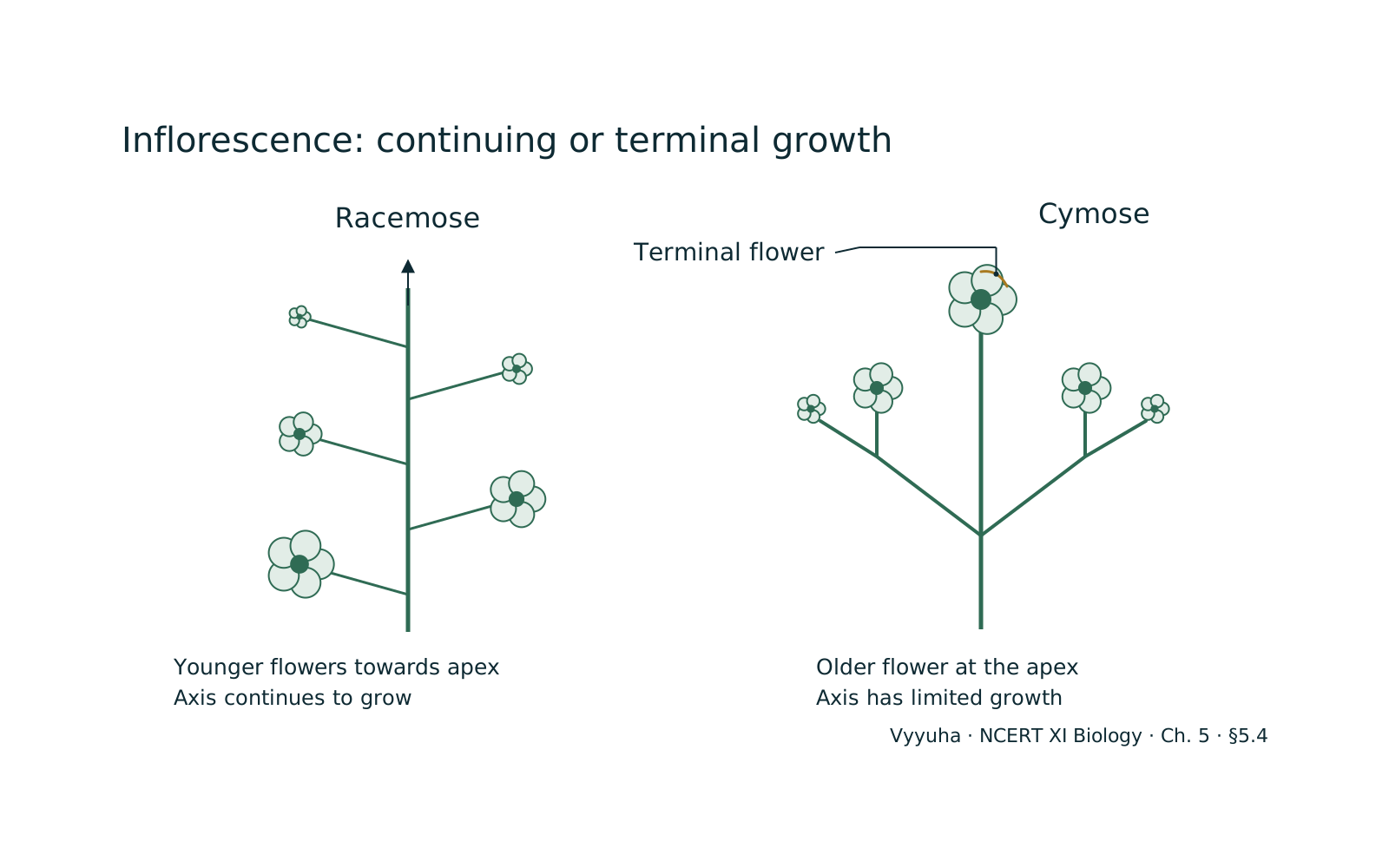
- Growth Pattern of Main Axis: — This is the primary distinguishing feature. In racemose inflorescences, the main axis has indefinite growth, meaning it continues to elongate and produce new flowers. In cymose inflorescences, the main axis has definite growth, terminating in a flower, which limits its further elongation.
- Succession of Flowers: — This refers to the order in which flowers mature and open.
* Acropetal Succession: Found in racemose types, where the youngest flowers are at the apex (tip) and the oldest flowers are at the base. Flowers open from base to apex. * Basipetal Succession: Characteristic of cymose types, where the oldest flower is at the apex (terminal flower), and younger flowers develop laterally below it.
Flowers open from apex to base. * Centripetal Succession: In some flattened inflorescences like capitulum (racemose), flowers open from the periphery towards the center. * Centrifugal Succession: In some flattened inflorescences like dichasial cyme (cymose), flowers open from the center towards the periphery.
Real-world Applications:
- Agriculture and Horticulture: — Understanding inflorescence types helps in plant breeding programs. For instance, knowing the flowering pattern can aid in optimizing pollination for crop yield (e.g., sunflower, maize). In ornamental plants, the inflorescence's aesthetic appeal is paramount (e.g., orchids, gladioli).
- Plant Identification and Taxonomy: — Inflorescence characteristics are crucial diagnostic features for classifying plant species. Botanists often rely on these patterns to distinguish between closely related plants.
- Ecological Studies: — The structure of an inflorescence influences its interaction with pollinators. For example, a dense cluster of small flowers (like in a capitulum) can act as a single large 'display unit' to attract generalist pollinators, while specialized inflorescences might target specific pollinators.
Common Misconceptions:
- Confusing a single flower with an inflorescence: — A common mistake is to consider any cluster of flowers as an inflorescence. An inflorescence is a system of flowers, not just a group. For example, a single rose is a flower, but the entire flowering stalk of a sunflower is an inflorescence (capitulum).
- Misidentifying Racemose vs. Cymose: — Students often confuse acropetal and basipetal succession or the indefinite vs. definite growth of the main axis. Remembering that 'racemose' implies 'race' or continuous growth, while 'cymose' implies 'culminating' or stopping, can be helpful.
- Ignoring Bracts and Bracteoles: — These small structures are often overlooked but are important diagnostic features for specific inflorescence types.
NEET-specific Angle:
For NEET, the focus is heavily on identifying the different types of inflorescences and associating them with specific plant examples. Memorizing the key characteristics (growth pattern, succession, presence/absence of pedicel, bracts) and classic examples for each type is crucial. Questions often involve matching columns, identifying the type from a description, or providing examples.
Types of Inflorescence:
I. Racemose Inflorescence (Indefinite or Indeterminate Inflorescence):
In this type, the main axis (peduncle) continues to grow indefinitely and does not terminate in a flower. Flowers are borne laterally in an acropetal succession, meaning the younger flowers are towards the apex and the older ones are towards the base. The inflorescence can be simple (unbranched peduncle) or compound (branched peduncle).
A. Simple Racemose:
- Raceme: — Peduncle is unbranched, bearing pedicellate (stalked) flowers in acropetal succession. Examples: Mustard (Brassica campestris), Radish (Raphanus sativus), Gulmohar (Delonix regia).
- Spike: — Similar to raceme, but flowers are sessile (without stalks). Examples: Achyranthes, Amaranthus, Bottle Brush (Callistemon).
- Spadix: — A type of spike with a fleshy peduncle, covered by one or more large, often brightly colored bracts called spathes. Examples: Maize (Zea mays - female inflorescence), Colocasia, Arum, Banana (Musa paradisiaca).
- Catkin: — A pendulous (hanging), spike-like inflorescence, typically unisexual, with sessile flowers. It usually falls off as a whole. Examples: Mulberry (Morus alba), Oak (Quercus), Birch (Betula).
- Corymb: — The main axis is short, and lower flowers have longer pedicels than upper ones, bringing all flowers to roughly the same level. Examples: Candytuft (Iberis amara), Cauliflower (Brassica oleracea var. botrytis).
- Umbel: — The peduncle is short, and all pedicellate flowers arise from a single point at the apex of the peduncle, forming a cluster. Often subtended by an involucre of bracts. Examples: Coriander (Coriandrum sativum), Cumin (Cuminum cyminum), Carrot (Daucus carota).
- Capitulum (Head): — The main axis is flattened into a receptacle, bearing numerous small, sessile flowers (florets) in centripetal succession. The entire inflorescence is surrounded by an involucre of bracts. Examples: Sunflower (Helianthus annuus), Marigold (Tagetes), Zinnia.
B. Compound Racemose (Panicle):
When the main axis of a raceme is branched, and each branch bears flowers in a racemose manner. Essentially, it's a raceme of racemes. Examples: Rice (Oryza sativa), Wheat (Triticum aestivum), Grape (Vitis vinifera).
II. Cymose Inflorescence (Definite or Determinate Inflorescence):
In this type, the main axis terminates in a flower, thus limiting its growth. Subsequent flowers develop from lateral branches below the terminal flower. Flowers are arranged in basipetal succession (oldest at apex, youngest at base) and often open centrifugally.
- Monochasial Cyme (Uniparous Cyme): — The main axis ends in a flower, and only one lateral branch arises below it, which also ends in a flower, and so on. It can be of two types:
* Helicoid Cyme: Lateral branches develop on only one side, forming a coil. Examples: Heliotropium, Hamelia, Drosera. * Scorpioid Cyme: Lateral branches develop alternately on opposite sides, forming a zigzag pattern. Examples: Cotton (Gossypium), Ranunculus, Freesia.
- Dichasial Cyme (Biparous Cyme): — The main axis ends in a flower, and two lateral branches arise below it, each terminating in a flower. This pattern can repeat. Examples: Jasmine (Jasminum), Bougainvillea, Dianthus.
- Polychasial Cyme (Multiparous Cyme): — The main axis ends in a flower, and more than two lateral branches arise below it, each terminating in a flower. Examples: Calotropis, Euphorbia.
III. Special Types of Inflorescence:
These are modified forms that do not strictly fit into racemose or cymose categories, or exhibit characteristics of both.
- Cyathium: — Highly reduced inflorescence, characteristic of the genus Euphorbia. It consists of a cup-shaped involucre formed by fused bracts, enclosing a single female flower (reduced to a pistil) in the center, surrounded by numerous male flowers (reduced to a single stamen). Nectar glands are often present on the rim of the involucre. Examples: Euphorbia species (e.g., Poinsettia, Crown of Thorns).
- Verticillaster: — A characteristic inflorescence of the Lamiaceae (mint) family. It consists of two axillary dichasial cymes on opposite sides of the stem, which are condensed and appear as a whorl of flowers in the axil of leaves. Examples: Ocimum (Tulsi), Salvia, Leucas.
- Hypanthodium: — The receptacle becomes fleshy and forms a hollow, pear-shaped structure with a small opening (ostiole) at the apex. The inner surface of this cavity bears numerous small, sessile, unisexual flowers (male, female, and sterile female flowers). Examples: Fig (Ficus species - e.g., Banyan, Peepal, Gular).
Understanding these diverse arrangements is key to appreciating the complexity and adaptive strategies in the plant kingdom, a crucial aspect for NEET aspirants.
Often confused with
Side-by-side differences the NEET paper likes to test.
| Aspect | Inflorescence | Cymose Inflorescence |
|---|---|---|
| Growth of Main Axis | Indefinite; continues to grow and produce flowers. | Definite; terminates in a flower, limiting further growth. |
| Arrangement of Flowers | Laterally borne on the main axis. | Terminal flower on main axis, subsequent flowers on lateral branches. |
| Succession of Flowers | Acropetal (youngest at apex, oldest at base). | Basipetal (oldest at apex, youngest at base). |
| Opening of Flowers | Centripetal (from periphery to center) or from base to apex. | Centrifugal (from center to periphery) or from apex to base. |
| Number of Flowers | Potentially numerous, as growth is indeterminate. | Usually fewer, as growth is determinate. |
| Examples | Mustard, Radish, Sunflower, Wheat, Rice. | Jasmine, Dianthus, Cotton, Calotropis, Bougainvillea. |
Racemose and Cymose inflorescences represent two fundamental strategies for floral arrangement in plants, primarily distinguished by the growth pattern of their main axis and the developmental sequence of their flowers.
Racemose types exhibit continuous growth of the main axis and acropetal flower succession, leading to potentially many flowers over time. In contrast, Cymose types have a main axis that terminates in a flower, resulting in basipetal succession and typically a more limited number of flowers on any given axis.
These differences reflect distinct evolutionary adaptations for pollination and resource allocation.
Why it is tested: For NEET, understanding these distinctions is paramount. Questions frequently test the ability to differentiate between these two major types based on their growth patterns, flower succession, and characteristic examples. Memorizing the key features and associated plant examples for each category is a high-yield strategy for the exam.
Questions students ask
6 answered on this topic.
What is the primary difference between racemose and cymose inflorescences?
The primary difference lies in the growth pattern of the main floral axis and the succession of flowers. In racemose inflorescences, the main axis grows indefinitely, and flowers are borne laterally in an acropetal succession (youngest at apex, oldest at base). In contrast, in cymose inflorescences, the main axis terminates in a flower, limiting its growth, and subsequent flowers develop from lateral branches in a basipetal succession (oldest at apex, youngest at base).
Why is the arrangement of flowers in an inflorescence important for a plant?
The arrangement of flowers is crucial for optimizing reproductive success. It influences the visibility of flowers to pollinators, facilitates efficient pollen transfer, and can prolong the flowering period. A well-organized inflorescence can act as a larger, more attractive display unit, guiding pollinators to multiple flowers, thereby increasing the chances of successful pollination and subsequent seed production.
Can you explain what acropetal and basipetal succession mean in the context of inflorescence?
Acropetal succession means that the youngest flowers are located at the apex (tip) of the inflorescence axis, while the oldest flowers are at the base. This pattern is characteristic of racemose inflorescences. Basipetal succession, on the other hand, means the oldest flower is at the apex (terminating the main axis), and the younger flowers develop below it, often on lateral branches. This is typical of cymose inflorescences.
What are bracts and bracteoles, and why are they relevant to inflorescence?
Bracts are modified, often leaf-like structures found at the base of the peduncle or individual flowers within an inflorescence. Bracteoles are smaller, secondary bracts found on the pedicel of a flower. They are relevant because their presence, absence, size, and arrangement are important diagnostic features for identifying different types of inflorescences and plant families. For example, the spathe in a spadix is a large, specialized bract.
Give examples of plants exhibiting special types of inflorescence.
Special types of inflorescence show unique modifications. Cyathium is found in Euphorbia species, such as Poinsettia. Verticillaster is characteristic of the mint family, exemplified by Ocimum (Tulsi) and Salvia. Hypanthodium is a distinctive inflorescence found in Ficus species, including the Fig, Banyan, and Peepal trees. These types often involve highly reduced flowers and specialized structures for pollination.
What is the difference between a simple and a compound inflorescence?
A simple inflorescence has an unbranched main floral axis (peduncle) that directly bears the flowers or flower clusters. Examples include a simple raceme or spike. A compound inflorescence, also known as a panicle in the racemose category, has a branched main axis, where each branch itself bears a smaller inflorescence unit. Essentially, it's an inflorescence of inflorescences, like a raceme of racemes, as seen in rice or wheat.