Percentage Composition — Explained
Detailed Explanation
The concept of percentage composition is a cornerstone of quantitative chemistry, providing a precise way to describe the elemental makeup of a chemical compound. It quantifies the mass contribution of each element within a compound relative to the compound's total mass, expressed as a percentage. This seemingly simple calculation underpins much of stoichiometry and analytical chemistry.
Conceptual Foundation
At its heart, percentage composition is a direct consequence of the Law of Definite Proportions (also known as Proust's Law), which states that a given chemical compound always contains its component elements in fixed ratios by mass, irrespective of its source or method of preparation.
For example, carbon dioxide () will always have a carbon-to-oxygen mass ratio of approximately 12.01:32.00 (or 3:8), meaning it will always be composed of about 27.29% carbon and 72.71% oxygen by mass.
This constancy allows us to characterize and identify compounds based on their elemental proportions.
Key Principles and Laws
- Law of Definite Proportions — As mentioned, this law is the bedrock. It ensures that the percentage composition for a pure compound is a unique and constant characteristic.
- Atomic Masses — The calculation relies on the accurate atomic masses of elements, typically found on the periodic table. These masses represent the average mass of an atom of that element, taking into account isotopes.
- Molar Mass — For a compound, the molar mass is the sum of the atomic masses of all atoms in its chemical formula. It represents the mass of one mole of the compound and is crucial for calculating the total mass of the compound in the percentage composition formula.
Derivations and Calculation
To calculate the percentage composition of an element in a compound, we use the following formula:
Let's illustrate with an example: Calculate the percentage composition of glucose ().
Step 1: Determine the molar mass of the compound.
Atomic masses: C = 12.01 g/mol, H = 1.008 g/mol, O = 16.00 g/mol. Molar mass of : g/mol g/mol g/mol
Step 2: Calculate the total mass of each element in one mole of the compound.
Mass of Carbon (C) = g Mass of Hydrogen (H) = g Mass of Oxygen (O) = g
Step 3: Apply the percentage composition formula for each element.
Percentage of Carbon = Percentage of Hydrogen = Percentage of Oxygen =
(Note: The sum of percentages should ideally be 100% or very close to it due to rounding.)
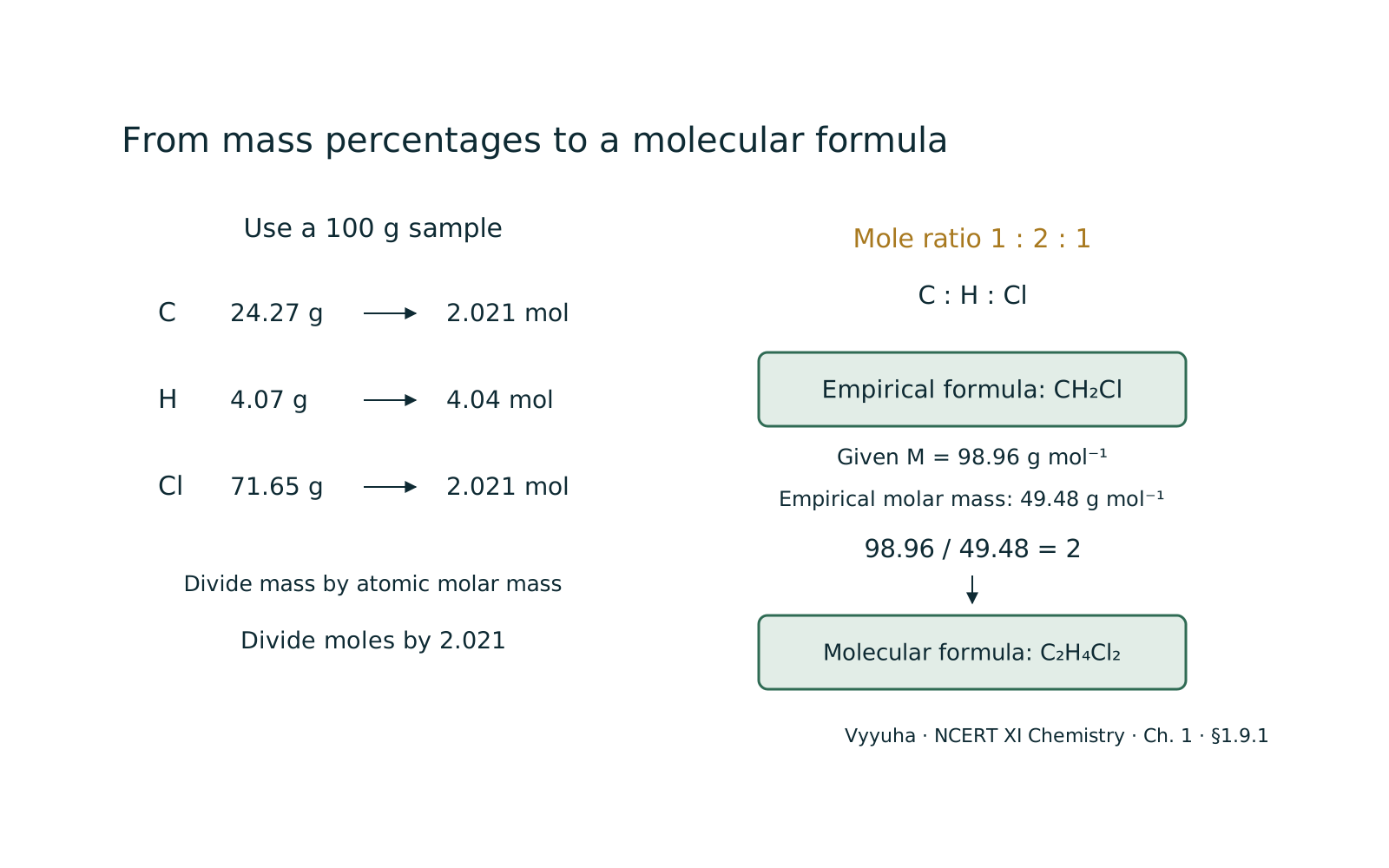
Reverse Application: Determining Empirical and Molecular Formulas
Percentage composition is not just for calculating elemental proportions; it's also a critical piece of information used to determine the empirical and molecular formulas of unknown compounds, especially in experimental chemistry.
Empirical Formula: This is the simplest whole-number ratio of atoms in a compound. If you are given the percentage composition of a compound, you can follow these steps to find its empirical formula:
- Assume 100 g of the compound — This simplifies the percentages directly into masses (e.g., 50% carbon means 50 g of carbon in a 100 g sample).
- Convert mass to moles — Divide the mass of each element by its atomic mass to find the number of moles of each element.
- Find the simplest mole ratio — Divide the number of moles of each element by the smallest number of moles calculated in the previous step. This gives a preliminary mole ratio.
- Convert to whole numbers — If the ratios are not whole numbers, multiply all ratios by the smallest integer that converts them into whole numbers. This gives the subscripts for the empirical formula.
Molecular Formula: This represents the actual number of atoms of each element in a molecule. Once the empirical formula is known, the molecular formula can be determined if the molar mass of the compound is also known. The relationship is:
Real-World Applications
- Quality Control — In industries (pharmaceuticals, food, materials science), percentage composition is used to ensure that products meet specified standards. For example, a fertilizer must contain a certain percentage of nitrogen, phosphorus, and potassium.
- Forensic Chemistry — Analyzing the percentage composition of unknown substances found at crime scenes can help identify them, linking them to suspects or sources.
- Nutritional Analysis — Food labels display the percentage by mass of various nutrients (e.g., protein, fat, carbohydrates) in a serving.
- Geochemistry and Mineralogy — Determining the percentage composition of minerals helps in identifying them and assessing their economic value (e.g., percentage of iron in an iron ore).
- Environmental Monitoring — Analyzing the percentage composition of pollutants in air or water samples helps in understanding pollution sources and impacts.
Common Misconceptions
- Confusing Mass Percentage with Mole Percentage — Percentage composition always refers to mass percentage. Mole percentage (or mole fraction) is a different concept, though related, and is calculated based on the number of moles, not mass.
- Errors in Molar Mass Calculation — A common mistake is incorrectly calculating the molar mass of the compound, leading to errors in all subsequent percentage calculations. Double-checking atomic masses and the number of atoms of each element is crucial.
- Rounding Errors — Premature rounding during intermediate steps can lead to inaccuracies in the final percentages, especially when determining empirical formulas. It's best to carry more decimal places and round only at the final step.
- Not Summing to 100% — If the calculated percentages don't sum up to 100% (or very close to it, considering rounding), it indicates an error in calculation or an element might have been missed.
NEET-Specific Angle
For NEET aspirants, percentage composition is not just a standalone topic but a foundational skill for solving a wide range of problems in 'Some Basic Concepts of Chemistry' and 'Stoichiometry'.
- Empirical and Molecular Formula Problems — These are frequently tested, requiring students to convert between percentage composition, empirical formula, and molecular formula.
- Stoichiometric Calculations — Understanding the mass contribution of elements helps in calculating reactant and product masses in chemical reactions, especially when dealing with impure samples or limiting reagents.
- Conceptual Questions — Questions might test the understanding of the Law of Definite Proportions and its implications for percentage composition.
- Hydrates — Calculating the percentage of water of crystallization in hydrated salts is a common application.
Mastering percentage composition ensures a strong grasp of quantitative chemistry, which is essential for scoring well in the chemistry section of NEET.
Often confused with
Side-by-side differences the NEET paper likes to test.
| Aspect | Percentage Composition | Mole Percentage |
|---|---|---|
| Basis of Calculation | Mass of element / Total mass of compound | Moles of element / Total moles of all elements |
| Unit | Expressed as % by mass | Expressed as % by moles (or mole fraction) |
| Formula | $ \frac{\text{Mass of element}}{\text{Molar mass of compound}} \times 100 $ | $ \frac{\text{Moles of element}}{\text{Total moles of elements}} \times 100 $ |
| Application | Determining empirical formula, quality control, elemental analysis. | Gas mixtures (partial pressures), solution concentrations (mole fraction). |
Percentage composition strictly refers to the mass percentage of each element in a compound, providing a quantitative measure of elemental contribution by mass. It is fundamental for determining empirical formulas and is based on the Law of Definite Proportions.
In contrast, mole percentage (or mole fraction) is based on the number of moles of each component relative to the total moles. While both describe proportions, they are used in different contexts and yield different numerical values for the same compound, making it crucial not to confuse them, especially in NEET problems.
Why it is tested: NEET relevance: Understanding the distinction is vital for accurate problem-solving in stoichiometry, gas laws, and solution chemistry. Confusing mass and mole percentages is a common trap in MCQs.
Questions students ask
5 answered on this topic.
What is the difference between percentage composition and mole percentage?
Percentage composition, by default, refers to the percentage by mass of each element in a compound. It tells you what fraction of the compound's total mass comes from a specific element. For example, in water, oxygen contributes about 88.
8% of the mass. Mole percentage, on the other hand, refers to the percentage of moles of each element relative to the total moles of all elements in the compound. While related, they are distinct. For instance, in , there are 2 moles of H for every 1 mole of O, so the mole percentage of H would be $(2/3) \times 100 = 66.
7\%$, which is very different from its mass percentage.
Why is percentage composition important in chemistry?
Percentage composition is crucial for several reasons. Firstly, it helps in identifying unknown compounds by comparing their elemental proportions to known substances. Secondly, it's fundamental for quality control in industries, ensuring products like fertilizers or pharmaceuticals have the correct elemental ratios.
Thirdly, it's a vital intermediate step in determining the empirical and molecular formulas of compounds from experimental data, which is a common task in analytical chemistry and frequently tested in NEET.
Does the percentage composition of a compound change if its source changes?
No, according to the Law of Definite Proportions (also known as Proust's Law), a pure chemical compound always contains the same elements in the same proportion by mass, regardless of its source or method of preparation. For example, water () will always have approximately 11.19% hydrogen and 88.81% oxygen by mass, whether it's from a river, a lab synthesis, or a glacier. This constancy is a defining characteristic of pure compounds.
How do I calculate the percentage of water of crystallization in a hydrated salt?
To calculate the percentage of water of crystallization, you treat the water molecules as a 'component' of the hydrated salt. First, determine the molar mass of the entire hydrated salt (e.g., ). Then, calculate the total mass contributed by the water molecules (e.g., ). Finally, divide the total mass of water by the molar mass of the hydrated salt and multiply by 100. This gives you the percentage by mass of water in the compound.
What is the relationship between percentage composition and empirical formula?
Percentage composition is the experimental data often used to determine the empirical formula. The empirical formula represents the simplest whole-number ratio of atoms in a compound. By converting the mass percentages of elements into mole ratios, and then simplifying these ratios to whole numbers, we can deduce the empirical formula. This process is a direct application of percentage composition data to establish the fundamental building block ratio of a compound.